


Welcome to the Stepwise Risk Outlook, which highlights and contextualizes over-the-horizon developments in key regions of the world and industries of the global market. Today’s featured interview is with Ian Cameron, Analyst.

Interview with Ian Cameron, Analyst
By Ian Cameron
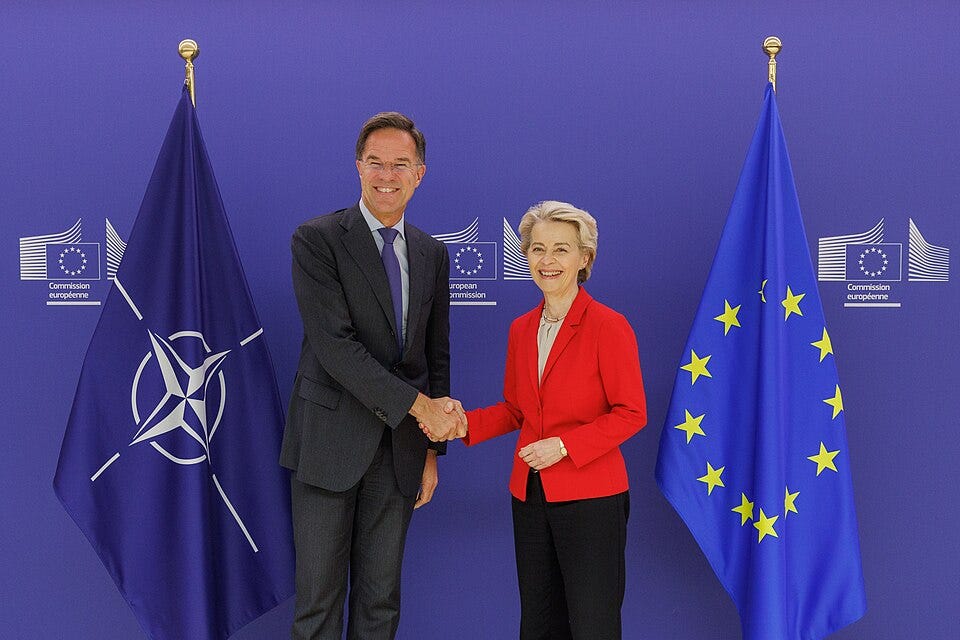
“Mark Rutte’s visit to the European Commission - 202410 - P064674-270218“ by Christophe Licoppe / European Union is licensed under CC BY 4.0.
Ian Cameron is an analyst and researcher with Steptoe’s Global Strategic Engagements Team, with a focus on US foreign policy, international security, and European and Russian geopolitics. Ian provides forward-looking analysis on domestic and geopolitical developments for international clients, providing assessments and key takeaways to guide strategic decisions and stakeholder engagement plans. He speaks and researches in German and Russian.
Ian sat down with Thomas Goldstein, the team’s other lead Europe analyst, to discuss current developments in European politics and security.
Or listen to the full interview here:

Listen to the news:
Global
A new US government report names 40 countries as transshipment risks, enabling Chinese trade diversion to avoid tariffs. The report, led by China hawk and White House advisor Peter Navarro and entitled the Great Transshipment Scam, finds that illegal transshipments cost an estimated $19 billion to $26 billion in lost annual tariff revenue, based on an estimated $40 billion to $303 billion in transshipments. The report names major trading partners, including the EU, Canada and Mexico, in addition to many smaller trading partners in Asia and the Middle East.
The US’s uneven tariff rates have created incentives for Chinese businesses to find alternative trade pathways to continue selling their goods to the lucrative US market. Low-tariff countries can benefit either by being passive transshipment hubs or by adding value through local assembly and repackaging for the US market. The US government has been aware of the transshipment risks but has yet to develop effective tools to systematically identify and counter transshipment. Some of the new trade agreements include specific anti-transshipment restrictions with penalties, but determining and enforcing rules of origin has proved challenging. The report suggested measures including AI tools at the border to scan cargo and documents, and tightening standards that define a product’s country of origin. The report signals that the US plans to elevate enforcement measures, including steep penalties, and is likely to add to trade tensions with China and many US trading partners.
Read More: Wall Street Journal [paywall], YahooFinance, White House
Europe
Moscow is bringing its own low-orbit satellite connectivity constellation online faster than expected. The Russian constellation, which is called Rassvet (Dawn), would provide Russian forces in Ukraine with better and more reliable connectivity and communications. Rassvet would also improve Russia’s ability to strike Ukraine with drones controlled via satellite. Russia had been using unauthorized Starlink terminals until February, when those terminals were disconnected following coordination between SpaceX and Kyiv.
Rassvet is still in its infancy, but Moscow is moving as fast as possible to develop the constellation. Russia launched its first package of satellites in March and its second in July. According to Ukraine, Russia has placed about 40 satellites in orbit so far and plans to have almost 300 satellites in orbit by 2027. Due to its small number of satellites, Rassvet doesn’t provide continuous coverage over Ukraine, but it has already started to provide partial capabilities.
Kyiv is asking SpaceX to allow Starlink use for targeting Russia in response to Rassvet. Since Russia will be better able to target Ukraine with long-range capabilities once Rassvet comes online, Kyiv wants to use Starlink to more reliably target launch sites inside Russia. SpaceX has consistently refused to allow Starlink to be used for strikes on Russian territory. Ukrainian president Volodymir Zelenskyy reportedly asked US president Donald Trump to intercede with SpaceX owner Elon Musk on the issue.
Read More: Kyiv Independent, Politico EU, The Atlantic
Middle East
Saudi Arabia formally created its Red Sea defense coalition. The grouping, announced in concept as the Multinational Maritime Defense Alliance, at the end of July, is intended to safeguard freedom of navigation through the Bab al-Mandeb Strait, the Red Sea and the Gulf of Aden. Fifteen countries have reportedly pledged to join, with 13 announcing their accession so far, including Bahrain, Turkiye, Egypt, Jordan, Kuwait, Qatar and Djibouti.
The coalition is an attempt to deter the Houthis and globalize the Red Sea issue, but will have little military heft. According to the Saudi government, the coalition will exchange information and intelligence, develop operational planning, and conduct joint naval exercises and drills, and potentially carry out joint naval operations. Significant joint military effort is unlikely, though; non-littoral states are wary of wading into the Iran quagmire.
The coalition notably excludes the UAE, underscoring shifting security alliances in the region and fading US primacy. Long the primary security guarantor and nuclear umbrella for the Middle East, the Iran war has scrambled regional security outlooks, leading regional capitals to diversify beyond US partnership. The new maritime coalition mirrors the Mecca Agreement on mutual defense between Saudi Arabia, Pakistan, and Turkiye, a recent sign of the ascent of new security groupings.
Read More: Al Jazeera, Middle East Eye, Council on Foreign Relations
Asia-Pacific
Russian President Vladimir Putin on Thursday visited a disputed island near Japan for the first time, prompting strong condemnation from Tokyo. The island, known in Russia as Iturup and Japan as Etorofu, is part of the Kuril chain east of Japan’s northernmost main island. Russia seized the islands following Japan’s surrender in World War II, though Tokyo continues to claim them as “inherently Japanese territory” and regards their return as a prerequisite for a formal peace treaty with Moscow. Putin’s visit marked the first by a Russian leader since then-President Dmitry Medvedev visited in 2010. Japanese Prime Minister Sanae Takaichi called the visit “absolutely unacceptable.”
The visit reinforces a broader regional narrative that Japan is abandoning its postwar security constraints. Since Takaichi’s November remarks that Japan could intervene militarily if China attacked Taiwan, Beijing has repeatedly framed Tokyo’s defense expansion as evidence of a shift toward militarization and a revival of its imperial past. Moscow has echoed the narrative, with its Pacific Fleet commander on Wednesday accusing Japan’s “military-political leadership” of pursuing “open militarization.” North Korea, meanwhile, has intensified rhetoric warning that Japan’s military buildup reflects a “re-invasion” mindset. The convergence suggests Tokyo’s security shift is increasingly becoming a point of alignment among its regional rivals, risking a more hostile and fragile environment for Tokyo to navigate.
Read More: Wall Street Journal [paywall], Reuters [paywall], Brookings Institute, East Asia Forum
Americas
Strikes against fishing boats off the coast of Ecuador earlier this year were part of a covert CIA program, according to recent reports. Eight Ecuadorian nationals are still missing after the Fiorella disappeared near the Galapagos Islands. Flight data shows that an American patrol plane approached the boat multiple times in January, including on the day it disappeared. The patrol plane is registered to a company whose address is a mailbox at a UPS store in Richmond, Virginia. Witnesses who survived strikes in March on two other boats, the Negra Francisca Duarte II and the Don Maca, reported in interviews that they were attacked by drones, detained and taken to El Salvador, only to be later returned to Ecuador.
The Trump administration has broadly expanded the CIA’s role in combating drug trafficking in Latin America. In some cases, this has included authorizing covert operations, including the potential use of lethal force. Agency personnel and resources played a key role in locating and tracking Venezuelan President Nicolás Maduro before his capture by US forces on narcotics-related charges. The agency has also reportedly deployed and is seeking to recruit intelligence assets in Cuba. In Mexico, two CIA officers were killed in a car accident in April following a joint operation with Mexican state-level security officials, which Mexico’s president later said she had no knowledge of, raising diplomatic tensions with the US.
Read More: Washington Post [paywall], New York Times [paywall]
Africa
The US and Nigeria held the second Joint Working Group to discuss Abuja’s Country of Particular Concern designation. The US and Nigerian delegations discussed progress made in dismantling jihadist networks and protecting Christian communities. The Trump administration designated Nigeria as a Country of Particular Concern in November 2025 following claims that Abuja failed to protect Nigerian Christians against violence from jihadist groups, causing some tension in relations. However, positive diplomatic engagements and enhanced security cooperation in recent months, including a joint operation that killed the leader of the Islamic State West Africa Province, have improved ties.
As the US and Nigeria continue to rekindle relations, the designation could be removed in the near term. While the US has stated that more work is needed to address Nigeria’s security challenges, the Trump administration’s continued diplomatic engagement and expanding security cooperation suggest that Washington is pursuing a more constructive approach. If current trends continue, the designation could be removed within six months, barring a sudden deterioration in bilateral ties or a significant increase in sectarian violence.
Read More: US Department of State, The Conversation, Africa Defense Forum, Reuters [paywall]
Geoeconomics
Global shipping costs are rising as Middle East rerouting collides with water-constrained capacity at the Panama Canal. Auction bids for scarce transit slots averaged $1.1 million in early August, more than 16 times their year-earlier level, while one 10,100-container vessel reportedly paid about $4 million to bypass the queue. More than 100 ships have been waiting roughly 10 days for passage as El Niño lowers Gatun Lake, prompting draft restrictions that can force vessels to carry less cargo. At the same time, instability around the Strait of Hormuz and Red Sea is redirecting energy and container traffic toward the Americas. MSC and CMA CGM have consequently introduced or raised Panama Canal surcharges to $100 per container.
Panama is a concentrated example of the broader capacity problem that Maersk now identifies as the principal force pushing container rates higher. Chief Executive Vincent Clerc pointed to port and inland congestion, including berth waits reaching 12 days in Shanghai and years of insufficient investment in terminals, railways and trucking infrastructure across China, northern Europe, South America and West Africa. Strong Chinese exports are adding volumes faster than these networks can process them, and the resulting delays keep vessels and containers tied up for longer, effectively reducing available shipping capacity even when the global fleet remains ample. If sustained, these higher freight costs could put renewed upward pressure on goods inflation, which will begin to appear in the data as existing inventories are depleted and transport costs pass through supply chains.
Read More: Financial Times [paywall], Reuters [paywall], Maersk, Supply Chain Dive, Atlantic Council
Disruptive Technology
Anthropic investors anticipate an IPO of $2 trillion in October. The company itself has managed expectations and reportedly does not have a specific target, but its institutional backers foresee annualized revenue between $100 billion and $120 billion. Annualized projected sales based on quarterly results are Anthropic’s preferred metric. If Anthropic does reach a revenue of $120 billion, it would represent up to tenfold growth over 2026. According to Anthropic’s investors, a $2 trillion valuation, just double the company’s May valuation of $965 billion, could be modest for the tech sector, where AI beneficiaries like Palantir trade at a valuation 55 times their revenue and SpaceX around 56 times after its IPO.
Anthropic filed for an IPO confidentially in June, giving it flexibility on when to IPO. As the company continues to sell its models to corporate consumers, it may decide to wait and maximize expectations based on continued growth. Anthropic will also navigate market risks, such as an emerging regulatory framework from the Trump administration, competition from China-based open-weight models, and volatile expectations from the market on AI capital expenditures.
Read More: CNBC, Quartz, Financial Times [paywall]
Energy
Yesterday, Romania shut off the second nuclear reactor at the Cernavodă power plant due to declining water levels in the Danube River, which are at a 90-year low. Due to a drought, Romania’s state-owned Nuclearelectrica does not believe it can safely cool the reactor core, requiring the plant to shut down operations. Romania previously shut off Cernavodă’s first reactor on July 28. Both reactors together typically generate about 20% of the country’s electricity and cannot be switched back on for about two weeks according to current weather forecasts, placing sizable energy pressure on Romania’s energy market. To offset the crisis, Romania is looking to import emergency electricity assistance from neighboring countries under an EU framework, as well as prolonging the operation of coal-fired plants.
Neighboring Hungary is currently implementing its own measures to prolong the water supply of its Paks nuclear reactor, such as constructing a riverbed barrier and deploying barges to sink to raise the water level.
Read More: Romanian Ministry of Energy [in Romanian], Politico, OilPrice
Transnational Crime and Corruption
A White House memorandum ordered the creation of a program to coordinate cyber operations by U.S. private companies against transnational criminal organizations. The program, overseen by representatives from the Departments of Justice and Homeland Security and reporting to White House advisors Steven Miller and Sean Cairncross, would allow participating companies to pitch and carry out cyber surveillance and “effects operations.” The initiative reportedly grew out of a White House push to revive “privateering” as a strategic option for anti-crime campaigns.
The program includes several restrictions on these proposed private sector cyber operations. Participants would be banned from targeting U.S. persons or groups part of or controlled by foreign governments. Participants are also required to put up a $1 million bond in case of noncompliance with the program.
The initiative mimics other state-affiliated hacking campaigns. Russia and other U.S. adversaries have been accused for years of using independent hacking groups as proxies to carry out foreign cyber-attacks. This hybrid warfare strategy creates plausible deniability for the directing government, though it requires careful calibration to not trigger escalations with targets. The new White House directive raises questions of legal liabilities for participating companies as well as new risks for diplomatic incidents where foreign governments retaliate against private operations against allied cyber groups.
Read More: White House, Financial Times [paywall], Royal United Services Institute
Defense
Poland is moving forward with its naval modernization and expansion program. The first of three multi-role frigates for the Polish navy launched into the Baltic Sea yesterday from Gdansk. The Wicher, which is part of Poland’s Project 106 Miecznik (Swordfish) class, is the largest Polish surface combatant since the early 20th century, and it represents a major step forward in Poland’s military ambitions and capabilities in the Baltic Sea. The Miecznik class will replace Poland’s two current frigates and is primarily designed for air defense and anti-submarine warfare (ASW), and the Wicher is set to be commissioned in 2029.
The Miecznik class is also a strong sign for Poland’s defense industrial base. Poland’s defense industrial base has historically been relatively weak despite the country’s status as one of Europe’s biggest defense spenders. American and South Korean firms in particular have profited from Warsaw’s spending. The frigate program, which is a partnership between Warsaw and London, uses a design from a British company but has production of the frigates in Poland through the Polish state arms company.
Poland has been advancing a large military modernization effort for several years. Warsaw’s military ambitions have the potential to place Poland as a linchpin in NATO’s land capabilities and in other areas like the Baltic Sea, and Poland’s defense industry can also profit from Warsaw’s efforts. However, the modernization program also could weigh on Poland’s financial position going forward.
Read More: Breaking Defense, The War Zone, Politico EU, Rand


Contact Us
Karl Hopkins
Partner
+1 202 429 6499
khopkins@steptoe.com
Melissa B. Mahle
Senior Advisor
+1 202 261 0577
mmahle@steptoe.com
Anni Coonan
Senior Intelligence Analyst
+1 212 506 3979
acoonan@steptoe.com
Samuel Bloebaum
Senior Due Diligence Analyst
+1 602 410 6240
sbloebaum@steptoe.com
Zayna Dembinski
Analyst
+1 202 778 3567
zdembinski@steptoe.com
Thomas Goldstein
Analyst
+1 202 862 6735
tgoldstein@steptoe.com
Ian Cameron
Analyst
+1 202 327 6908
icameron@steptoe.com
Elton Smole
Analyst
+1 202 261 0556
esmole@steptoe.com
Carter Spahn
Intelligence Fellow
+1 202 261 7555
cspahn@steptoe.com
Chris Dantes
Intelligence Fellow
+1 202 327 6904
cdantes@steptoe.com
Legal disclaimer: This Substack is for educational and informational purposes only and does not constitute the rendering of legal counseling or other professional services. Reading, subscribing to, or communicating through this Substack does not create an attorney-client relationship. Do not send confidential information through this platform. Consult qualified legal counsel regarding your specific circumstances.