


Welcome to the Stepwise Risk Outlook, which highlights and contextualizes over-the-horizon developments in key regions of the world and industries of the global market. Today’s featured deep dive by Carter Spahn examines the US' foreign direct investment deals.

The Economic Risks Behind the United States $10 Trillion Investment Deals
By Carter Spahn
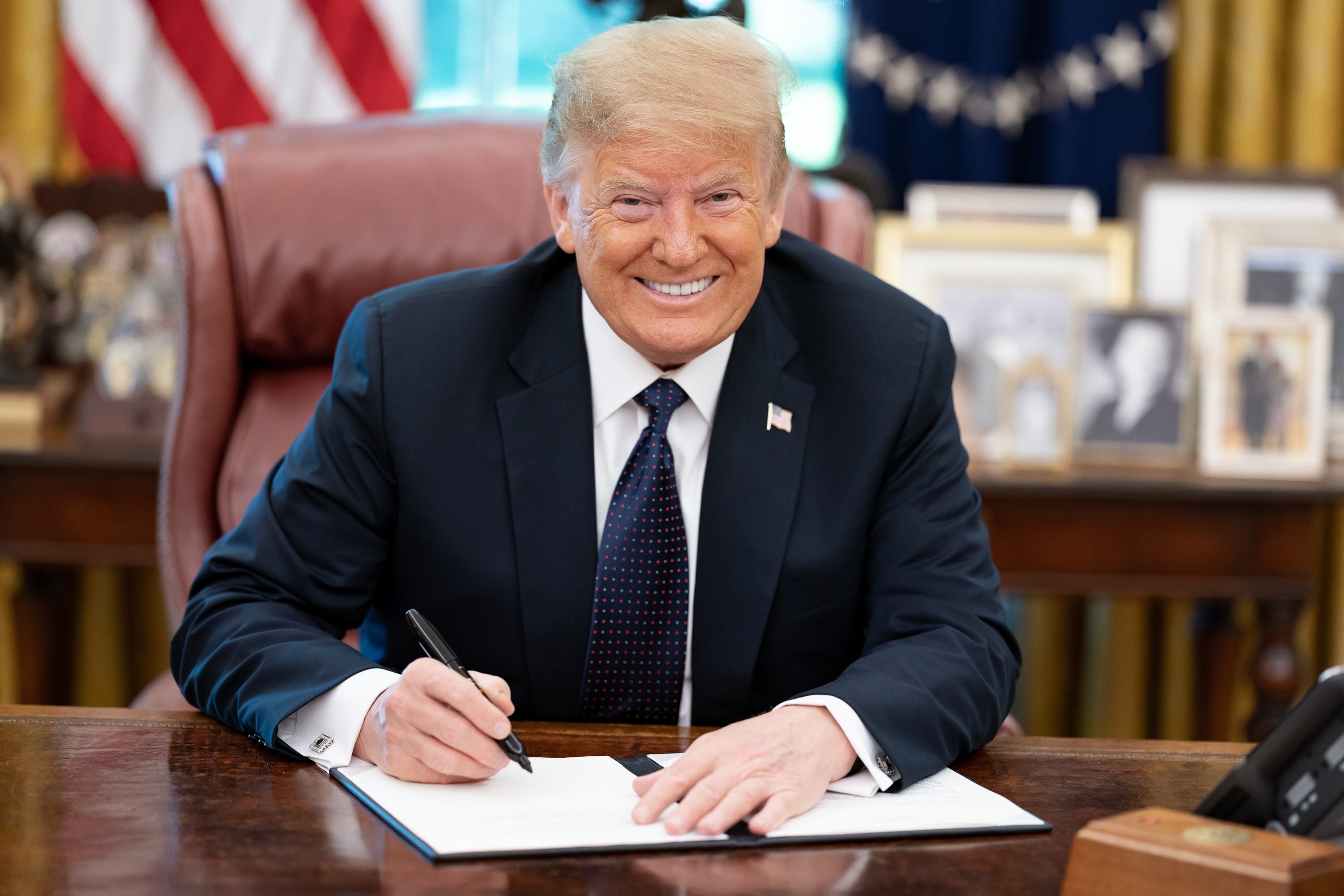
“President Trump Signs a Presidential Memorandum“ by The White House is marked with Public Domain Mark 1.0.
Increasing foreign direct investment (FDI) into the US was a key component of the Trump administration’s bilateral trade deals. The White House touts its trade and investment diplomacy as securing $9.49 trillion for the US. If successful, the historic wave of foreign capital would be a once-in-a-generation investment into the corporate fabric of America. However, these pledges are less straightforward than they appear: based on a line-by-line reclassification of the Department of Commerce’s published figures, only an inclusive upper bound of roughly $4.12 trillion can be classified as US-directed investment language, although that figure contains nonbinding, project-contingent and potentially overlapping components. Of that, only $217.7 billion is new spending that has been explicitly or officially connected to named projects under the agreements so far. The remainder of Commerce’s total consists largely of broader commercial activity and corporate spending that the administration attributes to its policies.
The gap between the announced figures and capital reaching the economy is due to the structure of the agreements. Most require no immediate payment, while several depend on investment decisions that foreign governments cannot control. For businesses, the risks run in both directions: slow implementation could leave suppliers and communities preparing for demand that never arrives, while rapid implementation could put serious pressure on the dollar and the US economy. The inflow of capital would create a stronger dollar, harming the competitiveness of US exports, and rapid construction could simultaneously cause inflation in sectors that cannot expand quickly, potentially prompting tighter monetary policy.
In today’s full analysis:
The Headline Combines Several Kinds of Deals
Why Capital Has Not Yet Reached Projects
Full Delivery Would Test the US Economy
Or listen to the full report here:

Listen to the news:
Global
With the expiration of the 60-day US-Iran MOU and the Strait of Hormuz mostly closed, concerns over risks to global oil supplies have returned. The price of oil is edging up, hitting a three-week high, as the market prices in the risk of prolonged closure of this key chokepoint for the export of oil, gas and byproducts from the Gulf. Almost six months into the conflict, the market has rebalanced from oversupplied to exceptionally tight, especially for refined products. While the forecasted global energy shock did not materialize when the Strait was initially closed, the drawing down of supply buffers exposes a new economic vulnerability of supply disruption and rising energy prices.
Energy security also requires strong global buffers against supply disruptions. The US, Europe and China have been able to manage the disruptions by tapping into strategic reserves, diversifying suppliers, surging US energy exports and retooling refinery operations to higher-demand by-products. China banned exports of certain by-products to prioritize domestic demand. Many countries were not so fortunate, forced to shut down factories or pay premium energy prices, public finances weighed down by efforts to cushion the impacts on vulnerable communities. A prolonged energy shock now risks destabilizing these vulnerable economies in Asia, the Americas and Africa, and the US and Europe will not be insulated if prices surge beyond the April peak of $126 per barrel towards $200 per barrel, triggering demand destruction.
Read More: Reuters [paywall], Business Insider, Foreign Affairs
Europe
Ukraine’s former Minister of Defense is demanding that the country hold elections. Mykhailo Fedorov, who was Ukraine’s defense minister until Ukrainian president Volodymir Zelenskyy fired him earlier this year, called for elections to occur even if they must take place while the war continues. He also criticized corruption and bureaucratic inefficiency in the government. Fedorov is highly popular with the Ukrainian public and holds significant influence. His firing earlier this year triggered large public protests calling for him to be reinstated as Minister of Defense.
The call for elections is a direct challenge to Zelenskyy. Zelenskyy’s government has come under increasing pressure from corruption scandals and from his firing of Fedorov, and his own personal popularity has fallen. There are also other potential figures who are interested in challenging Zelenskyy for leadership of Ukraine. Valerii Zaluzhnyi, Ukraine’s current ambassador in London and the former chief of Ukraine’s armed forces, has expressed interest in running. Earlier this year, he reportedly met with Zelenskyy, who attempted to talk him out of running because it would undermine national unity.
Holding elections in Ukraine would be both legally and logistically challenging. Ukraine cannot legally hold elections while the state is under martial law, is facing constant bombardment by Russia and needs to prepare for a tough winter. Ukraine would also have to worry about Moscow trying to influence any elections or to sow chaos and divide Ukrainian society.
Read More: Politico EU, Kyiv Independent, Ukrainska Pravda
Middle East
Israel bombed a Syrian base on the Turkish border, prompting condemnation from Türkiye and the US. Israel struck a defunct airbase in northwestern Syria on Tuesday, claiming that Syria was about to violate an agreed-upon security status quo by permitting the deployment of Turkish troops at the base. US Special Envoy to Syria and Iraq Tom Barrack sharply criticized the strikes,
The episode comes amid rising tensions between President Trump and Prime Minister Netanyahu. In recent weeks, Israel has flatly rejected a US-brokered plan to disarm Hamas in Gaza to progress the peace deal there, and has stalled on the US-brokered deal to disarm Hizballah and end the Israeli presence in southern Lebanon. President Trump increasingly sees Netanyahu – once one of his closest partners – as a hindrance to US objectives in the region. Washington wants the resolution of ongoing conflicts (in service of a deal with Iran, as well as broader stability), while Israel is unwilling to accept a deal that does not eliminate risk to its homeland.
Read More: New York Times [paywall], Reuters [paywall], Axios, Axios
Asia-Pacific
China’s Foreign Minister Wang Yi will begin a two-day visit to South Korea tomorrow, marking his first official trip to the country in five years. Wang is expected to meet his counterpart Cho Hyun, as well as President Lee Jae Myung and National Security Adviser Wi Sung-lac. Talks are expected to focus on Seoul’s push for dialogue on the Korean Peninsula, regional security and the direction of ROK-China relations. Seoul likely hopes Beijing can leverage its political and economic ties with Pyongyang to facilitate President Lee’s long-desired goal of resuming inter-Korean dialogue—a position North Korean leader Kim Jong Un has rejected, with Pyongyang removing references to reunification from its constitution this year.
The trip comes as questions mount over Washington’s broader commitment to the region. This week, President Trump called on the Pentagon to reduce US-ROK joint military drills, citing their cost, his relationship with North Korean leader Kim Jong Un and Seoul’s refusal to support US efforts against Iran. The move also comes alongside signs of a broader shift in US strategic priorities toward the Middle East and Western Hemisphere, notably the redeployment of the USS George Washington from the Pacific to the Middle East, temporarily leaving the western Pacific without a US aircraft carrier. Together, these moves raise questions about the durability of US defense arrangements in the Indo-Pacific—and could give Beijing an opening to position itself as a more consistent regional partner and deepen ties with Seoul.
Read More: The Korea Herald, South China Morning Post [paywall], Reuters [paywall], East Asia Forum
Americas
US President Donald Trump announced a three-day pause on tariffs that were due to take effect Tuesday at midnight. Trump announced on social media just before the deadline that Canada and the US had struck an eleventh-hour deal. Canadian trade negotiators in Washington were directed by the Canadian Prime Minister to offer targeted concessions to the Trump administration to avoid an escalation in trade tensions. Trump claimed that the deal was subject to the finalization of documents. Carney, however, described the negotiations in more cautious terms, claiming that progress had been made, but there was more work to be done to reach a deal.
The 50% tariffs that were set to take effect would have affected $20 billion in US imports from Canada on products ranging from hockey sticks to building materials. They would have been the first use of tariffs under Section 338 of the Tariff Act of 1930, which gives the White House the power to impose duties on trading partners that discriminate against US commerce. Tariffs under this authority would likely face legal challenges in the US. The proposed 50% tariffs were, according to US Trade Representative Jamieson Greer, a response to Canadian retaliation against previous tariffs imposed by the Trump administration. In the negotiations, Canadian officials are seeking to make any deal dependent on the elimination or lowering of Section 232 tariffs on industrial goods including steel and aluminum. Automobile duties are also a point of contention. The US does not want to lower the current 25% tariffs to anything lower than 15%. The final terms of the recently announced agreement remain to be seen.
Read More: New York Times [paywall], NBC, Reuters [paywall]
Geoeconomics
Government borrowing costs are rising and hitting multi-decade highs across major advanced economies. The US 30-year Treasury yield reached 5.33%, its highest since 2007, while the 10-year yield climbed to roughly 4.74%. Japan’s 10-year yield touched 2.95%, a 30-year high, and its 30-year yield exceeded 4.1%. German and French long-term yields reached their highest levels since 2011 and 2009, respectively, while British borrowing costs approached peaks last seen in 1998. Oil prices above $90 per barrel have revived expectations that central banks may need to keep interest rates elevated, and governments are issuing more debt as defense and social spending increase. Technology companies have also issued nearly $220 billion of bonds this year to finance AI infrastructure, creating additional competition for global capital.
The fiscal impact will accumulate as governments refinance maturing debt at higher yields, causing interest payments to absorb a larger share of future budgets. Countries will face less room for spending on critical issues unless they raise taxes, cut other programs or borrow even more. That can create a feedback loop in which higher interest costs enlarge deficits, additional issuance increases the supply of bonds, and investors demand a further premium to absorb them. Sovereign yields also establish the baseline for mortgages and corporate borrowing, so an increase raises financing costs throughout the economy and can slow investment.
Read More: Reuters [paywall], Financial Times [paywall], The Wall Street Journal [paywall], Atlantic Council
Disruptive Technology
ICYMI: On Monday, the European Central Bank (ECB) warned that US technology stocks will “likely” experience a correction. ECB economists argue that the current enthusiasm for AI-driven stocks like the “Magnificent Seven” mirrors earlier precedents, like the railway boom or dotcom bubble. Each of those periods saw transformative technology with productivity-enhancing implications, but investors are engaging in a highly unpredictable exercise of choosing the winners of the boom, which incentivizes investors to demand a risk premium or become overly confident in their bets. The ECB warns that a correction would also affect EU insurers and pension funds, which are heavily exposed to US tech stocks.
Read More: ECB, CNBC, Financial Times [paywall]
Energy
China has spelled out its targets for energy infrastructure development by 2030. The 15th Five-Year Plan for the oil and gas sector set out goals on areas such as LNG receiving capacity, LNG storage capacity, and pipeline construction and capacity. Beijing intends to build capacity for receiving 200 million tons of LNG and for storing natural gas exceeding 13% of total domestic consumption. The plan also mentions several specific pipelines, such as the Hainan–Guangdong natural gas pipeline, Lianyungang–Yizheng crude oil pipeline and the Wen 23–Anqing natural gas pipeline, as well as general goals in expanding pipeline capacity.
China is simultaneously directing more money into its electricity grid. Over the next five years, Beijing will direct a record 5 trillion yuan ($722 billion) into its electricity grid in an effort to address climate and renewable energy bottlenecks. This figure is a 40% increase in comparison to past five-year cycles. At the moment, China’s clean power generation significantly outruns the energy grid’s capacity to absorb power. China leads the world in curtailments, the pre-emptive rejection of wind or solar power due to limits in grid capacity.
Rising curtailment is part of a larger trend globally. Multiple other countries, including Australia, India, and Japan, have all curtailed significant amounts of renewable energy generation due to lacking grid capacity. One potential way forward will be to more efficiently deploy new infrastructure and to scale up battery storage capacity.
Read More: Reuters [paywall], Reuters [paywall], China Daily
Transnational Crime & Corruption
UK Prime Minister Andy Burnham announced new policies to crack down on high street businesses accused of money laundering. Burnham’s plan allows local authorities to block the opening of vape shops, gambling outlets, candy stores, barber shops and other “dodgy” businesses engaged in tax evasion and money laundering. The number of vape shops specifically has risen by over 1,300% since 2016, allegedly due to their easy exploitation by organized crime. The plan is part of a wider initiative to revive local commercial high streets.
Burnham’s plan builds on an ongoing police effort to rein in criminal high street operations. In May 2026, the UK National Crime Agency (NCA) announced a three-year, GBP 30 million effort by a dedicated High Street Organized Crime Unit to crack down on “barber shops, vape stores, mini-marts and sweet shops” engaged in criminal activity across the UK.
BBC investigations have uncovered vast networks of high street shops engaged in money laundering, human trafficking and tax evasion. Undercover journalists found tunnels supplying high street stores with illegal cigarettes, shell companies using stolen identities to hide company ownership and violent conflicts between rival operators. The NCA estimated that high street stores laundered at least GBP 1 billion in criminal proceeds each year.
Read More: Financial Times [paywall], Financial Times [paywall], BBC, Royal United Services Institute
Defense
The Army is getting ready to look for new solutions from the private sector for intelligence-related problems. The Army is putting together an outline of intelligence-related problems, ranging from sensing and collection analysis to data exploitation, that Army leadership wants the private sector to develop tools for. The Army is preparing to release a characteristics of need (CoN) for these issues that will outline the problems and request solutions from industry. This CoN will be the third such document from the Army’s portfolio acquisition executive for command and control and counter-command and control; the first two addressed next-generation command and control and electromagnetic spectrum operations.
Read More: Breaking Defense


Contact Us
Karl Hopkins
Partner
+1 202 429 6499
khopkins@steptoe.com
Melissa B. Mahle
Senior Advisor
+1 202 261 0577
mmahle@steptoe.com
Anni Coonan
Senior Intelligence Analyst
+1 212 506 3979
acoonan@steptoe.com
Samuel Bloebaum
Senior Due Diligence Analyst
+1 602 410 6240
sbloebaum@steptoe.com
Zayna Dembinski
Analyst
+1 202 778 3567
zdembinski@steptoe.com
Thomas Goldstein
Analyst
+1 202 862 6735
tgoldstein@steptoe.com
Ian Cameron
Analyst
+1 202 327 6908
icameron@steptoe.com
Elton Smole
Analyst
+1 202 261 0556
esmole@steptoe.com
Carter Spahn
Intelligence Fellow
+1 202 261 7555
cspahn@steptoe.com
Chris Dantes
Intelligence Fellow
+1 202 327 6904
cdantes@steptoe.com
Legal disclaimer: This Substack is for educational and informational purposes only and does not constitute the rendering of legal counseling or other professional services. Reading, subscribing to, or communicating through this Substack does not create an attorney-client relationship. Do not send confidential information through this platform. Consult qualified legal counsel regarding your specific circumstances.