


Welcome to the Stepwise Risk Outlook, which highlights and contextualizes over-the-horizon developments in key regions of the world and industries of the global market. Today’s featured deep dive by Thomas Goldstein examines impact of the new congressional sanctions bill.

The Lindsey O. Graham Russia Sanctions Act of 2026: Outlook for Markets and US Trade Policy
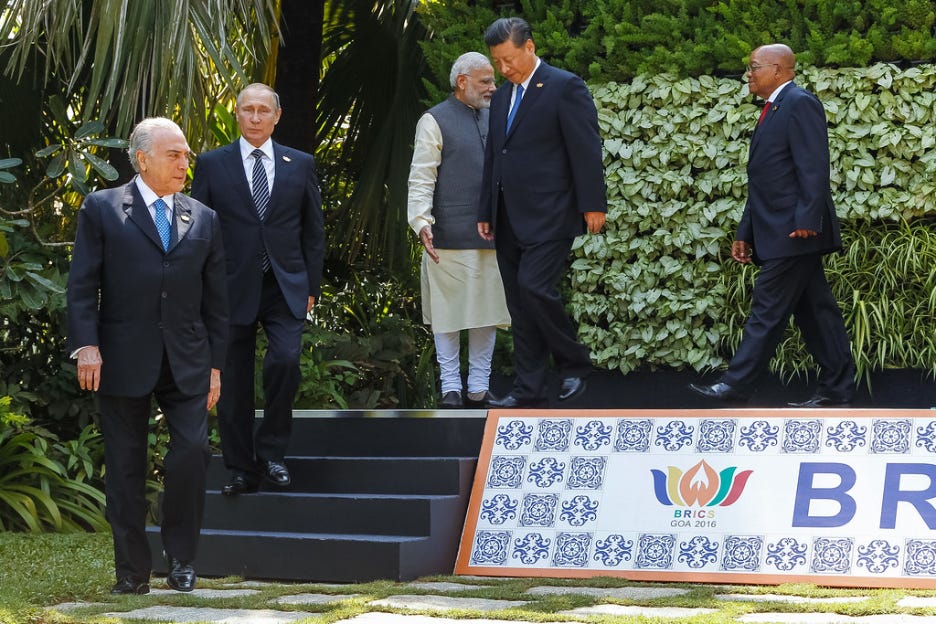
“16/10/2016 - Foto oficial dos Chefes de Estado e de Governo do BRICS“ by Michel Temer - Fotos livres, com o crédito. is licensed under CC BY 2.0.
The Lindsey O. Graham Russia Sanctions Act of 2026 is waiting in the House hopper once it returns from recess on September 1. The bill would authorize the White House, at its discretion, to impose secondary tariffs of up to 100% on the top five importers of Russian oil and gas, in addition to the top five countries facilitating sanctions evasion and any country that knowingly makes additional crude or natural gas purchases. The bill is slated to pass if President Trump continues to prioritize it, and if adopted, the White House may treat the secondary tariff authority as negotiating leverage against China and India, or possibly the EU bloc, to extract political concessions. In terms of upside risks, the Russia sanctions bill could improve US alignment with the G7 Russia sanctions regime, simplifying the compliance environment. On the downside, a flexible tariff authority could return trade policy whiplash, and secondary tariffs by themselves are unlikely to reroute global energy markets in line with US policy objectives.
In today’s full analysis:
Inside the Russia Sanctions Bill
Congressional Outlook Towards Adoption
Assessing the Risks of the Graham Sanctions Bill
Or listen to the full report here:

Listen to the news:
Global
The US Department of War has ordered 30 US universities to audit their partnerships with foreign universities and military training institutes. The Pentagon seeks to protect US government-funded research from theft and exploitation by “malign foreign influence and intellectual property theft.” In July, the Pentagon updated the Section 1286 list, which now includes 130 academic and research institutions located in China, Russia and Iran alleged to be engaged in activities that increase the likelihood of taxpayer-funded research and development efforts being misappropriated.
The expansion of the 1286 list is part of a growing trend to securitize academic research in specific fields. The European Commission has blocked Chinese entities from participating in sensitive portions of the Horizon Europe research program, targeting fields like health, digital technology, and civil security. Chinese academic institutions dominate the US’s Section 1286 list. These policies seek to de-risk international research collaboration from assisting China’s military-civil fusion strategy in the context of strategic competition and economic security.
Read More: Associated Press, US Department of War, European Commission
Europe
The UK and EU are advancing post-Brexit negotiations around a youth mobility scheme. The previous Labour government under Keir Starmer prioritized a “reset” with the EU that got stuck on this issue. In general, Brussels wants a return to the system before the UK left, with full access for EU citizens to UK universities at the same tuition as British students. Meanwhile, London wants to base the scheme similarly to Australia or New Zealand, in which British students still pay less, and EU students would be given time-bound visas. London is pushing for a cap of 50,000 students per year, while the EU wants more than 100,000.
Striking a deal on youth mobility may be crucial for a broader UK-EU reset. UK Prime Minister Andy Burnham has suggested he personally wants the UK to rejoin the EU, although not under the current government mandate. Nonetheless, he will continue Starmer’s work in trying to qualify the UK for a host of EU initiatives. These could include UK participation in the EU’s defense industrial investments or qualification for “Buy European” procurement standards in clean energy technology or cloud computing. A previously planned reset summit for July 22 was postponed after Burnham took over Number 10 from Starmer.
Read More: Telegraph, Independent, Financial Times [paywall]
Middle East
Yemen risks a return to all-out war if strikes continue, per UN warnings. On Monday, the UN human rights chief warned of a risk of return to “full-scale conflict” following new Houthi strikes on the government-controlled cities of Marib and al-Makha early this week. The return of the ground war has largely been eclipsed by the Houthi blockade on Saudi exports in the Bab al-Mandeb Strait, but the Houthis have traded escalating attacks with the Saudi-backed government in eastern Yemen and Saudi Arabia itself for over a month.
Saudi Arabia isn’t interested in all-out war, and the Houthis can’t execute one – meaning both seek to increase the costs of engagement for the other side while avoiding significant escalation. Now embroiled in a war they earlier appeared eager to avoid, the Houthis will press their advantage to reshape the political environment in Yemen by raising the costs of the status quo for Saudi Arabia. Their longstanding demands include unrestricted flights into Sanaa and Saudi payment of public sector salaries in Houthi territory. Saudi Arabia, for whom the conflict from 2016 to 2022 was a reputational disaster, wants to avoid an all-out war while imposing new costs for escalation against it (see the Multinational Maritime Defense Alliance and the Mecca Joint Defense Agreement, both signed this month).
Nonetheless, the conflict will destabilize international shipping and further globalize the US-Iran war. This conflict is increasingly being fought via airstrikes and maritime attacks, unlike earlier rounds, which will limit escalation but concentrate costs on international shipping and logistics. The continuation of the war also serves Iran by broadening the borders of the regional conflict and raising hurdles to resolve its various moving parts.
Read More: EuroNews, Al Jazeera, International Crisis Group, Al Jazeera
Asia-Pacific
The Pakistani government on Wednesday filed a review challenging a Supreme Court order announced Tuesday to transfer former Prime Minister Imran Khan from prison to a private hospital, arguing prisoners should generally receive treatment at public facilities. The move comes despite months of increasing concerns over Khan’s health from his sons, lawyers and supporters, including reports of deteriorating vision and the transparency of his medical treatment. The Court ordered Khan to be transferred to Shifa International Hospital in Islamabad within 48 hours for examination by a medical board that includes his personal physician, while also ordering weekly family visits and phone calls with his sons.
Khan and his supporters maintain the prosecutions are politically motivated and linked to the military-backed government’s efforts to prevent his return to power. He led Pakistan from 2018 until his ouster in a parliamentary no-confidence vote in 2022 and has been imprisoned since August 2023 amid a sprawling series of legal cases. Khan has faced more than 100 cases, including corruption and state-secrets charges, although several have since been overturned or suspended. His Pakistan Tehreek-e-Insaf party remains highly popular despite sweeping crackdowns. The episode highlights the increasingly blurred boundary between Pakistan’s formal judicial institutions and its political power structure, particularly notable given recent sweeping changes to Pakistan’s judiciary, which transferred constitutional jurisdiction from the Supreme Court to a newly established Federal Constitutional Court.
Read More: Reuters [paywall], CNN, Amnesty International, Middle East Monitor
Americas
The US Drug Enforcement Agency (DEA) is co-hosting the 40th International Drug Enforcement Conference (IDEC) in Buenos Aires this week. In coordination with Argentina’s National Ministry of Security, the summit is taking place from August 18-20 with hundreds of senior law enforcement officials and delegates from IDEC member countries. The focus of the summit, under the theme of “Justice Through Strength and Unity,” is on confronting transnational organized crime and global drug trafficking networks. Discussions are aimed at operational cooperation, intelligence sharing, and coordinating enforcement priorities across international trafficking, money laundering, and narco-terrorism.
The location of the summit in Argentina this year underscores the close ties between Washington and Buenos Aires. US President Donald Trump and Argentinian President Javier Milei are closely aligned on economic and foreign policy, amid a broader regional alignment across Latin America. Right-wing governments have recently been elected in the last seven regional elections, drawing support for anti-crime policies in response to rising violence. The US has taken a stronger role in combating criminal groups in the Western Hemisphere, imposing sanctions on cartels and designating some gangs as foreign terrorist organizations.
Mexico’s security minister attended the summit despite US-Mexico tensions. The two North American neighbors are engaged in an ongoing dispute over security, sovereignty, and the recent US targeting of Mexican officials, including the son of former president Andres Manuel Lopez Obrador, whose visa was revoked last week. Mexico is balancing security cooperation with concerns over unauthorized CIA operations on Mexican soil, as well as US indictments of members of President Claudia Sheinbaum’s Morena party.
Read More: US Embassy in Argentina, El Pais, Mexico Business News
Africa
The US International Development Finance Corporation (DFC) committed $62.8 million to rare-earth projects in Malawi, Angola, Madagascar and South Africa. Of that funding, $50 million will be allocated to the Phalaborwa project in South Africa. The site contains commercially extractable concentrations of neodymium, praseodymium, dysprosium, terbium and other rare earths essential to producing defense systems, electric vehicles and wind turbines.
The move comes amid efforts by the Trump administration to incentivize private investment in African mining sectors. Two DFC executives stated that private investors remain unwilling to fund rare-earth projects in African countries due to their higher risk profile and concerns that US-backed projects may be outcompeted by Chinese companies, which have significant economic influence in a majority of African countries. The US DFC is likely to expand financing of rare-earth and critical minerals projects across Africa to mitigate those risks.
Read More: Reuters [paywall], Africa’s Point
Geoeconomics
The UAE has suspended all trade and financial transactions with Iran until further notice. Abu Dhabi announced the measure after claiming two Iranian ballistic missiles targeted maritime traffic before falling into the Gulf, an accusation Tehran denied. The exposure is substantial, with World Trade Organization data showing that the UAE supplied more than 30% of Iran’s imports, about $21 billion, and received nearly 13% of its exports, worth roughly $7 billion, in 2024. Dubai also functions as a re-export hub through which Iranian businesses obtain third-country goods, settle payments and access international commercial infrastructure. Much of this activity had already stopped during the early fighting and only partly resumed in late June, meaning the immediate decline may be smaller than the prewar figures would imply.
The suspension targets the intermediary system supporting Iranian commerce under sanctions. Blocking UAE-based payments, trade finance and re-exports will raise transaction costs and force Iranian companies toward slower and less transparent channels for goods. That pressure comes as the IMF forecasts Iranian inflation approaching 70% this year and a 5.4% economic contraction. Informal transfers and shell companies may preserve some trade. The UAE will also lose port, financial and retail activity, but the decision shows that the nation values protecting maritime security and access to Western financial markets over its commercial relations with Iran.
Read More: Associated Press, Reuters [paywall], Financial Times [paywall], Washington Institute
Disruptive Technology
Leading Chinese AI developers have purchased and received batches of 10,000 Nvidia’s AI-enabling H200 chips in recent weeks. The relaxing of import restrictions partially loosens China’s AI policy, which focuses on cultivating a homegrown AI technology stack, thereby insulating the value chain from chokepoints controlled by the US. China is continuing its policy but offering some exceptions on the case-by-case requests of its leading AI developers as they seek to procure enough compute for AI model training. Chinese regulators are also allowing for larger shipments of the H200 to Hong Kong, which has a separate customs policy, but the city does not have much space for new data centers. China’s domestic chipmaking capacity has improved its capabilities, but not its scale due to the lack of manufacturing technologies equivalent to the Netherlands-based ASML.
Increased imports of H200s may improve the prospects of a US-China trade truce renewal. The import of American hardware is a tacit sign that China’s most advanced AI models still cannot rely entirely on Chinese-manufactured chips to stay competitive. This gives China an incentive to keep export controls disarmed across emerging technologies. However, China is alarmed by increased US prohibitions on some equipment, like drones and humanoid machines, through the Federal Communications Commission.
Read More: Engadget, Financial Times [paywall]
Energy
Russia expects to begin construction of a nuclear small modular reactor (SMR) in Myanmar in 2027. Myanmar’s current president, Min Aung Hlaing, visited Moscow on August 18 and met with Russia’s president Vladimir Putin and Russia’s prime minister Mikhail Mishustin to discuss bilateral cooperation. Following the meetings, the head of Rosatom, Russia’s state nuclear energy company, announced that Russia expects to sign a contract by the end of this year and begin construction of a nuclear plant in 2017. After the meetings, Putin stated that the two countries intend to deepen cooperation across a number of areas such as energy and defense policy, and Putin also mentioned potential cooperation on oil or gas production on Myanmar’s continental shelf.
Myanmar and Russia have been moving closer together recently. The visit to Russia was Min Aung Hlaing’s first visit to a non-neighboring country since becoming president, although he has visited Russia repeatedly in the past. The original cooperation agreement between the two countries on SMRs was signed in March 2025, and earlier this year Moscow and Naypyidaw signed a military pact.
Rosatom is undertaking a global push for new nuclear energy deals. Rosatom is piloting the foreign deployment of its SMRs in a project with Uzbekistan, and the company has plants under construction in a number of countries globally. Specifically, Russia has targeted nuclear cooperation agreements with the Global South.
Read More: Reuters [paywall], Vedomosti [in Russian], World Nuclear News, Defense Post, Stepwise Risk Outlook
Transnational Crime and Corruption
Ukraine President Volodymyr Zelenskyy fired a senior advisor after she was the target of an anti-corruption raid. Ukraine’s National Anti-Corruption Bureau (NABU) raided the home of Iryna Mudra, Zelenskyy’s deputy chief of staff, as part of an investigation into corruption in Ukraine’s energy industry. Nabu accused Mudra and other government officials of laundering about $3.4 million through Ukraine’s central bank to cover the bail of a former energy minister jailed for corruption.
The allegations compound corruption scandals affecting Zelenskyy’s government. NABU investigations have also targeted a presidential chief of staff, a deputy prime minister, the Ukrainian ambassador to the US and several members of parliament from Zelenskyy’s party. Former Defense Minister Mykhailo Fedorov specifically cited corruption in his recent call for parliamentary elections, calling it a threat to Ukraine’s national security amid its war with Russia.
Read More: Financial Times [paywall], Wall Street Journal [paywall]
Defense
The US is unprepared to deal with threats posed by unmanned systems. A senior US military official speaking at the recent Space and Missile Defense Symposium has warned that the US lacks both the sensors and the interceptors to deal with potential threats to US territory from swarms of low-cost drones. To adapt, the US military is trying to improve interoperability between military radars and assets from law enforcement agencies and to deploy new mobile Fly-Away Kits for rapid detection and response.
Figuring out how to counter low-cost drones is a global issue. Germany has recently had two instances of drones creating threats to airports. Earlier this month, a drone carrying explosives was found at the Leipzig airport, which is a major hub for shipping and the military. Two drones were also observed flying over a German military base two days after the incident at the Leipzig airport. In general, sightings of drones flying near civilian and cargo airports have picked up in Europe in the last year.
Read More: Drone Front, The Guardian, CBS


Contact Us
Karl Hopkins
Partner
+1 202 429 6499
khopkins@steptoe.com
Melissa B. Mahle
Senior Advisor
+1 202 261 0577
mmahle@steptoe.com
Anni Coonan
Senior Intelligence Analyst
+1 212 506 3979
acoonan@steptoe.com
Samuel Bloebaum
Senior Due Diligence Analyst
+1 602 410 6240
sbloebaum@steptoe.com
Zayna Dembinski
Analyst
+1 202 778 3567
zdembinski@steptoe.com
Thomas Goldstein
Analyst
+1 202 862 6735
tgoldstein@steptoe.com
Ian Cameron
Analyst
+1 202 327 6908
icameron@steptoe.com
Elton Smole
Analyst
+1 202 261 0556
esmole@steptoe.com
Carter Spahn
Intelligence Fellow
+1 202 261 7555
cspahn@steptoe.com
Chris Dantes
Intelligence Fellow
+1 202 327 6904
cdantes@steptoe.com
Legal disclaimer: This Substack is for educational and informational purposes only and does not constitute the rendering of legal counseling or other professional services. Reading, subscribing to, or communicating through this Substack does not create an attorney-client relationship. Do not send confidential information through this platform. Consult qualified legal counsel regarding your specific circumstances.