


Welcome to the Stepwise Risk Outlook, which highlights and contextualizes over-the-horizon developments in key regions of the world and industries of the global market. Today’s featured deep dive by Elton Smole and Carter Spahn examines recent developments in the USMCA renegotiations.

North American Trade War Escalates as US and Canada Impose Tit-for-Tat Tariffs
By Elton Smole and Carter Spahn
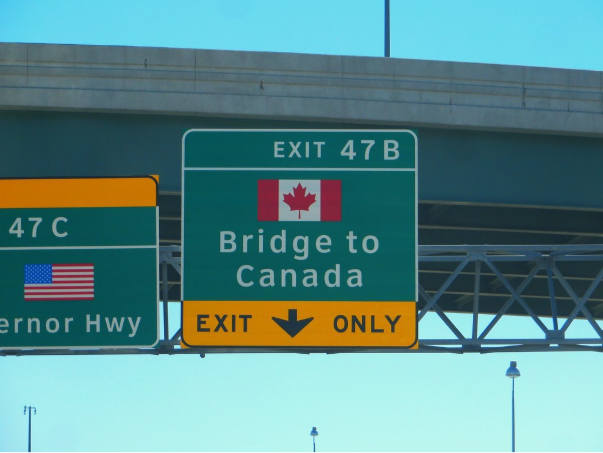
“Exit to Ambassador Bridge, Detroit, Michigan“ by Ken Lund is licensed under CC BY-SA 2.0.
Less than two months after the US declined to extend USMCA for another 16 years, a trade war is escalating between Washington and Ottawa, whose trade relationship is close to $900 billion. Tit-for-tat retaliation over recent tariffs threatens to eliminate thousands of jobs and raise costs for businesses and consumers in both countries. With bilateral trade talks between the US and Mexico set to continue in September, the US-Canada trade tensions also threaten to reshape the broader diplomatic balance in North America amid ongoing discussions over the future of USMCA.
In a turbulent week, US President Donald Trump announced a deal last Tuesday night, just hours before 50% tariffs on $20 billion in Canadian imports were due to take effect. Trump’s three-day extension allowed more time to iron out the agreement, but talks collapsed just before the Friday deadline. Canadian Prime Minister Mark Carney instructed negotiators to walk away from what he described as a “bad deal” for Canada, which reportedly would have included restrictions on Canada’s ability to make trade deals with third countries. US officials argued that the package would have placed Canada in the most favorable tariff position of any major exporter to the US. On Saturday, Carney gave a defiant speech to Canadians, described the US actions as an “attack,” and announced that Canada would retaliate against the US with dollar-for-dollar tariffs due to take effect September 8. The Trump administration has since threatened new 50% tariffs on Canadian autos to take effect on January 1, 2027.
In today’s full analysis:
The Failed Interim US-Canada Deal
Bilateral Negotiation Updates
Geopolitical Context and Economic Implications
Or listen to the full report here:

Listen to the news:
Global
The daily global average sea surface temperature reached its highest recorded level on August 22, exceeding the previous record set in March 2024. Copernicus Climate Change confirmed a record temperature of 21.1 degrees C (70 degrees F). The seas are normally warmest in March and April, with the peak August temperature resulting from an extreme El Niño event in the tropical Pacific coupled with decades-long gradual warming from climate change.
El Niño is expected to strengthen during the coming months, impacting marine life, weather patterns and agriculture. Marine heatwaves stress coral reefs and reduce plankton, shocking habitats and leading to mass die-offs and shifts in migratory patterns of fish. The impact on agriculture will differ by region. Southeast Asia, India, Australia and Central America are expected to have hot and dry conditions, threatening crops and elevating wildfire risks. Parts of the US will be wetter-than-normal. Europe, which suffered from extreme summer heat, expects a milder winter with increased precipitation.
Read More: EU Copernicus, Woods Hole Oceanographic Institution, S&P Global
Europe
Ukraine is coming up against a major budgetary shortfall in defense spending. Kyiv must figure out how to close a €23 billion gap in its defense budget as the country comes under increasing pressure from Russian drone and missile attacks. This is despite the EU’s €90 billion loan to Ukraine, €30 billion of which the EU has already committed to provide this year. Because it had taken so long for the EU to reach agreement on the loan, Kyiv had pulled forward spending originally meant for the second half of 2026.
Ukraine is also in an increasingly tough position according to the country’s former defense minister. Mykhailo Fedorov recently stated that Ukraine is slowly losing its fight against Russia and that Kyiv has a limited window to make changes to its strategy in order to shift the war in its favor. Since he was fired from government earlier this year, an event that triggered public protests, Fedorov has become a major critic of the Ukrainian government. He recently called for elections to occur in Ukraine even if they had to happen while the war continues, but that demand was met with significant pushback within Ukraine.
Read More: Politico EU, Reuters [paywall], Euronews
Asia-Pacific
The Philippines plans to further bolster its unmanned capabilities, aiming to strengthen deterrence against China in the South China Sea while managing significant budget constraints. Philippines Defense Secretary Gilberto Teodoro on Tuesday proposed to allocate 50 billion pesos ($810 million) to its drone modernization program in 2027, a 25% increase from this year, as part of a broader 6.3% increase in defense spending. Drones offer a relatively cost-effective means of maintaining persistent surveillance across the Philippines’ expansive maritime territory while distributing sensors and complicating Chinese military planning. The approach reflects Manila’s focus on improving resilience and deterrence by denial rather than matching China’s capabilities as it combats persistent financial constraints.
Manila is also seeking to build out the domestic systems, connectivity and expertise needed to make the unmanned platforms an effective force multiplier. The Armed Forces of the Philippines is looking to Ukraine’s development of indigenous drones as a model, emphasizing locally produced aerial and maritime systems that could support asymmetric maritime deterrence. Manila and Kyiv are reportedly discussing advancing a drone co-production initiative that could pair Ukraine’s combat-tested technology with the Philippines’ efforts to develop a more technology-driven defense posture. The Philippines already operates unmanned aerial vehicles for intelligence, surveillance and reconnaissance, providing a foundation for further expansion.
Read More: Reuters [paywall], South China Morning Post [paywall], East Asia Forum
Americas
Dozens of people have been killed in a massacre in Haiti this week. The United Nations put the death toll at 47 after gangs targeted the town of Kenscoff, near the upper-class suburbs of Haiti’s capital, Port-au-Prince. The gangs reportedly went on a rampage in the town, burning homes and killing indiscriminately. The US also reported that 50 people had been kidnapped. The figures released by Haitian authorities put the casualties at 25 dead, 15 missing, and 10 wounded, and 25 homes burned.
UN human rights experts described the attack as a strategic terror tactic, with the goal of intimidating the population closer to the country’s seat of power. Gangs have taken control of territory and key roads across Haiti in recent years, preventing elections. There is currently a 5,500-person international force deployed to the Caribbean nation to fight the gangs, and acting Haitian Prime Minister Alix Didier Fils-Aimé described the attack as a challenge to his government and the rule of law, vowing to respond with reinforcements.
Haiti recently scheduled its first election in a decade for December, with a runoff planned for February of next year. Acting Prime Minister Fils-Aimé has been the leading public authority in Haiti since February 2026, with the backing of the US, after the dissolution of the Transitional Presidential Council. Haiti’s government has been in a state of disarray for years, especially after the assassination of President Jovenel Moïse in 2021. Gang terror poses a serious threat to the implementation of the upcoming elections.
Read More: New York Times [paywall], Reuters [paywall], NPR
Africa
Nigerian President Bola Tinubu ordered an immediate rescue operation following the mass kidnapping of civilians in the country’s north. Last Friday, gunmen abducted a large number of civilians at a mosque in north-central Niger State. Residents and African media have claimed up to 600 residents were kidnapped, but this number has not been verified. If true, the incident would mark the largest kidnapping in the country’s history. The incident follows a major rescue operation by Nigerian forces earlier this month that freed 308 hostages. Mass kidnappings are commonly used by jihadist and criminal groups to extract ransom payments from the government.
The major security failure underscores persistent readiness challenges within Nigerian security forces. The killing of Islamic State commander Abu Bilal al-Minuki was a substantial blow to Islamic State West Africa Province (ISWAP), but attacks from ISWAP, Boko Haram, and other jihadist groups persist. The government lacks control over the north and has failed to disrupt terrorist illicit financial networks, including ransom payments. Nigeria continues to respond to terrorist threats reactively rather than proactively, indicating deficiencies in intelligence and early warning.
Read More: Reuters [paywall], Al Jazeera, AP, ISS Africa
Geoeconomics
Several major central banks are expected to hike rates as inflation spreads. The European Central Bank is anticipated to raise its deposit rate by 25 basis points to 2.5% in September after eurozone inflation approached 3%. In Japan, 57% of economists surveyed by Reuters expect a September increase from the Bank of Japan to 1.25%, while nearly two-thirds forecast rates of at least 1.5% by March 2027. Australia’s July core inflation rate surprise of 3.6% raised the market-implied probability of a September hike by the Reserve Bank of Australia from 17% to 38%, with another increase fully priced by February. This comes as the Federal Reserve is expected to hold off on rate hikes, although US inflation of 3.7% and increasingly hawkish policymakers leave the door open to renewed tightening.
The same energy shock is generating different policy responses. Europe’s dependence on imported energy makes it particularly vulnerable to inflation, while the weak yen magnifies Japan’s import costs and Australia’s tight labor market increases the risk that higher prices spread into wages. Rate increases cannot restore energy supplies; central banks are instead trying to prevent fuel costs from becoming embedded in broader prices and inflation expectations. The divergence could strengthen the euro, yen and Australian dollar if the Fed remains on hold, while higher Japanese yields may attract capital back from US and European bonds.
Read More: Reuters [paywall], Reuters [paywall], Reuters [paywall], Financial Times [paywall], BIS
Disruptive Technology
Foreign actors are increasingly targeting EU officials through messaging platforms, using disruptive cyber techniques to penetrate sensitive communications. An EU cyber defense presentation reported on Politico identified account takeovers and “state-sponsored spearphishing” as major threats to EU officials, with more than 190 threat actors targeting the EU ecosystem over the past year. Russian-linked groups were implicated, marking the first time a foreign government has been linked to the cyberattacks. Attackers have used personalized social media to compromise EU official accounts, specifically targeting high-ranking people in politics, the military, diplomacy and investigative journalists.
Moreover, a German industry study found 37% of companies attributed at least one cyberattack in the past year to a foreign intelligence service, with China and Russia accounting for the largest shares of those attributed incidents. The overlap between state intelligence services and criminal networks further complicates attribution and underscores how disruptive technologies are lowering barriers for foreign actors to conduct espionage and influence operations.
Read More: Politico, Euronews, Reuters [paywall]
Energy
Fusion energy companies are deliberately avoiding the term “nuclear” for regulatory purposes. Many startups don’t use the language of nuclear energy in order to distance themselves from preexisting conceptions of nuclear power and to highlight how fusion differs from nuclear fission. In line with that, the Nuclear Regulatory Commission is proposing rules that would place fusion under a different regulatory regime and regulate fusion facilities more lightly than nuclear reactors. Many projects would also be under state instead of federal regulatory oversight.
Fusion energy is a growing field both in the US and globally. Fusion energy startups have attracted significant private capital and offer remarkable opportunities for sectors like AI, since fusion facilities could provide renewable energy for data centers. From July 2025 to July 2026, global investment in fusion energy reached almost $4.5 billion across more than 50 private companies. While the US and China lead in terms of global investment in fusion energy, a number of other countries such as the UK, Germany and Japan also have significant investments in fusion technologies.
Read More: Financial Times [paywall], Reuters [paywall], Deutsche Welle [in German]
Defense
The US Navy is establishing an office for the defense industrial base. Acting Secretary of the Navy Hung Cao announced the creation of a new Office of the Defense Industrial Base, which will take the lead on enhancing supply chains and speeding up work on bringing dual-use technologies into the Navy. Cao has decided to choose Andrew Magliochetti to take over the new office as deputy assistant secretary of the Navy. Magliochetti had served as director of the Navy’s Office of Small Business Programs until recently, and before that he had worked in the financial industry.
The maritime defense industrial base has been a major emphasis point for the White House. Earlier this month, US President Donald Trump released a memorandum titled “Rebuilding the United States Navy and America’s Shipbuilding Industrial Base,” and he has also pursued other major naval products like plans for new battleships. The Trump administration is also reportedly looking to promote nuclear-powered merchant ships as part of the White House’s emphasis on the shipbuilding industrial base.
Read More: Defense Scoop, Financial Times [paywall], Breaking Defense


Contact Us
Karl Hopkins
Partner
+1 202 429 6499
khopkins@steptoe.com
Melissa B. Mahle
Senior Advisor
+1 202 261 0577
mmahle@steptoe.com
Anni Coonan
Senior Intelligence Analyst
+1 212 506 3979
acoonan@steptoe.com
Samuel Bloebaum
Senior Due Diligence Analyst
+1 602 410 6240
sbloebaum@steptoe.com
Zayna Dembinski
Analyst
+1 202 778 3567
zdembinski@steptoe.com
Thomas Goldstein
Analyst
+1 202 862 6735
tgoldstein@steptoe.com
Ian Cameron
Analyst
+1 202 327 6908
icameron@steptoe.com
Elton Smole
Analyst
+1 202 261 0556
esmole@steptoe.com
Carter Spahn
Intelligence Fellow
+1 202 261 7555
cspahn@steptoe.com
Chris Dantes
Intelligence Fellow
+1 202 327 6904
cdantes@steptoe.com
Legal disclaimer: This Substack is for educational and informational purposes only and does not constitute the rendering of legal counseling or other professional services. Reading, subscribing to, or communicating through this Substack does not create an attorney-client relationship. Do not send confidential information through this platform. Consult qualified legal counsel regarding your specific circumstances.