

Welcome to the Stepwise Risk Outlook, which highlights and contextualizes over-the-horizon developments in key regions of the world and industries of the global market. Today’s featured interview is with Chris Dantes, Intelligence Fellow.

Interview with Chris Dantes, Intelligence Fellow
By Chris Dantes
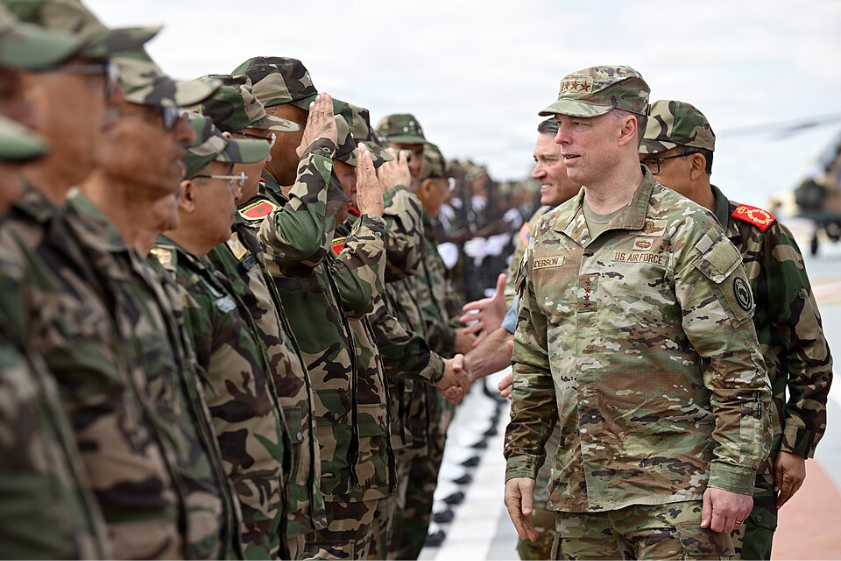
“African Lion 26 capstone combined field exercise“ by Jason Johnston is marked with Public Domain Mark 1.0.
.jpg)
Chris Dantes is an Intelligence Fellow with Steptoe’s Global Strategic Engagement Team, with a focus on developments in geopolitical and security challenges across Africa. Part of the Global Strategic Engagement Team’s Intelligence Fellowship for graduate-level students, Chris will receive his Master’s in National Security and Intelligence from Texas A&M’s Bush School of Government and Public Service in May 2027. Chris provides market intelligence and political risk analysis in support of client legal proceedings and strategic advising.
Chris sat down with Stepwise Editor-in-Chief Anni Coonan to discuss his takes on ongoing developments in Africa.
Or listen to the full interview here:

Listen to the news:
Global
The devastating flash flood in Nepal on Wednesday highlights the risks to lives and critical infrastructure posed by glacier instability caused by warming temperatures. Hundreds of people died, and thousands are missing, with large-scale damage to hydropower dams, roads, building and bridges. The Hindu Kush mountain range stretches from Afghanistan to Pakistan, some 500 miles long, and is home to the highest mountains in the world, including Mount Everest. It contains the largest volume of ice on Earth outside the North and South Pole regions. Researchers report that the glaciers across these mountains are melting at an accelerated rate, with ice-loss rates doubling since 2000. The Nepal disaster risks being the first of many future natural disasters triggered by unstable glaciers.
Together with ice sheets in Greenland and Antarctica, glaciers lock up about 70% of the world’s freshwater reserves. Scientists are warning that the globe may have passed the tipping point to reverse the disappearance of small glaciers across Europe, East Africa, Indonesia and South America. With most glaciers shrinking or disappearing, glacier loss is a threat to natural and human water supplies in many parts of the world, posing additional long-term risks to communities dependent upon these reserves.
Read More: CBS News, United Nations, National Oceanic and Atmospheric Administration
Europe
Some EU countries are demanding reductions in the EU’s next budget. Six countries, all of which pay more into the EU budget than they take out, have issued a call for the EU Commission to cut several hundred billion euros from the current long-term budget proposal. In their joint statement, Germany, Denmark, the Netherlands, Austria, Finland and Sweden wrote that the budget of almost €2 trillion should be reduced across all areas of spending. Germany had already called for cuts to the budget in the past. The countries also rejected new joint EU debt.
The countries want more cuts in some areas than others. The six countries also argued that the EU should focus on common priorities like defence, competitiveness, migration and sovereignty. This would come in contrast to areas like cohesion and agricultural policy.
The EU Commission has already begun to push back. The same day, EU Commission President Ursula von der Leyen called for the bloc’s budget to finance the EU’s “independence” from outside powers. At the same time, other countries like Italy and Spain are pushing for a larger budget. Going into the rest of the year, the member states and the EU will have to negotiate a common position, with European Council President Antonio Costa hoping to achieve agreement by the end of the year.
Read More: Reuters [paywall], Politico EU
Middle East
The Kurdish Syrian Democratic Forces (SDF) formally dissolved, a significant step for Syria’s postwar stability. The formal agreement to disband is the culmination of a January agreement. Under this week’s final deal terms, SDF members will be absorbed into the Syrian military, leaders will move to substantive roles in the government, and Kurdish will become an official language of education. Misalignments between Damascus and the US-backed paramilitary group had been a major source of concern for President al-Sharaa’s government as it works to strengthen state authority and govern the war-torn country.
Syria’s continuing stability hinges on credible minority representation and equitable economic progress. For Syria, which has emerged as a major regional FDI destination and destination for Hormuz-alternative pipelines, uniting the country’s myriad ethnic and religious groups and patchwork of armed groups is key. Skeptics worry that promises of inclusion will fall by the wayside now that the SDF is dissolved; even if not, Kurds may struggle to gain political representation (there are just eight Kurds in Syria’s 210-person transitional parliament, while Kurds make up about 10% of the population). SDF integration is a hopeful step for sectarian unity, but deeper fissures must still be healed.
Read More: Reuters [paywall], Newsweek, Al Hurra, KurdPress
Asia-Pacific
Malaysia on Thursday finalized the first phase of a voluntary repatriation program that will see at least 1,500 Rohingya refugees returned to Myanmar beginning September 29. Malaysia’s Home Ministry said the repatriation process will use two Myanmar naval vessels and a hospital ship. As of August 15, 10,388 Myanmar nationals, primarily ethnic Rohingya, were being held at immigration detention depots in Malaysia. Of these, around 4,008 individuals will be channeled into the Refugee Registration Document (DPP) program, while 5,000 are slated for voluntary repatriation under an agreement with Myanmar.
The program is moving forward despite longstanding international concerns over conditions on the ground in Myanmar. Earlier this month, the Malaysian government said it would not proceed if refugees faced risks to their lives upon return. However, international reporting continues to document abuses against the Rohingya by multiple parties to Myanmar’s civil war, with a UN report finding “systematic discrimination by all parties, with absolute impunity.” The move could put Malaysia in a difficult position as it balances its efforts to manage a large refugee population against concerns that repatriation could expose Rohingya to renewed persecution. Malaysia is home to more than 215,000 refugees and asylum seekers registered with the UNHCR, including more than 126,000 Rohingya.
Read More: Nikkei Asia [paywall], Al Jazeera, UN News
Americas
The US and Venezuela are reportedly close to a landmark oil deal that would give the US access to around 90 billion barrels of Venezuela’s proven oil reserves. This would more than double the US’ current proven oil reserves, as the US Strategic Petroleum Reserve hits a 40-year low. The deal, which is still being negotiated but is currently in the advanced stages, could give the US an ownership stake in at least 17 of Venezuela’s most productive oil fields, including fields in the Orinoco Belt as well as Lake Maracaibo. It remains to be seen if the US would create joint ventures or hire companies to develop the oil fields. A final deal could be announced shortly, but there is still a chance that it could fall through.
The negotiations are being led by US Secretary of State Marco Rubio and interim Venezuelan President Delcy Rodriguez. This comes as the Venezuelan government has recently engaged in talks with the Venezuelan opposition leader Denorah Figuera. The talks are aimed at eventually calling elections, raising questions around the interim Rodriguez government’s authority to make such a deal with the US. Legal questions also remain around the mechanisms behind such an agreement. One potential legal model would involve a lease, with auctions to allocate oil fields to US producers.
The US Office of Foreign Assets Control (OFAC) on Thursday released a series of general licenses authorizing activities related to Venezuela’s oil sector. The licenses also authorize certain transactions with Venezuela’s state-owned oil company PdVSA, as well as activities across mineral operations (including gold) and telecommunications. The licenses also provide that the Venezuelan government would not directly receive revenues from this oil production. Rather, monetary payments are to be made into Foreign Government Deposit Funds or other accounts approved by the US Department of the Treasury.
Read More: Axios, The Wall Street Journal [paywall], Al Jazeera, OFAC, La Jornada [Spanish]
Geoeconomics
Federal Reserve Chair Kevin Warsh is set to address the Jackson Hole symposium today as markets look for signs that the central bank’s anti-inflation rhetoric will translate into tighter policy. Central bankers are gathering from August 27–29 for the annual conference, formally focused this year on financial innovation, payment systems, cryptocurrencies and stablecoins. The most anticipated event is Warsh’s first Jackson Hole address as Fed chair. Investors are listening for an indication of what economic conditions would prompt Warsh to tighten policy. The Fed held rates at 3.5%–3.75% in July despite three policymakers favoring an increase, while July PCE inflation remained at 3.7%. Futures assign only a 34% probability to a September hike but a 74% chance of one by December.
The speech will also be a test of Fed credibility and independence. Warsh has rejected conventional forward guidance, but his limited explanations have left investors uncertain about how the Fed will respond to inflation that has exceeded its 2% target for 65 consecutive months. Additionally, Treasury Secretary Scott Bessent’s expansion of long-term bond buybacks as government borrowing costs rise creates the appearance that the Treasury is trying to loosen financial conditions while the Fed considers tightening them. A hawkish stance from Warsh could lift short-term yields and the dollar, while another vague or dovish message might initially support equities but push long-term yields higher if investors demand greater protection against inflation.
Read More: Kansas City Fed, Reuters [paywall], The Wall Street Journal [paywall], Financial Times [paywall], Peterson Institute for International Economics
Disruptive Technology
A cyberattack on three major UK airports last week exposed the data of 8.7 million customers, marking one of the country’s largest recent breaches. Manchester Airports Group (MAG) said Thursday hackers accessed customers’ emails, phone numbers, vehicle registrations and postcodes through WiFi sign-ups and car park bookings at Manchester, London Stansted and East Midlands airports. Bank and payment details were not compromised, and airport operations remained unaffected.
The attack underscores growing pressure on operators of critical infrastructure to strengthen cyber defenses as malicious actors increasingly demonstrate their ability to penetrate sensitive systems. A 2025 attack on check-in systems disrupted operations at Heathrow, Brussels and Berlin airports, causing delays and cancellations, while an Iran-linked attack earlier this month shut down a small UK power generator for four days—the first reported instance of Iranian-linked hackers successfully taking such a facility offline in the UK. As attacks increasingly serve not only to steal data or disrupt services but also to demonstrate access to critical infrastructure, governments face greater pressure to shift from responding to individual incidents toward building systemic resilience before attackers can translate access into wider disruption.
Read More: Financial Times [paywall], The Telegraph [paywall], The Guardian
Energy
New Delhi is in the process of reforming its nuclear energy sector. A new draft framework would place significant additional requirements on foreign reactors, which could deter companies from partnering with foreign suppliers and could limit the inflow of investment and technical knowledge. The framework would obligate companies wanting to deploy imported reactors to have operational and licensing certifications from the country of origin and to have design approval from India’s atomic energy regulator before construction. The framework also reportedly leaves some issues like tariffs and financial and technical qualifications unanswered.
The new regulatory framework will have an impact on India’s nuclear energy development plans. India intends to build out its nuclear power capacity almost tenfold in the next two decades, and it will be reliant on investments to meet the industry’s expected $210 billion needs for that goal. India already passed a new nuclear law last year in service of this goal.
Read More: Reuters [paywall], Bloomberg [paywall]


Contact Us
Karl Hopkins
Partner
+1 202 429 6499
khopkins@steptoe.com
Melissa B. Mahle
Senior Advisor
+1 202 261 0577
mmahle@steptoe.com
Anni Coonan
Senior Intelligence Analyst
+1 212 506 3979
acoonan@steptoe.com
Samuel Bloebaum
Senior Due Diligence Analyst
+1 602 410 6240
sbloebaum@steptoe.com
Zayna Dembinski
Analyst
+1 202 778 3567
zdembinski@steptoe.com
Thomas Goldstein
Analyst
+1 202 862 6735
tgoldstein@steptoe.com
Ian Cameron
Analyst
+1 202 327 6908
icameron@steptoe.com
Elton Smole
Analyst
+1 202 261 0556
esmole@steptoe.com
Carter Spahn
Intelligence Fellow
+1 202 261 7555
cspahn@steptoe.com
Chris Dantes
Intelligence Fellow
+1 202 327 6904
cdantes@steptoe.com
Legal disclaimer: This Substack is for educational and informational purposes only and does not constitute the rendering of legal counseling or other professional services. Reading, subscribing to, or communicating through this Substack does not create an attorney-client relationship. Do not send confidential information through this platform. Consult qualified legal counsel regarding your specific circumstances.