


Welcome to the Stepwise Risk Outlook, which highlights and contextualizes over-the-horizon developments in key regions of the world and industries of the global market. Today’s featured deep dive by Dan Arbell examines the Gaza peace deal.

Skepticism Prevails as Trump Announces Agreement to Disarm Hamas
By Dan Arbell
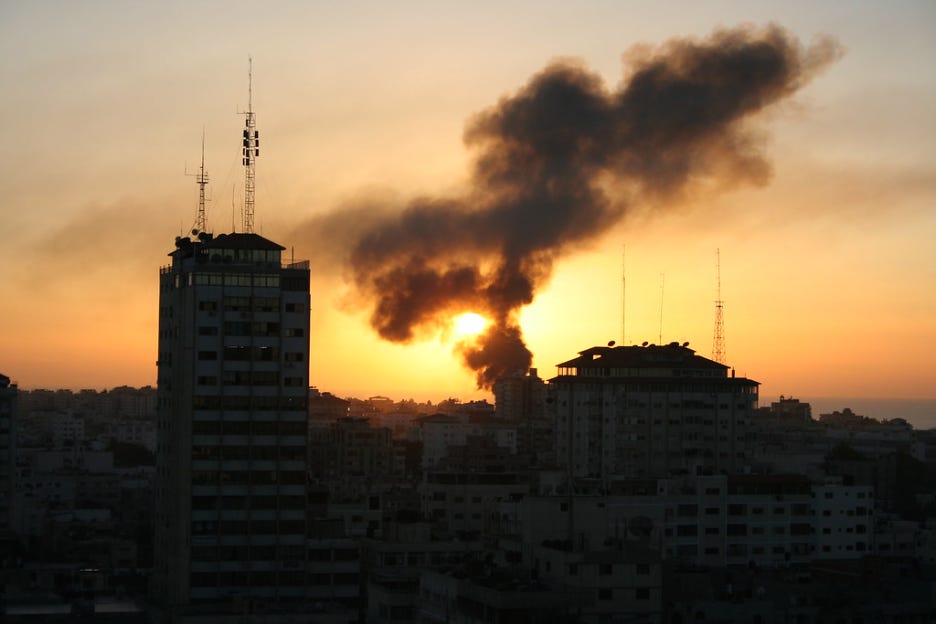
“Gaza Burns“ by Al Jazeera English is licensed under CC BY-SA 2.0.
On July 30, 2026, US President Donald Trump announced a landmark agreement between the US-led international Board of Peace and Hamas for the complete disarmament of the Palestinian militant group and other armed factions in Gaza. The announcement, hailed by the Trump administration as a “historic breakthrough” and a “monumental step” toward peace, represents a critical milestone in implementing the second phase of Trump’s 20-point Gaza ceasefire plan that came into effect in October 2025. However, persistent disagreements on a number of fronts mean that prospects for Gaza stabilization and reconstruction remain remote. The agreement has exposed significant divides among the US, Israel, Hamas, Palestinian factions, and regional mediators. These key stakeholders continue to have conflicting views regarding implementation sequencing, Israeli withdrawal timelines, and fundamental commitment levels to the peace framework. The deal’s failure would contribute to broader instability for the regional economy and signal continued disruption as strategic distance between the US and Israel grows.
In today’s full analysis:
The US Perspective and Israeli Ambivalence
Hamas’ Calculus
Implementation Challenges and Lingering Uncertainty
Or listen to the full report here:

Listen to the news:
Global
The UN finds that companies and financial institutions are not acting quickly enough to protect biodiversity. The first draft of the global review for the Kunming-Montreal Global Biodiversity Framework (KMGBF), released in June, will be discussed in preparatory talks this week, ahead of the Convention on Biological Diversity (CBD) in Armenia in October. The UN argues that biodiversity loss is no longer just an environmental issue but a systemic economic risk, affecting financial stability, supply chains and human wellbeing.
At the halfway point toward the Framework’s 2030 targets, spending that harms nature still far exceeds funding aimed at protecting it. Under the Framework, countries committed to protect 30% of land and sea by 2030, restore degraded ecosystems and reduce subsidies for activities that harm nature. Despite dedicated funding vehicles like the Cali Fund and the Global Biodiversity Framework Fund, the funding gap is estimated between $700 billion and $1.1 trillion.
Read More: Reuters [paywall], Convention on Biological Diversity, UNESCO
Europe
The White House is stepping back from earlier commitments to let Ukraine produce Patriot missiles. US President Donald Trump recently denied that the US had agreed to allow Ukraine to produce patriot missiles under license, stating that the US had reconsidered the risks of allowing Ukraine to access the technology involved. In an unexpected move, the US had previously agreed to move forward with Ukraine on interceptor production during a meeting between Trump and Ukrainian president Volodymyr Zelenskyy at the NATO summit in Ankara. This shift from the White House represents a setback for Kyiv in its fight against Russia and its overall attempts to secure American support for Ukraine’s war effort. US ambassador to NATO Matthew Whitaker said that defense industrial agreements remain under discussion with Ukraine, but that nothing would be ready by the winter.
Ukraine’s stockpiles to defend against ballistic missile strikes have run out. The Patriot air defense system is Ukraine’s only reliable method to intercept Russian ballistic missiles, and Kyiv is sounding the alarm that it has run out of interceptors. Simultaneously, Russia is still conducting a large-scale campaign against Ukrainian cities using a mixture of drones and different types of missiles. In an attack on August 1, Russia fired almost 200 drones and 35 missiles, including 9 ballistic missiles, only one of which was intercepted.
Ukraine’s need for ballistic missile interceptors will likely become even more acute in winter. Throughout the course of the war, Russia has most aggressively targeted Ukraine with missile and drone attacks during winter. According to research by the Center for Strategic and International Studies (CSIS), the intensity of Russia’s drone and missile campaign increases almost 20% on average during winter.
Read More: New York Times [paywall], Washington Post, Kyiv Post, Center for Strategic and International Studies
Middle East
The US has used “virtually all” of its long-range precision missiles during the Iran war, per military sources. Media reported that the US Army has used most of its stockpile of Army Tactical Missile Systems (ATACMS) and Precision Strike Missiles (PrSM), which allow accurate strikes from a safe distance. One source said that CENTCOM had depleted its stockpile and resupplied from other areas. The report – which the White House denies – follows an assessment last week that the US has used about half of its stockpile of Patriot and THAAD missile interceptors.
Weapons shortages could force riskier decisions in Iran and affect readiness in other theaters. Observers of the weapons depletion worry that a relative lack of long-range missiles will narrow the Trump administration’s options for striking Iran and lead to riskier operations, from closer by, to continue striking key targets deep inside Iran -which will expose US troops and other assets to Iranian strikes. Further afield, the shortage could trickle down to Ukraine, which has asked for more Patriots, and would affect the US’ readiness for a potential confrontation with China. Even if a new conflict does not occur, the shortages provide valuable intelligence about the US defense arsenal and production architecture to its rivals.
The Pentagon has moved to boost production, but it will take time. Yesterday, the Pentagon announced framework agreements to triple Patriot and quadruple THAAD interceptor production. But it takes six weeks to assemble a single THAAD and almost two years to produce a Patriot interceptor.
Read More: Reuters [paywall], CSIS, American Enterprise Institute, Military Times
Asia-Pacific
Prime Minister Anutin’s two-day visit to Indonesia underscored Thailand’s efforts to deepen strategic and economic ties with key ASEAN partners. Anutin arrived in Jakarta yesterday, marking the first visit by a Thai prime minister to Indonesia in 15 years. During his meeting with Indonesian President Prabowo Subianto, the two set a target to increase bilateral trade to US$20 billion by 2030 through the newly launched Indonesia-Thailand Strategic Partnership Roadmap 2026–2030. The roadmap, covering security, economic development and socio-cultural sectors, is designed to expand market access, increase joint investment and reduce trade barriers. The two also pledged to bolster regional food and energy security through initiatives on agricultural technology, supply chain resilience and logistics, as well as the launch of the Indonesia-Thailand Energy Forum.
Anutin is also signaling a more pragmatic approach to Myanmar, calling for “calibrated re-engagement” ahead of his Thursday meeting with junta leader Min Aung Hlaing. Anutin on Tuesday underscored the need for “flexibility and pragmatism” while maintaining ASEAN’s principle of non-interference, a principle which has constrained the bloc’s ability to address members’ domestic governance and human rights records. ASEAN’s recent face-to-face meeting with Myanmar representatives, the first since the 2021 coup, underscores the bloc’s shift from diplomatic isolation to reengagement with the junta-led country as spillover from the crisis remains a serious issue. Against this backdrop, the junta’s decision to allow detained former leader Aung San Suu Kyi on Monday to make a rare photographed appearance highlights the military government’s growing attempts to portray itself as a civilian administration, despite ongoing attacks on civilian populations. Concerns remain that such engagement, particularly at the leader-to-leader level, helps legitimize Myanmar’s military government.
Read More: Antara, Jakarta Globe, Thai Examiner, Reuters [paywall], New York Times [paywall], Lowy Institute
Americas
Outgoing Colombian President Gustavo Petro visited Havana, Cuba over the weekend. It was his final official state visit before the inauguration of President-elect Abelardo de la Espriella on Friday. Cuba and Colombia maintain an important diplomatic relationship, most notably in the context of Colombia’s negotiations with rebel groups. The 2016 peace agreement between the Colombian government and the FARC was agreed upon in Havana. During his recent visit, Petro met with Cuban President Miguel Diaz-Canel, urged US President Donald Trump to engage in dialogue with Cuban officials, and called for measures to prevent US military action towards the island.
The visit highlights the contrast between the outgoing and incoming administrations in Colombia. Petro was Colombia’s first leftist president, and he leaves office having largely failed to improve security in Colombia through his Total Peace strategy of negotiating with rebels. De la Espriella rode a wave of right-wing support largely fueled by fears around the recent uptick in violence. De la Espriella is expected to align Colombia’s security policy with US objectives in the region, and it remains to be seen how this will affect Bogotá’s relationship with Havana. Colombia has historically been among the closest partners of the US for security cooperation in Latin America and is set to retake this role after the end of Petro’s term.
Read More: AFP, AP [Spanish], Reuters [paywall]
Geoeconomics
A new report showed US factory activity accelerated sharply in July, with demand, production and hiring all strengthening. The Institute for Supply Management’s manufacturing PMI rose from 53.3 in June to 55.6, exceeding the 54.0 consensus forecast and reaching its highest level since May 2022. Readings above 50 indicate that activity is expanding, making July the sector’s seventh consecutive month of growth. The production index jumped 6.3 points to 58.5, its strongest reading since November 2021, while new orders increased to 56.7 and order backlogs rose to 55.0. Export orders returned to expansion, and the employment index climbed from 49.7 to 52.8, the first expansionary reading in 33 months. Moreover, fifteen of the 18 industries covered by ISM reported growth. The breadth of the increase suggests that the improvement extends beyond a single industry, although AI infrastructure and defense-related demand remain particularly important drivers.
Supply disruptions and inflation complicate the headline. ISM’s supplier-deliveries index rose to 58.9, indicating that delivery times lengthened; because this component is inverted, supply-chain congestion mechanically raises the overall PMI even when delays are caused by tariffs or Middle East shipping disruptions. The prices-paid index declined from 73.0 to 71.1 but remained exceptionally high, marking the twenty-second consecutive month of rising material costs. Manufacturers cited steel and aluminum tariffs, petroleum prices, freight costs, scarce electronics and critical-mineral shortages, while 62 percent of survey comments were negative. As a result, persistent input inflation could limit the Federal Reserve’s ability to accommodate the expansion with lower interest rates.
Read More: Institute for Supply Management, Reuters [paywall], McKinsey Global Institute
Disruptive Technology
The White House will convene leading AI developers today to discuss next steps regarding its AI safety framework. The White House has reportedly finalized its AI safety framework laid out by the June 2 executive order, which also envisions voluntary model testing and evaluation before public release. The framework spells out confidentiality, cybersecurity, insider-risk, intellectual property protection use, and nondisclosure requirements for a period of up to 30 days for when the government and “trusted partners” within the tech industry access new models before the public.
AI safety has gained momentum after Anthropic’s release of the Mythos model in April. Several other events have underlined the need for a framework. Leading developers have disclosed that their most powerful models have escaped testing environments and have hacked private companies; concerns over a potential jailbreak led to export controls on foreign national use of Mythos 5 and Fable 5, leading to their temporary disablement; and Chinese competitors like Zhipu and Moonshot have rapidly caught up with American frontier capabilities through an open-weight development environment and their alleged industrial-scale distillation campaigns.
Read More: Axios, CNN, Strait Times
Energy
The US Department of Energy (DoE) is under pressure for not bringing Venezuelan oil capacity online fast enough. Global oil markets have been in turmoil in recent months due to the US war with Iran and Ukraine’s war against Russia, and despite the White House’s efforts no new oil deals between American companies and Venezuela have been finalized yet. The DoE has reportedly pursued a more cautious approach emphasizing partnership with Caracas, whereas critics have promoted a more aggressive strategy to boost production in Venezuela as fast as possible. One specific complaint has been that “wildcatters,” a term for smaller and more risk-tolerant firms, haven’t been given the necessary support by the DoE to enable their access to Venezuela’s oil resources.
The US has reportedly been deeply involved in managing Venezuela since ousting the country’s leader, Nicolas Maduro. Secretary of State Marco Rubio has had a very hands-on role in influencing Venezuela’s politics and economy: the country’s finances, natural resources, and government. As part of that, Rubio and the US administration have moved to rework the oil sector and enable access for US companies, and the US also controls the sanctions waivers that affect which countries are allowed to do business in Venezuela.
Read More: Axios, New York Times [paywall], Council on Foreign Relations


Contact Us
Karl Hopkins
Partner
+1 202 429 6499
khopkins@steptoe.com
Melissa B. Mahle
Senior Advisor
+1 202 261 0577
mmahle@steptoe.com
Anni Coonan
Senior Intelligence Analyst
+1 212 506 3979
acoonan@steptoe.com
Samuel Bloebaum
Senior Due Diligence Analyst
+1 602 410 6240
sbloebaum@steptoe.com
Zayna Dembinski
Analyst
+1 202 778 3567
zdembinski@steptoe.com
Thomas Goldstein
Analyst
+1 202 862 6735
tgoldstein@steptoe.com
Ian Cameron
Analyst
+1 202 327 6908
icameron@steptoe.com
Elton Smole
Analyst
+1 202 261 0556
esmole@steptoe.com
Carter Spahn
Intelligence Fellow
+1 202 261 7555
cspahn@steptoe.com
Chris Dantes
Intelligence Fellow
+1 202 327 6904
cdantes@steptoe.com
Legal disclaimer: This Substack is for educational and informational purposes only and does not constitute the rendering of legal counseling or other professional services. Reading, subscribing to, or communicating through this Substack does not create an attorney-client relationship. Do not send confidential information through this platform. Consult qualified legal counsel regarding your specific circumstances.