


Welcome to the Stepwise Risk Outlook, which highlights and contextualizes over-the-horizon developments in key regions of the world and industries of the global market. Today’s featured deep dive by Elton Smole examines the potential political impacts of the Venezuela earthquakes.

Venezuela’s Future in Limbo After Catastrophic Quakes
By Elton Smole
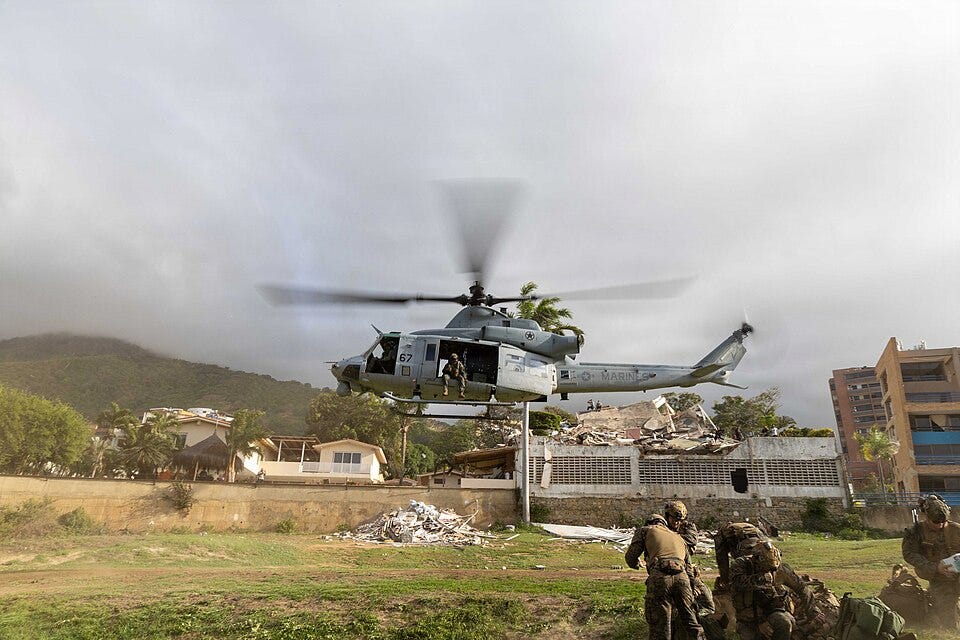
By U.S. Marines 24MEU by Cpl. Daniel Garcia - Public Domain
Venezuela’s devastating June 24 earthquakes have transformed a delicate post-Maduro transition into a high-stakes test of the Trump administration’s strategy to maximize US influence. The Trump administration’s approach aims to advance US regional dominance and secure access to Venezuela’s energy resources, but this strategy risks further political instability and could undermine prospects for long-term democratic and economic recovery.
Venezuela’s political and economic future was already uncertain before the 7.2 and 7.5 magnitude quakes. The January 3 capture of former President Nicolas Maduro by US forces raised the hopes of the political opposition led by the exiled Maria Corina Machado. However, the Trump administration has instead backed the interim government of Maduro’s former vice president, Delcy Rodriguez. Rodriguez has largely accommodated US interests by reforming energy sector regulations, inviting new foreign investment and ceding stewardship of state revenues to the US Treasury Department. However, following last month’s earthquakes, President Trump’s pledge to “run Venezuela” has transformed into a liability, and his goal of stabilizing the Rodriguez regime has become a potential powder keg.
In today’s full analysis:
From Natural Disaster to Political Catalyst
Trump’s Response Seeks to Maximize US Leverage
Risks of the US Strategy in Venezuela

Global
Arab Gulf states are accelerating planning of new export routes as permanent alternatives to transit through the Strait of Hormuz. The reignition of fighting between the US and Iran has once again effectively closed the Strait and access to and from the Persian Gulf for commercial shipping. Ports in the Persian Gulf are critical infrastructure supporting the export of oil, gas and petroleum byproducts, as well as being important logistics hubs for East-West trade. Iran’s intention to control this vital shipping route for its own benefit presents the neighboring Gulf States with a quandary: permit Iran to turn the waterway into an economic tool of coercion or develop alternatives that reduce dependence on export infrastructure in the Persian Gulf.
The Gulf states are piling into the latter option, moving rapidly to build new pipelines, rail networks and port facilities. There are at least seven new pipelines either currently under construction or on the drawing board. Iraq, Syria and the US are in talks to revive a historic 500-mile pipeline from Iraq to Syria’s Mediterranean coast. The UAE plans to build a new port and container terminal in the Gulf of Oman, bypassing the Strait of Hormuz. This would reduce Dubai’s dependence on the Jebel Ali hub. Saudi Arabia has launched a new rail corridor connecting ports in the Persian Gulf—including Dammam, King Fahd Industrial Port, and Jubail Commercial Port—with the Al Haditha border crossing on the border with Jordan. Kuwait is looking at regional pipeline tie-ups with Saudi Arabia and the UAE.
Qatar has no viable option to bypass the Strait for its LNG exports. LNG must be cooled to liquid form and carried by specialized tankers, i.e., there is no pipeline solution. Either Qatar will need to reach a political agreement with Iran, or its gas will remain trapped and the global energy market will need to adjust to the protracted loss of 20% of global supply.
Read More: Axios, Middle East Eye, Railway Pro, Jerusalem Post, New York Times [paywall]
Europe
EU member states have been unable to reach consensus on a new sanctions package against Russia. The EU has failed for a third consecutive day to come to an agreement on the bloc’s new package of sanctions against Russia, and ambassadors have pushed further rounds of negotiation to next week. The issue at hand is freezing the price cap on Russian oil, which would, due to the war in Iran, likely rise significantly because of global oil price increases. The one-week deferment gives the EU some leeway to reach an agreement before August 1, which is when the new cap will automatically become effective without agreement.
EU members are putting a price on their agreement for new sanctions, which could undercut European unity on sanctions policy. Vienna wants compensation for Austria’s Raiffeisen Bank, which Vienna claims suffered billions of euros of expropriation of its Russian operations. Greece has objected to EU restrictions on trading Russian LNG. Some proposed sanctions had already been either watered down or removed, such as modifications made to a proposed ban on visas for Russian soldiers or the decision to drop potential sanctions against Patriarch Kirill, the head of Moscow’s Orthodox Church. However, it is ultimately likely that member states will reach an agreement on sanctions, especially since the 21st sanctions package is seen as strong.
Read More: Politico EU, Euractiv, Reuters [paywall]
Middle East
The US and Iraq are set to announce $60 billion in new bilateral deals tomorrow, including the revival of an Iraq-Syria oil pipeline. New Iraqi Prime Minister al-Zaidi will announce the deals at the US Chamber of Commerce on Friday with Energy Secretary Chris Wright, following a White House visit that projected “tremendous chemistry” between Trump and al-Zaidi. The deal package is to be anchored by US support for the revival of the Kirkuk-Baniyas pipeline, damaged since 2003 but now seen as an important strategy to circumvent the Strait of Hormuz.
The US is shifting bilateral focus to economic ties as Iraq aligns more closely with Washington than Tehran. President Trump pushed openly for al-Zaidi’s confirmation, judging other candidates as too pro-Iran, and al-Zaidi has announced policies that will reduce Iranian influence in Baghdad (like disarming nonstate, Iran-backed militias). Al-Zaidi put a point on the shift at the meeting, saying that “on September 30th, American forces will leave, and American companies will enter” – a big change in the bilateral relationship with significant upside for US companies.
Read More: Semafor, Reuters [paywall], DW
Asia-Pacific
India’s cabinet on Wednesday approved funding for the second phase of the country’s semiconductor program, as New Delhi seeks to establish itself as a major player in the global semiconductor ecosystem. Semicon 2.0 expands policy and financial support across every major segment of the semiconductor value chain. The 1.28 trillion Indian rupees ($13.3 billion) in funding will be distributed across six pillars, including semiconductor design and IP development, machinery and materials, fabrication plants, advanced packaging and outsourced assembly and testing (OSAT), as well as R&D and talent development.
The program’s broad scope reflects New Delhi’s view that semiconductors are a strategic industry underpinning its long-term economic and technological ambitions. Its emphasis on developing capabilities across the semiconductor value chain aligns with the country’s Viksit Bharat (Developed India) initiative, under which technological self-reliance and resilient supply chains are central to the broader “Made in India” strategy. Building globally competitive capabilities in these high-value industries is expected to contribute significantly to India’s long-term economic target. By 2047, the centenary of its independence, India aims to achieve developed-country status with an ambitious $30 trillion economy and a per capita income of $18,000, requiring more than a sevenfold expansion in nominal economic output over the next two decades.
Read More: Press Information Bureau India, NITI Aayog, CRN Asia, Bain & Company
Americas
The United States announced that it will impose a 25% tariff on a range of Brazilian imports beginning July 22, following a yearlong Section 301 investigation that concluded Brazil had engaged in unfair trade practices. According to the Office of the US Trade Representative, the measures target issues including digital trade restrictions, ethanol market access, and illegal deforestation. While the tariffs will apply to a broad range of goods, several of Brazil’s largest exports to the United States are exempt, including coffee, beef, avocados, Brazil nuts, petroleum products, and aircraft parts. Brazilian President Luiz Inácio Lula da Silva condemned the move and said Brazil would pursue both retaliatory measures under its Reciprocity Law and a challenge through the World Trade Organization. An ongoing US investigation into forced labor in global supply chains could result in an additional 12.5% tariff next week, potentially raising the effective tariff rate on some Brazilian imports to 37.5%.
The tariffs come amid increasingly strained political relations between Washington and Brasília. The original investigation was launched shortly after Senator Flávio Bolsonaro, son of former President Jair Bolsonaro, visited the White House last year, fueling accusations from Lula and his allies that the Bolsonaro family encouraged US pressure on Brazil. Flávio Bolsonaro has denied supporting the tariffs and, earlier this month, asked US officials to delay their implementation until after Brazil’s October elections, arguing that they could strengthen Lula politically. Recent polling suggests the dispute may be having that effect, with Lula benefiting from a rally-around-the-flag dynamic as he positions himself as defending Brazilian sovereignty against foreign pressure. The issue has become a prominent feature of Brazil’s increasingly polarized political environment ahead of the pivotal elections.
Read More: CNN, New York Times [paywall], Reuters [paywall]
Africa
Ethiopia launched its first National Dialogue in an effort to address years of ethnic tensions and chart a path toward national reconciliation. The dialogue brings together more than 4,000 representatives from across the country to discuss the nation’s most pressing issues. Participants will discuss issues identified through nationwide public consultations conducted by the Ethiopian National Dialogue Commission.
However, the dialogue faces serious questions about its legitimacy and ability to deliver lasting peace. Some opposition leaders argue that the government failed to adequately consult them during the planning process, effectively limiting their participation. Meanwhile, armed groups like the Oromo Liberation Army, the Tigray People’s Liberation Front (TPLF) and the Amhara Fano do not have representatives attending. These exclusions, combined with widespread public distrust in political institutions, undermine confidence that the dialogue can produce broadly accepted outcomes.
The success or failure of the National Dialogue will have major implications for Ethiopia’s future and stability in the Horn of Africa. Ethiopia is one of the fastest-growing economies in Sub-Saharan Africa, driven by investment in mining, energy and agriculture. Political instability and unresolved ethnic conflict threaten to stall economic growth. Failure to achieve meaningful progress could further destabilize a region already strained by war in Sudan and growing instability in South Sudan and Somalia. The absence of negotiations with the TPLF also increases the risk of renewed conflict in the Tigray region.
Read More: allAfrica, The Conversation, Deloitte
Geoeconomics
China’s latest GDP report shows a marked slowdown and a widening gap between industrial production and domestic demand. Official real GDP expanded 4.3% year over year in the second quarter, down from 5% in the first quarter, below the 4.5% consensus forecast and beneath the lower end of Beijing’s 4.5%–5% annual target. The economy grew 0.9% from the previous quarter and 4.7% across the first half, leaving the full-year target achievable but increasingly dependent on stronger performance later in 2026. Production remained the principal source of strength: industrial output increased 5.4% in the first half, while high-tech and equipment manufacturing grew 13.3% and 9.3%, respectively. Domestic demand was considerably weaker. Retail sales increased only 1.3%, fixed-asset investment fell 5.7%, private investment declined 8.5% and property investment contracted 18%.
The composition of growth makes China continuously more dependent on foreign demand. Exports rose 13.4% in yuan terms during the first half and 20.8% in June, while mechanical and electrical products accounted for almost two-thirds of total trade. This export strength is compensating for the property downturn, weak consumption and declining investment, but it also pushes Chinese production into foreign markets and intensifies demands for trade protection in the US and Europe.
Read More: Reuters [paywall], Financial Times [paywall], Rhodium Group
Energy
France is being forced to curtail power generation from its nuclear plants as a result of Europe’s ongoing heat waves. EDF, the company that manages France’s fleet of nuclear plants, announced it had to shut down three plants and run seven more at reduced power in order to comply with environmental restrictions to avoid discharging excessively hot water into rivers. So while there are no issues with the power plants themselves, the reactors, which cool themselves with water that is then released back into rivers, the plants are limited by the heat wave’s impact on the rivers themselves.
Concerns about French power could have an impact on the country’s attractiveness for other, energy-intensive industries. Paris has used its abundant nuclear power to try and attract industries like AI and cloud computing, which can have high energy demand. The impact of climate change on France’s nuclear industry will potentially have an effect on Paris’ ability to keep courting those industries. Doubts about nuclear power can also feed into the political debate, with groups like the left-wing France Unbowed having already begun linking concerns about climate change to an anti-nuclear stance.
Read More: Euronews, The Guardian, Politico EU


Contact Us
Karl Hopkins
Partner
+1 202 429 6499
khopkins@steptoe.com
Melissa B. Mahle
Senior Advisor
+1 202 261 0577
mmahle@steptoe.com
Anni Coonan
Senior Intelligence Analyst
+1 212 506 3979
acoonan@steptoe.com
Samuel Bloebaum
Senior Due Diligence Analyst
+1 602 410 6240
sbloebaum@steptoe.com
Zayna Dembinski
Analyst
+1 202 778 3567
zdembinski@steptoe.com
Thomas Goldstein
Analyst
+1 202 862 6735
tgoldstein@steptoe.com
Ian Cameron
Analyst
+1 202 327 6908
icameron@steptoe.com
Elton Smole
Analyst
+1 202 261 0556
esmole@steptoe.com
Carter Spahn
Intelligence Fellow
+1 202 261 7555
cspahn@steptoe.com
Chris Dantes
Intelligence Fellow
+1 202 327 6904
cdantes@steptoe.com
Legal disclaimer: This Substack is for educational and informational purposes only and does not constitute the rendering of legal counseling or other professional services. Reading, subscribing to, or communicating through this Substack does not create an attorney-client relationship. Do not send confidential information through this platform. Consult qualified legal counsel regarding your specific circumstances.