

Welcome to the Stepwise Risk Outlook, which highlights and contextualizes over-the-horizon developments in key regions of the world and industries of the global market. Today’s featured deep dive by Thomas Goldstein examines the opportunities and obstacles to Türkiye taking a larger leadership role in NATO.

Momentum Builds for a Larger Turkish Role in NATO, But Obstacles Remain
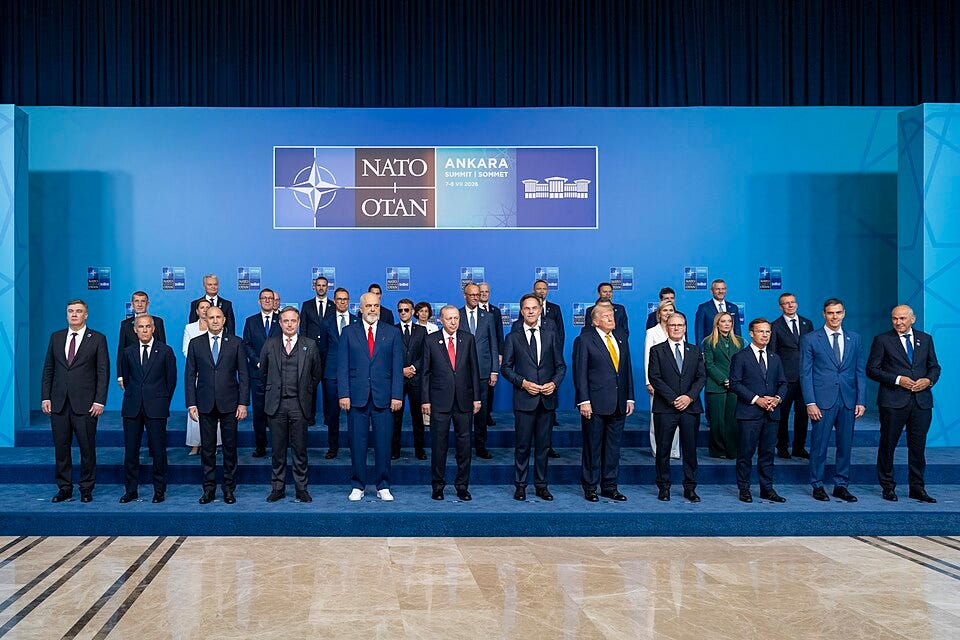
"Official photo - 2026 NATO Summit in Ankara" by Stenbocki maja is licensed under CC BY 4.0.
The 2026 Ankara Summit affirmed the “NATO 3.0” trajectory, in which the US seeks to pass off alliance operational leadership to the Europeans. However, there is no obvious regional leading power to take on this responsibility. The US is warming to Türkiye due to its dynamic defense industrial base, experience with NATO mission commands, and strong conventional force. However, the rest of NATO Europe is wary of Türkiye’s hedging with Russia, blocking Türkiye from EU defense industrial initiatives. Nonetheless, momentum is gaining for stronger EU-Türkiye defense cooperation. Greece and Türkiye have begun a rapprochement to resolve maritime disputes, and the EU is backing a new UN plan to reconcile Cyprus’ frozen conflict. Upside risks of greater Turkish leadership include leveraging Türkiye’s defense industrial capacity for Europe’s rearmament. The downside risks include policy misalignment if NATO Europe compartmentalizes or implicitly supports Ankara’s independent foreign policy.
In today’s full analysis:
The Growing Divergence of the US and EU on Türkiye
The Obstacles to Turkish Leadership
The Risks

Global
Middle East and Ukraine war disrupts helium supply chain with shortages expected for Europe. The cascading effect of Qatar’s inability to export helium gas and Ukrainian attacks on the Orenburg processing and helium plant in western Russia is squeezing supplies and driving up prices. In April, Russia started limiting helium exports. This month, China, a major consumer of Russian and Qatari helium, announced plans to cut off re-exports of Russian helium to Europe, securing its supply for domestic use. The US is the largest global supplier, previously supplying 42% of the market, but it will not be able to meet all of Europe’s demand.
Helium gas is used in multiple critical industries due to its unique inert, cryogenic and thermal properties. Helium is required to cool manufacturing equipment and stabilize silicon wafers during advanced microchip production. High-capacity hard drives used in data centers and cloud computing are helium-sealed to reduce friction and increase storage density. In the healthcare sector, liquid helium is essential to the functioning of MRI and NMR machines. Helium is also used in aerospace and defense industries, such as for pressurized liquid-fueled rocket engines used by SpaceX and NASA.
Read More: Financial Times [paywall], Forbes, Reuters [paywall]
Europe
The European Commission fined Chinese marketplace AliExpress for €550 million. The mega-fine is one of the few issued under the Digital Services Act (DSA), which empowers the Commission to take action against large online platforms (i.e., over 45 million users) that do not comply with platform governance obligations, including protecting consumers from harmful or illegal content. The Commission alleges that AliExpress had an insufficient system for moderating the sale of illegal, counterfeit, and dangerous products on its site, nor did it effectively apply penalties to prevent this activity. AliExpress now has until October 20 to submit an action plan to improve its platform governance within the bloc.
This application of the DSA complements the EU’s trade measures. While the DSA is not itself a trade measure, the alleged lack of effective oversight on e-commerce sites—the violation in question—could facilitate the influx of low-value goods into the EU, a growing concern. Over nine of ten packages imported into the bloc originate from China, mostly due to the small-value parcels. EU member states have increasingly called upon the European Commission to propose new trade measures to regulate trade with China and rectify a growing trade deficit. The EU approved a flat €3 customs duty on small packages in February 2026.
Read More: European Commission, AP, Financial Times [paywall]
Middle East
Lebanese President Aoun meets President Trump in Washington today to discuss the US-backed plan for Hizballah and Israel. Aoun is the first head of state in nearly 20 years to visit the White House, a signal from Washington of its investment in managing the ongoing Israel- Hizballah conflict. Iran has succeeded in tying the outcome of the conflict in Lebanon to its broader war with the US, making resolution there critical to any future ceasefire.
The meeting comes as the ceasefire faces a major test – the withdrawal of Israeli forces and reentry of Lebanese troops in parts of southern Lebanon. On Tuesday, Lebanese Armed Forces (LAF) troops began deploying in a southern Lebanese town after Israeli troops withdrew, in line with the US-brokered plan. But the LAF will still need to disarm Hizballah (which the group firmly opposes) and allow the return of tens of thousands of internally displaced Lebanese to an area that has been ravaged by war.
The key issue is how to force Hizballah to disarm. Aoun will seek more US pressure on Israel to withdraw, while the US will want tangible results on Hizballah disarmament. But there is no clear plan to achieve disempowerment of the deeply entrenched group – the LAF is underfunded, untested, and potentially unwilling to fight countrymen; Syrian intervention is unpopular with everyone but President Trump; and Israeli intervention would be difficult for Lebanon to accept, and would face the same obstacles as Israel’s multi-year, unsuccessful efforts to destroy Hamas.
Read More: Reuters [paywall], The Hill, Reuters [paywall], Wall Street Journal [paywall
Asia-Pacific
US Secretary of State Marco Rubio is in Manila for the ASEAN Foreign Ministers’ Meeting and related summits, underscoring US efforts to reaffirm its commitment to the increasingly influential regional bloc amid intensifying competition with China. The ASEAN-led meetings bring together officials from the US, China, Russia, Japan, India, Australia, South Korea, the UK and the EU, making them one of the few multilateral forums where competing powers engage directly. Rubio has indicated he is open to meeting Chinese Foreign Minister Wang Yi and Russian Foreign Minister Sergei Lavrov on the sidelines, with the Kremlin sharing openness to such a meeting. The gathering comes as Southeast Asian states navigate competing pressures, including concerns over global energy markets amid the Iran war, US trade tensions and regional security.
Rubio’s visit coincides with renewed tensions in the South China Sea. China and the Philippines traded accusations after vessels from both sides encountered one another near Second Thomas Shoal, where the Philippines maintains a grounded military outpost. Manila said a Chinese Coast Guard vessel approached dangerously close and injured a Philippine servicemember, while Beijing claimed its forces acted with restraint after Philippine personnel confronted Chinese officers. The incident comes days after the tenth anniversary of the 2016 arbitral ruling that invalidated the legal basis for China’s South China Sea claims—a decision Beijing continues to reject. The episode highlights the persistent risk of escalation in waters where US treaty commitments to the Philippines heighten the broader strategic stakes.
Read More: Reuters [paywall], Inquirer, ASEAN, France24, NBC News, Business Times
Americas
Former Brazilian congressman Eduardo Bolsonaro has been granted permanent US residency through an EB-1A “extraordinary ability” visa, effectively a green card. Bolsonaro, the son of former President Jair Bolsonaro, has lived in the United States since early 2025. The development comes one month after Brazil’s Supreme Court sentenced him to four years and two months in prison for seeking US intervention in legal proceedings involving his father, who was convicted for his role in an alleged coup plot following the 2022 election. Eduardo Bolsonaro has denied wrongdoing and said he intends to remain in the United States unless he receives amnesty in Brazil.
The decision comes amid growing tensions in US-Brazil relations. Last week, the Trump administration announced 25% tariffs on selected Brazilian imports, while continuing to criticize the treatment of Jair Bolsonaro by Brazilian authorities. Eduardo Bolsonaro has been accused by prosecutors and political opponents of lobbying US officials to pressure Brazil through sanctions and other measures, allegations he denies. The green card approval is therefore likely to fuel further debate over the Bolsonaro family’s close ties to the Trump administration and their influence on the increasingly strained relationship between Brasília and Washington.
Read More: Reuters [paywall], G1 [Portuguese], DW [Portuguese]
Geoeconomics
President Trump on Monday signed orders to impose an additional 50% tariff on a range of Canadian goods imported into the US under Section 338, raising trade hostilities between the neighbors. The tariffs are in response to alleged Canadian discrimination against US motor vehicles, dairy and alcohol. The tariffs are set to effect Canadian goods regardless of whether the goods are covered by the US-Mexico-Canada Agreement (USMCA). Energy products, potash, fish and critical minerals will be exempt from tariffs. Calls for tit-for-tat retaliation are growing in Canada, including from Ontario Premier Ford stating, “Canada should respond tariff for tariff, dollar for dollar.” Canada is one of two countries that retaliated against the Trump administration’s first round of tariffs last year, maintaining a 25% counter-tariffs on select US exports.
The tariffs add to mounting US-Canada trade tensions after the Trump administration decided not to extend the USMCA earlier this month, while US-Mexico negotiations persist. US Trade Representative Jamieson Greer is in Mexico City today to convene three-day bilateral USMCA review talks, marking their third round of bilateral USMCA talks, while the US and Canada have yet to begin formal negotiations. Recent engagement patterns suggest future USMCA negotiations may focus less on broad trilateral reform and more on targeted bilateral discussions, as sector-specific issues and rules of origin increasingly dominate the agenda. While trade continues to operate under the existing USMCA framework, North American businesses face a more uncertain policy environment, pushing industry to likely place greater emphasis on long-term strategic planning, including contingency measures to mitigate potential supply chain disruptions.
Read More: The White House, CNN, Office of the United States Trade Representative, Inside Trade [paywall], Politico, Reuters [paywall], Center for Strategic and International Studies
Energy
Geopolitical risk factors continue to shape global demand for renewable energy technologies. Exports of renewable energy tech, largely from Chinese companies that dominate those supply chains, have surged globally. This is especially the case in energy import-dependent countries. Chinese exports of residential lithium-ion batteries rose 45% year on year in March through May, with Australia and India recording particularly large surges in imports. Likewise, China’s solar cell exports rocketed up 80% year on year in March and 60% in April, and solar exports to Asia and Africa continued to record strong performances. China’s exports of EVs have also profited from the global demand for these products.
Not all regions and countries are taking similar approaches to solving their import dependencies with green technologies. The push for renewable energy has been particularly strong in Asia and Europe, where many governments have seen energy crises as a way to drive forward preexisting energy initiatives for reducing reliance on traditional fuels. In Asia, China has exemplified this approach in its policies towards wind and solar energy. France, Germany, the UK and Spain have all adopted new policies to hasten the deployment of electrification technologies. However, some countries have leaned towards policies to support consumers or reduce the impact of the energy crisis, such as lowering taxes or boosting domestic production of energy sources like coal.
Whether or not this trend continues will likely depend on how energy markets develop. The longer oil and natural gas prices remain elevated due to supply constraints, the more likely countries will commit resources to reducing structural dependencies. Moreover, a more unpredictable global energy market stemming from geopolitical risks also incentivizes boosting domestic production and diversification of energy supplies.
Read More: Bloomberg [paywall], Reuters [paywall], Oilprice.com


Contact Us
Karl Hopkins
Partner
+1 202 429 6499
khopkins@steptoe.com
Melissa B. Mahle
Senior Advisor
+1 202 261 0577
mmahle@steptoe.com
Anni Coonan
Senior Intelligence Analyst
+1 212 506 3979
acoonan@steptoe.com
Samuel Bloebaum
Senior Due Diligence Analyst
+1 602 410 6240
sbloebaum@steptoe.com
Zayna Dembinski
Analyst
+1 202 778 3567
zdembinski@steptoe.com
Thomas Goldstein
Analyst
+1 202 862 6735
tgoldstein@steptoe.com
Ian Cameron
Analyst
+1 202 327 6908
icameron@steptoe.com
Elton Smole
Analyst
+1 202 261 0556
esmole@steptoe.com
Carter Spahn
Intelligence Fellow
+1 202 261 7555
cspahn@steptoe.com
Chris Dantes
Intelligence Fellow
+1 202 327 6904
cdantes@steptoe.com
Legal disclaimer: This Substack is for educational and informational purposes only and does not constitute the rendering of legal counseling or other professional services. Reading, subscribing to, or communicating through this Substack does not create an attorney-client relationship. Do not send confidential information through this platform. Consult qualified legal counsel regarding your specific circumstances.