


Welcome to the Stepwise Risk Outlook, which highlights and contextualizes over-the-horizon developments in key regions of the world and industries of the global market. Today’s featured interview is with Samuel Bloebaum, Senior Analyst.

Interview with Samuel Bloebaum, Senior Analyst
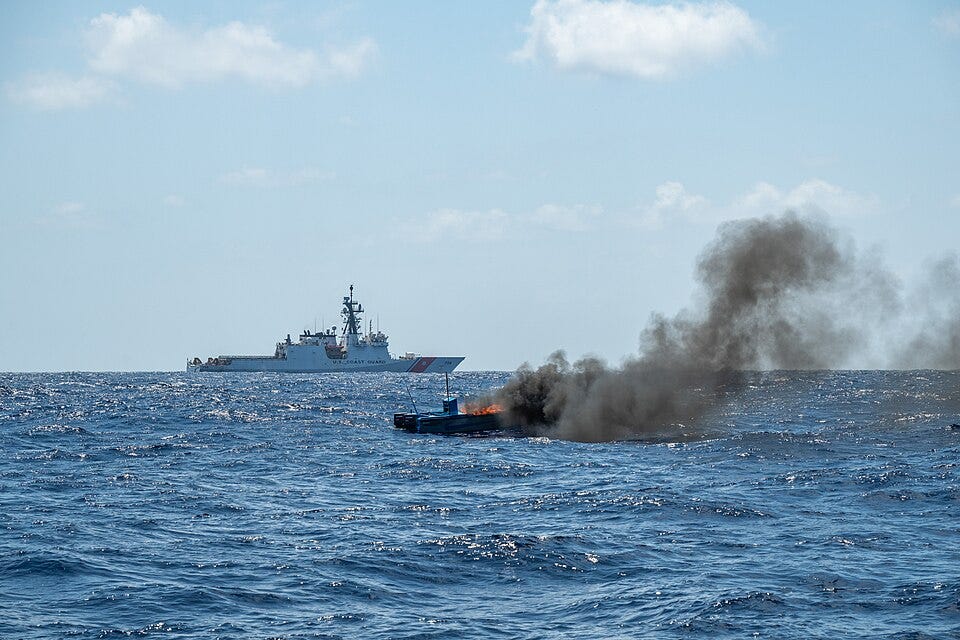
“U.S. Coast Guard Cutter Kimball interdicts drug smuggling vessel in Eastern Pacific Ocean” by the U.S. Coast Guard / Petty Officer 3rd Class Austin Wiley is in the public domain.
.jpg)
Samuel Bloebaum is a senior analyst with Steptoe’s Global Strategic Engagement Team and leads the team’s due diligence investigative work. With a background in geopolitical risk analysis and complex investigations spanning English-speaking countries, Latin America and the Middle East, Sam provides clients with a firm understanding of counterparty risks and compliance red flags. Sam has led projects evaluating multinational supply chain risks, country-specific industry stakeholder analyses and offshore asset tracing.
Sam sat down with Stepwise Editor-in-Chief Anni Coonan, the subject of last week’s entry in Stepwise’s ongoing “Meet the Team” series, to discuss the business impacts of transnational crime and the geopolitical implications of anti-narcotrafficking trends.

Global
Wildfires in Spain and France burn out of control, prompting emergency actions. Spain has declared a national emergency due to the wildfires, a first for the country. More than 10,000 people have been evacuated from densely populated mountainous areas north of Madrid. France has evacuated the entire Cap Ferret peninsula, as blazes threaten homes and tourism infrastructure. Both countries have sought help from the EU to contain the blazes. Around 20,000 people have been evacuated in the region so far.
2025 was the worst fire year on record, and 2026 is on the record’s heels, with August and September expected to continue hot and dry conditions. So far this year, 1254 fires have been detected, more than double the long-term average of 569 fires. Fires have scorched 254,388 hectares (628,606 acres). Wildfires release a complex mixture of gases and aerosols, including large amounts of carbon dioxide and ‘black carbon’. The impact on air quality is significant, creating health hazards across the region.
Read More: Euronews, European Commission, US Environmental Protection Agency
Europe
NATO advances plan on an eastward pipeline network. NATO’s Cold War-era pipeline network, extending 10,000 kilometers, ends at western German states, thereby failing to ensure logistical readiness in the event of an eastern contingency. Proponents of an Eastern Europe Pipeline System (EEPS), namely Poland and Romania, are stuck receiving fuel from road and rail tankers, insufficient for a wartime scenario. Moreover, the capacity of the current network, about 4 million cubic meters, would likely run out in the early days of a conflict due to extra demand to launch land forces, airlift operations, and jet sorties to the east.
The EEPS is the envisioned response to these logistical problems. Approved on July 22 by all 32 NATO member states, the plan will be the largest and most expensive commonly funded project in NATO’s history, taking up to 20 to 30 years to complete and costing an estimated €27 billion. The fuel network is a dual-use investment utilized to supply NATO operations, national military operations, and civilian centers. For example, the main established network (CEPS) supplies the Frankfurt Airport and also the Ramstein Air Base, supplying aviation fuel for American logistical operations. In Germany, market-based contracts for civilian consumers to utilize CEPS cover about 70% of the pipeline’s annual operating costs, making the investment a relatively sustainable project.
Read More: NATO, Politico, Centre for Eastern Studies
Middle East
New satellite imagery shows Iran rapidly rebuilding key infrastructure damaged by US and Israeli strikes. Satellite images of military infrastructure shared with news outlets show Iran quickly rebuilding missile bases, bridges, ports and production facilities, despite weathering more than 20,000 airstrikes at the height of the war.
The images belie claims that Iranian offensive capability has been destroyed, and signal that it may be able to endure months more of active conflict. President Trump and Israeli sources have repeatedly asserted that Iranian offensive capabilities have been all but decimated, but Iran was already restoring drone production in May, during active conflict. The rapid rate of rebuilding is sparking worries in Washington and Jerusalem that Iran is nowhere near bowing to the pressure of the airstrike campaign and will be able to endure several more months of active conflict.
Read More: Wall Street Journal [paywall], CNN, Jerusalem Post
Asia-Pacific
South Korea on Thursday dropped its denuclearization-first approach as a precondition for talks with North Korea, as it seeks new strategies to reopen dialogue after seven years of suspended formal communication. Unification Minister Chung Dong-young affirmed the long-term goal of a denuclearized Korean Peninsula remains unchanged, but said making denuclearization a precondition for engagement is unrealistic. Seoul is instead adopting a “peace-first” strategy, which aims to freeze Pyongyang’s nuclear program as concerns over its expanding arsenal continue to grow. The revised approach aligns with President Lee Jae-myung’s “pragmatic diplomacy” foreign policy, which for inter-Korean relations prioritizes peaceful coexistence and crisis management.
The shift reflects the changing security landscape. Since late 2023, Pyongyang has embraced a “two hostile states” policy, abandoning reunification and later formalizing the change by removing all references to it from its constitution this year. North Korea has also rapidly expanded its nuclear capabilities and accelerated military modernization across all theatres. At the same time, both Beijing and Moscow have quietly stopped public calls for North Korea’s denuclearization amid deepened military cooperation with Russia and strengthened trade with China. The changes also coincide with shifting public attitudes in South Korea, where reunification is increasingly viewed as a long-term aspiration rather than an immediate policy priority. Together, the shifts underscore diminishing regional support for a denuclearization-first approach, reflecting a broader recognition that freezing North Korea’s nuclear program may be a more realistic near-term objective than eliminating it altogether.
Read More: Korea JoongAng Daily, Korea Economic Institute of America, The Korea Herald, Wall Street Journal [paywall], The Brookings Institution
Americas
A federal judge in New York has scheduled the criminal trial of former Venezuelan President Nicolás Maduro and his wife, Cilia Flores, to begin on June 1, 2027. US prosecutors accuse the pair of participating in a narcoterrorism conspiracy that allegedly involved coordinating with drug traffickers to send large quantities of cocaine into the United States. Maduro and Flores have pleaded not guilty to the charges. During a court appearance this week, Judge Alvin Hellerstein set a November hearing to consider several legal challenges expected from the defense, including arguments related to the legality of Maduro’s capture by US forces in January and claims that he is entitled to immunity as a former head of state.
The case is expected to be one of the most consequential foreign political trials ever held in a US court. Maduro, who continues to maintain that he is Venezuela’s legitimate president, was removed from power and brought to the United States following a US military operation earlier this year. The proceedings are likely to test the legal boundaries of prosecuting a former foreign leader on US soil, while also drawing renewed attention to Washington’s role in Venezuela’s political transition. The trial comes as Venezuela’s interim government, led by Acting President Delcy Rodríguez, continues to govern with US backing, making the case a focal point in both US-Venezuela relations and the broader debate over international accountability for alleged transnational criminal activity.
Read More: Wall Street Journal [paywall], ABC, Reuters [paywall]
Africa
The US is reportedly considering military options against the al-Qaeda affiliate JNIM in Mali. US officials also stated that Washington has been urging governments across North and West Africa to purchase American equipment and services in support of counterterrorism operations. The report follows efforts from Washington to deepen cooperation with Bamako after years of tension with the anti-Western military junta. Some senior officials have advocated for limited military action against Jama’at Nusrat al Islam wal Muslimin (JNIM), but there is no indication that a decision has been made or that a broader consensus exists within the Trump administration.
Any military action would likely be limited in scope. If force is used, it will likely take the form of targeted airstrikes against JNIM leaders and logistics or command-and-control hubs, similar to US strikes conducted in Nigeria last December. While such strikes could disrupt the group’s operational capabilities in the short term, they are unlikely to significantly reduce JNIM’s influence or reverse its territorial gains without sustained pressure from Malian ground forces. Moreover, Mali’s continued hostility toward cooperation with members of the Economic Community of West African States limits the ability of regional partners to conduct joint counterterrorism operations.
Read More: The Washington Post [paywall], Stepwise Risk Outlook, Africa Center for Strategic Studies
Geoeconomics
Japanese negotiators are reportedly withholding financing for two small modular reactor (SMR) projects in the US because of unresolved questions over legal liability for possible nuclear-related accidents. Part of the second tranche of projects announced as part of Tokyo’s pledge to deploy up to $550 billion in US investments in exchange for tariff reduction includes plans for construction of two SMR projects, worth $40 billion together. However, the projects have since stalled because Japan wants legally binding assurances that its lenders will not be held liable for any nuclear accident on US soil. Although US Commerce Secretary Howard Lutnick assured Japanese officials they would bear no such liability, those guarantees have not been formalized, leaving uncertainty over the allocation of legal risk.
The dispute highlights a broader challenge facing the Trump administration’s tariff-for-investment strategy: translating political agreements into bankable projects requires clear legal and financial frameworks for many of its allied partners. Similar ambiguities emerged immediately after the US-Japan trade deal, with disagreements over profit-sharing arrangements, tariff implementation and the scope of commitments widely reported. As Washington presses Tokyo to announce additional projects, including a potential semiconductor plant and an energy export terminal, unresolved liability issues will continue to slow the delivery of agreements long after they are concluded, leaving Japan in a difficult position.
Read More: Financial Times [paywall], New York Times [paywall], Reuters [paywall], Japan Times
Disruptive Technology
The Clarity Act reaches an impasse over ethics provisions. Republicans aim to pass the Clarity Act, the sweeping crypto legislation that places most crypto oversight with the Commodity Futures Trading Commission, next week before the August recess begins. However, Senate Democrats have conditioned final support on strong ethics provisions that disallow government officials from profiting off crypto trades while in public service. Under the latest draft, government officials cannot issue or sponsor digital currencies, but those provisions do not apply to children. Moreover, only the Department of Justice can enforce the legislation, which Democrats distrust. The original champions of the Clarity Act, namely Sen. Angela Alsobrooks (D, MD), have withdrawn support until the ethics provisions are amended.
Read More: Yahoo!news, Politico, New York Times [paywall]
Energy
High energy prices and continued volatility are a factor in driving inflation worries. Both the European Central Bank (ECB) and Türkiye’s central bank held interest rates steady, but both are also looking at the impact of volatile energy prices as they go forward. The ECB left the option open to increase borrowing costs in the next several months, and while Türkiye’s central bank had signaled a desire to cut rates, the central bank is holding steady after sharply raising inflation forecasts in May. The dollar has also been rising on the back of high oil prices from the collapse of the US-Iran ceasefire.
Oil prices have moved rapidly upwards since the ceasefire’s collapse. Brent crude prices rose to above $100 for the first time since the US and Iran resumed fighting. The spike occurred after reports of two attacks on Saudi oil tankers in the Red Sea. Oil prices had dipped to around $72 per barrel just a few weeks ago. However, prices remain short of their high point this year; they reached almost $115 dollars in May.
Read More: AP, Wall Street Journal [paywall], Wall Street Journal [paywall], Reuters [paywall]
Transnational Crime and Corruption
The US Office of Foreign Assets Control (OFAC) issued new narcoterrorism sanctions on Thursday targeting the Jalisco New Generation Cartel (CJNG). CJNG’s founding leader Nemesio “El Mencho” Oseguera was killed by the Mexican military with US intelligence support in February. The package revealed El Mencho’s stepson, Juan Carlos Valencia Gonzalez, took over the cartel and identified Valencia’s core officials. The question of who would succeed El Mencho had previously been the subject of significant speculation. In addition to designating Valencia, the OFAC sanctions targeted over 50 Mexican individuals and entities involved in CJNG’s drug smuggling, money laundering and assassination operations.
The same day, OFAC issued sanctions targeting fundraising apparatuses for Hamas and the Muslim Brotherhood. The sanctions press release identified front organizations and charities accused of soliciting international donations ostensibly for humanitarian efforts and diverting the funds towards militant and criminal activities. The sanctions designated the London-based secretary-general of the Muslim Brotherhood General Secretariat and accused him of fundraising for Turkish charities linked with Hamas. OFAC has designated Muslim Brotherhood branches in Egypt, Sudan, Jordan and Lebanon since January 2026.
Read More: US Treasury, US Treasury, El Pais [paywall], The Times, Jerusalem Post


Contact Us
Karl Hopkins
Partner
+1 202 429 6499
khopkins@steptoe.com
Melissa B. Mahle
Senior Advisor
+1 202 261 0577
mmahle@steptoe.com
Anni Coonan
Senior Intelligence Analyst
+1 212 506 3979
acoonan@steptoe.com
Samuel Bloebaum
Senior Due Diligence Analyst
+1 602 410 6240
sbloebaum@steptoe.com
Zayna Dembinski
Analyst
+1 202 778 3567
zdembinski@steptoe.com
Thomas Goldstein
Analyst
+1 202 862 6735
tgoldstein@steptoe.com
Ian Cameron
Analyst
+1 202 327 6908
icameron@steptoe.com
Elton Smole
Analyst
+1 202 261 0556
esmole@steptoe.com
Carter Spahn
Intelligence Fellow
+1 202 261 7555
cspahn@steptoe.com
Chris Dantes
Intelligence Fellow
+1 202 327 6904
cdantes@steptoe.com
Legal disclaimer: This Substack is for educational and informational purposes only and does not constitute the rendering of legal counseling or other professional services. Reading, subscribing to, or communicating through this Substack does not create an attorney-client relationship. Do not send confidential information through this platform. Consult qualified legal counsel regarding your specific circumstances.