


Welcome to the Stepwise Risk Outlook, which highlights and contextualizes over-the-horizon developments in key regions of the world and industries of the global market. Today’s featured deep dive by Chris Dantes examines drivers of insecurity in the Red Sea.

Prolonged Instability in the Horn of Africa Risks Further Disruptions to Red Sea Commerce
By Chris Dantes
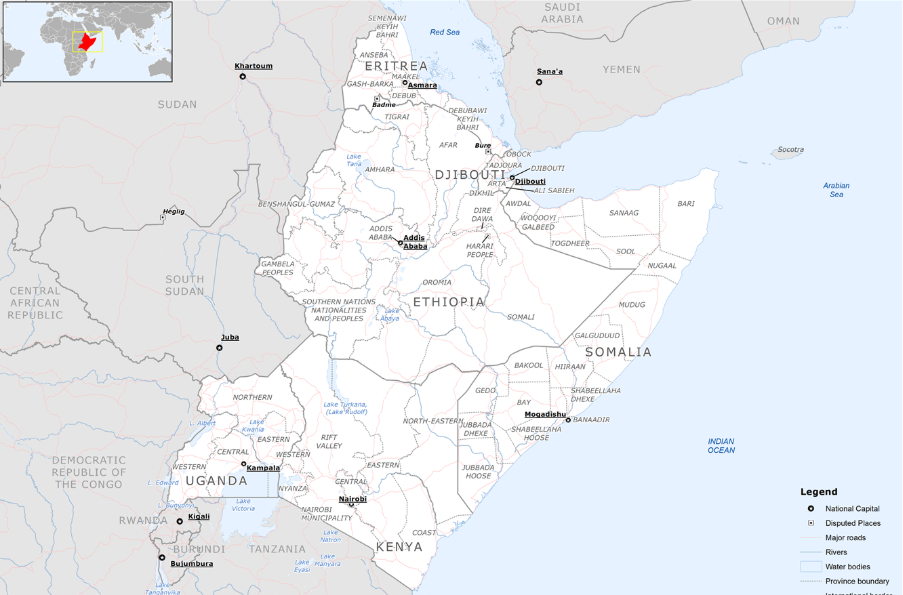
"Horn of Africa Base Map" by JRC, EU is licensed under CC BY 4.0.
Global shipping has come under greater pressure as strikes from the Houthis in Yemen threaten maritime commerce in the Red Sea. Discussions over securing these waterways often emphasize stability on the Arabian Peninsula, but instability on the African side of the Bab el-Mandeb Strait may prove just as consequential. As internal political fragmentation, interstate rivalry, and war continue to shape the Horn, the region is emerging as an increasingly important factor behind Red Sea security. If these challenges remain unaddressed, further disruptions to Red Sea commerce could occur, impacting energy markets and trade through the Bab el-Mandeb Strait.
Against this backdrop, the US has increased engagement with countries in the Horn of Africa. This month, Massad Boulos, senior White House advisor for Arab and African affairs, met with Eritrean and Somali representatives in Cairo to discuss regional security initiatives, the exact details of which are unknown. If renewed US engagement does not also address competing regional alignments and deep internal political divisions, efforts to safeguard maritime trade through cooperation with security partners in the Horn are unlikely to succeed. Conversely, a more stable Horn of Africa—or one that avoids a wider regional conflict—could provide a more reliable security arrangement in the Red Sea post Iran war.
In today’s full analysis:
Competing Regional Alignments Undermine Red Sea Security Cooperation
Additional Obstacles to Stability
Prospects of Stability and Risks
Or listen to the full report here:

Listen to the news:
Global
The US, UK and EU central banks all held rates steady in July decisions despite concerns of oil-driven inflation. The US Federal Reserve’s decision yesterday was accompanied by the same policy statement issued in June, affirming the focus on returning inflation sustainability to the 2% goal. Similarly, the Bank of England kept rates steady today, with wait-and-see policy statements that support expectations that the BoE will raise rates in the final quarter of 2026 and again in 2027. The European Central Bank (ECB) also left rates unchanged in its July decision, stating that while uncertainty remains high, the full inflationary impact of the energy shock has yet to play out. Bank of Japan is also expected to keep rates steady on Friday, while signaling growing concerns about inflationary pressures from the Middle East war and weak yen.
The aligned decisions mask internal dissent and prospects that key central banks may diverge in policy in the second half of 2026. In the Fed, three bank presidents disagreed with the majority, calling for a quarter-point rate increase to address inflation that has run above target for five years. This is the first time since 2016 that three officials dissented in the same direction over a policy change. US markets retreated in response to the Fed’s decision, signaling investors’ assessment of growing risks to economic growth and a bet that the Fed under the new leadership of Chairman Kevin Walsh will be more reactive than proscriptive. In the UK, three policymakers voted for a quarter-point rate increase, urging faster tightening policy, citing concerns that the broadening conflict in the Middle East risks driving up inflation. The ECB already raised interest rates earlier this year, and financial markets expect further increases this year, driven by rising energy costs.
Read More: Yahoo!Finance, Reuters [paywall], Morningstar, Reuters [paywall], World Economic Forum
Europe
The US formally launched a six-month force posture review in Europe on Tuesday. The Under Secretary of War for Policy, Elbridge Colby, emphasized that the review will usher in an “irreversible” transition toward European responsibility for their conventional defense to fulfill the administration’s vision of “NATO 3.0,” an alliance dedicated to deterrence. The announcement follows the US announcing that it would reduce capabilities dedicated to an alliance-wide crisis response through the new NATO Force Model, including strategic bombers, fighter jets, air refueling aircraft, and armed reconnaissance drones; submarines will be cut entirely.
The review will be technical and is unlikely to usher in a full US withdrawal. The review is being led by the current Supreme Allied Commander, Gen. Alexus Grynkewich, meaning it will likely prioritize where NATO Europe can quickly replace American capabilities to optimize alliance sustainability. Moreover, the US Congress has mandated that the US keeps 76,000 troops in Europe unless the Pentagon can certify good grounds to breach that limit. Moreover, the Iran war has underscored the importance of European basing for global American military operations, so current military hubs like Ramstein are unlikely to be drastically affected. Eastern flank states like Poland have effectively lobbied to increase American troop levels, so the review may even enable a resource shift toward those allies.
Read More: Politico, Stars and Stripes, Military Times
Middle East
The Iran-backed Houthis in Yemen are considering collecting fees for passage of the Bab al-Mandeb Strait. According to regional sources, the militant group – which controls Yemen’s east around the Bab al-Mandeb – is looking into how to impose fees on “most” traffic in the chokepoint, mirroring Iranian efforts to impose fees on traffic in the Strait of Hormuz (which countries including India and China have reportedly already paid). Chinese ships would be exempted, reportedly.
The practice would introduce a new shock in the global market, and normalize the privatization of international waterways. Pre-war, roughly 10-15% of all maritime trade volume and 30% of global container traffic transited the Bab al-Mandeb each year, making the waterway arguably a more significant global chokepoint than the Strait of Hormuz. While initial disruptions would cause a shock, international shippers would likely ultimately pay a fee – setting a dangerous precedent.
It would also accelerate regional plans to reduce reliance on maritime shipping. Gulf oil exporters are already scrambling to invest in overland pipelines, rail, and even truck routes. Saudi Arabia and the UAE are expanding existing pipelines that bypass the Strait of Hormuz (although the Saudi plan involves loading in the Red Sea – complicated by the Houthi blockade), Iraq and Turkiye recently signed a deal to expand a pipeline from Iraq to the Mediterranean, and Syria is attempting to revive abandoned pipelines through its territory.
Read More: Reuters [paywall], Council on Foreign Relations, The New Arab
Asia-Pacific
Reports suggest China will transfer between 300 and 400 shoulder-fired air-defense missile launchers (MANPADS) to Iran, worth between $60 and $70 million. Reuters on Tuesday said the purchase would transit through Pakistan and include both Chinese-made QW-12 and FN-16 missiles. The reported acquisition would expand Iran’s existing stockpile of MANPADS—made up of domestically produced Misagh-series MANPADS and possibly older Soviet launchers—and bolster its reportedly vulnerable air-defense network. The acquisition could support Tehran’s reported efforts to build a more decentralized air-defense network, drawing on Ukraine’s use of mobile, distributed systems, including MANPADS, to complicate and deter air attacks.
Both China and Pakistan have denied the report. Since the outbreak of the Iran war, China has repeatedly been accused of selling weapons, including MANPADS, to support Iran’s war effort, resulting in several US-led sanctions against Chinese firms and individuals. Nonetheless, China maintains it has never sold or transferred weapons to either party in this war. China’s response to the Iran war has been relatively muted, limited to calling for both sides to engage in peaceful talks. Notably, Beijing has shown it is not interested in mediating and did not even confirm the credit it was given for being an unofficial mediator earlier in the conflict. China’s interests in a limited war reflect its more economically driven attitude toward the region. Meanwhile, Pakistan, which is actively exploring new avenues to resume talks between Washington and Tehran, said the report was “absolutely concocted and false.”
Read More: Reuters [paywall], East Asia Forum, The New York Times [paywall], US-China Economic and Security Review Commission
Americas
The sinking of the state-run ferry MV Barima on July 18 has become a national tragedy and a political flashpoint in Guyana. The 87-year-old vessel capsized off the Essequibo coast while traveling from Georgetown to Port Kaituma, carrying an estimated 179 passengers. Authorities have recovered more than 70 bodies and believe the final death toll could approach 100, making it the country’s deadliest disaster since the 1978 Jonestown tragedy. Guyana’s police filed charges against the captain and crew on Tuesday. Survivor accounts and media reports have raised questions about overcrowding, the age of the vessel, and the speed of the rescue response, fueling public anger and calls for accountability. The tragedy has also intensified political tensions, with opposition figures criticizing the government’s handling of the disaster and protesters demanding investigations into possible negligence amid concerns that Guyana’s oil wealth has not translated into better public services and infrastructure.
The disaster comes against the backdrop of one of the world’s fastest-growing economies. Since offshore oil production began in 2019, Guyana’s GDP has expanded dramatically, driven by nearly 11 billion barrels of proven oil reserves and investments. New infrastructure projects, foreign investment, and rapid construction have transformed the capital Georgetown, while the government under President Irfaan Ali has promoted ambitious plans to diversify the economy through education, technology, energy, and transportation projects. Yet some warn that Guyana faces the classic risks of the “resource curse,” including weak institutions, governance challenges, labor shortages, corruption concerns, and persistent inequality.
Read More: New York Times [paywall], Bloomberg [paywall], AP
Africa
South Africa and Russia agreed to strengthen security cooperation following a visit by the South African Army Chief to Moscow. South African military officials are also scheduled to visit Russian military academies and defense companies, potentially paving the way for officer training and greater Russian arms sales to Pretoria. The agreement comes amid worsening US-South Africa relations, particularly following the US’ decision to permanently end the President’s Emergency Plan for AIDS Relief (PEPFAR) funding to the country.
Russia-South Africa relations have historically been close, but ending critical public health assistance risks accelerating Pretoria’s shift toward geopolitical competitors. Cooperation on public health is an important source of US soft power and political influence. The withdrawal of PEPFAR funding creates opportunities for Russia and others to deepen security and economic engagement. Furthermore, this decision could alienate pro-Western political parties in South Africa and strengthen the African National Congress’ ties to Russia and China.
Read More: Business Insider Africa, Semafor Africa, The Hill, Carnegie Endowment for International Peace
Geoeconomics
The New York Times found some US businesses are once again turning to China for manufacturing, citing the narrowing tariff differential with other countries. Countries US manufacturers had shifted production to—such as Mexico, Thailand and Vietnam—to shield their operations from the US-China trade war now face tariffs of their own. Meanwhile, the October Trump-Xi summit in Busan, which rolled back major tariffs on Chinese goods and paused escalation, narrowed China’s tariff gap with others dramatically. Although China still faces additional sectoral tariffs, the resulting convergence has made it increasingly attractive to return to China because of its overall more cost-efficient ecosystem. Moreover, it has become less financially possible for some companies to maintain production in Southeast Asia, which has less-developed supply chains, more vulnerable to external shocks, bureaucratic hurdles and weaker infrastructure, all of which raise costs.
That calculus, however, could prove short-lived. The Trump administration continues to signal additional tariffs are on their way, such as possible action following the results of USTR’s ongoing Section 301 investigation into structural excess capacity and production, an issue which the US often raises with China. For companies weighing where to locate production, China may currently offer the strongest combination of manufacturing capacity and cost efficiency compared to Southeast Asian peers, but the risk of renewed US tariffs means returning to China could ultimately prove to be a costly bet on the durability of the current trade ceasefire.
Read More: New York Times [paywall], Bloomberg [paywall], Peterson Institute for International Economics
Energy
The administration has tapped five states to potentially host sites for recycling nuclear waste. The Nuclear Lifecycle Innovation Campuses are part of a project by the White House to house and repurpose spent nuclear fuel, enable reactor deployment, and develop the full nuclear fuel cycle. The five states, all of which are led by Republican governors, would receive significant financial support for hosting the campuses that would total billions of dollars. The states could also attract significant new investment from sectors like nuclear power and data centers. In total, the Department of Energy (DoE) received almost 30 applications from 26 different states.
The White House is pushing legislation in Congress that would enable these new campuses. The administration’s plan to have DoE partner with states to store nuclear waste requires changes to federal law, and the White House has reportedly been circulating its plans on Capitol Hill and among industry leaders. The changes would pivot the permanent storage of nuclear waste away from Yucca Mountain in Nevada, which is currently the only legal site for high-level nuclear waste, it would change the way waste is classified, and it would reintroduce a fee on nuclear generation for waste disposal that had been stopped by courts.
This is all part of the administration’s push to invigorate the American nuclear industry. The White House’s stated goal is to quadruple nuclear power generation in America by 2050, which would require a long-term solution for nuclear waste.
Read More: Oilprice.com, Politico, AP
Transnational Crime and Corruption
Russian authorities charged the founder of encrypted messaging app Telegram for “facilitating terrorist activities.” Russia accused Telegram of failing to take down a dating chatbot used by Ukrainian intelligence to recruit Russians to attack security personnel and infrastructure. Russia’s Federal Security Service said that 46 Russians had been recruited through the chatbot within the last year. Telegram founder Pavel Durov, who emigrated from Russia and holds French and Emirati passports, denied any wrongdoing.
The charges coincide with Russia’s efforts to push Russians into using state-controlled online platforms. Russia has been intermittently blocking access to Telegram since February and has promoted the state-run messenger Max as a replacement.
Telegram has come under investigation elsewhere as well. France detained Durov in 2024 over allegations that Telegram failed to monitor criminal activity on its platform. French police reportedly called him in for questioning again earlier this month. UK regulators also launched an investigation into the spread of child sexual abuse material through Telegram in April. India temporarily banned Telegram in June amid concerns that draft entrance exams were spreading on the app. Brazil banned Telegram twice in 2022 and 2023 for spreading misinformation and hosting neo-Nazi group chats.
Read More: Financial Times [paywall], Reuters [paywall], New York Times [paywall]


Contact Us
Karl Hopkins
Partner
+1 202 429 6499
khopkins@steptoe.com
Melissa B. Mahle
Senior Advisor
+1 202 261 0577
mmahle@steptoe.com
Anni Coonan
Senior Intelligence Analyst
+1 212 506 3979
acoonan@steptoe.com
Samuel Bloebaum
Senior Due Diligence Analyst
+1 602 410 6240
sbloebaum@steptoe.com
Zayna Dembinski
Analyst
+1 202 778 3567
zdembinski@steptoe.com
Thomas Goldstein
Analyst
+1 202 862 6735
tgoldstein@steptoe.com
Ian Cameron
Analyst
+1 202 327 6908
icameron@steptoe.com
Elton Smole
Analyst
+1 202 261 0556
esmole@steptoe.com
Carter Spahn
Intelligence Fellow
+1 202 261 7555
cspahn@steptoe.com
Chris Dantes
Intelligence Fellow
+1 202 327 6904
cdantes@steptoe.com
Legal disclaimer: This Substack is for educational and informational purposes only and does not constitute the rendering of legal counseling or other professional services. Reading, subscribing to, or communicating through this Substack does not create an attorney-client relationship. Do not send confidential information through this platform. Consult qualified legal counsel regarding your specific circumstances.