

Welcome to the Stepwise Risk Outlook, which highlights and contextualizes over-the-horizon developments in key regions of the world and industries of the global market. Today’s featured deep dive by Samuel Bloebaum examines illicit gold mining in Venezuela.

Illicit Gold Mining in Venezuela: Reform or Regression?
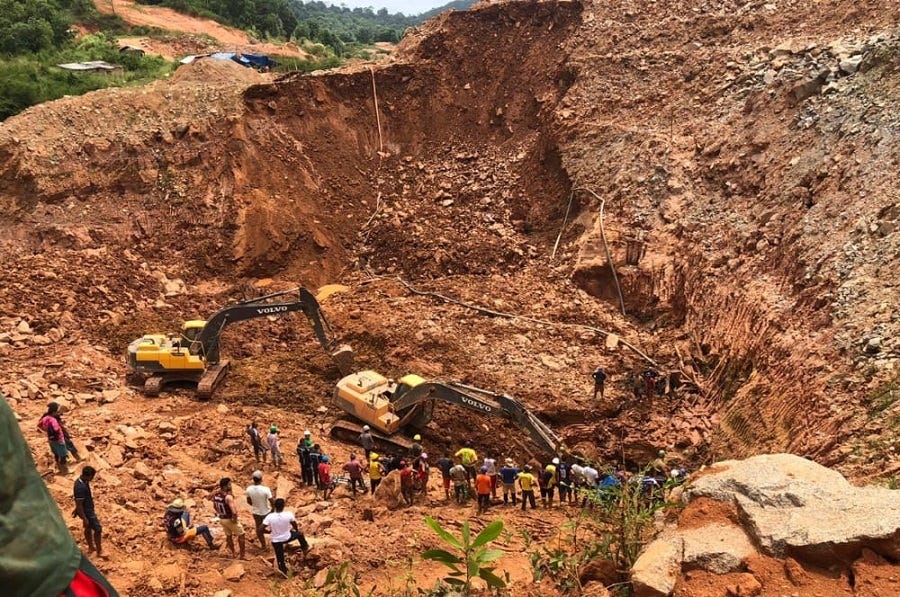
“Landslide Gold mine Lourenço Amapá Brazil“ by Redes Sociais is licensed under CC BY 3.0.
This post is the first in a series on global trends in the illicit gold trade.
Several US-designated criminal and militant organizations, including Tren de Aragua, Cartel de los Soles, and the Colombian National Liberation Army (ELN) control significant territory in mineral-rich southern Venezuela, centered on the country’s Bolívar state. The illicit local mining sindicatos enjoyed over a decade of protection from these organizations, as well as from corrupt Venezuelan political and military officials. The mining activities primarily produce gold, which is used by the illicit actors for sanctions evasion, bribes and funding further illicit activities. The US, having captured Nicholas Maduro in January, has engaged in military cooperation and economic support with the new government in Caracas to disrupt entrenched organized crime by targeting illicit mining operations. If these efforts are successful, the new Venezuelan government could become more stable and local criminal organizations could lose a key source of revenue and money laundering. However, if implemented haphazardly, the reforms could further entrench corruption networks in the country’s mining industry.
In today’s full analysis:
Venezuela’s Gold Economy: State-Enabled Anarchy
The US Response: Carrot and Stick
Potential Pitfalls

Global
The US-Iran ceasefire abruptly collapses, jeopardizing early recovery gains for Gulf supply chains. On Monday and Tuesday, Iran fired missiles at three tankers transiting the Strait of Hormuz along the Omani route, precipitating US retaliation, Iranian escalation and the US decision to revoke the Iranian oil sanctions waiver. Markets responded to President Trump’s remarks that he believed the ceasefire deal to be over. Brent crude futures jumped by 5% to $78 a barrel. A small number of commercial ships successfully transited through the strategic waterway on Tuesday, but nowhere close to pre-war levels. The resumption of fighting will strengthen incentives to diversify supply chains away from the Persian Gulf.
Neither the US nor Iran was satisfied with less-than-expected benefits of the ceasefire. While attacks were scaled down, the Strait of Hormuz was not reopened to the free flow of shipping and the US sanctions waiver did not unlock all roadblocks for Iranian oil exports. In an attempt to exert control, Tehran’s new Persian Gulf Strait Authority mandated that ships must follow a regime-established route that passes along the Iranian coast and that alternatives are prohibited and required vessels to carry Iranian-approved insurance. Western maritime insurance providers were not allowing coverage for vessels to Iranian ports, interpreting this would fall outside the scope of the US sanctions waiver.
While US-Iran talks continue for a negotiated settlement, they are most likely stalled, creating incentives for both parties to reinstate pressure tactics. The ceasefire was to last 60 days (through mid-August), during which time negotiations were expected to focus on Iran’s nuclear program, US sanctions, reparations, among other issues. It is likely no coincidence that this latest escalation coincides with the mass funeral of the late Iranian Supreme Leader Ayatollah Khamenei, as a show of continuing defiance and strength.
Read More: Wall Street Journal [paywall], OilPrice.com, Reuters [paywall]
Europe
Reform UK leader Nigel Farage announced yesterday that he will stand in a by-election amid a parliamentary probe into his party’s financial disclosures. Farage allegedly failed to disclose a £5 million donation in April 2024, before he entered Parliament but during the 12-month period in which he must report “parliamentary or political activities.” Farage stated that the donation is meant to be a personal gift at his discretion, such as for personal security, and therefore did not need to be reported; however, he may have used the funds for Reform UK’s offices and staff. The parliamentary probe into the matter is ongoing and would not have a severe legal effect; at worst, it could cause a parliamentary sanction and trigger a by-election for Farage’s constituency.
By triggering a by-election outright, Farage is seizing the initiative to obfuscate a parliamentary sanction and reaffirm a democratic mandate. He called the by-election a “people versus the establishment” referendum. Moreover, Farage may seek to utilize the mini-campaign to pressure Andy Burnham, the presumptive successor to Keir Starmer as Prime Minister, to call snap elections. However, the move will not stop the parliamentary inquiry. Moreover, most parties announced they will not participate in the Clacton by-election, likely clearing the way for Farage’s re-entry to Parliament and depriving Reform UK of extra oxygen.
Read More: BBC, Deutsche Welle, Politico
Middle East
Saudi Arabia appears to be blocking payments to Emirati accounts, escalating the growing bilateral rift. The Financial Times reported on Tuesday that several sources had reported that payments from Saudi banks to UAE-based accounts belonging to individuals and businesses had been returned or indefinitely blocked since May, with no explanation. The blocking of financial flows threatens to disrupt one of the most important economic relationships in the Gulf, and intensifies the two countries’ growing strategic divide.
UAE-Saudi division has grown over misalignments on Israel, oil policy, Yemen and other proxy conflicts. The dispute broke into the open with a public spat over Emirati backing of a Yemeni secessionist group that seized territory from the Saudi-backed internationally recognised government in December. The picture fractured further with the UAE’s exit from OPEC last month, seen as a direct snub against Riyadh. But tension is based on longstanding economic competition as both countries seek to diversify away from oil, strategic misalignments in Yemen, Somalia, Libya and elsewhere, and the UAE’s alliance with Israel.
Further public animosity could threaten the regional economic order and the US’ relationships with two of its most important Gulf allies. The rivalry has affected regional economic flows before, such as with a Saudi law requiring companies to relocate regional headquarters to the Kingdom or the snarling of cross-border trade in 2021 following new Saudi import restrictions. Further division could make it more difficult for businesses to engage in the two largest regional economies and for the US to manage its critical defense and strategic relationships.
Read More: Financial Times [paywall], Middle East Eye, Semafor, Arab Gulf States Institute
Asia-Pacific
Chinese-built AI models are gaining traction among US companies due to their cost efficiency and a narrowing performance gap with leading US models. As businesses contend with rising token costs from frontier AI systems, open-source and open-weight models—many of the most capable of which are developed by Chinese firms—have become an increasingly attractive alternative. At the same time, a growing body of evidence points to rapid improvements in the performance of Chinese-built models, with many now believed to trail leading US frontier models by only a matter of months.
Beyond advances in AI model development, China is pushing ahead with plans to develop its vertically integrated domestic AI ecosystem. DeepSeek’s reported efforts to develop its own AI chip exemplify this strategy of reducing dependence on foreign semiconductor suppliers while strengthening China’s homegrown AI ecosystem. Beijing also appears increasingly willing to treat frontier AI as a strategic national asset. Recent reports indicate Chinese authorities are considering restricting overseas access to the country’s most advanced AI models, with access potentially tiered according to model sensitivity. Tighter state oversight could introduce new supply chain and geopolitical risks for US firms relying on Chinese AI services.
Read More: CNBC, Reuters [paywall], Reuters [paywall], US-China Economic and Security Review Commission, Economist [paywall], Center for Strategic and International Studies
Americas
On July 7, the UN General Assembly voted to debate US sanctions on Cuba by an overwhelming majority. In total, 136 votes were in favor of proceeding with the debate, while nine votes were against and 30 were abstentions. In the resulting session, US Ambassador to the UN Michael G. Waltz defended the US policy towards Cuba, insisting that “communism never worked,” while Cuba’s foreign minister Bruno Rodriguez accused the US of committing “genocide” against the Cuban population. The US embargo on Cuba was criticized by various regional blocs including ASEAN, the Africa Group, and the Group of 77 and China. Several European countries, including Germany, abstained from the vote. The session was the second deliberation on the embargo this year, but it did not result in a resolution condemning the US policy.
Cuba experienced its third nationwide blackout of this year on July 6. Power was partially restored the following day. Two total blackouts previously occurred within a week in March. The energy crisis has fueled public protests in a country where dissent is harshly punished by the ruling party. Angry residents banged pots in the street on Tuesday night, demanding that the government “turn on the lights.” The country remains under an effective US blockade on energy shipments. US pressure on the island seeks to force the island’s authoritarian government to implement economic reforms. Last month, Cuba’s National Assembly passed a broad set of 176 market-oriented reforms focused on opening the economy for private enterprise.
Read More: UN News, Miami Herald [paywall], CNN, BBC
Africa
The Africa Finance Corporation has secured $753 million to support completion of the US-backed Lobito Corridor railway project. The project aims to upgrade existing railway lines and build new ones connecting copper and cobalt mines in the DRC and Zambia to Angola’s Atlantic Port of Lobito. Since 2023, the US has committed over $4 billion to the railway, making the project one of Washington’s primary instruments of economic statecraft in Africa.
The latest funding marks a significant step in advancing the project, which Washington views as integral to countering China’s entrenched influence in Central Africa. Chinese companies led previous rail infrastructure projects in the region, cementing Beijing’s influence over critical mineral supply chains running through the Copperbelt. If successfully completed, the Lobito Corridor project is expected to increase the railway’s transportation capacity tenfold to 4.6 million metric tons and reduce the cost of transporting critical minerals by up to 30%. The financing also follows the successful shipment of copper through the corridor to a Belgian refinery in June, underscoring the strategic value for Western states seeking to diversify critical mineral supply chains.
Read More: International Railway Journal, Reuters [paywall], US International Development and Finance Corporation, Business Insider Africa, Atlantic Council
Geoeconomics
President Trump today ordered US officials to halt trade with Spain. Speaking at the NATO summit in Ankara, Trump cited Spain’s refusal to meet the alliance’s new 5% defense-spending target and Madrid’s unwillingness to support US operations in the Iran war. The order follows months of tension after Spain resisted US use of Spanish airspace and jointly operated bases, and it targets a country that is not a major US trade adversary but part of the EU single market. Spain’s government downplayed the threat, arguing that bilateral commerce is driven by private companies and that trade policy is handled at the EU level.
Spain enters the dispute from a position of relative economic strength. The Bank of Spain expects the economy to grow about 2.3% this year, well ahead of the eurozone, largely driven by tourism: the government expects a record 100 million foreign tourists in 2026. Spain has also become one of the EU governments most willing to deepen commercial ties with China while openly challenging Washington, further driving a wedge between the two nations. As a result, Spain has become one of Europe’s most attractive destinations for Chinese greenfield investment, especially due to its lower-cost EU production base, port access, and access to the single market.
Read More: Reuters [paywall], OECD, CSIS
Disruptive Technology
Canada anticipates buying Type 212CD submarines developed by ThyssenKrupp Marine Systems (TKMS), a procurement that could range between $20 billion and $30 billion before maintenance costs. The procurement occurs under the Canadian Patrol Submarine Project (CPSP), which seeks to deploy up to 12 Arctic-capable submarines, including four by 2034. This will replace and expand Canada’s current fleet of four Victoria-class vessels, which reach the end of their operational life by the mid-2030s. Contract negotiations are still ongoing, meaning that Canada could still turn to the runner-up bid, South Korea’s KSS-III submarine. The Type 212CD’s diamond hull and non-magnetic material make the vessel stealthier to sonar-based radar systems. The Type 212CD is diesel-powered but integrates hydrogen fuel cells to extend dive times without surfacing. As part of the deal, TKMS is reportedly exploring investment in redeveloping Canada’s Port of Churchill Manitoba, a heavy torpedo plant, and a dedicated space launch complex in Canada.
The choice of a German-Norwegian system over a South Korean system is also a deliberate choice for defense industrial coupling. The announcement coincides with the start of the Ankara NATO summit, where Canada seeks to prove its commitment to the alliance’s 5% NATO pledge. Sustained defense spending will require a defense industrial ramp-up across the alliance, benefitting from coordinated joint procurement. However, Canada’s bet on an industrial ramp-up comes with risks. Germany’s other maritime projects, such as the F126 frigate, have faltered amid subcontracting delays, consortium bickering, manufacturing errors, bureaucratic hurdles, and division of shipyard work. Such obstacles could occur with the Type 212CD consortium and Canadian partners too.
Read More: Breaking Defense, CBC, Financial Times [paywall]
Energy
Germany is planning reforms to incentivize the construction of new gas power plants. The government in Berlin has agreed to increase the maximum allowable bid per megawatt for tenders (€244,000 from €173,000). Germany intends to tender 12 gigawatts of energy capacity in 2026, and Berlin is emphasizing gas-generated energy. Simultaneously, Germany announced plans for a new state-owned strategic gas reserve, which will store up to 10% of Germany’s total gas storage capacity. Berlin plans to begin filling the reserve in 2027, with purchases spread out across several years.
Any new gas plants will need to be in line with Germany’s carbon neutrality goals. The gas plants are part of Germany’s move to phase out coal, and Germany has set a goal to become carbon neutral by 2045. Therefore, all new gas plants will have to be convertible to use hydrogen energy. Despite that, the plans have elicited criticism from some political groups in Germany, such as the environmentalist Greens.
Read More: Reuters [paywall], Reuters [paywall], Bloomberg [paywall], Tagesschau


Contact Us
Karl Hopkins
Partner
+1 202 429 6499
khopkins@steptoe.com
Melissa B. Mahle
Senior Advisor
+1 202 261 0577
mmahle@steptoe.com
Anni Coonan
Senior Intelligence Analyst
+1 212 506 3979
acoonan@steptoe.com
Samuel Bloebaum
Senior Due Diligence Analyst
+1 602 410 6240
sbloebaum@steptoe.com
Zayna Dembinski
Analyst
+1 202 778 3567
zdembinski@steptoe.com
Thomas Goldstein
Analyst
+1 202 862 6735
tgoldstein@steptoe.com
Ian Cameron
Analyst
+1 202 327 6908
icameron@steptoe.com
Elton Smole
Analyst
+1 202 261 0556
esmole@steptoe.com
Carter Spahn
Intelligence Fellow
+1 202 261 7555
cspahn@steptoe.com
Chris Dantes
Intelligence Fellow
+1 202 327 6904
cdantes@steptoe.com
Legal disclaimer: This Substack is for educational and informational purposes only and does not constitute the rendering of legal counseling or other professional services. Reading, subscribing to, or communicating through this Substack does not create an attorney-client relationship. Do not send confidential information through this platform. Consult qualified legal counsel regarding your specific circumstances.