


Welcome to the Stepwise Risk Outlook, which highlights and contextualizes over-the-horizon developments in key regions of the world and industries of the global market. Today’s featured deep dive by Ian Cameron examines the recent evolution of the Arctic's role in international trade and security.

The Arctic’s Value is Increasing in an Age of Geoeconomic Competition
By Ian Cameron
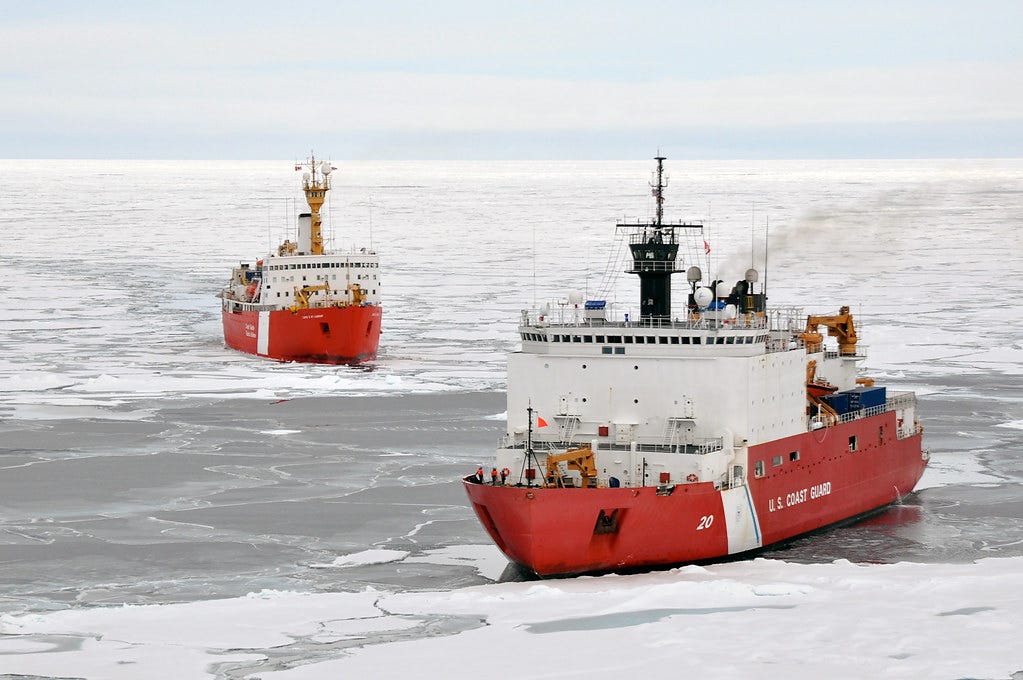
"Canadian Ship Louis S. St-Laurent and Coast Guard Cutter Healy in the Arctic Ocean" by DVIDSHUB is licensed under CC BY 2.0.
The Arctic is gaining geoeconomic relevance amid the US war in Iran and US-China trade tensions. These geopolitical disruptions have put global shipping, international energy markets, and critical raw materials at the center stage of global competition. The Arctic has the potential to contribute to solutions in all three areas. However, over the last several years, the Arctic has become increasingly contested in the security realm in the wake of Russia’s full-scale invasion of Ukraine. Moreover, the Trump administration’s approach, specifically its policy towards Greenland, has upset the region’s traditional geopolitical equilibrium. The region’s rising importance creates significant upside risks for businesses involved in the Arctic, as well as increasingly constrained global supply chains. On the other hand, the region’s geography and dynamics expose it to logistical difficulties, as well as geopolitical and reputational issues in the era of climate change.
In today’s full analysis:
Arctic Resources, Shipping Lanes, and Geoeconomic Competition
Security in the Arctic and Evolving Geopolitics
The Risk Environment

Global
Global military spending in 2025 rose by 2.9% despite the US scaling back spending on military aid. The new data-rich report by SIPRI found that the US remains the largest military spender, at $954 billion, with China coming in second at an estimated $336 billion and Russia third, at an estimated $190 billion. This is the 11th consecutive year of rising expenditures. The US military spending fell primarily due to a drop in assistance to Ukraine.
Nuclear states are modernizing and expanding their nuclear forces as arms control frameworks weaken. Of the nine nuclear powers (including Israel), most deployed new nuclear-armed or nuclear-capable weapon systems during 2025. Russia and the US together possess around 83% of all stockpiled nuclear warheads. China is expanding its nuclear arsenal faster than any other country and showcased several new nuclear systems during its 2025 military parade. Nuclear norms on arms control, disarmament, and non-proliferation are eroding. Russia deployed nuclear weapons to Belarusian territory, showing a lowering of the threshold for potential use. Arms control negotiations among the US, Russia, and China remain out of reach as the New START treaty between the US and Russia approaches expiration.
Great power competition and large-scale interstate wars are driving systemic disruptions in global security. Across all major world regions in 2025, there was a pattern of escalating armed conflict. Assessing global trends, the SIPRI analysts suggest that the norm against territorial conquest is under severe strain, with annexations and occupations in Ukraine, the Middle East, and the South China Sea. The retreat of multilateral peace frameworks, erosion of constraints on the use of force, and the resulting increase of conflict-related threats to human security are converging into an interlocking crisis.
Read More: Stockholm International Peace Research Institute, Deutsche Welle
Europe
Germany and France reportedly agreed to abandon plans to jointly build a European sixth-generation fighter jet, the so-called Future Air Combat System (FCAS). The cancellation is owed to disputes between German and French defense primes, which have disagreed on project leadership, workshare, design, maintenance rights, and export rights. The cancellation so far only concerns the fighter jet, which is the main dimension of FCAS, but Germany and France expressed some optimism that cooperation is still possible on the “nervous system” of FCAS, such as the collaborative drones, sensors, satellites, and a cloud system. Theoretically, a trans-European “system of systems” could be interoperable with separate jet designs, but cooperation will presumably run into the same hurdles as other joint projects.
Joint projects allow scalability and cost efficiency, but the end of FCAS is a bad omen for other potential collaborations. The EU’s defense industrial policy aims to promote joint ventures and joint procurement to unlock a continental scale of demand for defense items as opposed to fragmented national markets. However, disputes over who wins and who loses on trans-European projects make joint ventures difficult. Overcoming the impulse to benefit national champions—and duplicating different air systems—could be crucial to ramping up defense industrial production on a scale similar to the US, which seeks to prioritize its resources in the Indo-Pacific.
Read More: Politico, Breaking Defense, Chatham House
Middle East
The Houthis entered the US-Iran war this week with strikes on Israel and a Red Sea blockade. On Monday, following a weekend of renewed high-level strikes between Iran and Israel, the Iran-backed Houthis in Yemen announced that they would impose a full ban on Israeli ships operating in the Red Sea. The Houthis had until now mostly sat out the conflict.
The Houthis’ entry threatens significantly greater global energy disruption. The Houthis control the Bab al Mandeb Strait, a chokepoint between the Arabian Sea and the Red Sea (and, subsequently, the Suez Canal and Mediterranean). Ships that cannot transit the Bab al Mandeb must reroute around the southern tip of Africa to reach Europe from Middle Eastern or Asian waters, and vice versa. Although the Houthis announced an effective blockade only on Israeli shipping, fear of attack will likely dampen shipping activity in general. Saudi Arabia, which is partially avoiding the Hormuz closure by using overland pipelines to a Red Sea port, could see exports slashed yet again, and longer routes or higher insurance would add to costs across the board.
Renewed Houthi control of the Red Sea foreshadows a Middle East where both maritime chokepoints are controlled by American enemies. The Houthis were likely closely watching Tehran’s efforts to establish Iran’s sovereign claim and administrative control on the ground in the Strait of Hormuz. While the US has strenuously opposed this structure, other countries have reportedly already paid fees. The Houthis may now be applying a lesson in how to further impose leverage on the global economy and generate new funds.
Read More: New York Times [paywall], Los Angeles Times, Reuters [paywall], The Jerusalem Post
Asia-Pacific
The ASEAN Future Forum (AFF 2026) concluded in Hanoi, Vietnam, on Wednesday. The forum was the third of its kind, with 1,200 participants from ASEAN member states in attendance. Discussions among regional leaders covered topics including energy security, supply chains, conflict prevention, and artificial intelligence. The “Made by ASEAN” strategy that emerged from the meetings seeks to push Southeast Asia beyond its traditional manufacturing role to drive innovation and create value across global supply chains.
Business leaders from Cambodia and Vietnam’s private sectors met on the sidelines of the forum on Monday to discuss trade. Vietnam is Cambodia’s top trading partner within ASEAN. The two countries seek to increase bilateral trade to $20 billion annually. In the first few months of 2026, trade between the two countries was around $3.3 billion.
AFF2026 followed the 38th annual U.S.-ASEAN Dialogue on June 3, 2026, in Jakarta, Indonesia. The dialogue was co-chaired by Assistant Secretary of State for East Asian and Pacific Affairs Michael George DeSombre and Cambodian Ministry of Foreign Affairs Secretary of State Kung Phoak. They highlighted the shared economic and security goals between the US and ASEAN through the U.S.-ASEAN Comprehensive Strategic Partnership. Areas of expanding partnership include the digital economy, artificial intelligence, and emerging tech.
Read More: State Department, Asia News Network, Voice of Vietnam
Americas
Mexico is deploying close to 100,000 security personnel ahead of the World Cup tournament kick-off on Thursday. Personnel will be deployed to Mexico City, Guadalajara, and Monterrey, where matches will be played, as well as a number of other cities hosting teams and training centers. Guadalajara, in Jalisco state, saw widespread chaos in February after El Mencho, then-leader of the Jalisco New Generation Cartel, was killed by Mexican armed forces. The Iranian national team will be based in Tijuana for the tournament.
Mexico’s large-scale security strategy, named Plan Kukulkan, will be a high-profile test of the government’s security capabilities. The plan involves coordination with state and local agencies, as well as the United States and Canada. Security cooperation between the US and Mexico has been a point of tension in recent months after FBI agents were discovered to be operating in Chihuahua state without the knowledge of Mexico’s federal government. US President Donald Trump designated several Mexican cartels as foreign terrorist organizations in March. In May, Trump signed a new counterterrorism strategy identifying the elimination of cartels as a top priority.
Read more: CNN, The Economist, Yahoo
Geoeconomics
Canada and Mexico are pushing to renew USMCA for another 16 years. Canada formally requested renewal ahead of the July 1 deadline, with Trade Minister Dominic LeBlanc calling the pact “highly beneficial” while also saying talks on US sectoral tariffs will be essential. Mexico has also backed extension, but negotiations are uneven: Washington has already engaged Mexico, while formal talks with Canada have lagged after a year of tariff retaliation, political friction, and Trump’s renewed “51st state” rhetoric. If the three countries do not agree to extend the pact by July 1, which is highly likely, USMCA shifts into annual renewal reviews until 2036.
The central US demand is a harder North American industrial bloc, especially in autos. Washington is pushing Mexico to source more car parts, including electronics often imported from China, inside North America for vehicles to qualify for duty-free treatment. It also wants to raise the regional-content requirement from 75% to more than 80% and require as much as 50% US-made content per vehicle.
Canada’s negotiating position is difficult. Mark Carney has tried to reduce dependence on the US by building trade ties with Asia, Europe, and other middle powers, but Canada’s biggest attraction to foreign investors remains access to the US market through USMCA. More than 85% of Canada-US bilateral trade remains tariff-free, the US still accounts for nearly 70% of Canadian exports, and automakers such as Toyota and Honda have heavily lobbied Ottawa to preserve USMCA because they rely on integrated North American production. As a result, Canada has pivoted from defiance to US demands to a “Fortress North America” approach, championed on Monday in DC by Ontario Premier Doug Ford, which would use USMCA to build a secure regional industrial bloc that reduces reliance on China and protects shared supply chains.
Read More: Financial Times [paywall], BBC, Reuters [paywall], Congressional Research Service, Center for Strategic and International Studies
Energy
Investment in green energy technology is outpacing traditional energy sources even as traditional energy continues to provide more output. The International Energy Agency’s (IEA) World Energy Investment 2026 report shows double the investment in green energy tech than in traditional energy sources. In total, green energy investment is projected to reach $2.2 trillion. However, traditional energy sources still supply approximately 80% of all global energy consumption, including electricity, heating, industry usage, and transportation. Investment in green technology has been running higher than traditional energy sources for around a decade, but the gap in investment has widened significantly since 2020 due to rapidly climbing investment in green energy.
There is a growing demand globally for accelerating the energy transition towards electrification and away from traditional energy imports. According to polling by YouGov, almost 65% of Europeans from five countries (Spain, Germany, Italy, France, and Poland) believe that reducing dependencies on traditional energy imports will make Europe more secure. Moreover, this view cuts across political divides. Renewables are also overtaking traditional energy sources in Africa as the continent shifts towards solar and wind power, as well as battery storage capacity. One example of this is an agreement between China and Zambia, signed in early May, to build three separate 300-megawatt energy projects. Africa is seeing rising industrial demand for energy, and the war in Iran has complicated imports due to rising prices.
Read More: Forbes, E3G, ABC News, International Energy Agency, Center for Strategic and International Studies
Transnational Crime and Corruption
Illicit drug manufacturers in Europe are using new technologies to design more potent and less detectable synthetic drugs. The European Union Drugs Agency (EUDA) warned in its new European Drug Report that criminal groups are harnessing AI-enabled pharmaceutical technologies to manufacture an increasing variety of “designer drugs” and precursors. Negative health outcomes, treatments, and detection strategies are less understood for these new illicit compounds. Traffickers are also using increasingly complex chemical processes to conceal drugs, including by concealing and extracting cocaine “dissolved” in imported plastics.
EU authorities are faced with sophisticated transnational trafficking networks. Production of cocaine and intermediary products in South America is at an all-time high. Most of this cocaine is shipped to Europe through trafficking networks managed by individuals from the Netherlands, the Philippines, Suriname, and West Africa. To avoid discovery by customs officials, drug-carrying merchant ships traveling from West Africa increasingly conduct at-sea drop-offs to power boats off the coast of Southern Europe, which then land on remote beaches or unmonitored docks. Despite continued significant seizures by European port authorities, cocaine prices in Europe trend lower each year due to increasing supplies.
Read More: Financial Times [paywall], European Union Drugs Agency, Global Initiative against Transnational Organized Crime


Contact Us
Karl Hopkins
Partner
+1 202 429 6499
khopkins@steptoe.com
Melissa B. Mahle
Senior Advisor
+1 202 261 0577
mmahle@steptoe.com
Anni Coonan
Senior Intelligence Analyst
+1 212 506 3979
acoonan@steptoe.com
Samuel Bloebaum
Senior Due Diligence Analyst
+1 602 410 6240
sbloebaum@steptoe.com
Zayna Dembinski
Analyst
+1 202 778 3567
zdembinski@steptoe.com
Thomas Goldstein
Analyst
+1 202 862 6735
tgoldstein@steptoe.com
Ian Cameron
Analyst
+1 202 327 6908
icameron@steptoe.com
Elton Smole
Analyst
+1 202 261 0556
esmole@steptoe.com
Carter Spahn
Intelligence Fellow
+1 202 261 7555
cspahn@steptoe.com
Chris Dantes
Intelligence Fellow
+1 202 327 6904
cdantes@steptoe.com
Legal disclaimer: This Substack is for educational and informational purposes only and does not constitute the rendering of legal counseling or other professional services. Reading, subscribing to, or communicating through this Substack does not create an attorney-client relationship. Do not send confidential information through this platform. Consult qualified legal counsel regarding your specific circumstances.