


Welcome to the Stepwise Risk Outlook, which highlights and contextualizes over-the-horizon developments in key regions of the world and industries of the global market. Today’s featured deep dive by Elton Smole examines Brazil’s “Banco Master” bank fraud scandal.

“Banco Master” Bank Fraud Scandal Upends Brazilian Politics Ahead of Elections
By Elton Smole
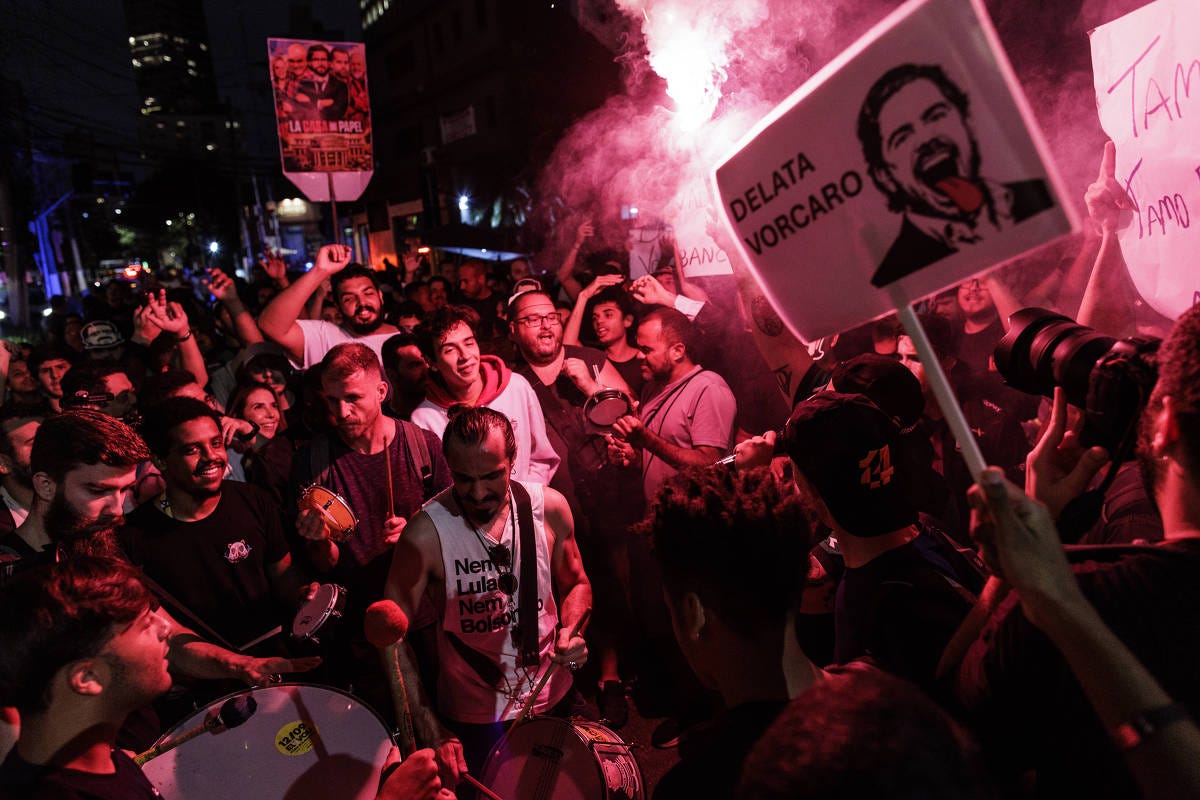
"Protestos contra o Banco Master" by Ópólitískur heimspekingur is licensed under CC BY-SA 4.0.
Brazil is embroiled in its most significant fraud investigation since the 2014 Lava Jato probe, following the largest bank fraud in the country’s history. The current crisis has upended the 2026 presidential race, boosting support for incumbent President Luiz Inácio Lula da Silva (Lula) and throwing a wrench in the campaign of Flávio Bolsonaro, the son of former President Jair Bolsonaro. Lula, who was previously jailed in the aftermath of Lava Jato, is running for his fourth term in office. Flávio Bolsonaro is running in lieu of his father, who is currently serving a prison sentence following a 2023 coup attempt.
The fraud scandal began with the liquidation of Banco Master after Brazil’s Central Bank blocked its acquisition. A subsequent investigation by the Federal Police has ensnared two supreme court justices, a senator, a former governor, bank regulators, and more recently, Flávio Bolsonaro himself. While powerful figures on both sides of the political spectrum have been implicated, the investigation is increasingly exposing ties between the former head of Banco Master, Daniel Vorcaro, and the Bolsonaros’ allies. As the investigation continues to expose corruption across the Brazilian establishment, emerging risks include institutional instability amid regulatory overhauls, financial volatility, political uncertainty in a key election year, and ripple effects across multiple economic sectors.
In today’s full analysis:
Operation Compliance Zero
Bolsonaro and the Dark Horse Leak
Political Implications and Risks

Global
G7 meeting of world economic powers strikes notes of tactical cooperation. US President Trump arrived triumphant with a ceasefire deal with Iran in hand, but details remain scant. The other members of the G7 praised the prospect of ending the conflict and reopening the Strait of Hormuz. A statement issued by France, the UK, Germany, Japan and Italy, later joined by Canada, expressed commitment to support the reopening of the waterway and proposed a “strictly defense and independent mission” to reassure commercial shipping and conduct mine clearance operations. French President Macron brokered a meeting with President Trump and Ukrainian President Zelensky, with Trump agreeing to discuss additional military support for air defense needs. The G7 agreed to increase economic pressure on Russia, with Trump reportedly considering the US could let lapse the waiver on Russian oil sanctions.
While the pundits praised the tone, all eyes are watching actions to implement policy statements. The ceasefire agreement is set to be signed on Friday. There is deep skepticism that the ceasefire agreement will translate into a sustainable agreement between the US and Iran. Trump is already backpedaling, saying the ceasefire agreement is not final, and that he could resume a bombing campaign if he does not like it. Israeli forces have carried out new strikes in southern Lebanon, despite US pressure to stop and Iran’s warning that the strikes are viewed as a violation of the interim agreement with Iran. On Ukraine, President Trump has also clouded policy intentions and distanced the US from peace efforts, saying Ukraine was not a US priority. The temporary US sanctions waiver on certain Russian seaborne oil and petroleum products expires today.
Europe
Momentum is emerging for new G7 sanctions against Russia. On Sunday, the UK interdicted the Russian shadow fleet vessel Smyrtos in the English Channel, and followed up on Tuesday with a new sanctions package targeting Yandex Bank, 20 new oil tankers, and LNG vessels, including those linked to Russia’s Arctic LNG 2 project. The LNG maritime transport ban partially converges with the EU’s maritime services ban, which will not be enforced until the rest of the G7 agrees to similar measures. The UK continues to exempt the maritime transport of Russian diesel and jet fuel, which are the tightest shortages facing Europe amid the crunch caused by the Iran war. As potential retaliation for the ship interdiction, reports indicate that a Russian warship fired warning shots over an English yacht on Tuesday.
At a G7 press conference, President Trump stated that the US could be “in a position” to enforce Russian sanctions once the Iran war is resolved. Trump reiterated that US sanctions exemptions on Russian fuel are intended to stabilize market supply, but oil prices are falling again now that a phased peace plan appears to have been struck. Reinforced US sanctions could pressure Russia to revisit talks, which the E3 seek to accelerate in coordination with the US. Putin’s presidential aide, Yury Ushakov, suggested that Steve Witkoff and Jared Kushner are slated to visit Moscow soon, without specifying a date.
The EU is finalizing its 21st Russia sanctions package. The original draft targets a network of nearly 90 Russian banks and 11 crypto platforms utilized to circumvent existing EU sanctions. The package will also cement the price cap on seaborne crude at $44.10 per barrel.
Read More: Politico, Politico, Reuters [paywall], Financial Times [paywall]
Middle East
Hizballah said that it believes Iran would not sign a nuclear deal if Israel stays in Lebanon. The proposed ceasefire – set to be signed in Switzerland on Friday – reportedly contains language that would compel an end to fighting in southern Lebanon, where Israel has expanded its operations against Hizballah in the last several months. Iran has repeatedly fought to include the Lebanese front in ceasefires in a bid to protect one of its most powerful remaining proxies.
There are real worries that Israel could act as a spoiler in the US-Iran deal. Israel has resisted US and Iranian efforts to tie an end to fighting in Lebanon to a broader ceasefire, chafing at the prospect of submitting to a deal that Jerusalem did not negotiate and seeing continued fighting against Hizballah as an existential concern. Israeli reluctance to submit to the terms of the ceasefire creates a real risk of scuttling the deal altogether.
Proponents of the deal are betting that the US and Iran both want the Strait of Hormuz open enough to weather the continuation of low-level Israeli-Hizballah conflict. This option could see Israel continuing preemptive strikes on Hizballah and maintaining its on-the-ground troop presence in southern Lebanon, similar to violence levels stipulated by past (now ostensibly lapsed) ceasefire agreements. But that option will require Israeli moderation and Iranian tolerance. The former could be tested by electoral politics as Israel approaches polls and the latter by frustration over nuclear negotiations.
Read More: Reuters [paywall], BBC, NPR, Wall Street Journal [paywall]
Asia-Pacific
Sri Lanka is facing a rapid increase in transnational cybercrime operations. A crackdown on scam centers in Southeast Asia has pushed criminal networks to relocate. Cambodia and Myanmar have recently been home to large-scale fraud factories, but Sri Lanka’s limited regulations have made it a new hub for global scam operations. These kinds of operations cost Americans $10 billion in 2024, including romance scams, crypto fraud, online gambling, and promoting fake companies to potential investors. Scam centers often staff their operations through trafficking or coercion and engage in extensive money laundering.
Sri Lankan police have carried out more than a dozen raids on scam centers this year, arresting over 1,000 alleged perpetrators. A raid last week in the capital Colombo resulted in the arrests of 18 Chinese nationals and one national of Laos. Investigators uncovered passports and fake documents, including forged legal certifications, company registrations, and US Treasury documents. Scamming at scale is one of the world’s fastest-growing industries, and Sri Lanka has become an appealing location for these operations due to its lenient visa process, available building space, telecommunications networks, and informal money transfer systems.
Read More: The Guardian, Bloomberg [paywall], The Diplomat
Americas
UN Secretary-General António Guterres visited Haiti on Tuesday. The security situation in the island nation has continued to deteriorate, with 2,300 killed so far this year, 100 kidnapped, and 1.5 million displaced. Guterres visited the headquarters of a new gang-suppression force, approved last September to replace the UN-backed mission led by Kenyan police. The new force is due to start operations in the coming weeks with troops from Jamaica, Chad, El Salvador and Guatemala.
A top Haitian security official was kidnapped last week in Port-au-Prince in the country’s latest escalation of violence. James Boyard was recently chosen as the Minister of Defense’s chief of staff before his abduction. His wife and 6-year-old daughter, a US citizen, were also abducted. Haitian police believe the Ti Bwa gang is responsible. The gang is led by Christ-Roi Chéry, who is known as Chrisla. At least 647 people were kidnapped in Haiti last year. Ti Bwa is one of many armed gangs exerting control over Haiti. Gangs control up to 90% of the capital, Port-au-Prince, with the Viv Ansanm gang federation controlling around 70%.
Guterres met with Prime Minister Alix Didier Fils-Aimé, who took power in February with the backing of the United States. Fils-Aimé is under pressure to hold elections this year. Haiti hasn’t had a president since Jovenel Moïse was killed in 2021. The country has not held elections since 2016. Fils-Aimé told Guterres that the transitional government is prioritizing security to make elections possible, with the support of the international gang-suppression force.
Read More: New York Times [paywall], AP, UN News
Africa
Somaliland President Abdirahman Mohamed Abdullahi made his first official visit to Israel. Israel became the first country to formally recognize Somaliland’s independence in December 2025, drawing significant backlash from Somalia and the African Union. Israel committed to expanding economic cooperation in agriculture, water management, and energy. Despite speculation Somaliland would host an Israeli military base, its defense minister stated no such discussions have taken place, though Israel pledged to help train Somaliland’s military and police forces.
The visit underscores Somaliland’s growing geopolitical importance to regional powers. Situated along the Gulf of Aden, Somaliland offers strategic access to key Red Sea shipping routes through its Port of Berbera. For Israel, closer ties with Somaliland strengthen its ability to monitor Houthi activity and counter attacks from the group. Somaliland’s location has also attracted the attention of other regional actors such as Ethiopia, which has sought greater access to the Red Sea to support its economic and strategic interests.
Read More: The Jerusalem Post, Reuters [paywall], The Conversation, Atlantic Council
Geoeconomics
The European Parliament approved the EU’s side of the Turnberry trade deal on Tuesday, clearing the last major legislative hurdle to implementing a fragile tariff truce with the United States. The legislation cuts duties on many US goods, including most industrial imports, and extends duty-free treatment for certain US lobster imports. In return, the United States is expected to implement a 15% tariff rate on most EU goods by July 24. The vote should allow Brussels to meet President Trump’s July 4 deadline after he threatened “much higher” tariffs if the EU failed to act.
The deal remains asymmetric. The EU is lowering its own barriers while accepting a broad US 15% tariff wall, a concession Brussels appears willing to make to avoid a worse escalation. The legislation also expires at the end of 2029, right after President Trump leaves office, and includes safeguards allowing the European Commission to suspend concessions if Washington breaches the Turnberry terms. Those protections could be triggered in the future, as President Trump threatened 100% tariffs on French wine unless Paris drops its digital tax.
The vote passed with support from the Parliament’s centrist groups, including the center-right European People’s Party, the center-left Socialists and Democrats (S&D), and the liberal Renew Europe coalition, which argued that approving the deal was necessary to avoid a damaging tariff escalation with the US. S&D was the key group behind the new safeguards. Opposition to the deal came primarily from parties on the nationalist right and parts of the left, which criticized the agreement as too one-sided.
Read More: New York Times [paywall], European Parliament, European Council on Foreign Relations
Disruptive Technology
The UK announced it will implement a social media ban for children under the age of 16, emulating a recent policy from Australia implemented in December 2025. The ban, slated for Spring 2027, will also include live streaming, stranger communication in online video games, and some AI chatbots. A social media curfew restricting under–18s from doomscrolling late at night is also being considered. Proponents of the social media ban argue that children need more time to be young before exposure to addictive platforms rife with potential online abuse. Opponents, including Reform UK, point out that the ban must be accompanied with stronger age verification measures and data collection, which may not prevent social media access due to widespread adoption of VPNs.
Social media bans are gaining momentum globally. According to a YouGov poll, about three-quarters of Britons support the idea of a social media ban for under–16s. Malaysia has enforced its own version of the ban this month, and Greece is expected to pass an under–15s ban this summer. In Australia, about 70% of children who had social media accounts before the ban have found ways to use prohibited social media, such as through VPNs, but Australia envisions the ban to have greater compliance in the next generation. The US is not seriously considering a similar social media ban but places extra safeguards on the data collection of under–13s.
Read More: Ars Technica, WIRED, The New York Times [paywall]
Energy
Oil prices have been in a steady decline since the announcement of a US-Iran agreement to open the Strait of Hormuz. Oil prices moved downwards to their lowest level in three months on June 16, with Brent settling at just under $79 a barrel. On February 27, a day before the US war with Iran began, Brent had closed at $72.48 a barrel. The expectation that the Strait of Hormuz will soon reopen, and the news that Iran will be able to sell its oil immediately upon signing the deal with the US, have been the primary factors pushing oil prices down. However, concerns about the Chinese economy, global inflationary pressures, and trends in interest rates have also all helped to lower oil prices.
Despite optimism from the US-Iran deal, energy markets will take time to recover from the effects of the war. The damage to energy infrastructure across the Gulf region is significant, already totaling up to almost $60 billion dollars by mid-April, with more than 80 energy facilities suffering damage. Likewise, the Strait of Hormuz remains dangerous due to mines placed across the waterway by Iran, and demining will need to occur. Moreover, shipping companies will not immediately return to their normal usage of the Strait of Hormuz given the provisional nature of the US-Iran agreement and the desire to ensure that political agreement translates into changes in the on-the-ground situation in the strait.
Some issues still must be resolved regarding the future of the Strait of Hormuz. Tehran reportedly wants to continue charging some kind of fee for transit through the strait after sixty days. The strait’s governance will likely be a key factor in how shipping recovers in the area over the next several months.
Read More: Reuters [paywall], Wall Street Journal [paywall], CNBC, CNBC, Axios [paywall], Frankfurter Allgemeine Zeitung, Atlantic Council
Transnational Crime and Corruption
Russia- and Iran-linked actors have used social media to recruit local saboteurs to carry out attacks across Europe. Individuals, most often teenage boys, are contacted anonymously on Telegram, Discord, or video game chat features and offered money to conduct espionage or sabotage operations where they live. The young proxies, identified in Ukraine, Poland, the UK, and the Netherlands, have carried out arson attacks and stabbings and installed spying devices targeting exile dissident organizations. One UK-based sabotage network was directed by Russia-based actors to spray-paint Islamophobic graffiti and set fire to a car and two properties linked to Prime Minister Kier Starmer.
European intelligence agencies assess that the trend may be a new hybrid warfare strategy for the governments of Iran and Russia. The anonymous recruiters often pose as political activists or independent Islamist groups, leaving little definitive evidence on whether the attacks are state-directed. Meanwhile, the teenage saboteurs themselves often have limited ideological motivations, awareness of who they are targeting, or understanding of the gravity of their actions.
Read More: Financial Times [paywall], Financial Times [paywall], Reuters [paywall]


Contact Us
Karl Hopkins
Partner
+1 202 429 6499
khopkins@steptoe.com
Melissa B. Mahle
Senior Advisor
+1 202 261 0577
mmahle@steptoe.com
Anni Coonan
Senior Intelligence Analyst
+1 212 506 3979
acoonan@steptoe.com
Samuel Bloebaum
Senior Due Diligence Analyst
+1 602 410 6240
sbloebaum@steptoe.com
Zayna Dembinski
Analyst
+1 202 778 3567
zdembinski@steptoe.com
Thomas Goldstein
Analyst
+1 202 862 6735
tgoldstein@steptoe.com
Ian Cameron
Analyst
+1 202 327 6908
icameron@steptoe.com
Elton Smole
Analyst
+1 202 261 0556
esmole@steptoe.com
Carter Spahn
Intelligence Fellow
+1 202 261 7555
cspahn@steptoe.com
Chris Dantes
Intelligence Fellow
+1 202 327 6904
cdantes@steptoe.com
Legal disclaimer: This Substack is for educational and informational purposes only and does not constitute the rendering of legal counseling or other professional services. Reading, subscribing to, or communicating through this Substack does not create an attorney-client relationship. Do not send confidential information through this platform. Consult qualified legal counsel regarding your specific circumstances.