

Welcome to the Stepwise Risk Outlook, which highlights and contextualizes over-the-horizon developments in key regions of the world and industries of the global market. Today’s featured deep dive by Anni Coonan examines potential obstacles to the Iran deal.

What Could Block the Iran Deal
By Anni Coonan
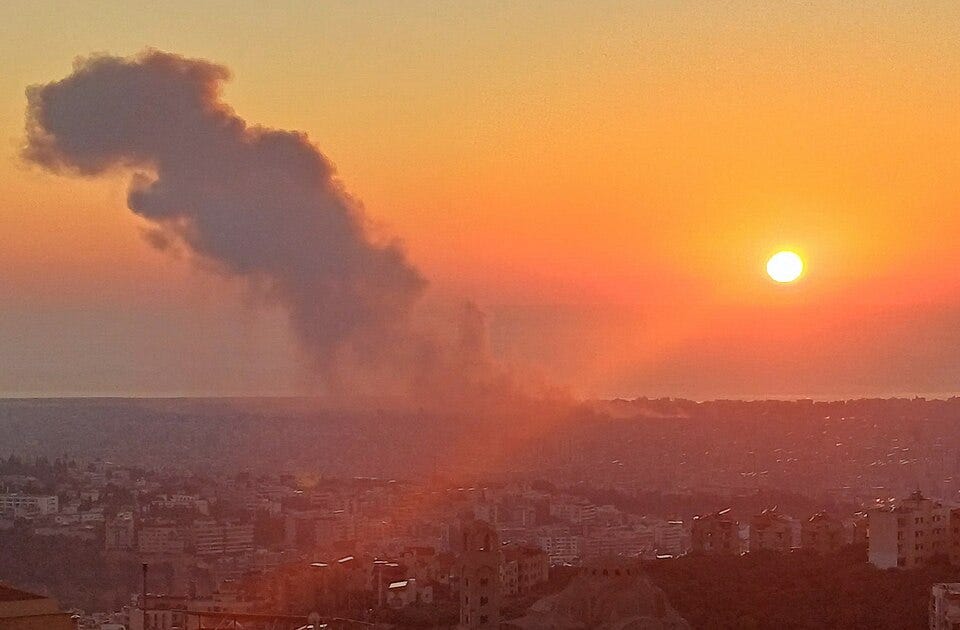
“Hezbollah Headquarter Airstrike 2024“ by Jimmyp84 is marked with CC0 1.0.
US-Iran negotiations started off rocky this week in Switzerland. Iranian negotiators ended Sunday talks early over American threats to resume bombing if a deal is not reached. The walkout followed days of Israeli strikes on Lebanon and Iran’s declared closure of the Strait of Hormuz (although ships continued to transit the waterway). Nonetheless, Pakistani and Qatari mediators expressed optimism following the second day of talks, and some concrete progress was announced. Both the US and Iran, plus energy importers and Gulf countries, deeply want a durable deal and are clearly committed to substantive negotiations. If a deal is not reached, it will likely be disagreements over the conflict in Lebanon or misalignment on the scope of restrictions on Iran’s nuclear program that scuttle it. Markets are holding steady on optimism around the new talks, but the hurdles are significant. A failure to come to a deal will put a stop to sanctions relief and $300 billion in development projects, not to mention risking the re-closure of the Strait of Hormuz and renewed global economic disruption.
In today’s full analysis:
The Lebanon Issue
Nuclear Particulars
The Spoilers that Weren’t: Hormuz, Missiles, and Proxies

Global
Unwinding Iran sanctions will be a complex process, politically and technically. The US partially lifted Iran oil sanctions on Monday, enabling Iranian oil exports. The 60-day general license covers crude oil, petrochemical products of Iranian origin and permits dollar-denominated trade, related banking and insurance services. Extension of the 60-day period depends upon successful progress of current negotiations between the US and Iran, as well as Iran’s strict compliance with the terms of the ceasefire agreement. Adherence to the ceasefire by all parties has been rocky thus far, but the agreement remains in force.
Moving beyond waivers, actual unwinding of the laws, executive orders and international sanctions and embargos will be complex and not all at once. Since the 1970s, US sanctions on Iran have been imposed under a variety of authorities and programs, related to its nuclear program, human rights and support for terrorist groups. Some can be lifted or amended by Executive Order, while others will require acts of Congress. There are 14 key active Executive Orders specific to Iran and at least nine statutes. The White House does not currently enjoy a consensus that supports the terms of the Iran MOU, and snap-back provisions are likely to be part of the political debate. Businesses will have good reasons to view transactions with Iran as high risk, with the evolving legal landscape, requirements for due diligence in a historically non-transparent business environment and exposure to sanctions-evasion risks on remaining sanctions.
Lifting of Syria sanctions can serve as a reference, as they too were complex with international dimensions. The US and EU started easing sanctions in January 2025, with the UN Security Council lifting terrorism-related sanctions on the new transitional leadership in November and the US repeated the Caesar Act in December 2025, the cornerstone of American secondary sanctions. While removal of Syrian sanctions enjoyed broad international political consensus, many international financial institutions remain reluctant to deal with Syria, 18 months after the fall of the Assad regime. Businesses must still navigate complex export controls and licensing requirements as some sanctions targeting former regime leaders remain in place.
Read More: Reuters [paywall], US Department of Treasury, US Department of Treasury, Harvard University
Europe
A conflict over historical memory from the Second World War is opening a rift between Warsaw and Kyiv. Polish President Karol Nawrocki announced the intention to revoke Poland’s highest state award from Ukrainian President Volodymyr Zelensky following a decision in Kyiv to name a military unit after the Ukrainian Insurgent Army (UPA), a military group from the 20th century that fought for Ukrainian independence from Russia. While in Ukraine the UPA evokes a long history of resistance to Moscow, Poland considers the UPA as a terrorist organization that killed thousands of Polish citizens and worked with Nazi Germany. The dispute has triggered internal conflict between Nawrocki and Polish Prime Minister Donald Tusk, who are from rival parties, and the conflict has also escalated, with Zelensky opting to skip the Ukraine Recovery Conference, which is taking place in Gdansk on June 25 and 26.
The dispute threatens to undermine a close partnership grounded in shared security concerns towards Moscow. Warsaw has been one of Ukraine’s staunchest supporters since Russia’s full-scale invasion, and Poland has served as the logistical hub for much of the military support from the US and from European partners that has gone to Ukraine. Poland has also accepted millions of Ukrainian refugees since 2022 and provided significant military and financial support to Ukraine.
This is not the first time that Ukraine and Poland have feuded since 2022, though. In 2023, the former government of Poland, which was led by the populist party Law and Justice (PiS), blocked imports of Ukrainian grain from entering the country under pressure from Poland’s agriculture sector. Nawrocki has also cast doubt on Kyiv’s prospects to join the EU and NATO. Polish public opinion has also taken a more negative turn towards Ukraine, which the conflict over the UPA will likely exacerbate.
Read More: New York Times [paywall], Kyiv Independent, Kyiv Independent, Politico EU, AP, Ukrainska Pravda
Middle East
Syria has made no progress integrating Sweida nearly a year after deadly sectarian violence. In a new report, a UN investigation confirmed that more than 1,700 in the southern province of Sweida – mostly Druze civilians – were killed, and that Syrian government forces, tribal fighters and Druze groups may have committed war crimes. Most concerningly, it assesses that no progress has been made on the implementation of the September 2025 roadmap for confidence-building and reintegration in Sweida.
The report highlights Syria’s deep governance challenges and threats to its economic rebound. The government in Damascus, led by a member of the former Sunni group Hayat Tahrir al-Sham, has struggled to build confidence domestically and abroad in its ability to ensure security throughout the country and to integrate Syria’s various minorities. Since taking power, Damascus has semi-successfully quelled various sectarian clashes and promised pathways to representation in the army and the government. Inability to make good on those promises threatens renewed clashes (instability the region can ill afford) and a stop to significant foreign aid and investment, a crucial lifeline for Syria’s future.
Read More: Reuters [paywall], Brookings Institution, Center for Strategic and International Studies
Asia-Pacific
New Delhi hosted the 16th BRICS National Security Advisors’ meeting on Monday and Tuesday. BRICS, which represents nearly half the global population and around 40% of the world’s GDP by purchasing power parity, is increasingly focused on security cooperation. Chinese Foreign Minister Wang Yi was in attendance, holding bilateral talks with a number of foreign officials on the sidelines of the gathering. These included India’s National Security Advisor Ajit Doval, Deputy Secretary of Iran’s Supreme National Security Council Qadir Nizamipour and South Africa’s Minister in the Presidency Khumbudzo Ntshavheni. In his address to BRICS partner countries, Doval outlined a stronger role for the bloc to combat emerging threats, including cooperation on counter-terrorism, cybersecurity, maritime security, and fighting transnational crime. India is pushing for expanded intelligence sharing among member countries of the bloc.
Bilateral talks between Doval and Wang signaled progress toward a normalization of ties between India and China. India’s foreign ministry described the talks as “constructive and forward-looking,” and Wang called for the resumption of bilateral dialogue mechanisms. He also urged exchanges in trade, finance, law enforcement, and media. Relations between New Delhi and Beijing have been improving after a period of friction that started with a border clash in 2020. In a statement released through China’s foreign ministry, Wang called for proper handling of sensitive issues and mutual respect for the two nations’ core interests. Wang also described BRICS as a mechanism to advocate the promotion of multi-polarization amid a shifting geopolitical landscape.
Read More: Reuters [paywall], China Daily, India Today
Americas
Bolivian President Rodrigo Paz declared a state of emergency on Saturday after blockades paralyzed the country for weeks. Protestors opposing Paz, the country’s first right-wing leader after decades of leftist rule, included workers’ unions, farmers, and supporters of former President Evo Morales. Upon taking office, Paz sought to stabilize the country’s economy, cutting fuel subsidies to shrink the national deficit. Responding to the economic situation, protestors have called for Paz to resign and blocked key roads, exacerbating shortages of fuel, food, and medical supplies. The economy has been at a standstill for more than 50 days, business groups estimated more than $2 billion in losses, and at least 14 people have been killed in the unrest.
Under the state of emergency, Bolivia’s police began clearing roadblocks. Six officers of the Bolivian Air Force were killed on Sunday after a light aircraft crashed while patrolling a blocked highway. As more roadblocks are cleared, security forces are preparing to push into the Chapare region, where Morales has been refusing to appear in court since 2024. He is accused of financing the demonstrators to seek impunity from an investigation into alleged abuse of a minor during his presidency.
The US State Department released a statement on Tuesday describing the unrest as a “grave threat” to democracy in Bolivia. It stated that a “violent minority” seeks to disregard the will of Bolivians who recently elected Paz. Since taking office, Paz announced plans for a $1.5 billion economic cooperation deal with the US to supply fuel. The joint statement was released with other countries in the Latin America region, including Argentina, Bolivia, Canada, Chile, Costa Rica, Dominican Republic, Ecuador, El Salvador, Guyana, Honduras, Jamaica, Panama, Paraguay and Peru. Latin America is experiencing a historic shift to the right, with recent elections in Chile, Peru, and Colombia.
Read More: CNN, AP, Reuters [paywall], Bloomberg [paywall]
Africa
The US and Kenya are close to finalizing a critical minerals cooperation agreement. The framework includes the development of several untapped deposits, including copper, graphite, lithium and nickel mines. Most notably, the US secured a preliminary deal to develop Mrima Hill, a niobium mine valued at $62.4 billion. President William Ruto stated that local processing would occur domestically, in line with a trend across African countries to capture more domestic value from the mining sector.
The agreement strengthens the US position in the competition for critical minerals. Mrima Hill was a highly contested project between American, Chinese and Australian companies. If finalized, the deal would advance US efforts to diversify its critical mineral supply chains. At the same time, Chinese companies remain deeply entrenched across the continent’s mineral-rich nations, such as the DRC. As competition between the US and China intensifies, Kenya’s mineral sector is likely to become an increasingly important arena for geopolitical influence and investment competition.
Read More: Semafor Africa, Business Insider Africa, Ecofin Agency
Geoeconomics
US manufacturing jobs are now weakening sharply, even as the administration continues to promise a manufacturing revival. S&P Global’s June flash PMI showed factory employment falling at the fastest monthly pace since May 2020, when the pandemic shut down large parts of the industrial economy. The employment index dropped from 51.6 in May to 47 in June, moving from expansion into contraction. US factory employment has fallen by 77,000 jobs, and private manufacturing construction spending has fallen to $15.2 billion, down about 16%, since President Trump’s second term began, undercutting the White House’s argument that tariffs and industrial policy are quickly rebuilding the blue-collar workforce.
Manufacturing output is still growing, but part of that expansion reflects companies pulling forward production because they fear future supply disruptions and price increases tied to the Iran war. At the same time, firms are dealing with rising raw-material costs, shifting tariff policy, and uncertainty over whether recent demand can last. Factory job cuts are running at the highest pace since 2009 if the pandemic is excluded, and about one-fifth of surveyed executives said they were still struggling to find workers willing or able to work in factories.
The labor constraint makes the manufacturing slowdown harder to reverse. In manufacturing, foreign-born workers made up 19.2% of durable-goods workers and 22.3% of nondurable-goods workers in 2024. If this administration’s immigration restrictions reduce the available labor pool, tariffs and industrial policy may raise demand for domestic production without creating the workforce needed to meet it. The counterpoint to that argument is that productivity could improve because automation and AI will allow individual workers to produce more, filling the gap.
Read More: Financial Times [paywall], Manufacturers Alliance
Disruptive Technology
China has taken the lead on the most powerful supercomputer in the world with LineShine, which is based in Shenzhen’s National Computer Center. Using only standard computer processing units (CPUs), the computer exceeded 2.19 exaflops in the High Performance Linpack benchmark. In other words, it has the ability to solve 2.2 quintillion calculations per second, more than any other supercomputer right now. The LineShine computer is also more efficient than the runner up, El Capitan, which is based in the US’ Lawrence Livermore National Laboratory. LineShine achieved a speed of 52.07 Gigaflops/Watt, while El Capitan operates at 60.94 Gigaflops/Watt.
LineShine’s non-reliance on CPUs instead of graphics processing units (GPUs) suggests there is a diversity of architectures in developing powerful supercomputers. China has reentered the supercomputer “top 10” for the first time in 2017 by designing around efficiency. The use of CPUs means that China can unlock vast reserves of compute despite not having access to frontier American GPUs, like the type of semiconductors produced by Nvidia, which can do multiple tasks at the same time. Instead, LineShine uses specialized circuitry in its CPUs to accelerate separate computing tasks and thereby achieve a similar outcome to GPUs. The creator of these types of powerful CPUs is based in the UK and not subject to American export controls, and China is likely now capable of advancing this type of technology independently.
Read More: yahoo!tech, Top500, The New York Times [paywall]
Energy
China is reportedly preparing a second LNG import terminal to increase its shipments from Russia. The Longkou terminal, which is located in the Shandong province, will serve cargoes from Russia’s heavily sanctioned Arctic LNG 2 plant. Currently, China imports LNG from the Russian project through the Beihai terminal in Guangxi, and the new terminal will significantly expand China’s capacity to absorb exports from Arctic LNG 2, which is designed to produce almost 20 million metric tons annually. China is the only known importer of cargoes from Arctic LNG 2, with the first LNG shipment reaching China in August 2025, and since then, China has taken 2.6 million tons of LNG through the Beihai terminal.
Energy cooperation is a part of the larger Russia-China partnership and offers relief to Russia’s energy sector. Since Russia began its full-scale invasion of Ukraine, its gas business, which was concentrated in Europe, has suffered significantly. An increase in exports to China would provide major relief to the Arctic LNG 2 project, which stalled due to sanctions. In April, construction modules meant for Arctic LNG 2 left China, after having been trapped there for over 2 years due to sanctions on the project. However, there are also areas of disagreement in energy cooperation between Beijing and Moscow. During his most recent visit to China, Russian President Vladimir Putin failed to finalize an agreement on the Power of Siberia 2 gas pipeline, a priority energy project for the Kremlin that has been stuck for years over disagreements on pricing.
Read More: Reuters [paywall], High North News, Moscow Times, Carnegie Endowment for International Peace
Transnational Crime and Corruption
The years-long investigation into alleged foreign bribery of European Union officials produced a new EU-wide arrest warrant. Belgian authorities accused Greek member of parliament Dimitris Avrampopoulos, who was European Commissioner for Migration, Home Affairs and Citizenship from 2014 to 2019, of participating in a criminal organization that routed bribes from foreign nations to influence EU policymaking. Avrampopoulos was an honorary board member of the NGO Fight Impunity from 2021 to 2022, which allegedly organized influence operations funded by Qatar, Morocco and Mauritius. He denied any wrongdoing and promised to waive his parliamentary immunity.
The “Qatargate” scandal emerged after raids by Belgian authorities in 2022. The alleged leaders of the bribery operation, Pier Antonio Panzeri, Eva Kaili and Francesco Giorgi, face ongoing prosecutions for corruption, money laundering and participating in a criminal organization. In 2024, the EU established the European Ethics Body in the wake of the scandal, though it remains non-operational due to boycotts within the European Parliament.
Read More: Politico.EU, Atlantic Council, Transparency International


Contact Us
Karl Hopkins
Partner
+1 202 429 6499
khopkins@steptoe.com
Melissa B. Mahle
Senior Advisor
+1 202 261 0577
mmahle@steptoe.com
Anni Coonan
Senior Intelligence Analyst
+1 212 506 3979
acoonan@steptoe.com
Samuel Bloebaum
Senior Due Diligence Analyst
+1 602 410 6240
sbloebaum@steptoe.com
Zayna Dembinski
Analyst
+1 202 778 3567
zdembinski@steptoe.com
Thomas Goldstein
Analyst
+1 202 862 6735
tgoldstein@steptoe.com
Ian Cameron
Analyst
+1 202 327 6908
icameron@steptoe.com
Elton Smole
Analyst
+1 202 261 0556
esmole@steptoe.com
Carter Spahn
Intelligence Fellow
+1 202 261 7555
cspahn@steptoe.com
Chris Dantes
Intelligence Fellow
+1 202 327 6904
cdantes@steptoe.com
Legal disclaimer: This Substack is for educational and informational purposes only and does not constitute the rendering of legal counseling or other professional services. Reading, subscribing to, or communicating through this Substack does not create an attorney-client relationship. Do not send confidential information through this platform. Consult qualified legal counsel regarding your specific circumstances.