


Welcome to the Stepwise Risk Outlook, which highlights and contextualizes over-the-horizon developments in key regions of the world and industries of the global market. Today’s featured deep dive by Chris Dantes examines US diplomatic attempts to resolve Libya’s political crisis.

US Reengagement in Libya and the Prospects for Peace
By Chris Dantes
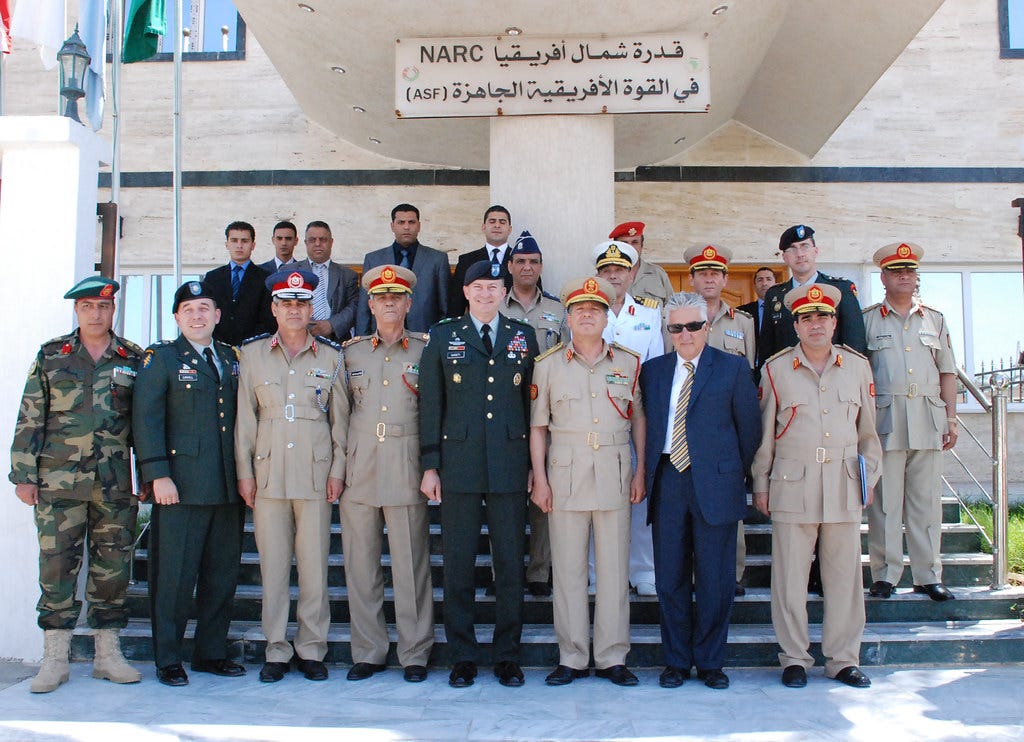
“LIBYA TRIP - Tripoli talks advance U.S. Army relationship with Libya land forces - MAY 2010“ by US Army Africa is licensed under CC BY 2.0.
Representatives from the US, Egypt, Saudi Arabia, and Türkiye met in Cairo last week to discuss proposals aimed at resolving Libya’s political crisis. The country’s energy sector has shown signs of recovery but remains vulnerable to persistent instability and corruption. Insecurity has facilitated the cross-border movement of terrorists and arms, exacerbating jihadist insurgencies across Africa. Against this backdrop, the US and regional powers have sought to broker peace between the rival governments in Tripoli and Tobruk. A successful power-sharing agreement could position Libya as a key energy producer and counterterrorism partner. But past peace initiatives unraveled as opposing factions, prioritizing their interests and emboldened by foreign backers, prolonged conflict. Failure to broker a lasting settlement could reverse recent gains in oil production and discourage foreign investment. Moreover, long-term instability could enable the expansion of the Islamic State.
In today’s full analysis:
US Interests and Peace Proposal, Explained
The Decline of Middle Power Competition
A Unified Libya is Possible, But Risks Remain

Global
China expands its tool kit for counter-sanctions measures, creating new risks for international businesses. Beijing lawmakers are reviewing a new law that will enable state prosecutors to file civil lawsuits against foreign organizations and persons who allegedly harm China’s interests. This law would be used as a countermeasure against foreign sanctions and trade restrictions. If passed, which is likely, foreigners in China, either residents or visitors, face increased risks of being denied permission to exit China, pending the resolution of litigation. Businesses face court orders to pay compensation and damages, as well as criminal penalties for compliance failure. Earlier this year, China adopted administrative measures adopting counter-measures against foreign entities discriminating against China’s industrial or supply chains (Decree 834) and a new regulatory regime enabling the government to take measures against foreign entities complying with coercive trade measures against China (Decree 835).
China’s build-out of its regulatory toolkit coincides with continued Western trade actions against China. The addition of Chinese national champions, such as Alibaba, to the US Department of War’s “Chinese Military Companies” list, aka 1260H list, has once again inflamed US-Sino trade tensions. The EU has launched multiple Foreign Subsidies Regulation investigations targeting Chinese investments, the most recent being the May 2026 investigations into JD.com’s proposed acquisition of a German retailer specializing in consumer electronics and home appliances. The G7 discussed Chinese trade policy, where participants warned against “China Shock 2.0,” a surge of highly subsidized Chinese exports.
Read More: Wall Street Journal [paywall], CNBC, European Union, World Economic Forum
Europe
European leaders gear up for the Ankara NATO summit from July 7-8. On Wednesday, Berlin hosted the leaders of NATO Europe’s five top militaries—Germany, France, Italy, the UK, and Poland—to define a common European position across a host of controversial issues before the NATO summit, such as mediating an end to the Russia-Ukraine war, assisting the Iran war offramp, and increasing European operational leadership of NATO. The “E5” will seek to replicate the relative success of the recent G7 summit in Evian-les-Bains, in which the US and Europe agreed in principle to extend sanctions on Russia. Simultaneously with the E5 gathering, NATO Secretary-General Mark Rutte visited the White House, where he argued that the Trump administration has unlocked NATO Europe’s military spending and largely utilized basing rights in Europe to support operations in Iran.
Last year’s summit at The Hague found consensus around the 5% GDP spending pledge, but the Ankara summit will face tougher questions on burden-shifting and doctrine. The US is pushing for a “NATO 3.0” strategy, in which the alliance adjusts its objectives as a deterrence-first and European-led organization. That means fewer out-of-area operations, peacekeeping, or exchanges with non-NATO partners. Last week, the US announced a six-month review of US forces in Europe, which followed reports of a planned drawdown of F-15 fighter jets and maritime reconnaissance aircraft reserved for NATO operations in Europe. The US is frustrated with NATO Europe after some allies, like Spain, restricted basing rights for US aircraft involved in Iran. Europe, meanwhile, is concerned about the US abandonment or renewed gestures toward annexing Greenland.
Read More: Politico, Associated Press, Stepwise Risk Outlook
Middle East
US Secretary of State Marco Rubio wrapped up a tour of the Arab Gulf, attempting to assuage anxieties about a deal with Iran. Rubio attended a meeting of the Gulf Cooperation Council in Bahrain, preceded by visits to the UAE and Kuwait (both heavily targeted during the war), with the message that the US is not going to undermine Gulf interests in a prospective deal. It is a tough sell: Gulf capitals’ primary concern, Iran’s proxies and missile and drone programs, are not on the negotiating agenda; they have the most to lose from a re-closure of the Strait, and they worry Iran will use the $300 billion development fund to modernize its military.
The visits come as Gulf states are adapting to the post-war regional order – potentially by reducing reliance on the US. Countries like Saudi Arabia are shifting spending away from ambitious megaprojects towards pipeline networks that bypass the Strait of Hormuz and upgrading military hardware and defense. The value of the American security umbrella, which puts targets on Arab countries, rather than protecting them, is being questioned. While some countries, like the UAE, are doubling down on the US, others are seeking their own détentes with Iran and seeking to reduce their military reliance on the US.
Read More: Reuters [paywall], Washington Post [paywall], New York Times [paywall], Arab Gulf States Institute
Asia-Pacific
MSCI has extended Indonesia’s downgrade review until November. In January, the index provider warned that it was considering downgrading the status of Indonesia’s equity market from “emerging” to “frontier.” The market has been grappling with a loss in investor confidence, and the prospect of a downgrade to “frontier” risked the prospect of a capital outflow in the billions. In the review process, MSCI is looking at Indonesian transparency reforms, investor concerns around opacity in shareholding structures, and suspicions of coordinated trading. This year, the rupiah is the worst-performing major currency in Asia, and Indonesia’s stock market has been the weakest in the region.
MSCI kept South Korea in the “emerging” market category in its decision on Tuesday. Seoul has been aiming for MSCI’s Developed Markets watchlist, a key step towards inclusion in the “developed” markets category. A key barrier for South Korea’s progress in the ranking has been the limited convertibility of the Korean won in offshore currency markets. While MSCI acknowledged some progress, investor concerns have not been fully addressed. On July 6, South Korea will open 24-hour trading in the dollar-won spot market.
Read More: CNBC, Wall Street Journal [paywall], Reuters [paywall]
Americas
Two devastating earthquakes struck Venezuela on Wednesday. The 7.2 and 7.5 magnitude quakes, which occurred in close succession, were the largest that the country has experienced in over a century. More than a day after the quakes, officials and civilians are still gauging the level of destruction that has occurred. The epicenter was about 100 miles west of Caracas, with heavy damage reported in the capital and the coastal city of La Guaira. Many residential buildings in Caracas have fully collapsed, and the search for survivors is ongoing.
Acting President Delcy Rodriguez has declared a state of emergency. In an announcement on state television, she announced that the airport in Caracas was closed, trains were not running, and school was cancelled for the next few days. As of Friday morning, the confirmed death toll is 589, with 2,980 injured. The death toll continues to rise, with the US Geological Survey estimating that fatalities could be in the thousands or tens of thousands. The Venezuelan government’s ability to respond to the disaster will be a defining factor of Rodriguez’s political future.
The United States has pledged to support Venezuela’s recovery efforts. The Department of State is deploying a regional Disaster Assistance Response Team (DART), along with search-and-rescue teams. Secretary of State Marco Rubio said in a statement on Thursday that the immediate focus was on locating survivors who remain buried under rubble. Countries from across the Latin American region and across the world have offered support and resources to aid Venezuela’s disaster response.
Read More: Reuters [paywall], AP, NBC, State Department
Africa
Al Qaeda militants launched attacks in Niger’s capital, reflecting a major deterioration in the capabilities of the AES. Fighters from al Qaeda affiliate Jama’at Nusrat al Islam wal Muslimin (JNIM) attacked the Diori Hamani International Airport, killing 11 soldiers and two civilians. The airport is a key target as it is co-located with Nigerien Air Base 101, the headquarters for the Alliance of Sahel States (AES) security organization.
Separately, the Islamic State Sahel Province (ISSP) conducted multiple sophisticated attacks against Nigerien military bases. Militants overran and looted two bases near the Mali-Niger border, killing approximately 85 soldiers. ISSP also claimed to have destroyed 22 vehicles and seized weapons caches. The attack highlights ISSP’s growing operational capabilities, strengthening its position in competition with its more dominant regional rival, JNIM.
JNIM and ISSP are escalating the scale and lethality of attacks to compete for influence across the Sahel. Mali, Niger, and Burkina Faso continue to be overwhelmed by JNIM and face an increasingly capable ISSP insurgency. Competition between the groups is likely to produce more frequent, complex, and strategically significant attacks, further challenging the AES members’ ability to secure major population centers and critical infrastructure.
Read More: Al Jazeera, Critical Threats
Geoeconomics
The second Pax Silica summit in Washington is concluding today with moderate success. Thirty-five countries signed a Joint Statement on AI Opportunity, aligning behind a pro-growth and pro-innovation approach to AI regulation while also committing to trusted supply chains and the infrastructure needed to power the next phase of AI deployment. The European Commission formally joined the initiative this week, and the Netherlands joined earlier, giving the effort more weight because Dutch participation brings ASML’s home government into the framework. Italy is also expected to join, with Foreign Minister Antonio Tajani and Secretary of State Marco Rubio expected to sign a memorandum of understanding after an earlier delay caused by a Trump-Meloni dispute over Iran.
The agenda is greater than chips. Pax Silica is designed to secure the full AI industrial stack, from energy and critical minerals to advanced manufacturing, semiconductor production, data infrastructure, and AI models. India used the summit to seek semiconductor investment and multilateral funding, including potential access to a US $250 million Pax Silica seed fund meant to support critical mineral extraction, processing, infrastructure, and manufacturing assets tied to trusted partners.
Pax Silica has become the Trump administration’s largest second-term effort at coalition building. The summit shows Washington understands it still needs large international cooperation to accomplish certain strategic goals, making Pax Silica important not just as a technology initiative, but as a test of whether the administration can translate “America First” diplomacy into a multilateral partnership.
Read More: Financial Times [paywall], Reuters [paywall], The National Interest
Disruptive Technology
A tight memory chip market is adding inflationary pressure across the tech world. Memory chips that transfer or store data are in high demand due to an AI-induced data center rollout. Demand for one type of memory—NAND, which saves information without power—is particularly increasing, but NAND demand is typically lower than DRAM, the standard type of memory chip. Building new fabs and production lines could take billions in investment and up to two or three years. In the meantime, memory chip producers are increasing margins to manage the current market. Price increases could reverberate across a range of goods, from smartphones, cloud computing, video game consoles, and cars. Bloomberg Economics notes that the average year-over-year price increase for memory kits was 237%, and that the peak price increase could be in February 2027.
A memory chip crunch could spur enthusiasm for extending interventionist policy on AI-enabling GPUs, like Nvidia’s chips. The trend in semiconductor regulations is to preserve a US advantage in computing, such as through export controls, subsidies, or capital investment to chip fabs, and the failed GAIN AI Act, which would have required American chip consumers to be prioritized over foreign buyers. Regulations modeled on prioritizing American demand could be revived in the memory chip domain if the memory chip price crunch increases pressure for intervention. Moreover, policymakers may become interested in derisking investment in memory chip production capacity, such as through equity stakes or subsidies. Nonetheless, intervention is also risky, given that the memory chip market is typically volatile and could cool.
Read More: Wall Street Journal [paywall], The Straits Times, Center for a New American Security
Energy
Iraq has reportedly considered exiting OPEC if it is not allowed to raise its oil production quota by the group. Baghdad is reliant on oil exports for the bulk of its income and has confronted a budget crisis due to the closure of the Strait of Hormuz. Although Baghdad would prefer to remain in OPEC with a higher quota, if that is not possible, Iraq will “consider all available options.” Iraq produced 1.48 million bpd in May, a drop from over 4 million in February before the beginning of the US war with Iran. Baghdad recently approved a plan to boost exports through the Kurdistan-Turkey pipeline to reduce reliance on the Strait of Hormuz. Iraq’s oil ministry has also denied any intention in Baghdad to leave OPEC.
OPEC+ is currently assessing members’ oil production capacity. OPEC+, an expanded group that includes members like Russia, will determine output baselines for 2027, which in turn inform the setting of quotas for members. While Iraq has often struggled to meet its quotas, a government spokesperson has said that the country is working to return to full capacity.
If Baghdad were to leave OPEC, it would be a major blow to the group. Iraq is a founding member of OPEC, which was founded in Baghdad in 1960, and Iraq is also OPEC’s second-largest producer. OPEC also suffered a hit to its membership earlier this year, when the UAE, OPEC’s third-biggest producer, exited the group. Abu Dhabi left the group to pursue its own strategy on investments and output. OPEC has already struggled with internal disunity and the rise of American oil output. Another major exit from OPEC would further weaken the oil-producing bloc’s ability to shape global energy markets.
Read More: Reuters [paywall], CNBC, Wall Street Journal [paywall], Atlantic Council
Transnational Crime and Corruption
Governments are increasingly targeting illicit gold mining, refining, and trafficking operations funding militants in South America and Africa. On Thursday, the US announced new sanctions on a Rwandan gold refinery accused of processing over 60kg of gold sourced from Congolese trafficking networks controlled by the Rwanda Defense Force and their local allied militia, M23. The US alleged that M23 funds its military operations and humanitarian violations through international gold sales. Earlier in June, Venezuelan military forces attacked gold mining militants in the country’s southeastern jungles, and Egyptian security forces detained hundreds of illegal miners on its border with Sudan, where gold smuggling funds the ongoing civil war.
The World Gold Council, a mining industry association, labeled global gold smuggling a “crisis” valued at over $120 billion and associated with conflict, sanctions evasion, and illicit finance. Gold prices experienced a historic rally over the last three years from $2,000/oz in 2023 to over $5000/oz in early 2026 and currently stand at about $4,000/oz. High global prices have incentivized criminal and militant organizations with international connections to invest in large-scale mining and smuggling operations. Refined gold’s untraceability also makes it useful for money laundering.
Read More: Financial Times [paywall], Reuters [paywall], Mining.com, AP


Contact Us
Karl Hopkins
Partner
+1 202 429 6499
khopkins@steptoe.com
Melissa B. Mahle
Senior Advisor
+1 202 261 0577
mmahle@steptoe.com
Anni Coonan
Senior Intelligence Analyst
+1 212 506 3979
acoonan@steptoe.com
Samuel Bloebaum
Senior Due Diligence Analyst
+1 602 410 6240
sbloebaum@steptoe.com
Zayna Dembinski
Analyst
+1 202 778 3567
zdembinski@steptoe.com
Thomas Goldstein
Analyst
+1 202 862 6735
tgoldstein@steptoe.com
Ian Cameron
Analyst
+1 202 327 6908
icameron@steptoe.com
Elton Smole
Analyst
+1 202 261 0556
esmole@steptoe.com
Carter Spahn
Intelligence Fellow
+1 202 261 7555
cspahn@steptoe.com
Chris Dantes
Intelligence Fellow
+1 202 327 6904
cdantes@steptoe.com
Legal disclaimer: This Substack is for educational and informational purposes only and does not constitute the rendering of legal counseling or other professional services. Reading, subscribing to, or communicating through this Substack does not create an attorney-client relationship. Do not send confidential information through this platform. Consult qualified legal counsel regarding your specific circumstances.