


Welcome to the Stepwise Risk Outlook, which highlights and contextualizes over-the-horizon developments in key regions of the world and industries of the global market. Today’s featured deep dive by Anni Coonan examines how subsea internet cables and AI expansion in the Middle East are threatened by the Iran war.

Iran War Threatens Strait of Hormuz Subsea Internet Cables and Gulf AI Boom
By Anni Coonan
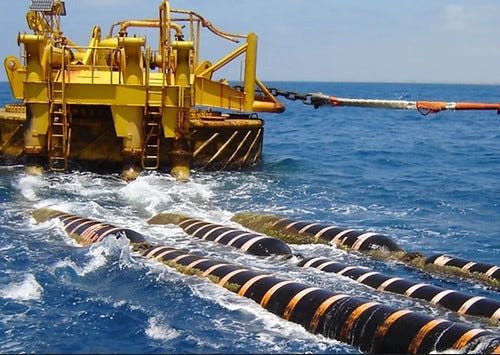
"underssea internet cable" by Thiện Ân is marked with Public Domain Mark 1.0.
The closure of the Strait of Hormuz—a chokepoint for 40% of the world’s oil and other maritime trade—has rocked the global economy. Below the maritime skirmishes, another crucial chokepoint is at risk: subsea fiber optic cables in the Gulf. Subsea cable networks globally carry an estimated 95% of all international data traffic, and in the Gulf are concentrated in just a few routes through the Red Sea and the Strait of Hormuz. Sitting at the intersection of Europe, Asia, and Africa, damage to these networks risks connectivity losses in one of the world’s most important internet traffic zones. Perhaps even more pressingly for the region, damage to existing networks threatens Gulf economies’ moonshot efforts to become the AI capitals of the world.
Efforts to expand terrestrial cable networks and increase reliance on satellites could mitigate the disruptive power of the Strait cable chokepoint, as well as create upside risks for host countries and global telecoms. But the persistence of security risks on sea and on land, alongside the growing awareness of subsea fiber optic cables as a national security concern, will build in risks and uncertainty for global internet traffic and regional AI ambitions.
In today’s full analysis:
Conflict, and Iranian Leverage, Risks Connectivity
Risks of Disruption: Connectivity and the AI Boom
The Global and Regional Impact

Global
Kyrgyzstan secures a seat on the UN Security Council. Wednesday’s election required multiple rounds before the Central Asian country gained a two-thirds majority, defeating the Philippines. Kyrgyzstan will represent the Asia-Pacific region, joining newly elected non-permanent members Austria and Portugal (Western European and other States), Trinidad and Tobago (Latin American and Caribbean Group), and Zimbabwe (Africa). While the other elected countries have had previous UNSC experience, this is Kyrgyzstan’s maiden term. The new Council term starts in January 2027.
Geopolitical divisions within the UNSC have led to deadlock over the last decade, reducing the effectiveness of the international security body. The five permanent members – China, France, Russia, the UK, and the US – have veto power and have wielded it 59 times since 2019. Russia has vetoed 48 resolutions, primarily related to Syria and Ukraine. n resolutions. China has vetoed six times, often joining Russia regarding Syria. The US has vetoed draft resolutions ten times, mostly related to Israel and Palestinian issues.
Kyrgyzstan is not expected to tip the balance with the UNSC. Bishkek has a historical alignment with Moscow as part of the former Soviet Union. More recently, the Eurasian country has sought to balance relations with Moscow, Beijing, and Western nations. Russia is its dominant security partner, but Bishkek has taken some steps to curtail Russian sanction evasion through the country. At the UN, Kyrgyzstan has abstained on major General Assembly resolutions condemning Russia’s invasion of Ukraine, tending to align in general with the Global South on issues. Kyrgyzstan’s foreign minister Kulubaev called on the UN to reform the UNSC by expanding the permanent representation of countries from Asia, Africa, and Latin America. Reform efforts by others call for abolishing veto powers completely.
Read More: United Nations, EuroNews, Foreign Policy [paywall], Geneva Centre for Security Policy
Europe
Romanian President Nicușor Dan nominated Eugen Tomac as Prime Minister on Thursday. Eugen Tomac, currently a lawmaker in the European Parliament, is an outsider whose People’s Movement Party did not earn election into the Romanian Parliament in the most recent elections. Nonetheless, President Dan has placed confidence in Tomac in order to sidestep the controversial discussions on which party should lead a “pro-Western” government focused on restoring the country’s fiscal health. President Dan has embraced the prospect of a “technical” government of “specialists,” which would insulate the political parties from the repercussions of an austerity agenda.
The political math presents an uphill battle for Tomac. The previous multiparty coalition collapsed one month ago after the Social Democratic Party (PSD), Romania’s largest, supported a no-confidence vote against Prime Minister Ilie Bolojan, who embarked on a controversial austerity agenda. Siegfried Mureșan, a Deputy Leader in the European People’s Party group, suggested that a technocratic government under Tomac could inflame perceptions that the government is undemocratic and untransparent.
The European Commission commended Romania’s progress in consolidating its fiscal health yesterday. The Commission has recommended that Romania close collection gaps in corporate and VAT taxes, reduce public sector wages, better monitor public expenditure, and pay down debts. In 2024, Romania’s budget deficit hit 9.3%, the highest in the EU and far above the 3% target.
Read More: Romania Insider, Associated Press, Politico
Middle East
An Iranian attack on Kuwait’s airport killed one, ramping up Iranian escalation. On Wednesday, an Iranian drone strike hit Kuwait’s recently reopened international airport, killing one person and injuring dozens. The strike (which came hours after the US halted a ship heading to an Iranian port) was the third attack on Kuwait in a week and the first conflict-related death outside of Iran in the last two months. The strike demonstrates Iran’s willingness to escalate even as the US signals that a ceasefire is near.
Concurrently, President Trump reportedly told aides that he will not resume all-out war with Iran unless American soldiers are killed. The statement signals a broad appetite to withstand low-level flare-ups – potentially for months – rather than return to a hot conflict. The conflict has become increasingly domestically unpopular for Trump as it weighs even more heavily on the global economy, and the statement is a reflection of Trump’s eagerness for both a deal and for the conflict to remain manageable.
The statement is a long leash for Iran and a disappointment for Gulf partners. The death of American servicemembers is a line Iran rarely crosses, anyway, and Tehran may see the statement as carte blanche to escalate up to that red line. However, Iran is also interested in ending the US blockade and finding a deal – but only after it has secured enough leverage to get favorable terms. For Gulf countries, who have long doubted the US’ commitment to its Middle Eastern security umbrella, the statement is a disappointment – and an echo, maybe, of the 2019 Iranian strike on Saudi oil infrastructure in Abqaiq, which prompted no US response and Gulf partners saw as a watershed in the defense relationship.
Read More: CNN, Wall Street Journal [paywall], Stratfor
Asia-Pacific
Venezuela’s interim President Delcy Rodriguez is in India for talks with President Modi, as the two countries seek to strengthen ties in the energy sector. New Delhi described Caracas as its preferred partner in the sector, as global oil supplies have been disrupted by the crisis in the Middle East. Rodriguez is scheduled to visit oil refineries in India and to meet with energy industry leaders in Mumbai.
India resumed oil purchases from Venezuela in February when US sanctions were eased by the oil pact between Washington and Caracas. Venezuela was one of India’s most important oil suppliers before 2019. In 2012, the South American nation was India’s third largest supplier, remaining in the top five until US sanctions halted imports in 2019. At the time, Venezuela was shipping 16 million tons of crude to India per year.
India was the second-largest importer of Venezuelan oil in May, purchasing 427,000 barrels per day. Venezuela is now on course to become the fourth-largest supplier of oil to India. The South Asian country is the world’s third-largest importer of oil. The disruption of oil flows through the Strait of Hormuz has severely impacted the supply of oil to India, which typically sources more than 40% of its supply through the Strait.
Read More: Reuters [paywall], BBC, AP
Americas
The United States sanctioned Cuban President Miguel Díaz-Canel on Thursday. He and four other individuals, as well as five entities, were added to the Specifically Designated Nationals (SDN) list. The other individuals include Díaz-Canel’s wife, two members of the Castro family, and the Ministry of the Revolutionary Armed Forces. The five designated entities include Cuban government ministries, a state-run tourism company, and Minera la Victoria SA, a Cuban gold mining joint venture created by Australia-based entity Antilles Gold Ltd and Cuban SOE Geominera SA.
Cuba’s tourism industry has collapsed as EO14404, which imposed secondary sanctions on parties dealing with GAESA, takes effect today, June 5. Spanish hotel chain Iberostar, which has been operating in Cuba since 1993, announced on Tuesday the closure of 12 of its 18 hotels on the island. On Wednesday, another major Spanish tourism company, Meliá, announced the closure of 15 hotels in Cuba. Canada’s Blue Diamond, with 15 properties on the island, also cut ties with Havana on Wednesday, and several airlines, including Air France and Air Canada, have suspended flights to Cuba.
The designations are part of Washington’s increasing pressure on Cuba’s leadership. The Cuban economy is in crisis, with blackouts and food shortages now part of daily life for the island’s residents. On Wednesday, the Central Bank of Cuba announced that it is suspending Visa and Mastercard services as of June 6, as a result of the recent sanctions.
Read More: Reuters, El País, Wall Street Journal [paywall], State Department, OFAC
Africa
Violence erupted in Mogadishu after the Somali parliament backed an extension of President Hassan Sheikh Mohamud’s term, a move widely viewed as undermining the electoral process. Somali troops clashed with anti-government militias and reportedly targeted the former president and prime minister, who opposed the change to presidential term limits. The unrest reflects broader disputes between the Federal Government of Somalia (FGS) and regional actors, including the federal government’s recognition of the newly established North East state in territory claimed by both Puntland and Somaliland. These disagreements have deepened political divisions and raised questions about the FGS’ legitimacy.
A more fractured Somalia could undermine US counterterrorism efforts. As the FGS struggles to maintain legitimacy, al Qaeda affiliate al Shabaab and the Islamic State Somalia Province may exploit political instability and security gaps to expand their influence and increase attacks. Political disputes between federal and regional authorities reduce the likelihood of a coordinated counterterrorism response, weakening efforts to contain the jihadist insurgency.
Read More: Reuters [paywall], Critical Threats, Africa Center for Strategic Studies
Geoeconomics
Private credit’s retail boom continues to falter rapidly. Cliffwater limited withdrawals from its $31 billion flagship corporate lending fund after redemption requests hit 17% in the second quarter, worth more than $5 billion, up from 14% in the first quarter. Blackstone also capped withdrawals from its $45 billion Blackstone Private Credit Fund for the first time after investors tried to pull $4.5 billion, or 10% of net assets, while the fund granted redemptions equal to 5% of its value.
Performance is an issue, but structure is too. Private credit and private equity funds were built around illiquid loans and company stakes, but managers increasingly sold “semi-liquid” versions to wealth and retail investors with quarterly redemption windows. That worked when money was flowing in, but it does not work when enough investors want out at once. Gating protects from a run on withdrawals and forced asset sales, but it also reminds investors that the liquidity they were offered is conditional, not guaranteed.
Private credit stumbling could have ripple effects. The ECB warned that if private credit keeps financing AI companies and data centers, and if AI cash flows disappoint, private credit could become a source of credit risk. The statement came after the bank ran a stress scenario that found limited direct losses for eurozone banks, but larger spillovers to insurers and pension funds; pension funds could lose 5% to 6% of assets, compared with about 4% for insurers, while bank losses would remain contained at no more than 1.3% of equity. The sector is not a replay of 2008, however, as most private credit funding is longer term and less runnable than subprime mortgage finance.
Read More: Financial Times [paywall], Wall Street Journal [paywall], European Central Bank, Financial Stability Board
Disruptive Technology
The European Commission released its new “Tech Sovereignty” package this week, which aims to build homegrown European digital champions. The point is not necessarily to replace American digital services—which account for 80% such services in the EU market—but to create redundancy and perhaps carve out value chain specialization. Fears of the US weaponizing a “kill switch” on digital services have ballooned among Europeans after the US slapped sanctions on an official of the Hague-based International Criminal Court, which locked them out of their email, phone, and bank accounts.
The package comprises two main pieces of legislation: a “Buy European” push for EU cloud services and direct investment authority in semiconductor fabs. The EU aims to triple its data center capacity in five to seven years, as well as couple semiconductor manufacturing ecosystems to provide components in those data centers. The European Commission’s approach will likely be inspired by France, a lead advocate of a sovereign tech capability that is steering its own €110 billion AI data center build-out through crowding-in private investment and accelerating permitting of new data centers on old industrial sites.
The Tech Sovereignty package could add further stress to the transatlantic relationship. The proposal is watered down from the original draft, certifying foreign cloud and digital services across four levels and only restricting some services depending on the extent of vulnerability or for securing certain public data. Nonetheless, US trade groups fear that the legislation invites further protectionism against US services. The package must still be debated by the European Parliament and national capitals.
Read More: European Commission, Associated Press, Politico, Stepwise Risk Outlook
Energy
The White House will use the Defense Production Act (DPA) to direct funds towards boosting American coal energy. The US government intends to provide $700 million to more than a dozen coal-fired power plants across the US. According to US President Donald Trump, the funds will go towards protecting existing coal mines and plants, as well as towards constructing two new coal plants and a new export terminal. The DPA is a Cold War statute for boosting American industry in the interest of national security. President Trump signed several memos in April to apply the DPA to various energy sectors as a response to the Iran war’s impact on global energy markets.
The administration has continually emphasized its support for traditional energy sectors and for American energy “dominance.” The administration has promoted LNG exports and production, expanded access to federal lands for oil, gas, and coal production, and withdrawn from international climate agreements it sees as undermining American energy security. President Trump draws a strong connection between energy policy and national security, and shortly after taking office in 2025, he declared a National Energy Emergency.
The US is not the only country to look to traditional energy sources in response to the global energy crisis. While many countries have reacted to the Iran war with increased focus on electrification and adoption of renewables, there has also been interest in traditional energy sources, including among some US allies in Europe. Italy recently elected to keep several coal-fired power plants connected to the grid, and Norway has pushed for the EU to drop its opposition to energy projects in the Arctic. There has also been an increased appetite among many energy companies to increase investment in exploration and new projects.
Read More: The Guardian, The Hill, The White House, The White House, Reuters [paywall], Bloomberg [paywall], Wall Street Journal [paywall]
Transnational Crime and Corruption
Recent arrests of Indonesian government officials highlighted the nation’s growing corruption issues. Indonesian prosecutors arrested the former head of a government-sponsored $15 billion free meals program on Wednesday for driving procurement contracts to unqualified foundations he controlled. President Prabowo Subianto placed the food program at the center of his 2024 election campaign and lamented that “those I loved [and] trusted” used the initiative for self-enrichment. Quality issues with the meals reportedly contributed to 33,000 food poisoning cases as of April.
On Thursday, Indonesia’s anti-corruption agency arrested a deputy immigration minister for extortion. The bureaucrat was accused of charging money for residence permits for foreigners in Indonesia between 2023 and 2024. Additionally, Nadiem Makarim, one of Indonesia’s most famous entrepreneurs and the education minister from 2019 to 2024, is on trial for corruption and faces 18 years in prison and Rp5.7 trillion ($317 million) in potential fines.
Additional corruption scandals could further undermine perceptions of Indonesia’s economic stability. Indonesia’s finance minister argued to credit rater S&P Global on Wednesday that the national budget deficit would remain below 3% of GDP despite recent spending increases. But Indonesian economists have begun disputing the reliability of official statistics released by Prabowo’s government.
Read More: Reuters [paywall], Reuters [paywall], Financial Times [paywall], Bloomberg [paywall], Foreign Policy [paywall]


Contact Us
Karl Hopkins
Partner
+1 202 429 6499
khopkins@steptoe.com
Melissa B. Mahle
Senior Advisor
+1 202 261 0577
mmahle@steptoe.com
Anni Coonan
Senior Intelligence Analyst
+1 212 506 3979
acoonan@steptoe.com
Samuel Bloebaum
Senior Due Diligence Analyst
+1 602 410 6240
sbloebaum@steptoe.com
Zayna Dembinski
Analyst
+1 202 778 3567
zdembinski@steptoe.com
Thomas Goldstein
Analyst
+1 202 862 6735
tgoldstein@steptoe.com
Ian Cameron
Analyst
+1 202 327 6908
icameron@steptoe.com
Elton Smole
Analyst
+1 202 261 0556
esmole@steptoe.com
Carter Spahn
Intelligence Fellow
+1 202 261 7555
cspahn@steptoe.com
Chris Dantes
Intelligence Fellow
+1 202 327 6904
cdantes@steptoe.com
Legal disclaimer: This Substack is for educational and informational purposes only and does not constitute the rendering of legal counseling or other professional services. Reading, subscribing to, or communicating through this Substack does not create an attorney-client relationship. Do not send confidential information through this platform. Consult qualified legal counsel regarding your specific circumstances.