


Welcome to the Stepwise Risk Outlook, which highlights and contextualizes over-the-horizon developments in key regions of the world and industries of the global market. Today’s featured deep dive by Ian Cameron examines Poland’s defense spending.

Outlook for Polish Defense Investment Amid Surge in Political Polarization
By Ian Cameron
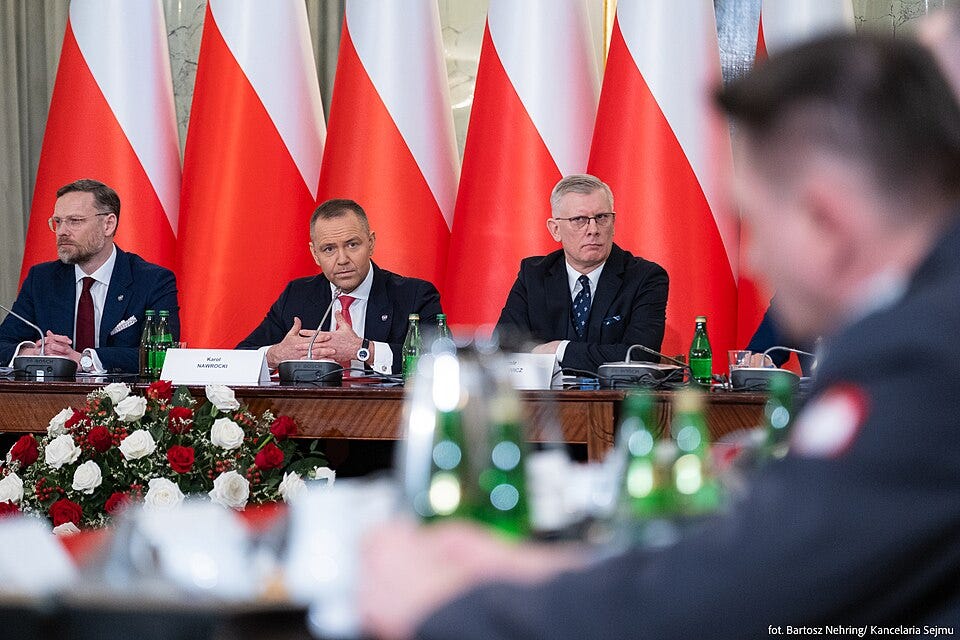
"Karol Nawrocki na Posiedzeniu Rady Bezpieczeństwa" by Sejm_RP is licensed under CC BY 4.0.
While Poland has emerged as a leader in European defense policy in the last several years, last month’s flare-up in the country’s long-running political crisis threatens to undermine Warsaw’s defense ambitions and investment plans. While defense policy has historically been an area of consensus among Poland’s dominant political parties, that consensus has fractured this year amid severe political polarization and new tensions in a long-running crisis over judicial independence. New political gridlock could undercut Warsaw’s ability to signal its long-term priorities and create clarity on its approach to defense policy, creating uncertainty for the defense industry and Poland’s international partnerships. However, any future government will continue to support high defense spending, investment into Poland’s domestic defense industrial ecosystem, and the bilateral relationship with Washington.
In today’s full analysis:
Poland’s Emergence as a Leader in European Defense
Poland’s Political Crisis and the 2027 Parliamentary Elections
Cracks Are Growing in Poland’s Defense Consensus: Risks and Outlook
Or listen to the full report here:

Listen to the news:
Europe
Yesterday, Ilse Aigner of Germany’s conservative Christian Social Union (CSU) was nominated by the major center parties to become the country’s next President. The Christian Democrats (CDU), the party of German Chancellor Friedrich Merz and the sister party to the CSU, in addition to the Social Democrats (SPD) and the Greens, jointly nominated Aigner, who is currently the Bavarian parliament speaker, to succeed current President Frank-Walter Steinmeier, whose final term expires in late March. The nomination from the major political parties assures Aigner’s presidency, barring unexpected developments. The German Presidency is indirectly elected by federal and state lawmakers and constitutionally does not hold much power. The role represents the country as the head of state for ceremonial matters and international conferences and can facilitate government formation. If elected, Aigner would be Germany’s first female President and the first from the CSU, a Bavarian regional party.
Aigner’s five-year term could witness unprecedented political challenges for the Federal Republic of Germany. The right-populist Alternative for Germany (AfD) is surging in national polls and currently holds an average eight-point lead over the CDU/CSU, the runner-up. This has translated into AfD parliamentary victories in the eastern German states of Saxony-Anhalt and Mecklenburg-West Pomerania in September. If AfD governs those states, the relationship to the federal government could become tense and intensify federalist gridlock. After the next parliamentary election—currently scheduled for 2029—Aigner may well have to navigate the government formation process with AfD in the lead.
Read More: Deutsche Welle, Politico, Der Spiegel [in German]
Middle East
The US evacuated American aircraft from an English air force base following threats from Iran. Two aircraft were moved from RAF Mildenhall to Germany early in the morning, and several others were moved to Germany and elsewhere later in the day. The move was in response to an unspecified Iranian threat.
The evacuation mirrors earlier threats on American assets in England and underscores Iran’s capabilities and ambitions to attack abroad. Last month, the US sent B-1 bomber aircraft back to the US from another RAF base amid concern around an Iran-backed plot to kill American pilots and target the aircraft (after which two men were charged in England). Congress’ Gang of Eight reportedly received a Monday briefing on Iranian threats expanding beyond the Middle East. While Iran has not been successful in orchestrating a large-scale attack on US assets abroad, the US and other countries have attributed a “wave” of attacks on Jewish sites, journalists and other targets in Europe and the US to Iran over the last year.
Read More: Wall Street Journal [paywall], CBS, State Department, International Centre for Counter-Terrorism
Americas
Canada is extending its tariff relief program on some US imports until June 30, 2028. In addition to extending the timeline, Ottawa is also expanding the scope of goods eligible for relief. The program, which is designed to reduce the burden of tariffs on Canadian firms as they transition away from US suppliers, has been in place since last year, when Canada first imposed retaliatory tariffs in response to the Trump administration’s levies. The relief program will now also cover non-steel goods used for extractive industries, goods used for public education, and goods deemed critical for national security and public health. However, tariff relief will no longer apply to some other products, such as trailers and aluminum wire, to incentivize domestic purchasing.
The exemptions cover a large share of potential tariff revenue for the Canadian government. According to a recent disclosure, Ottawa assessed around C$14 billion in tariffs on US products from March 2025 to October 26, 2026, but nearly C$9 billion of that was relieved to soften the blow for Canada’s economy, resulting in just over C$5 billion in net revenue from tariffs. Furthermore, some Canadian manufacturers have said that the relief program has disadvantaged their domestic sales within Canada.
Read More: The Globe and Mail, Reuters, Mining Weekly
Geoeconomics
US inflation slowed in October but exceeded expectations, with price increases remaining broad. The Consumer Price Index rose 0.4% from September, down from the previous month’s 0.6% increase but above economists’ 0.3% forecast. Core CPI, which excludes food and energy, increased 0.3% for a third consecutive month, exceeding expectations of 0.2%. Shelter rose 0.3% and accounted for more than 30% of the monthly headline increase. Food prices increased 0.5%, while energy rose 0.7%, slowing sharply from September’s 5.2% jump. Medical care, vehicle insurance and household furnishings also became more expensive, while used-vehicle prices declined. BLS did not publish annual headline or core inflation rates because the government shutdown prevented collection of the necessary comparison data in October 2025.
The report strengthens the case for a December Fed hike and gives advocates of a larger increase more support. Before the release, Governor Christopher Waller said he would support a quarter-point increase even if inflation moderated, but that a half-point increase should be considered if monthly core CPI remained around 0.3% or higher; October’s reading meets that condition. The Fed’s benchmark rate remains at 3.75%–4%, with its next meeting scheduled for December 8–9. Other economists believe that by looking past temporary tariff and energy shocks, a more gradual response is justified. Continued tightening would increase costs for borrowers with floating-rate debt and could restrain household spending and business investment.
Read More: BLS, Reuters [paywall], Federal Reserve, Peterson Institute for International Economics
Energy
Energy assets in the Middle East are continuing to come under attack. Saudi Arabia’s East-West oil pipeline was attacked on November 9, resulting in a fire. While the attack did not disrupt operations, it underscores the ongoing threats to regional energy infrastructure. The pipeline had stopped operations for a period in September following a drone strike. Likewise, Iraq’s Khor Mor gas field, which is located in the semi-autonomous Kurdistan region, temporarily stopped operations on November 8 following a suspected drone attack that caused a fire, potentially by hitting an LPG tank. The site has repeatedly been targeted, allegedly by Iranian-backed militias, and regional authorities referred to the incident as a terrorist attack.
Despite the ongoing threats and disruptions to regional energy infrastructure, oil prices continue to fall. Washington’s public reluctance to renew military operations against Iran has helped drive Brent crude futures down to below $93 per barrel, a steep fall from a high of $113 per barrel just over a week ago. Despite that, risks remain for energy flows out of the region. Periodic attacks on infrastructure, the ability of the US Navy to secure the Strait of Hormuz, and ongoing diplomatic efforts all contribute to significant instability around energy production and exports in the region.
Read More: Reuters [paywall], Financial Times [paywall], Wall Street Journal [paywall]
Transnational Crime and Corruption
The G7 launched a new anti-drug trafficking initiative to increase security measures at ports and combat rising narcotics imports into Europe. The “G7+ Ports Network to Combat Drug Trafficking” was announced during the G7 summit in France in June and convened for the first time during a G7 foreign ministers’ summit in Paris yesterday. The network includes the G7 nations, Brazil, South Korea and international organizations such as Interpol, the United Nations Office on Drugs and Crime, the International Maritime Organization and the World Customs Organization. The network will allow for intelligence sharing between global ports and law enforcement agencies.
The initiative follows a trend of France being the leading European nation for maritime anti-trafficking efforts. In late 2025, the French navy began using sniper fire to disable suspected drug smuggling boats in the Atlantic Ocean. It has also pursued diplomatic arrangements with North African countries to arrest and extradite traffickers. It will likely continue to leverage its G7 presidency to push for more anti-trafficking initiatives.
Read More: Reuters [paywall], French Foreign Ministry, French Foreign Ministry


Contact Us
Karl Hopkins
Partner
+1 202 429 6499
khopkins@steptoe.com
Melissa B. Mahle
Senior Advisor
+1 202 261 0577
mmahle@steptoe.com
Anni Coonan
Senior Intelligence Analyst
+1 212 506 3979
acoonan@steptoe.com
Samuel Bloebaum
Senior Due Diligence Analyst
+1 602 410 6240
sbloebaum@steptoe.com
Zayna Dembinski
Analyst
+1 202 778 3567
zdembinski@steptoe.com
Thomas Goldstein
Analyst
+1 202 862 6735
tgoldstein@steptoe.com
Ian Cameron
Analyst
+1 202 327 6908
icameron@steptoe.com
Elton Smole
Analyst
+1 202 261 0556
esmole@steptoe.com
Carter Spahn
Intelligence Fellow
+1 202 261 7555
cspahn@steptoe.com
Chris Dantes
Intelligence Fellow
+1 202 327 6904
cdantes@steptoe.com
Legal disclaimer: This Substack is for educational and informational purposes only and does not constitute the rendering of legal counseling or other professional services. Reading, subscribing to, or communicating through this Substack does not create an attorney-client relationship. Do not send confidential information through this platform. Consult qualified legal counsel regarding your specific circumstances.