


Welcome to the Stepwise Risk Outlook, which highlights and contextualizes over-the-horizon developments in key regions of the world and industries of the global market. Today’s featured deep dive by Chris Dantes examines the South African election results.

The Future of US-South Africa Relations in an Era of Political Transition
By Chris Dantes
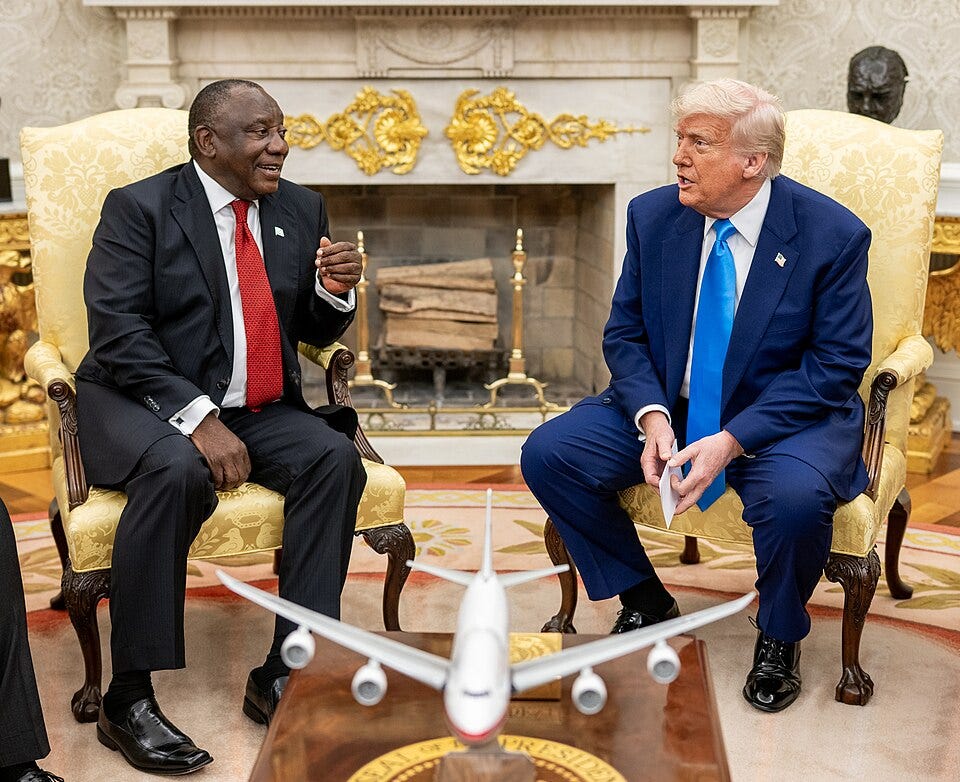
“President Donald Trump meets with President of South Africa Cyril Ramaphosa” by Daniel Torok is marked with Public Domain Mark 1.0.

On November 4, South Africa held municipal elections with significant implications for the country’s future political direction and international relationships. The African National Congress (ANC), the country’s longstanding incumbent party, suffered historic losses and received 30.75% of the vote—less than a third of total votes and 14 points below its results in 2021 local elections. Meanwhile, the center-right Democratic Alliance (DA), the largest opposition party and ANC’s main partner in the Government of National Unity, finished second with 24.65% of the vote. DA-affiliated councilors won greater support across urban areas and key economic hubs.
The results not only underscore the expanding role of opposition parties in local governance but raise questions about the ANC’s ability to maintain its dominance in the central government, potentially opening the door to a DA-led coalition after the 2029 general elections. Should municipal leaders from the DA succeed in addressing voters’ grievances, the next general election could become considerably more competitive. A future DA-led coalition at the national level could modernize South Africa’s infrastructure, expand foreign investment and rebalance relationships with the US, China and other international partners. However, increased political fragmentation could stall the implementation of DA-backed economic reforms, potentially reducing investor confidence and leaving longstanding infrastructure issues and policy uncertainty unaddressed.
In today’s full analysis:
The Decline of South Africa's Liberation Party
Opposition Parties Fragment South Africa’s Political Landscape
A Potential US-South Africa Rapprochement?
Or listen to the full report here:

Listen to the news:
Europe
The first diplomatic trilateral between the US, Ukraine, and Russia in nine months ended with an agreement in principle for the largest prisoner exchange since 2022. Presidential envoys Jared Kushner and Steve Witkoff will be in Moscow today to follow up with Russian President Vladimir Putin, before meeting Ukrainian President Volodymyr Zelenskyy tomorrow in Dublin. Zelenskyy indicated that the prisoner exchange agreement is a positive step forward but not a breakthrough on the high-level issues of territory and security guarantees. Yuri Ushakov, part of the high-level Russian delegation, called the US-mediated talks in Abu Dhabi “substantive and quite useful.”
Kushner indicated that the US pushed for the inclusion of European representatives at the talks, but the Russian delegation suggested that it is too early for their inclusion. Kremlin spokesperson Dmitry Peskov later stated that the Europeans’ financing and supplying of Ukraine “do not indicate” a desire for peace. European national security advisors—including Günter Sautter of Germany, Jonathan Powell of the UK, and Emmanuel Bonn of France—had traveled to Abu Dhabi but did not attend the US-mediated talks. Nonetheless, US interest in including European voices on a postwar security architecture could improve transatlantic trust. The EU will likely discuss whether to appoint a single representative in future talks.
Read More: AP, Euronews, Aljazeera
Asia-Pacific
Indonesia’s Vice President Gibran Rakabuming Raka is stepping down. His resignation was spurred by controversy around his academic credentials; he has been unable to prove that he received a high school diploma, a requirement for holding office, despite later earning a university degree. This comes alongside an unrelated investigation into allegations that top officials, including the chief of staff, were involved in wiretapping the president, resulting in multiple arrests last week. Upon submitting his resignation on Wednesday, Raka said his intention was to avoid a drawn-out political controversy.
The Indonesian rupiah dropped to record lows yesterday against the dollar, prompting intervention from Bank Indonesia to contain the selloff. This is partially because the dollar strengthened due to expectations that the Fed will raise rates next month, but the rupiah’s trajectory reflects broader concerns around the state of Indonesia’s economy amid the recent political instability. Indonesian stocks and bonds are also down, and concerns remain that MSCI will reclassify Indonesia from Emerging Market to Standalone Market. MSCI launched the consultation last month and will make a final decision by next June.
Read More: New York Times [paywall], AP, Bloomberg [paywall], MSCI
Americas
Salvadoran forces supported an airstrike this week on the headquarters of a major Haitian gang near Port-au-Prince. El Salvador’s President Nayib Bukele said the base was used for kidnapping, weapons trafficking and extortion by the 400 Mawozo gang. Strikes also targeted the home of the gang’s leader, Wilson Joseph, also known as Lanmò Sanjou. Joseph had recently requested UN mediation in a letter to UN Secretary-General António Guterres, citing fear of military escalation in Haiti. Up to 20 people were reportedly killed in this week’s strikes. Haitian Prime Minister Alix Didier Fils-Aimé released a statement on Tuesday praising Bukele’s involvement in combating Haiti’s gangs.
Fils-Aimé will visit El Salvador next week to discuss the continued involvement of Salvadorian forces on Haitian soil. This comes ahead of the approaching February elections in El Salvador. Bukele seeks to attract broader support for his heavy-handed approach to fighting crime, which has often drawn international scrutiny. Despite these criticisms, Bukele maintains over a 90% approval rating in El Salvador, which has seen crime rates plummet in recent years. However, El Salvador’s risky approach in Haiti has drawn mixed reactions from Washington, including support from the Trump administration but sharp criticism from State Department officials, exposing a rift in US foreign policy in the Caribbean.
Africa
Democratic Republic of the Congo President Felix Tshisekedi approved a law allowing for a referendum on changing presidential term limits. The DRC’s current constitution sets a two-term presidential limit. However, Tshisekedi has been advocating for constitutional changes that would enable him to govern for a third term, arguing that conflict in eastern Congo with Rwanda-backed rebels could prevent many citizens from voting in the 2028 elections. The legislation, approved by parliament in October, has led to protests and drawn criticism from opposition figures, who argue that Tshisekedi is consolidating power in violation of the constitution.
These changes not only follow a broader trend of intensifying authoritarianism on the continent but also have significant implications for the war in eastern Congo. Despite participating in US- and Qatar-mediated peace talks, the Tshisekedi government has continued its drone and ground campaign against M23, which was recently reorganized by former DRC president Joseph Kabila into the Front pour la Refondation de la Nation (FRN). Should Tshisekedi serve a third term, fighting in North and South Kivu is likely to continue absent any major concessions by the FRN and Rwanda before the 2028 elections. Defections of DRC officers to the FRN in support of Kabila have also raised the stakes and could incentivize Kinshasa to intensify its military campaign, delaying implementation of the US-backed peace framework.
Read More: Reuters [paywall], Critical Threats
Geoeconomics
Only $37.5 billion of the $1.4 trillion pledged under US trade agreements with Japan, South Korea and Taiwan has advanced into financing or investment. An analysis reported by the Financial Times puts progress at 2.7%: $10.96 billion in Japanese financing, $2.4 billion from South Korea for a Texas power plant, and $24.1 billion in Taiwanese corporate investment, largely from TSMC. Taiwan’s separate credit-guarantee scheme has yet to approve a project. The wider pledges ($550 billion from Japan, $350 billion from South Korea and $500 billion from Taiwan) span multiple years and combine investments, loans and guarantees.
The slow rollout reflects the difficulty of turning political deals into projects with acceptable returns and manageable risks. For example, South Korea requires commercially reasonable investments and limits annual funding under its $200 billion strategic investment program to $20 billion, helping contain the pressure that large dollar outflows could place on its currency. Its proposed participation in Alaska’s LNG project remains under review because construction costs, completion timelines and future demand remain uncertain. Even projects that secure funding take years to complete: the Texas power plant receiving Korea’s initial contribution targets first operations in 2029 and full capacity in 2032.
Read More: Financial Times [paywall], Yonhap, Peterson Institute for International Economics, Stimson Center, Steptoe Risk Outlook
Disruptive Technology
The European Commission revealed the Digital Fairness Act (DFA) yesterday, signaling a potential expansion of its digital consumer protections. The DFA proposal envisages new restrictions for the design of online shopping—from e-commerce platforms or shopping integrations in gaming or social media—such as allowing consumers to turn off addictive features and personalized ads (and disallowing them for minors), requiring transparent pricing to prevent dynamic price spikes, and making digital subscriptions easier to cancel. The DFA proposal also suggests delegating the European Commission direct investigatory powers into potential “large-scale” digital unfairness practices, with disciplinary fines up to 6% of a company’s worldwide turnover. The Commission predicts that preventing manipulated purchases and subscriptions could save EU consumers €10.3 billion per year.
EU member states and the European Parliament will now scrutinize the proposal, potentially starting a new lobbying battlefield in Brussels. As it stands, the European Parliament’s center may take opposing views on the DFA. A conservative bloc, led by the European People’s Party, is more likely to suggest that the DFA’s proposals could theoretically be enforced through existing legislation and an extra Act could contradict the Commission’s simplification and competitiveness agenda. Other groups, including some parliamentarians in the Socialists and Democrats group, have suggested that the DFA does not go far enough. The proposal to give the Commission direct enforcement powers may upset EU member states but comes after lagged readiness to enforce AI rules, with only 8 of 27 members establishing regulatory bodies by the deadline.
Read More: European Commission, Politico, International Association of Privacy Professionals
Energy
Ukraine is renewing its campaign against Russian refining capacity. Since late October, Kyiv has successfully brought Russia’s refining capacity down by 30% following a pause in attacks amid pressure from the United States. Washington had previously reached an agreement with Russia on providing sanctions relief to Russian diesel in exchange for Moscow selling to the US. Washington then attempted to pair its diesel agreement with an energy ceasefire between Moscow and Kyiv, but ultimately those efforts fell through.
The attacks are putting Russia in an uncomfortable position regarding the diesel agreement with the US. Ukraine’s strikes are creating pressure on Russia’s domestic fuel market, just as they did during the summer, which could complicate Moscow’s efforts to hold up its end of the agreement with the US. The agreement had already come under pressure due to the reluctance of American companies to purchase from Russia. Failure on the diesel agreement front could push the US away from prior recent efforts to signal openness to economic reconciliation with Russia. In turn, that could play into the ongoing negotiations that the US is mediating between Russia and Ukraine.
Read More: Reuters [paywall], Yahoo News, Moscow Times [in Russian], Stepwise Risk Outlook
Transnational Crime and Corruption
The UK announced the completion of a wide-ranging initiative to crack down on high street businesses engaged in money laundering, a major priority of the Burnham government. “Operation Machinize” reportedly arrested 349 people and seized and froze GBP 5.9 million in illicit assets. Police raids also seized significant quantities of illegal drugs, vapes, tobacco, and cigarettes being sold out of illicit high street businesses. The proliferation of money laundering fronts operating as vape shops, barber shops, candy stores and other similar businesses on UK high streets has become a highly visible sign of the country’s struggles to revive commercial districts without enriching criminals.
Read More: UK National Crime Agency, Organized Crime and Corruption Reporting Project
Defense
A German defense company is releasing its own battlefield software for militaries. Helsing, a German defense technology company, is moving into the market for capabilities to assist militaries in processing vast amounts of battlefield information with their new AI platform Clarity. Clarity is intended to sort and process data from a number of different sources like drones, satellites, and open-source intelligence in order to help military users. Helsing, which has had its products used on the battlefield in Ukraine, has claimed it has been able to incorporate that experience.
The current market for battlefield software is led by the American firm Palantir. Helsing is moving into a market dominated by Maven, Palantir’s own battlefield software, which is already inside both the Pentagon and NATO. Palantir has also had years of time to refine its products, and, like Helsing, has had its products used in Ukraine, according to Ukraine’s former Defense Minister Mykhailo Fedorov.
Divergence in military AI could feed into a split between American and European defense products. According to Helsing, its products are developed in Europe and run on customer-owned infrastructure, which corresponds to an increasing desire in Europe to loosen external dependencies and retain greater control over military capabilities and data.
Read More: Reuters [paywall], Defence Industry Europe, Kyiv Independent


Contact Us
Karl Hopkins
Partner
+1 202 429 6499
khopkins@steptoe.com
Melissa B. Mahle
Senior Advisor
+1 202 261 0577
mmahle@steptoe.com
Anni Coonan
Senior Intelligence Analyst
+1 212 506 3979
acoonan@steptoe.com
Samuel Bloebaum
Senior Due Diligence Analyst
+1 602 410 6240
sbloebaum@steptoe.com
Zayna Dembinski
Analyst
+1 202 778 3567
zdembinski@steptoe.com
Thomas Goldstein
Analyst
+1 202 862 6735
tgoldstein@steptoe.com
Ian Cameron
Analyst
+1 202 327 6908
icameron@steptoe.com
Elton Smole
Analyst
+1 202 261 0556
esmole@steptoe.com
Carter Spahn
Intelligence Fellow
+1 202 261 7555
cspahn@steptoe.com
Chris Dantes
Intelligence Fellow
+1 202 327 6904
cdantes@steptoe.com
Legal disclaimer: This Substack is for educational and informational purposes only and does not constitute the rendering of legal counseling or other professional services. Reading, subscribing to, or communicating through this Substack does not create an attorney-client relationship. Do not send confidential information through this platform. Consult qualified legal counsel regarding your specific circumstances.