
Welcome to the Stepwise Risk Outlook, which highlights and contextualizes over-the-horizon developments in key regions of the world and industries of the global market. Today’s featured deep dive by Thomas Goldstein examines the implications of the UK’s October Budget for defense investment.

What the Proposed UK Budget Means for Defense Investment
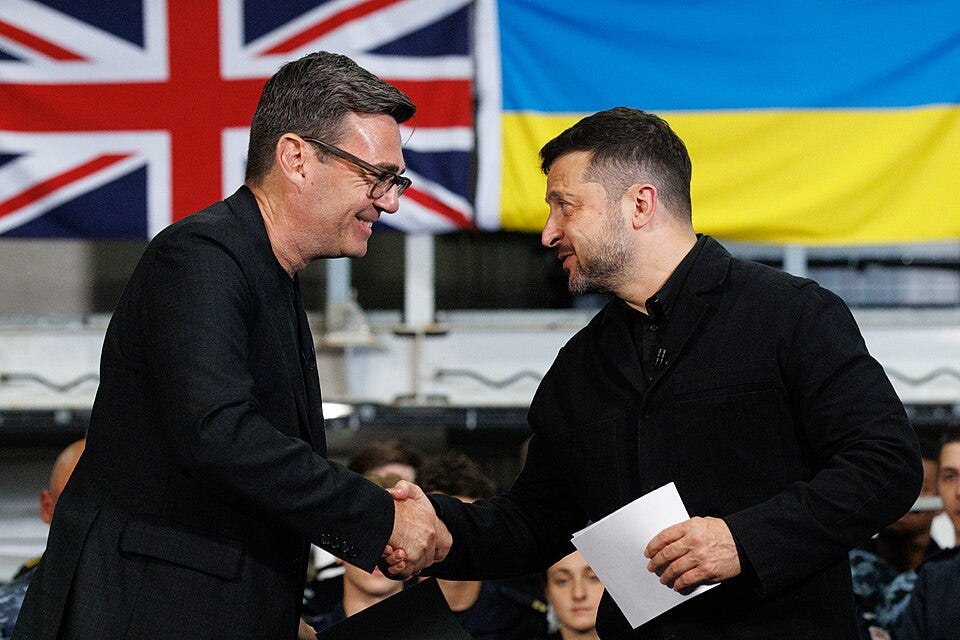
“Prime Minister Andy Burnham meets Ukrainian President Volodymyr Zelenskyy” by Number 10 is licensed under Open Government License 3.

The UK’s October Budget proposal embraces a new defense spending goal of 3% of GDP by 2030, but the UK is slated only to spend 2.7% by then, a roughly £20 billion gap. Nonetheless, the Budget envisions numerous innovative financing mechanisms to increase private and international finance in the UK defense industry, including a Multilateral Defense Mechanism, a multilateral bank to underwrite joint procurement. Some key unknowns remain, including what the Multilateral Defense Mechanism will look like, whether it will attract more participants, and whether it could secure the UK in EU defense initiatives. On the upside, the Budget adds momentum to increased defense spending and integrating nontraditional defense actors in the defense industry. On the downside, leaving funding questions unanswered could decrease confidence in the UK’s defense investment plans.
In today’s full analysis:
What is in the UK Budget for Defense
The UK’s Defense Agenda Outlook
The Risks
Or listen to the full report here:

Listen to the news:
Europe
Belgian Prime Minister Bart de Wever offered his resignation to King Philippe yesterday after budget negotiations extended beyond an informal deadline. The King has not decided whether to accept it yet, opting instead to consult party leaders today on a potential path forward and meet with De Wever on Friday. The Flemish socialists and the Francophone center-right Reformist Movement—together part of a five-party coalition—disagree on whether to raise value-added taxes and income taxes. Belgium is a highly indebted country whose deficit was 5.2% in 2025, far above the EU target of 3%, and its public debt-to-GDP ratio is 110%. The government is targeting €10 billion in either savings or new revenue to restore fiscal sustainability. The King’s office warned that snap elections may exacerbate Belgium’s fiscal instability, so either a budget compromise or a new coalition would be preferred.
Read More: Politico, yahoo!news, Reuters [paywall]
Middle East
Syria’s foreign minister said the country was considering joining the Mecca Joint Defense Agreement with Saudi Arabia, Türkiye and Pakistan. At the Manama Dialogue security conference in Bahrain, Asaad al-Shaibani told audiences that “discussions are currently underway” to evaluate Syria’s membership. The original accords, signed in August in Mecca, commit signatories to a NATO-style mutual defense pact, as well as boosting security cooperation in other areas.
Membership would strengthen Syria’s regional relationships, but could create significant pressures on Syria’s fragile new government and military. Syria has thus far sought to stay out of regional conflicts in a bid to build up its own state capacity, but relationships with Türkiye (an original patron of the rebel group that ousted Assad and now leads Syria’s government) and Saudi Arabia (a major diplomatic and financial backer) have become increasingly important. The Mecca pact’s mutual defense agreement appears somewhat flexible, but Ankara and Islamabad have since agreed to send troops to Saudi Arabia for defense, and joining could commit Damascus to the same effort. Syria will weigh its place in regional partnerships against the capabilities of its military, and demands at home.
Implications for Israel’s presence in Syria are an open question. An element that has not been widely covered is what the pact could mean for Israel’s ongoing presence in Syria and attacks within its borders (al-Shaibani claimed at the dialogue that Israel has carried out more than 1,000 attacks on Syria since Assad’s fall). Joining the accord may simply be a hedge against greater operations, but could create a sticky situation for Türkiye, Saudi Arabia and Pakistan, none of whom have good relations with Israel.
Read More: New York Times [paywall], Al-Jazeera, Carnegie Endowment for International Peace
Americas
A powerful Haitian gang leader has appealed to the United Nations to facilitate talks. Wilson Joseph, better known as “Lanmò Sanjou” and the leader of the 400 Mawozo gang, sent a letter to UN Secretary-General António Guterres requesting the deployment of a UN delegation to facilitate dialogue and mediation. Joseph said he feared an escalation of violence following recent clashes and argued that negotiations should take precedence over military action. He also claimed that 400 Mawozo had raised a “white flag” and was prepared to participate in discussions aimed at achieving a peaceful resolution to Haiti’s crisis. A UN spokesperson acknowledged receipt of the letter but said that this did not constitute recognition of the author or endorsement of the contents.
The request comes as El Salvador expands its security involvement in Haiti. El Salvador deployed more than 2,000 troops after four Salvadoran aviation technicians were attacked and remain missing following an October 18 clash in the Plaine du Cul-de-Sac region. Joseph said that the four were dead while the Salvadorian government believes they are alive. Since then, fighting has intensified between Haitian gangs and security forces, including Haitian police and soldiers, international personnel under the UN-backed Gang Suppression Force, private contractors, and the recently deployed Salvadorian forces, which are largely operating outside the UN framework. In his letter, Joseph warned that comments by Salvadoran President Nayib Bukele could lead to reprisals and further violence, with the Haitian civilian population ending up the primary victims of an escalating conflict.
Africa
The African National Congress (ANC), South Africa’s ruling party, is expected to perform poorly in several major metropolitan municipalities in upcoming local elections. On November 4, South Africans will elect councilors to select mayors responsible for overseeing municipal services. The vote comes at a pivotal moment in South African politics, with the ANC facing declining urban support amid frustration over deteriorating service delivery. Voters are increasingly concerned about failing local infrastructure, including recurring water shortages and power outages. Other prominent issues include corruption, crime, illegal immigration, and rising costs. Candidates affiliated with the Democratic Alliance (DA), South Africa’s second-largest party, are positioned to make gains in Johannesburg and other economically significant cities.
Increasing foreign investment in major cities depends on improvements in governance, infrastructure and stability. Widely viewed as more pro-business than the ANC, DA-led administrations in Johannesburg and other key commercial centers could strengthen municipal management and improve service delivery, enhancing both quality of life and the local business environment. More reliable infrastructure and stronger fiscal oversight could help lower operational risks for international firms. However, the extent of any improvements will depend on whether coalition governments remain stable and can effectively implement reforms. If DA-led municipalities demonstrate measurable progress in restoring basic services, reducing corruption and combating crime, the party could strengthen its credibility and thus gain more support ahead of the 2029 national elections.
Read More: AP, Reuters [paywall], Institute for Security Studies
Geoeconomics
The US plans to remove South Africa and Rwanda from the African Growth and Opportunity Act (AGOA) on January 1, 2027, withdrawing preferential tariff treatment for qualifying exports. President Trump notified Congress on November 2 following an annual eligibility review. USTR cited barriers to American trade and investment and concerns involving US national security and foreign policy, alongside corruption in South Africa and human rights and rule-of-law issues in Rwanda. The decision follows broader US–South Africa tensions and efforts by Washington to pressure Rwanda to cease its support to rebels in eastern Congo. AGOA, which was enacted in 2000, provides eligible African countries with duty-free access for thousands of products and was extended through 2028 in September, but individual countries remain subject to annual eligibility reviews. Rwanda’s apparel benefits have already been suspended since 2018.
The impact will be concentrated on exporters that built their businesses around preferential access to US customers. AGOA covered roughly 10% of South Africa’s exports to the US and 1% of its global exports in 2025, limiting the broader exposure. However, citrus growers say orchards planted for the US market cannot readily redirect fruit elsewhere because of different plant-health requirements and consumer preferences. Wine exporters likewise expect to lose ground to competing suppliers. These businesses face pressure to absorb additional duties through lower margins or risk losing orders, with some growers warning of job losses. Earlier African tariff disruptions caused US buyers to find other suppliers, so a future reversal of this suspension may not revive affected industries.
Read More: USTR, Reuters [paywall], Business Insider Africa, Center for Global Development, Brookings
Energy
The US is pressing for a resumption of Russian energy sales to Europe. Washington has reportedly lent its support to a resumption in European gas imports from Russia through pipelines that transit Ukraine. In order to bypass European sanctions, the sales would route through an American intermediary, and proceeds would go to an escrow account in a third-party jurisdiction to avoid funding Russia’s war effort. The White House sees the initiative as part of negotiations to reach an energy ceasefire before winter arrives. This isn’t the first time the US has discussed a renewal of Russia’s energy business with Moscow – the administration has explored bringing the Nord Stream pipelines back into service after a peace agreement with the inclusion of American businesses.
Europe is staunchly opposed to any return to dependence on Russian energy. The EU has passed legislation phasing out all imports of Russian gas by the end of 2027, and any potential energy cooperation with Moscow even after a peace deal remains extremely controversial within Europe. Moreover, European capitals now see Russian energy as a dependency that Moscow can exploit and therefore not as a reliable energy source. Ukraine has kept its position guarded about the initiative; while Kyiv opposes energy cooperation with Russia, any resumption in gas transit from Russia to Europe would provide Kyiv with much-needed funds by way of transit fees.
Recently, the US has pivoted more towards economic reengagement with Russia as Washington looks to keep energy prices down. The US has provided Russia with sanctions relief on diesel exports and waived implementation of sanctions from recently passed legislation.
Read More: Wall Street Journal [paywall], Kyiv Independent, Reuters [paywall], Stepwise Risk Outlook
Defense
Germany is deepening its defense cooperation with Nordic partners. The Leopard 2A8 German main battle tank has entered production in Norway through an agreement between the tank’s German manufacturer and a Norwegian company as Oslo and Berlin build up their defense partnership. This is part of the Hansa Arrangement that the two capitals agreed on in February, which prioritizes maritime operations, space-based surveillance, defense industrial cooperation, and other policy areas. Germany and Norway are also cooperating on submarines, with both navies planning to operate Type 212CD submarines. The two are also cooperating more closely on military exercises.
Finland and Germany are also expanding defense industrial connections. German company KNDS is partnering with a Finnish company on deliveries of armored personnel carriers for Germany’s military, with serial deliveries set to begin in 2027. The German legislature approved the purchase of Finnish armored personnel carriers in 2025, and the current contract is for delivery of 349 vehicles. The agreement foresees technology transfer to German partners from the Finnish company, with production for over half of the order to take place in Germany.
Germany has been rapidly expanding its military and defense industrial capacity. Berlin has undertaken a major shift in defense policy and has unleashed large flows of investment into its defense industrial ecosystem and into its military as Germany looks to become the largest conventional military power in Europe.
Read More: Defense News, Defense24, Stepwise Risk Outlook


Contact Us
Karl Hopkins
Partner
+1 202 429 6499
khopkins@steptoe.com
Melissa B. Mahle
Senior Advisor
+1 202 261 0577
mmahle@steptoe.com
Anni Coonan
Senior Intelligence Analyst
+1 212 506 3979
acoonan@steptoe.com
Samuel Bloebaum
Senior Due Diligence Analyst
+1 602 410 6240
sbloebaum@steptoe.com
Zayna Dembinski
Analyst
+1 202 778 3567
zdembinski@steptoe.com
Thomas Goldstein
Analyst
+1 202 862 6735
tgoldstein@steptoe.com
Ian Cameron
Analyst
+1 202 327 6908
icameron@steptoe.com
Elton Smole
Analyst
+1 202 261 0556
esmole@steptoe.com
Carter Spahn
Intelligence Fellow
+1 202 261 7555
cspahn@steptoe.com
Chris Dantes
Intelligence Fellow
+1 202 327 6904
cdantes@steptoe.com
Legal disclaimer: This Substack is for educational and informational purposes only and does not constitute the rendering of legal counseling or other professional services. Reading, subscribing to, or communicating through this Substack does not create an attorney-client relationship. Do not send confidential information through this platform. Consult qualified legal counsel regarding your specific circumstances.