


Welcome to the Stepwise Risk Outlook, which highlights and contextualizes over-the-horizon developments in key regions of the world and industries of the global market. Today’s featured deep dive by Elton Smole examines what US troops in Ecuador means for the future of counternarcotics in Latin America.

US Troops in Ecuador Present New Model for Counternarcotics in Latin America
By Elton Smole
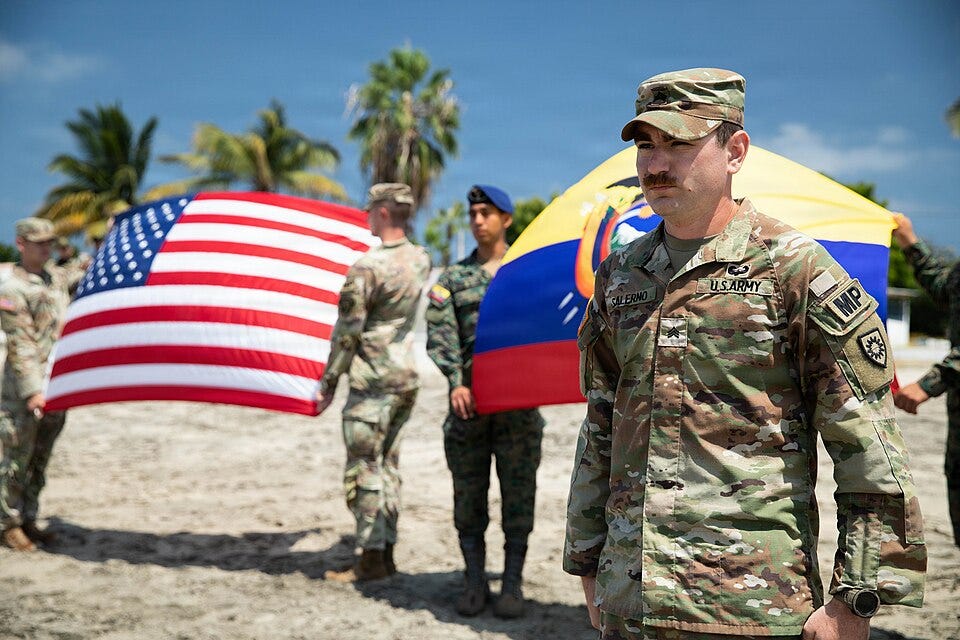
“940th Military Police Company Conducts Exercise El Gato with Ecuadorian Armed Forces” by Staff Sgt. Caleb Sooter is marked with Public Domain Mark 1.0.
.jpg)
The presence of US forces in Latin American counternarcotics operations has entered a new chapter as the Trump administration steps up engagement with Shield of the Americas partners to authorize direct land strikes and joint operations with US military personnel to combat cartels. The US has historically supported allied anti-narcotics operations in the region through equipment and intelligence sharing. The new model being deployed in Ecuador represents a shift to more direct involvement, which the Trump administration seeks to replicate across the region. This model has been welcomed by some right-wing governments, but comes with legal and geostrategic downside risks, including that strikes over the past year have failed to meaningfully achieve their intended purpose of reducing drug trafficking to the US. Still, the recent US actions in Ecuador appears to be setting a new model for US military involvement across the Western Hemisphere.
In today’s full analysis:
Ecuador Raids Target Transnational Groups with US Boots on the Ground
US Security Cooperation Terms Remain Uneven Across the Region
Limited Results and Risks to Regional Stability
Or listen to the full report here:

Listen to the news:
Global
Amid a global shortage of diesel fuel, the US demands the EU draw down on emergency inventories or risk a US diesel export ban. EU countries hold nearly 109 million tons of emergency crude and fuel stocks. The EU’s emergency diesel stocks are mainly in Germany and France, accounting for about 35% of the total EU stockpile. The US has asked the EU to release 120 million barrels of diesel in the next six months, an amount equal to about one month of total EU diesel consumption. The average price of diesel in the EU has soared by around 40% since January, creating domestic pressures to increase available supply.
With major disruptions in global trade due to conflict, top producing countries are imposing diesel export bans, or considering new bans. The US, the largest global exporter (15.4% of the global market in 2025), is considering a diesel export ban due to rising prices and voter discontent with rising transportation costs and overall inflation. Russia, the second largest (9.5% in 2025), first imposed a partial export ban in September 2025, extending a full ban in July 2026, citing domestic needs related to the Ukraine War. Persian Gulf producers are struggling to get their diesel to market (about 10% of global supply) due to the blockage of the Strait of Hormuz. Chinese refiners have suspended exports of oil products to regions beyond Hong Kong and Macau until further notice from Beijing for domestic energy security.
Read More: Reuters [paywall], Yahoo!Finance, Reuters [paywall], Deutsche Welle, Politico
Europe
Slovakia Prime Minister Robert Fico raised the possibility of snap elections in January 2027 amid coalition division over the dismissal of a government minister from parliament. Tomáš Taraba, the former Deputy Prime Minister and Minister for Environment, had fallen out of favor with his own party, the Slovakia National Party (SNS), for continuing decarbonization initiatives against the wishes of SNS leadership. Taraba agreed alongside Fico and SNS in May to step down as Minister if the dispute was ongoing by the end of September, but he had refused to step down. Independents that back Fico’s government voted against it to dismiss Taraba from parliament, weakening the government’s thin majority.
If an election were held, Fico’s coalition is expected to lose seats. Fico’s left-wing Smer party is polling at about 17%, six points lower than its 2023 result. Fico’s coalition partners are fairing worse, with SNS polling at 2% (three points lower) and the social-democratic Voice – Social Democracy party polling at 7% (eight points lower). The highest polling party is currently the liberal Progressive Slovakia party at 20%. If Fico’s government collapses, parliament will have a chance to form a coalition based on the 2023 election results before snap elections.
Read More: RBC Ukraine, Reuters [paywall]
Middle East
The Syrian government met with Hizballah officials for the first time in a bid to calm tensions. Syria reportedly pledged not to intervene in Lebanon (including pledging not to answer US requests to create a peacekeeping presence there) and asked Hizballah to help stop cross-border smuggling and dismantle its remaining sleeper cells in Syria. The meeting was mediated by Turkiye and did not result in any concrete agreements. The parties have a troubled history: Syria under Assad leadership occupied Lebanon and exerted significant influence there for over 30 years until 2005, while Hizballah fighters fought on the side of President al-Assad during the civil war.
The meeting was reported days after Syria claimed to find an active Hizballah cell preparing rocket attacks. On Tuesday, Syrian intelligence services reportedly “thwarted a sabotage plot” in Daraa in which Hizballah agents were preparing rocket launchers, apparently for attacks against the Syrian state. Hizballah in Lebanon disputed the reports; the plans may have been undertaken by a splinter cell more closely aligned with Iran, which would prefer a destabilized Syria to better serve as a corridor for proxy activity.
Read More: Reuters [paywall], The Times of Israel, CNN, Al Majalla
Asia-Pacific
Chairman of the House Select Committee on China John Moolenaar yesterday called on the State Department to investigate strengthened China-ROK ties, arguing it poses “significant risks” to US interests. In a letter to Secretary of State Marco Rubio, Moolenaar highlights increased leader-level engagement and South Korean semiconductor investments in China, as well as what he characterizes as more lenient regulatory treatment of Chinese firms than US companies. He specifically contrasts Seoul’s treatment of Chinese e-commerce platforms with its handling of US-based Coupang, arguing the disparity could disadvantage American firms and increase Chinese access to Korean consumer data.
The letter comes as trade, investment and greater Korean contributions to regional security become increasingly central to the Washington-Seoul alliance. In exchange for tariff relief, Seoul pledged $350 billion in US investment. However, conflicting accounts of the talks and investment details have frequently protracted trade talks between the two allies. Most recently, President Trump yesterday announced South Korea would invest some $200 billion in US projects, including $54 billion for the Alaska LNG pipeline. In contrast, South Korea’s Industry Ministry Kim Jung-kwan earlier today pushed back on Trump’s characterization of the investment, stating “Putting out figures, or using definitive language, goes far beyond what was agreed.”
Read More: House Select Committee on China, The Chosun Daily, US Department of Commerce, Wall Street Journal [paywall], Channel News Asia
Americas
A controversy over Our Lady of Aparecida, Brazil’s patron saint, has become a flashpoint in Brazil’s elections just days before the first round of voting. Flávio Bolsonaro sparked the controversy after saying he would “declare Brazil belongs to Jesus Christ” if elected, prompting claims that he intended to remove Our Lady of Aparecida as Brazil’s patron saint. Evangelicals make up a key part of Bolsonaro’s base, as Catholicism is on the decline in Brazil. The claims about Our Lady of Aparecida, who is especially important for Catholics, were amplified by Lula supporters on social media. Bolsonaro then denied the allegations, calling them “fake news,” but the dispute has become a late campaign issue that could hurt him among Catholic voters in his tight race against Lula. Fake news and misinformation more broadly remain a key concern in the campaign. Brazilians will go to the polls on October 4 for the first round of voting.
Read More: AP, WRAL, Financial Times [paywall]
Africa
Explosions in Addis Ababa were reportedly drone strikes carried out by a rebel group. Explosions were heard in the capital and have been attributed to drone attacks by a rebel group affiliated with the Alliance for Survival, according to a source linked to the rebels cited by Reuters. If accurate, the attack marks the first in Ethiopia’s capital and a major escalation in the ongoing conflict between Addis Ababa and the Tigray People’s Liberation Front (TPLF).
In addition to the risks of greater regional instability and external actors becoming involved, the conflict could undermine regional counterterrorism initiatives. Ethiopia is reportedly considering withdrawing its 3,000 troops from the African Union Stabilization and Support Mission in Somalia (AUSSOM) to support operations against the TPLF, a move that could create a significant security gap along the Ethiopia-Somalia border.
Combined with Uganda threatening to withdraw all 4,500 troops by August 2027, AUSSOM will shrink substantially if one or both countries follow through on these actions (AUSSOM has approximately 11,900 troops in total), increasing the risk of a major resurgence in al-Shabaab activity. In such a scenario, the Federal Government of Somalia (FGS) would likely rely more heavily on Türkiye, its principal foreign security partner, but Ankara’s growing unpopularity among the anti-FGS coalition is likely to weaken the counterterrorism response significantly.
Read More: Reuters [paywall], Bloomberg [paywall], Somali Guardian, Stepwise Risk Outlook
Geoeconomics
US economic growth was revised higher for the second quarter as consumer spending and investment proved stronger than previously estimated. Real GDP expanded at a 2.2% annualized rate, up from the previous 1.5% estimate. First-quarter growth was also revised upward, from 2.1% to 2.5%. Consumer spending grew at a 3.8% pace, accelerating from 0.7% in the first quarter, while business investment excluding housing increased 9%. Private domestic demand, which combines consumption and fixed investment while excluding trade, inventories and government spending, rose 4.6%. Imports increased 12.6%, partly reflecting purchases of computer chips and other equipment supporting AI investment, subtracting nearly 1.7 percentage points from the GDP calculation. The Atlanta Fed’s GDPNow model points to continued momentum, estimating third-quarter growth at 3.7% on September 30, down from 5% following new consumption and trade data. That remains a preliminary model estimate ahead of the government’s October 29 release.
Rising Treasury yields could make that growth harder to sustain. The 10-year yield reached 5.34% on October 1, its highest since 2002, while the 30-year yield touched 5.68%. Persistent inflation concerns and stronger economic activity have reinforced expectations for elevated interest rates, while heavy government borrowing and corporate debt issuance for AI infrastructure are adding to bond supply. The selloff continued even after softer August inflation data reduced expectations for an October Fed hike. If sustained, higher yields would raise mortgage and corporate financing costs, discouraging home purchases and business investment. They could also weigh on equity valuations, weakening the wealth gains supporting household spending.
Read More: BEA, Reuters [paywall], The Wall Street Journal [paywall], Reuters [paywall], Brookings
Disruptive Technology
ICYMI: On Tuesday night, tech leaders signed a voluntary AI “self-policing” pledge at the White House. The accord, which President Trump called “morally binding,” involves four pledges. First, leading AI developers committed to “robust internal controls” to ensure model alignment in crucial high-risk areas, like cybersecurity, biosecurity, and chemical threats. Second, the developers committed to having internal teams ensure those controls work as intended. Third, the developers agreed to partner with third-party external auditors, similar to Dario Amodei’s calls for “embedding” third parties to ensure safety. Fourth, an independent committee of these companies’ board of directors will receive reports from the internal team and auditors.
The pledge is non-binding but appears to coalesce the industry and the White House closer toward an AI safety regulatory framework. As more hacking and misalignment incidents occur, momentum for stronger AI safety protocols is growing. The pledge bridges President Trump’s preferred emphasis on American AI dominance while also embracing the prospect of a federal third-party evaluation regime similar to Illinois, the only state with a mandatory embedding policy.
Read More: Associated Press, CBS News, The Hill
Energy
OPEC+ intends to keep their output targets unchanged at their upcoming meeting. While many of the group’s members have been raising production in recent months, they are still producing at well below their quota levels due to the fallout from the war with Iran. OPEC+ had increased output targets steadily throughout the year up until October, but according to reporting, there will likely be no more alterations to production targets in the fourth quarter of this year. OPEC+ is currently producing 25 million barrels per day (bpd), around 5 million less than in February.
Read More: Reuters [paywall], New York Times [paywall]
Transnational Crime and Corruption
The US sanctioned 10 people and entities connected to an ATM robbery ring connected to the Tren de Aragua (TdA) criminal group. According to the release by the Office of Foreign Assets Control (OFAC), the robbers carried out “jackpotting” attacks on ATMs in the US by installing malware on the machines that caused them to dispense cash without debiting an account. The TdA-linked scheme reportedly stole millions of dollars through jackpotting attacks, which were then largely laundered through cryptocurrency conversions. Since October 2025, 98 individuals have been indicted by the Department of Justice over ATM jackpotting schemes, many of whom allegedly had “extensive direct and indirect links” to TdA.
The jackpotting malware was reportedly developed by Anibal Alexander Canelon Aguirre (a/k/a Prometheus), a Venezuelan national and one of the FBI’s Ten Most Wanted Fugitives. Since at least 2024, Prometheus has allegedly provided the malware to US-based robbers and laundered the stolen cash through cryptocurrency transactions. Cryptocurrency diligence group Chainalysis linked Prometheus’ and his associates’ transactions to major stablecoin money laundering operations based in Mexico, Colombia, and Venezuela. The sanctioned individuals’ wallet addresses all utilized mainstream cryptocurrency exchanges to deposit stablecoins worth over $4.77 million, though it is unclear how much of this sum is derived from the jackpotting attacks.
Read More: US Department of the Treasury, Miami Herald, Chainalysis, Federal Bureau of Investigation
Defense
Germany is looking at potential partnership options for its next-generation fighter jet. Berlin is reportedly considering two potential paths for developing its next-generation fighter jet: joining the Global Combat Air Programme project with the UK, Italy and Japan or beginning a new joint development program with Spain and Sweden. Germany is in talks with Britain about potentially joining GCAP, which London is pushing for. However, Berlin reportedly sees a partnership with Sweden and Spain as more aligned with Germany’s needs and as more beneficial for Germany’s work share on a development project.
Germany’s joint development program with France fell apart earlier this year. Berlin had been partnering with Paris for years on the Future Combat Air System (FCAS) program, which collapsed this summer over disagreements over workshare, technology and knowledge sharing, and strategic requirements. Spain was also involved in the FCAS program.
Germany is rapidly increasing its defense expenditures and building its defense industrial base. Berlin is investing heavily across a number of different capability areas, and Germany’s defense expenditures are outstripping those of other European leaders like France and the UK. Germany is also directing the large majority of its investment and procurement into its own defense industrial ecosystem.
Read More: Welt [paywall] [in German], Politico EU, Stepwise Risk Outlook


Contact Us
Karl Hopkins
Partner
+1 202 429 6499
khopkins@steptoe.com
Melissa B. Mahle
Senior Advisor
+1 202 261 0577
mmahle@steptoe.com
Anni Coonan
Senior Intelligence Analyst
+1 212 506 3979
acoonan@steptoe.com
Samuel Bloebaum
Senior Due Diligence Analyst
+1 602 410 6240
sbloebaum@steptoe.com
Zayna Dembinski
Analyst
+1 202 778 3567
zdembinski@steptoe.com
Thomas Goldstein
Analyst
+1 202 862 6735
tgoldstein@steptoe.com
Ian Cameron
Analyst
+1 202 327 6908
icameron@steptoe.com
Elton Smole
Analyst
+1 202 261 0556
esmole@steptoe.com
Carter Spahn
Intelligence Fellow
+1 202 261 7555
cspahn@steptoe.com
Chris Dantes
Intelligence Fellow
+1 202 327 6904
cdantes@steptoe.com
Legal disclaimer: This Substack is for educational and informational purposes only and does not constitute the rendering of legal counseling or other professional services. Reading, subscribing to, or communicating through this Substack does not create an attorney-client relationship. Do not send confidential information through this platform. Consult qualified legal counsel regarding your specific circumstances.