


Welcome to the Stepwise Risk Outlook, which highlights and contextualizes over-the-horizon developments in key regions of the world and industries of the global market. Today’s featured deep dive by Chris Dantes examines South Korea’s expanding defense cooperation.

South Korea Expands its Defense Ties Amid Great Power Competition and Uncertain Inter-Korean Relations
By Chris Dantes
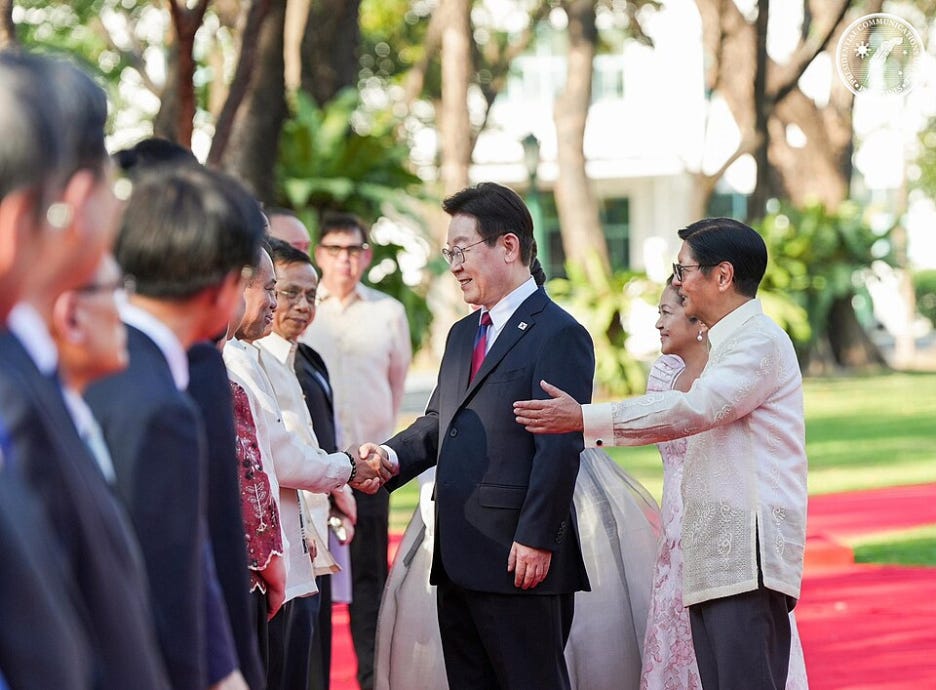
“South Korean president Lee Jae Myung and Philippine president Bongbong Marcos in Manila, 2026” by the Presidential Communications Office is marked with Public Domain Mark 1.0.
_06.jpg)
South Korean President Lee Jae Myung is seeking a greater role in international security and defense supply chains while also pursuing a more self-reliant defense posture. South Korea's expanding defense partnerships reflect a broader effort to translate its growing defense-industrial capacity into political influence and reduce strategic vulnerabilities amid intensifying US-China competition. Yet as Lee advocates for “peaceful coexistence” with North Korea, Pyongyang's continued military development and deepening cooperation with Russia underscore the potential limits of this approach. Together, these trends create new opportunities for defense-industrial and security cooperation in Southeast Asia, the Middle East and North Africa, but raise uncertainty about the Korean peninsula’s longer-term security environment.
In today’s full analysis:
Seoul Navigates a Contested Security Environment
Deepening Defense Cooperation with Middle Powers
Implications for Businesses
Or listen to the full report here:

Listen to the news:
Global
British intelligence sees a growing threat matrix to the homeland posed by Iran, Russia and terrorists harnessing cyber tools. In a public briefing, MI5 director-general Sir Ken McCallum stated that the UK is devoting more resources to countering threats to the state than during the Cold War. Russian military and intelligence services are targeting the UK in hybrid warfare, calibrated to fall below the threshold to trigger NATO’s mutual defense clause. Russia is engaging in sabotage operations, recruiting operatives online for paid work. Iran is demonstrating its foreign intelligence capabilities, attempting to target military sites. The UK has stood up a new AI Threat Assessment Centre, as terrorists and other hostile actors seek to use AI-enabled reconnaissance and attack methodologies.
This threat landscape extends to other European countries as well as the US. Countries are hardening their critical infrastructure, including communications networks, energy grids, water plants and digital infrastructure to reduce vulnerabilities to physical and hybrid sabotage. Military and intelligence agencies are moving beyond defensive measures to build toolkits for offensive operations to manipulate, degrade, disrupt, deny and destroy adversary targets. Cyberspace is already recognized as an operational warfighting domain, alongside land, sea, air and space.
Read More: Wall Street Journal [paywall], White House, European Union Institute for Security Studies
Europe
Baerbel Bas, Germany’s Labor Minister and the co-Chair of the center-left Social Democrats (SPD), stepped down from her positions on Monday. Bas’ decision is personal, as she desires time to process a death in her family. Nonetheless, the decision will begin a leadership contest that can magnify the political divisions within the SPD, whose rank and file have critiqued leadership to demand more concessions from the SPD’s senior coalition partner, the center-right Christian Democrats (CDU/CSU). This could create pressure to demand prioritization of the SPD’s policies in the coalition contract, including regarding healthcare and retirement benefits, that clash with the CDU’s reform agenda. In the meantime, Alexander Schweitzer, a former premier of the federal state of Rhineland-Palatinate, will perform interim duties as Labor Minister.
An SPD leadership contest could take place in either December or January. Lars Klingbeil, the other co-chair of the SPD and the current Vice-Chancellor, would also be challenged in such a contest. Klingbeil’s campaign to maintain leadership as a co-chair could add stress to the government coalition; if new leadership or a new co-chair disagrees with Klingbeil’s compromises, the coalition could grind to a halt or possibly break. It could also weaken the SPD’s performance in upcoming state-level elections in April 2027.
Read More: Deutsche Welle, Politico, Der Spiegel [in German], Stepwise Risk Outlook
Middle East
The UN called on the US and Iran to agree to a longstanding proposal to move fertilizer through the Strait of Hormuz. The proposal, first put forward last month, would see the UN facilitate the transport of fertilizer components through the Strait from Oman, with the consent of the US and Iran as part of a peace deal or alongside negotiations. Neither the US nor Iran has addressed the proposal.
If a deal is not agreed, a missed growing season could compound a global food crisis. Prior to the war, one third of global fertilizer shipments passed through the Strait, and shipments have cratered since the onset of the war (almost none of the recovery of transits has included fertilizer shipments). Available fertilizer capacity has fallen by nearly 40% since the strait was disrupted, and if no progress is made, prices of food staples could soar up to 80%.
Read More: Reuters [paywall], Wall Street Journal [paywall], Al Jazeera
Asia-Pacific
US payments giant Visa announced on Tuesday it received approval from the People’s Bank of China to prepare to establish a domestic bankcard clearing institution in China. The approval allows Visa to complete preparations over the next year before applying for an operating license, potentially enabling it to process domestic yuan-denominated card transactions through its own network. The move follows similar approvals for other US payment networks, including Mastercard in 2023. However, unlike Mastercard, which entered through a joint venture with state-backed NetsUnion Clearing, Visa is pursuing a wholly foreign-owned operation.
The decision signals Beijing’s willingness to expand foreign access to selected financial services. Visa stands to benefit from China’s large domestic payments market but will face entrenched local competitors. The timing carries diplomatic significance as it follows US President Donald Trump’s summit with Chinese leader Xi Jinping earlier this year in Beijing, which Visa CEO Ryan McInerney was part of the delegation for. The approval comes ahead of the leaders’ expected meeting on the sidelines of the APEC summit in Shenzhen next month, possibly underscoring Beijing’s strong interest in maintaining stable relations as the two remain engulfed in their repeatedly extended trade détente.
Read More: Visa, South China Morning Post [paywall], Wall Street Journal [paywall], CNBC
Americas
Jamaica received 22 deportees from the US on Tuesday, its first third-country deportations from the US. Jamaica had signed a bilateral memorandum of understanding in June approving the plan. This agreement provides that the Jamaican government will transfer deportees back to their home countries or elsewhere after their arrival in Jamaica. A joint statement from the Jamaican Ministry of National Security and Peace and the Ministry of Foreign Affairs and Foreign Trade described the agreement as a transit arrangement, which would not be funded by the government. Rather, deportees would be supported by the UN’s International Organization for Migration. Jamaica did not agree to accept deportees with criminal records. The arrangement has been denounced by Jamaican opposition leaders who raised national security concerns.
This comes amid a growing number of agreements between the Trump administration and other countries willing to accept deportees from third countries. In many of these cases, the individuals being deported are not citizens of and have no ties to their destination countries. At least 35 nations have entered into similar agreements with the US, and the Trump administration has earmarked around $410 million to support this effort. There are ongoing legal challenges against third-country deportations, but five European Union member states are now looking to push forward with similar plans to deport asylum seekers whose applications are rejected to third countries outside the EU.
Read More: Al Jazeera, CBS, ABC
Africa
Former President of the Democratic Republic of the Congo (DRC) Joseph Kabila is organizing a new military-political coalition with AFC/M23 members, confirming his support for the insurgency. The move follows months of accusations from Kinshasa that Kabila supports M23, the Rwanda-backed insurgent group that is a member of the broader Alliance Fleuve Congo (AFC), a coalition that seeks to overthrow the Congolese government. The new alliance, the Front pour la Refondation de la Nation (FRN), will replace the AFC and includes multiple M23 officials. The former president, who opposes current President Felix Tshisekedi after a power-sharing agreement between the two collapsed, was sanctioned by the US in April 2026 for allegedly financing M23.
The formation of the FRN also coincides with reports of severe internal divisions within M23, which could explain the reorganization. M23 security services reportedly thwarted a plot by Théo Binamungu, a senior political official, and other political and military figures to oust M23 military chief Sultani Makenga and reassign the military intelligence chief, as well as the governorships of North and South Kivu, provinces in eastern Congo where the AFC has organized parallel governments.
Concerns have mounted that Kabila’s official involvement could mobilize more individuals to join the FRN, intensifying the conflict. This, in turn, is likely to prompt the Tshisekedi government to intensify its drone campaign and ground operations in eastern Congo, delaying US-backed peace proposals to stabilize the region and encourage greater investment in the country’s critical minerals sector. However, tensions carried over from the AFC are likely to persist and could affect the FRN’s stability.
Read More: Al Jazeera, Critical Threats, Stepwise Risk Outlook
Geoeconomics
US inflation accelerated in September as gasoline prices jumped and underlying price pressures remained firm. The Consumer Price Index rose 0.6% from August, when it increased 0.4%, lifting annual inflation to 3.7% from 3.4%. Gasoline prices climbed 9.1%, accounting for more than half of the monthly increase. Core CPI, which excludes food and energy, rose 0.3% for a second consecutive month, while its annual rate increased to 2.6% from 2.4%. Shelter prices gained 0.4%, and used vehicles, airline fares and clothing also became more expensive. Food prices were unchanged overall, with a small decline in grocery prices offsetting higher restaurant costs. The figures show that energy remains the principal driver of the headline increase.
The report raises the likelihood of another Federal Reserve rate hike at its October 27–28 meeting. Immediately after the release, traders priced in roughly a 50% probability of an October increase, up from around 20%. Treasury yields and the dollar rose, while US stock futures fell. The Fed already raised rates by 25 basis points in September, and its central concern is whether higher energy costs sustain broader inflation. Some economists expect delayed increases in diesel-related costs and persistent services inflation to slow the decline in underlying prices, even as energy prices eventually ease, suggesting borrowing costs could remain elevated after gasoline stops pushing headline inflation higher, thereby prolonging pressure on household spending and business investment.
Read More: BLS, Reuters [paywall], Reuters [paywall], Peterson Institute for International Economics
Disruptive Technology
ICYMI: The White House is making its incident reporting regime mandatory due to increased risks of AI mishandling of government systems. The Super Intelligence Task Force’s clarified that incident reporting is a “national security obligation” for model developers. This clarification occurs after Anthropic disclosed that its models submitted 19 nonimmigrant visa applications to the State Department based on publicly available information found on the department’s website. Similar mistakes have likely occurred across government agencies.
The move from a voluntary to a mandatory regime sends a strong regulatory signal early into the Super Intelligence Task Force’s tenure. The Task Force will submit a report on AI risks and opportunities in Q1 2027, possibly informing regulatory action on AI safety. The White House’s current AI safety initiatives have so far been voluntary to preserve a light-touch regulatory posture, but momentum for stronger regulation is increasing on both sides of the political aisle.
Read More: Axios, PYMNTS, TechCrunch
Energy
The EU is considering a windfall tax on energy companies. Wopke Hoekstra, the European Commissioner responsible for climate and taxation, announced that the Commission would establish a working group to look into the viability of a windfall tax on energy. Some European capitals (Germany, Spain, Portugal, Italy, Poland and Austria) have already called on the EU Commission before to implement a levy on energy profits derived from the effects of the war in the Middle East. The EU has implemented such a measure before; in 2022 the EU responded to Russia’s invasion of Ukraine and the subsequent energy shock with a windfall tax. However, that measure provoked legal challenges which are still being worked out in the court system.
Some countries are taking unilateral steps on energy policy. Lisbon has already implemented a 33% tax on extraordinary profits for energy companies for 2026. Germany intends to establish a new consumer levy in order to fund a new emergency gas reserve, which would cover the loss of Germany’s largest import infrastructure for up to 30 days.
Read More: Reuters [paywall], Reuters [paywall], Financial Times [paywall]
Transnational Crime & Corruption
The criminal trial of Serhii Kuzniestov, a former Ukrainian army officer accused of participating in the 2022 bombing of the Nord Stream gas pipelines, begins today. Kuzniestov was arrested in Italy in August 2025 and charged with a war crime by German prosecutors in July 2026. The prosecutors accused Kuzniestov and a team of divers, sailors, and explosives experts of carrying out the bombing on behalf of Ukrainian state entities. A scuba diver, Vladimir Zhuravlyov, is also facing an extradition case in Croatia.
The trial is politically awkward for Germany, which is simultaneously supporting Ukraine in its war against Russia. Kuzniestov’s lawyer has argued that the Nord Stream pipeline was a “Russian weapon” and a legitimate military target. The defendant’s counsel asserted that he would be unable to defend himself in court without exposing Ukrainian state secrets. Kyiv has consistently denied involvement in the Nord Stream bombings. A German court ruled in December that the Nord Stream bombers could lose legal protections owed to lawful combatants and that the pipelines were not legitimate military targets. It also ruled that the pipeline’s Russian owners could not join the prosecution as co-plaintiffs.
Read More: Reuters [paywall], Financial Times [paywall], Wall Street Journal [paywall]
Defense
India is selling its domestic defense products in Central Asia. Tajikistan and Turkmenistan have reached an agreement to import India’s Akash short-range surface-to-air missile system, giving New Delhi a foothold in Central Asian defense markets. Indian defense exports have skyrocketed recently, jumping 62% from the period between March 2025 and March 2026 as New Delhi works to build up its domestic defense industry and arms export business.
Russia’s war against Ukraine has created opportunities in defense cooperation. Tajikistan and Turkmenistan have historically been dependent on Russian arms and are potentially looking to diversify as Russia’s defense production is focused on domestic demand. Armenia, a member of the Russian-led Collective Security Organization, became the first buyer of the Akash system in 2022. Yerevan has also emerged as India’s largest market for defense exports. India has also historically had a strong defense relationship with Moscow.
Read More: Defense News, Reuters [paywall], War on the Rocks


Contact Us
Karl Hopkins
Partner
+1 202 429 6499
khopkins@steptoe.com
Melissa B. Mahle
Senior Advisor
+1 202 261 0577
mmahle@steptoe.com
Anni Coonan
Senior Intelligence Analyst
+1 212 506 3979
acoonan@steptoe.com
Samuel Bloebaum
Senior Due Diligence Analyst
+1 602 410 6240
sbloebaum@steptoe.com
Zayna Dembinski
Analyst
+1 202 778 3567
zdembinski@steptoe.com
Thomas Goldstein
Analyst
+1 202 862 6735
tgoldstein@steptoe.com
Ian Cameron
Analyst
+1 202 327 6908
icameron@steptoe.com
Elton Smole
Analyst
+1 202 261 0556
esmole@steptoe.com
Carter Spahn
Intelligence Fellow
+1 202 261 7555
cspahn@steptoe.com
Chris Dantes
Intelligence Fellow
+1 202 327 6904
cdantes@steptoe.com
Legal disclaimer: This Substack is for educational and informational purposes only and does not constitute the rendering of legal counseling or other professional services. Reading, subscribing to, or communicating through this Substack does not create an attorney-client relationship. Do not send confidential information through this platform. Consult qualified legal counsel regarding your specific circumstances.