

Welcome to the Stepwise Risk Outlook, which highlights and contextualizes over-the-horizon developments in key regions of the world and industries of the global market. Today’s featured deep dive by Carter Spahn examines the implications of rising global government debt.

The World’s Governments Face a Debt Reckoning
By Carter Spahn
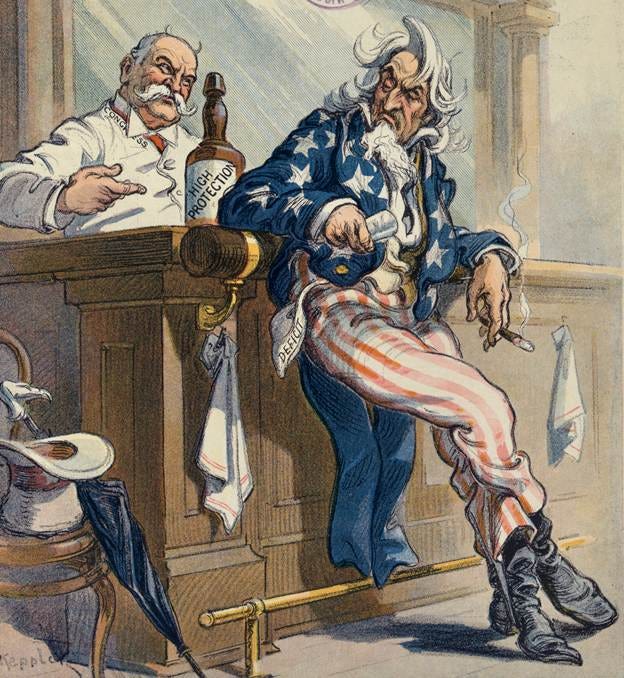
“The Honest Bartender’s Bracer” by Udo J. Keppler is in the public domain.

The world is in debt. Global public debt reached a nominal value of $111 trillion in 2025, up from $49 trillion in 2010. Including private borrowing, total debt reached roughly $365 trillion in the first half of 2026, more than three times annual global GDP. The cost of carrying these obligations is shaping what governments can afford.
Many governments face growing spending commitments without the political consensus needed to stabilize their debt burdens. Borrowing allows governments to postpone difficult choices, but rising interest costs and weaker growth narrow their options. What governments protect and what they sacrifice will affect public services, investment and their ability to respond to the next downturn, while potentially risking domestic stability. For businesses, investors’ doubts about a government’s finances can raise borrowing costs through higher bond yields, while pressure to rein in public spending could reduce government subsidies.
In today’s full analysis:
Promises Under Pressure
The Cost of Buying Time
The Creditor Cometh
Or listen to the full report here:

Listen to the news:
Global
Reuters investigation identifies “heat storms” as a climate risk that is upending life around the world. Reuters, working with meteorologists and climate researchers, has documented a new phenomenon of expansive heat waves swarming the planet that, once rare – averaging five active storms per year in the 1960s – now average about 102 a year. While heat waves last a week or less, heat storms persist for months. The largest heat storm on record lasted 367 days over 2023-2024 and impacted almost 85% of the globe.
Heat storms are changing living conditions through lasting, systemic effects. They exacerbate droughts and fires across Europe and Latin America. Warming temperatures are shifting agricultural zones, with less rainfall in some areas but creating more beneficial environments in high northern terrain. While heat storms have increased in frequency, cold snaps and the length of winter have decreased. The Reuters investigation recommends naming heat storms as a way to increase awareness and focus policymakers on climate resiliency.
Read More: Reuters [paywall], Celsius.Earth
Europe
Romanian parliament confirmed Luca Niculescu, a diplomat and former journalist, as Prime Minister with a technocratic government backed by the Social Democrats (PSD), the largest faction in Parliament. Romania has endured nearly six months of instability after PSD withdrew from a grand coalition over disagreements with austerity policies. Romanian President Nicușor Dan attempted to form a government three times with liberal candidates, but failed each time without support from PSD or the populist-right Alliance for the Union of Romanians (AUR), which seeks snap elections. Under the agreement, only PSD will be represented in Niculescu’s cabinet, but the centrists and the liberals will not file a vote of no-confidence for at least six months to allow the passing of a budget.
The PSD-led cabinet intends to pass an investment-focused budget instead of austerity and possibly invite the liberals into a renewed grand coalition after six months. Romania has entered the EU’s Excessive Debt Procedure to bring down spending from over 9% in 2024 to 3% by 2030. An investment-focused budget will aim to unlock €11 billion in EU recovery funds and invest in energy infrastructure.
Read More: Politico, BalkanInsight, Reuters [paywall]
Middle East
US Envoy Tom Barrack told Middle Eastern partners that the US’ role as security guarantor is “ending” at the Global Security Forum in Doha over the weekend. It’s a message that has been delivered with varying bluntness by successive administrations, but the specifics are notable. Barrack, in line with President Trump’s historically anti-forever-war base, characterized past US interventions as a “mistake” and called on US partners to “realign.” The statement comes as the US reportedly considers a resumption of large-scale hostilities against Iran ahead of upcoming midterms.
The message comes as the Middle East is attempting a security pivot – but the US’ role cannot be replaced. The Mecca Accords, including a mutual defense agreement, between Saudi Arabia, Türkiye and Qatar, is a notable example; it is in company with broader Gulf efforts to boost domestic defense spending, ink new regional and mini-lateral defense cooperation agreements, and boost bilateral relationships with major defense product producers like France, Italy and South Korea. But underlying the shift is the understanding that the US security umbrella cannot be replaced, even as it is demonstrated to have serious holes and even targets – teeing up an uncertain defense environment for the Middle East in coming years.
Read More: Wall Street Journal [paywall], AGSI, Reuters [paywall], Stimson Center
Asia-Pacific
Malaysia on Tuesday deregistered the country’s main opposition coalition, Perikatan Nasional (PN), less than two weeks before candidate nominations for the November 14 Melaka state election. The Registrar of Societies cited PN’s failure to adequately address concerns over an internal dispute after coalition party member Bersatu alleged it had been excluded from a key coalition meeting. The decision prevents PN’s parties from contesting under a shared banner, potentially complicating the opposition’s election preparations. PN plans to challenge the decision in court, alleging political interference.
The Melaka election will be the next test for Prime Minister Anwar Ibrahim following losses in three other state polls over the past year. Anwar’s leadership has been repeatedly criticized, including by coalition partner UMNO (United Malays National Organization), which has voiced support for an early general election, which is not constitutionally required until February 2028. Meanwhile, public anger continues to grow over the government’s perceived failure to squash corruption and accusations that he and his party are linked to “corporate mafia” dealings.
Read More: South China Morning Post [paywall], South China Morning Post [paywall], Strait Times
Americas
Canadian Prime Minister Mark Carney will travel to Türkiye on Wednesday for meetings Thursday and Friday aimed at deepening bilateral ties. During the visit, Carney will meet Turkish President Recep Tayyip Erdoğan in Ankara to discuss trade, investment, defense, security, and people-to-people ties, while also providing an update on negotiations toward a Canada-Türkiye free trade agreement. He will then travel to Istanbul to meet with business leaders as part of Ottawa’s broader effort to diversify trade and strengthen relationships with key “middle powers” amid ongoing tensions with the United States.
Energy cooperation is expected to be a key outcome of the visit. Canada and Türkiye are expected to sign agreements to deepen collaboration in the energy sector, with discussions on potential Turkish purchases of Canadian LNG, cooperation on critical minerals, and nuclear energy. The two sides are also expected to establish a working group to assess a potential role for Canadian CANDU reactor technology in Türkiye’s planned expansion of nuclear power generation, which Ankara sees as a major component of its long-term energy strategy.
Read More: The Globe and Mail [paywall], Reuters [paywall], CBC
Africa
Libya’s Haftar-aligned House of Representatives voted to approve a 2019 maritime boundary memorandum with Türkiye. The agreement, originally signed between the internationally recognized Government of National Accord and Türkiye, established an Exclusive Economic Zone extending from Türkiye’s southern Mediterranean shore to Libya’s northeast coast. The deal was heavily contested by Greece, Cyprus, and Egypt, who argued that the EEZ violated their sovereignty. Greece rejected this most recent approval, arguing it lacks legal validity.
The vote underscores Ankara’s deepening influence in eastern Libya. Türkiye previously backed the western government in Tripoli against Haftar and the eastern government during the civil war. However, Ankara has since pursued rapprochement with the Haftar family, culminating in security cooperation, including a deal in July to develop military facilities and surveillance systems. Türkiye is now balancing relations with both governments to secure eastern approval of its maritime demarcation line with Libya. The vote is likely to intensify ongoing eastern Mediterranean disputes and signals the growing pragmatism of Türkiye-Haftar relations despite their previous rivalry.
Read More: Al Jazeera, Reuters [paywall], Brookings Institution, Stepwise Risk Outlook
Geoeconomics
APEC finance ministers warned that persistent global economic imbalances threaten growth and stability, but stopped short of agreeing to specific corrective measures. Meeting in Hong Kong on October 20–21, representatives of the forum’s 21 economies, including the US, China and Japan, pledged closer economic-policy coordination and reaffirmed the importance of keeping supply chains and trade corridors open. The statement identified geopolitical tensions, volatile commodity prices, tighter financing conditions and rising debt vulnerabilities as risks to growth. Ministers also supported strengthening household consumption where needed, while preserving fiscal sustainability. Separately, they endorsed a voluntary, nonbinding framework for financing digital infrastructure, encouraging development-bank guarantees and blended public-private financing to attract investment. These initiatives establish areas for cooperation without specifying how members will reduce persistent trade surpluses and deficits.
Reducing those imbalances would require different, and politically difficult, changes in China and the US. The IMF has urged China to shift growth toward domestic consumption and called on Washington to reduce budget deficits through tax or spending adjustments. Stronger Chinese household demand could absorb more domestic production and increase imports, while smaller US fiscal deficits would raise national saving and help narrow the external deficit.
Read More: APEC, Associated Press, Reuters [paywall], IMF, Peterson Institute for International Economics
Disruptive Technology
The Department of Homeland Security issued an Exclusion and Removal Order for DeepSeek products from federal IT systems over national security concerns. The order extends restrictions on the use of DeepSeek products, which had already existed for national security agencies in December 2025, to federal civilian agencies. That means existing and new IT systems must be insulated from DeepSeek products, and government contractors will be expected to do the same. The order notes that the Chinese government could access personally identifiable and other sensitive data collected by DeepSeek. Chinese Foreign Ministry spokesperson Mao Ning stated that Beijing opposes “overstretching the concept of national security” to politicize technology. The order could add further tension to the US-China trade truce, which expires in January 2027.
Read More: The Hill, TechCrunch, Federal Register [pdf]
Energy
The EU is also considering a softer stance on energy drilling in the Arctic. Brussels is reportedly set to drop its call for a moratorium on energy drilling in the Arctic. The EU’s draft policy still says that the bloc will “prioritize” renewable energy and energy options outside the Arctic, that Brussels will work for an international commitment to prevent energy development in the Arctic, and that the EU wants energy resources in the region to remain in the ground. However, this is still a shift from its last strategy, when the EU had called for a global moratorium on drilling in the Arctic.
Arctic drilling policy has been a topic of intense discussion between Brussels and Norway. Oslo, which continues to work on developing new Arctic energy resources, has lobbied the EU to soften its stance toward Arctic energy drilling. Norway sells almost all of its energy exports to the EU, and the bloc’s stance on importing Arctic energy would therefore have a significant impact on Norway.
The shift is part of the EU’s newly released Arctic strategy. The new strategy, which updates the last document from 2021, focuses heavily on security in the region and promises to build out satellite surveillance, boost monitoring of critical undersea infrastructure and assist EU members in developing their icebreaker fleets. The EU’s emphasis on the Arctic matches growing geopolitical tensions in the region.
Read More: Reuters [paywall], Bloomberg [paywall], Financial Times [paywall], Euronews
Transnational Crime and Corruption
The US is hosting the US-Pacific Islands Conference of Police Ministers this week as transnational criminals are becoming more prevalent in the Pacific. The US, represented by delegations from numerous federal law enforcement agencies, is hosting police ministers from across the Pacific, including Ecuador and the Philippines. Topics for the conference include confronting narcotrafficking, scam centers, and illegal fishing by criminal enterprises. The conference is co-chaired by the nation of Palau. Regional observers note that the vast geography of the Pacific and limited resources of island nations allow for criminals to use the ocean as a “narco highway” connecting Asia, Australia, and North and South America.
The conference comes as Pacific nations have been increasing law enforcement cooperation. On Sunday, a coalition of Pacific islands chiefs of police formed the Pacific Community of Policing. Australia, a member of the new coalition, praised it as an opportunity to combat security threats without members being forced to give up sovereignty. The Pacific Island Forum Leaders Meeting also launched the Waqa Moana initiative last month to tackle maritime security and criminal trafficking issues.
Read More: US Department of State, Lowy Institute, Center for Strategic and International Studies
Defense
Both the US Navy and Army are developing and implementing programs for using AI in repair and maintenance. The Navy is expanding the ceiling on its contract to use a combination of sensors and robots paired with AI to repair vessels. The Navy is quadrupling the ceiling of the contract to $300 million, which would likely allow it to scale from 18 Pacific Fleet ships to also work on the Atlantic Surface Fleet. For its part, the Army’s Communications-Electronics Command is piloting a program to digitize the service’s approximately 7,500 maintenance training manuals. The program, known as Artificial Intelligence-Assisted Maintenance (AIAM), is intended to consolidate the manuals in a cloud-based and artificial intelligence-enhanced program. AIAM remains in the pilot phase currently, with around 200 to 250 manuals having been digitized.
Read More: Defense Scoop, Stars and Stripes


Contact Us
Karl Hopkins
Partner
+1 202 429 6499
khopkins@steptoe.com
Melissa B. Mahle
Senior Advisor
+1 202 261 0577
mmahle@steptoe.com
Anni Coonan
Senior Intelligence Analyst
+1 212 506 3979
acoonan@steptoe.com
Samuel Bloebaum
Senior Due Diligence Analyst
+1 602 410 6240
sbloebaum@steptoe.com
Zayna Dembinski
Analyst
+1 202 778 3567
zdembinski@steptoe.com
Thomas Goldstein
Analyst
+1 202 862 6735
tgoldstein@steptoe.com
Ian Cameron
Analyst
+1 202 327 6908
icameron@steptoe.com
Elton Smole
Analyst
+1 202 261 0556
esmole@steptoe.com
Carter Spahn
Intelligence Fellow
+1 202 261 7555
cspahn@steptoe.com
Chris Dantes
Intelligence Fellow
+1 202 327 6904
cdantes@steptoe.com
Legal disclaimer: This Substack is for educational and informational purposes only and does not constitute the rendering of legal counseling or other professional services. Reading, subscribing to, or communicating through this Substack does not create an attorney-client relationship. Do not send confidential information through this platform. Consult qualified legal counsel regarding your specific circumstances.