

Welcome to the Stepwise Risk Outlook, which highlights and contextualizes over-the-horizon developments in key regions of the world and industries of the global market. Today’s featured deep dive by Zayna Dembinski examines Gen Z protests in India and implications for upcoming elections.

India’s Wave of Gen Z Protests and Growing Distrust in Democratic Institutions
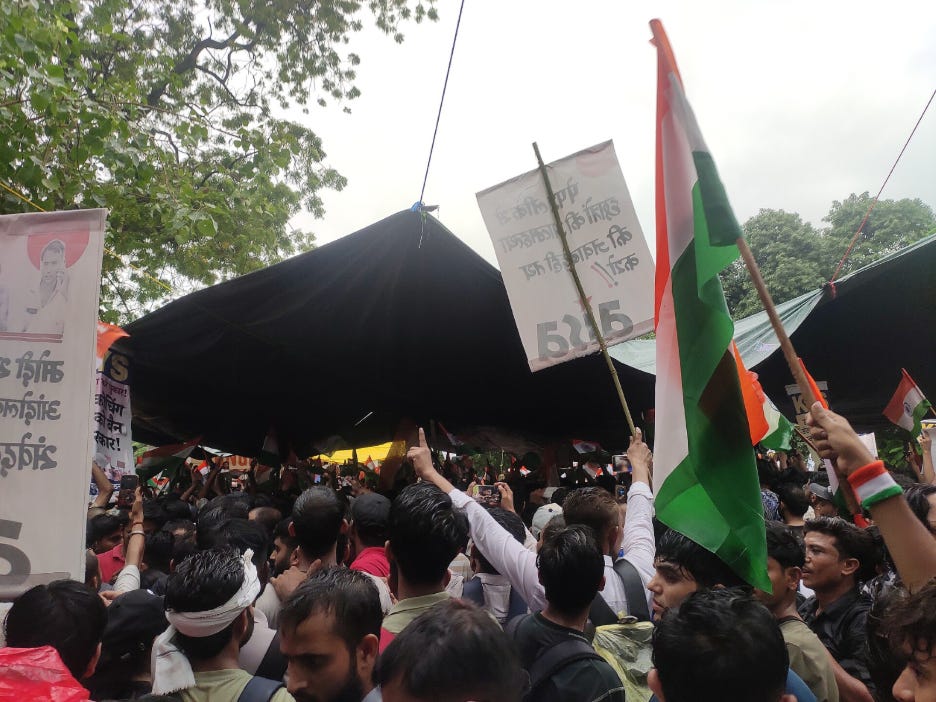
“Students from All Over India protesting against 2026 NEET UG paper leak place Jantar Mantar on 20 July 2026 ahead of Parliament March 31” by Sumita Roy Dutta is marked with CC BY-SA 4.0.

India’s latest wave of protests over large-scale voter-roll revisions has renewed scrutiny of electoral integrity and highlighted distrust in its institutions. The demonstrations have brought together opposition parties and the youth-led Cockroach Janata Party (CJP), amplifying growing pressure on Prime Minister Narendra Modi’s ruling Bharatiya Janata Party (BJP). And the government’s crackdown on demonstrators, which has drawn international condemnation for its heavy-handedness, further intensifies concerns over the BJP’s handling of public grievances. Prolonged protests risk deepening public dissatisfaction ahead of key 2027 state assembly elections, disrupting key business activities, and further alienating its large youth population already frustrated by limited economic opportunities.
In today’s full analysis:
Immediate Triggers and Underlying Grievances
Protests and the Government’s Heavy-Handed Response
Outlook and Business Implications
Or listen to the full report here:

Listen to the news:
Global
International security agencies urged mass updates to websites that use PHP programming language, which underpins about 70% of the internet. The PHP Foundation released a statement clarifying that it theoretically understood two critical vulnerabilities related to memory safety and error execution since 2024. It noted that the exploitation of those vulnerabilities would have allowed malicious actors to take control of servers and steal sensitive data, but exploitation required an impractical chain of steps. However, frontier AI models could have closed the execution gap. Therefore, the PHP Foundation has worked with cybersecurity actors on a coordinated disclosure of patches on October 21. Security agencies from the US, UK, Canada, Japan, and Australia urged rapid updates or taking servers offline to perform updates expeditiously. Several government websites in the EU were taken down.
Read More: The PHP Foundation, Politico, Reuters [paywall], Wiz
Europe
European Commission President Ursula von der Leyen hinted yesterday that proposals to strengthen the EU’s trade countermeasures are coming in December. President von der Leyen stated that the new trade tools will likely match recent proposals in a recent Franco-German white paper, namely a “cut-off” tool to quickly limit access to dumped foreign products that distort the internal market, as well as a diversification tool and a “solidarity mechanism” for countries affected by cheap imports. The cut-off tool would be quicker than the existing Anti-Coercion Instrument, which requires a qualified majority and approval from the European Parliament to activate.
The codification of such trade tools would reflect a paradigm shift for the EU, originally a free trade bloc, to embrace geoeconomic flexibility. The EU’s trade deficit with China topped an average of €1 billion per day in 2025, undermining the competitiveness of legacy European industrial manufacturers. Germany, historically a protectionism skeptic, has moved closer to the French position.
Read More: Yahoo!news, Politico, Euronews
Middle East
US troops and diplomats are evacuating Middle East posts amid new risks of US escalation and the Houthi flare-up in Yemen. The US ordered some diplomats and family members to depart postings in Saudi Arabia yesterday over rising risks of Houthi strikes – also a consistent signal of planned new escalation. Concurrently, US officials told news media that the US had been quietly reducing its footprint.
The news comes as regional escalation is widening and threats of new US escalation are rising. Disruption from Houthi strikes on Saudi Arabia has risen, including nearing one hundred deaths and disruptions to oil production and air travel, and a broader regional coalition has signaled support for the conflict. Meanwhile, President Trump has repeatedly threatened new major strikes on Iran, either after midterms or sooner, potentially using major armaments to strike Iran’s remaining nuclear enrichment sites. The US is openly increasing its options with the transfer of a new carrier strike group to the Middle East this week. With the diplomatic channel stuck for weeks, new strikes may be a way for the US to signal action ahead of elections, but reengagement risks further spillover as the war becomes increasingly regionalized.
Read More: CBS, Reuters [paywall], NPR, CNN, Jerusalem Post
Asia-Pacific
The Philippines is interested in expanding cooperation with Taiwan on protecting undersea cables and countering “grey zone” tactics in their shared region. Speaking in Washington on Wednesday, Filipino diplomat Felipe F. Carino III said the two sides were exploring “practical and more pragmatic” approaches to undersea cable cooperation, which he linked to tensions in the South China Sea. Potential areas of cooperation include knowledge sharing and capacity building; whether joint patrols would be on the table is unclear.
Carino said the Philippines was exploring closer cooperation “notwithstanding [its] one China policy.” Manila has maintained this policy framework since signing the Philippines-China Joint Communique in 1975. His remarks drew a sharp response from Beijing, with China’s Foreign Ministry spokeswoman reiterating on Thursday that “there is no gray area on the Taiwan question” and urging the Philippines to uphold the one-China policy.
Both Taiwan and the Philippines regularly face what they view as Chinese grey zone tactics, including maritime aggression, which seem aimed at undermining their sovereignty and expanding Beijing’s reach. Both have individually stepped up their responses to perceived Chinese maritime incursions and appear poised to deepen cooperation: next October, Taiwan’s Coast Guard is planning a visit to the Philippines. This would mark its first known call since 1974, the year before Manila switched diplomatic recognition to the PRC.
Read More: Reuters [paywall], Nikkei Asia [paywall], China Daily
Americas
El Salvador’s President Nayib Bukele announced on Wednesday a military operation in Haiti to rescue four Salvadoran members of an international security force being held hostage by Haitian gangs. The four Salvadorians are aviation technicians for the UN-backed Gang Suppression Force, which is made up of forces from several nations including Chad and Sri Lanka. Gangs opened fire on their armored vehicle in Croix-des-Bouquets, Port-au-Prince, and they have been missing since attempting to flee the burning vehicle.
Bukele gave a forceful statement demanding the hostages’ release and threatening an even more forceful response if they are not released. In a statement on X, Bukele said: “Today’s attack is nothing compared to what is coming if they do not release the four hostages alive. And do not take our words as empty threats. We have already finished with the gangs in El Salvador, and we can finish with you too.” The Haitian government also released a statement describing the situation as an “absolute priority,” and a meeting was held at the prime minister’s office to assess the ongoing operation and the need for any further action in cooperation with the Gang Suppression Force.
Read More: AP, Reuters [paywall], New York Times [paywall]
Africa
Nigeria reported its first Ebola case in the current outbreak on Tuesday, raising concerns about further regional spread. The patient is a diplomat who traveled from Uganda to Abuja, according to the Nigeria Centre for Disease Control and Prevention (NCDC). The NCDC confirmed the patient is infected with the Bundibugyo strain and is monitoring 44 individuals who were in contact with the patient. During the 2014 Ebola epidemic, Nigeria’s rapid response and support from international organizations helped contain the outbreak within 21 days, limiting it to 19 cases and seven deaths. Further transmission could be prevented if the Nigerian government mounts a similar mobilization, strengthening cross-border surveillance and rapidly identifying and isolating suspected cases. However, the risk of additional cross-border infections remains and underscores the need for regional coordination.
Read More: Radio France Internationale, AllAfrica
Geoeconomics
The IMF expects the Middle East, North Africa and Pakistan to contract this year as the Iran war disrupts energy exports and wider economic activity. Its regional outlook, released October 22, projects a 1.3% decline in output in 2026. Gulf Cooperation Council economies are expected to shrink 4.8%, compared with the 2% growth forecast in April. Kuwait and Qatar face particularly severe contractions of 16.7% and 15.6%, respectively, while Saudi Arabia’s economy is projected to shrink 3.3% and the UAE’s 3.9%. Oman is the only GCC economy expected to grow, expanding 4.1%. Disrupted energy production and shipping are combining with damage to tourism, trade and investor confidence. Oil-importing economies have proved more resilient, supported by remittances, tourism receipts and government assistance, although their capacity to cushion further shocks is narrowing.
Any projected recovery will not erase the war’s economic damage or the pressure on government finances. The IMF forecasts regional growth of 6.6% in 2027, but output would generally remain below pre-war projections, and further disruptions could undermine the rebound. Lower energy exports reduce the taxes, royalties and dividends available to governments, limiting their ability to support other economic activity.
Read More: Reuters [paywall], The National, IMF, Atlantic Council
Energy
The UK is approving the Jackdaw North Sea gas field after years of political and legal delays. According to Energy Minister Miatta Fahnbulleh, the project can start providing gas supplies by the end of the month, which will help alleviate pressure from the Iran war. The decision was also greeted with approval by US President Donald Trump, who has repeatedly encouraged London to approve the field. The Jackdaw project had been in limbo after climate groups challenged its permits.
London is trying to balance energy security and economic pressures with its climate policy goals. The UK’s Labour government is seeking to reconcile globally rising focus on energy supply security with its climate ambitions. As part of that, the government is creating a new Energy Wealth Fund with an initial £2 billion ($2.7 billion) investment to promote clean energy and demonstrate London’s continued commitment to the energy transition. The approval has still received sharp criticism from the Green Party, which called it “climate vandalism.”
The next big question is the Rosebank oilfield. Rosebank has been in a similar limbo to the Jackdaw field, but Fahnbulleh is reportedly leaning towards rejecting Rosebank as more export-oriented and not grounded in energy security concerns. However, the ultimate decision would lie with Prime Minister Andy Burnham. Chancellor John Healey is reportedly more in favor of approving the Rosebank project.
Read More: Reuters [paywall], BBC, The Guardian
Defense
The US is planning to expand its military presence in Greenland in 2027. The Pentagon will evaluate options over the winter to build out US basing in Greenland with a goal to break ground on new facilities in 2027. In September, the administration announced plans to expand the US presence at Pituffik Space Base and to develop sites at Mestersvig and Narsarsuaq into new US bases.
The plans are coming approximately a month after the US signed a new trilateral agreement with Denmark and Greenland. The agreement enables a larger presence on the island and has generally expanded the US’ partnership with Denmark on Arctic security around Greenland. The agreement also foresees deployment of the US’ proposed “Golden Dome” missile defense system.
The Arctic is taking on increasing importance for security and geopolitics. The EU has also taken an increasingly security-oriented approach to Arctic policy, and the US has repeatedly expressed concerns about Chinese and Russian security threats in the Arctic in the context of Greenland’s importance to national security.
Read More: Defense One, Army Recognition, Reuters [paywall] Council on Foreign Relations, Stepwise Risk Outlook


Contact Us
Karl Hopkins
Partner
+1 202 429 6499
khopkins@steptoe.com
Melissa B. Mahle
Senior Advisor
+1 202 261 0577
mmahle@steptoe.com
Anni Coonan
Senior Intelligence Analyst
+1 212 506 3979
acoonan@steptoe.com
Samuel Bloebaum
Senior Due Diligence Analyst
+1 602 410 6240
sbloebaum@steptoe.com
Zayna Dembinski
Analyst
+1 202 778 3567
zdembinski@steptoe.com
Thomas Goldstein
Analyst
+1 202 862 6735
tgoldstein@steptoe.com
Ian Cameron
Analyst
+1 202 327 6908
icameron@steptoe.com
Elton Smole
Analyst
+1 202 261 0556
esmole@steptoe.com
Carter Spahn
Intelligence Fellow
+1 202 261 7555
cspahn@steptoe.com
Chris Dantes
Intelligence Fellow
+1 202 327 6904
cdantes@steptoe.com
Legal disclaimer: This Substack is for educational and informational purposes only and does not constitute the rendering of legal counseling or other professional services. Reading, subscribing to, or communicating through this Substack does not create an attorney-client relationship. Do not send confidential information through this platform. Consult qualified legal counsel regarding your specific circumstances.