


Welcome to the Stepwise Risk Outlook, which highlights and contextualizes over-the-horizon developments in key regions of the world and industries of the global market. In today’s Stepwise Risk Outlook, we’re introducing a new segment: Watch List. Periodically on Fridays, our analysts will cover parallel trends across multiple countries.

Watch List: Europeans Protest Over Affordability Ahead of Elections
By Ian Cameron, Thomas Goldstein, and Elton Smole
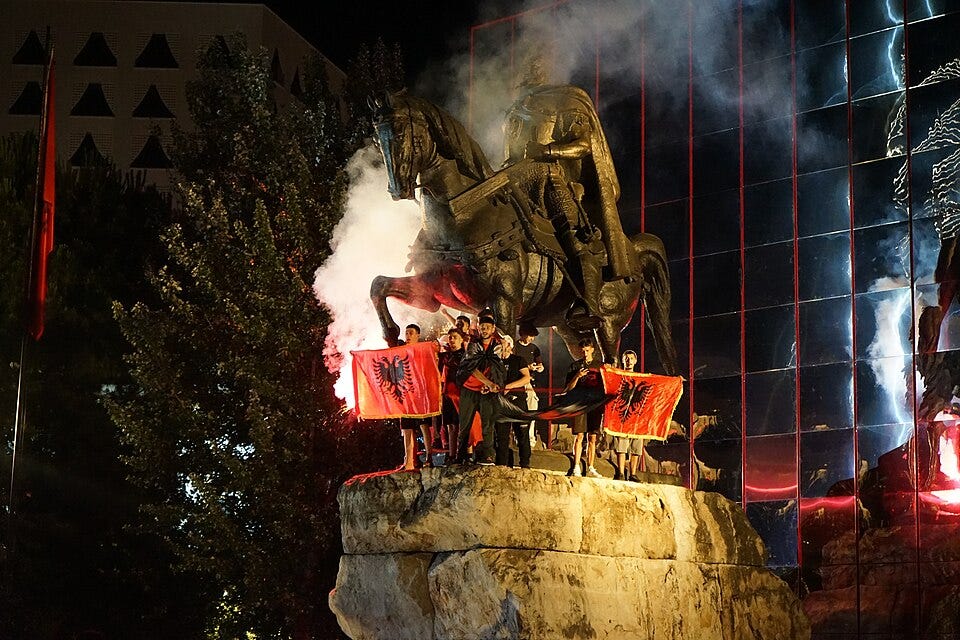
“Flamingo Revolution Tirana Protest” by Albinfo is licensed under Creative Commons Attribution 4.0 International.

Over the past several weeks, major protests have erupted throughout the European continent. Driven by affordability concerns and coming in advance of elections in France, Italy and Spain, the demonstrations are rocking European capitals and creating new risks for market confidence, the EU’s policy agenda and multinational operations. Read our analysts’ takes on protests in France, Spain, Italy, and Albania below.
In today’s full analysis:
Ian Cameron, Europe analyst – France’s domestic unrest is colliding with the country’s growing economic and fiscal difficulties
Thomas Goldstein, Europe analyst: Spain’s protests are focused on housing costs but sparked elections that could lead to government change
Ian Cameron, Europe analyst – Economic unhappiness across Italy is putting the government under increasing pressure
Elton Smole, Europe and Americas analyst: Albania’s anti-government protests call for political change amid push for EU membership
Or listen to the full report here:

Listen to the news:
Global
Defense sovereignty is gaining momentum as countries seek to reduce their defense technology dependence on the US and supply chain vulnerabilities to China. The political dispute behind the curtailing of access for the Ukrainian armed forces to American-owned Starlink is fueling a sense of urgency across Europe about the risks of over-dependence on the US with no ready European alternative. China’s policies to restrict critical minerals and specialty magnet exports to European defense companies are still working their way through the European defense sector as companies search for alternatives, which are few. The increased political and market risks will strengthen the case being made in EU capitals for Buy European policies and send market signals to European defense contractors on emerging opportunities and possible increases in government investment.
Demand for defense sovereignty is not new. The emerging defense industries in the Arab Gulf states are an outgrowth of policies adopted to reduce their dependence on US and European defense technologies. At critical junctions, the US and European governments have restricted arms sales to the Gulf states for political reasons. The UAE and Saudi Arabia have been investing in defense technologies, building domestic capabilities while diversifying their defense relationships. Those investments are now producing new technologies in smart weapons, autonomous systems and electronic warfare that Gulf states own and control.
Read More: Reuters [paywall], Financial Times [paywall], CNN, Carnegie Endowment
Europe
Romania is accelerating deployment of additional surveillance capabilities to the Black Sea as attacks on commercial vessels increase. Since the beginning of October, at least seven commercial cargo vessels have been hit in or near the territorial waters of Romania or Bulgaria, and at least 30 sailors are reported dead or missing. No state actor has officially been attributed, but Romanian F-16 fighter jets have scrambled and shot down at least two Russian drones over Romanian territorial waters in the past week. On October 20, the North Atlantic Council – NATO’s decision-making body – agreed to deploy additional maritime patrol aircraft, radars, and drones to the Black Sea to deter further attacks.
Russia may be increasing the frequency of attacks to increase leverage over Ukraine. Kyiv and Moscow are both attempting to maximize economic pain to each other’s exports. As Ukraine increases “kinetic” sanctions on Russian refineries and “shadow fleet” oil tankers, Russia has increased targeting of cargo ships in the Black Sea, including ships carrying Ukrainian wheat and fertilizer. Attacking all vessels deters shipping for everyone. Moreover, Russia may be interested in slowing or disrupting Romania’s gas projects in the Black Sea, which could help Southeastern Europe diversify from Russian gas.
Read More: Reuters [paywall], The Defense Post
Middle East
Israel ordered a “full lockdown” of the West Bank after soldiers killed two men suspected of launching an attack on Hebron. Five were injured in the attack on Friday morning. The army said it prevented a “terror attack on Israeli civilians” and, two hours later, ordered the full closure of the West Bank and cordoned off the city of Hebron. Prime Minister Netanyahu blamed Hamas for the attack, but no group has claimed it.
The closure comes amid mounting violence and tension between Israel and Palestinians ahead of Israel’s Tuesday election. Settler violence in the occupied West Bank has spiked sharply, prompting condemnation from the EU, UN and – in an unusual move – the US (which resulted in the arrest of ten over unspecified attacks). But Tuesday’s election complicates the response: Netanyahu wants to present a strong response to Hamas, in line with his record as a security-minded leader, and avoid upsetting his likely coalition members on the far right, who are pro-settlement. The frontrunner of his more moderate challengers, Gadi Eisenkot, has characterized the attacks as “Jewish terrorism,” and the Arab parties have become a surprisingly influential player as negative Arab sentiment has risen.
Read More: NPR, The New York Times [paywall], The Times of Israel, Reuters [paywall], BBC
Asia-Pacific
China on Thursday unveiled revised rules on outbound investment, strengthening reporting requirements for major adverse developments and overseas reinvestment projects. The revised measures expand the existing framework to cover individuals alongside enterprises and other organizations. The rules aim to strengthen safeguards for Chinese investors against overseas risks, including political instability and policies Beijing considers discriminatory. The rules will take effect on December 1.
The revisions come as Chinese companies face heightened scrutiny of overseas investments, particularly in the US and Europe. China’s outbound direct investment reached $213.6 billion in 2025, while its overseas investment stock totaled $3.4 trillion, keeping the country among the world’s top three outbound investors for nine consecutive years. The revisions also come the same day the US Treasury proposed rules implementing the Comprehensive Outbound Investment National Security (COINS) Act, which would require notification of certain US investments in dual-use strategic technologies in countries of concern, including China.
Read More: The State Council of the People’s Republic of China, China Daily, US Department of the Treasury
Americas
Venezuelans took to the streets Thursday to demand elections. Thousands of opposition supporters demonstrated in Caracas and other cities in the country’s first nationwide opposition protest in nearly two years, calling for a date to be set for presidential elections and for the return of exiled opposition leader and Nobel Peace Prize winner Maria Corina Machado. The protests were organized by her Vente Venezuela movement amid growing frustration that no election timetable has been announced since former president Nicolas Maduro was removed in January and replaced by interim president Delcy Rodriguez. Despite Venezuela’s history of harsh crackdowns on dissent, security forces maintained a relatively limited presence, and the demonstrations remained largely peaceful.
Talks on a political transition have continued gradually through US-backed negotiations between the interim government and the opposition faction led by Dinorah Figuera. This has included a new round of talks this month but has yet to produce an agreement on elections. The discussions are focused on reforming Venezuela’s Supreme Court and electoral council before a vote can be scheduled, a process that could take significant time. Machado’s movement is not directly participating in the talks, though she has said she will not obstruct them, while continuing to press for elections to be held by July 2027.
Read More: Al Jazeera, Time, Reuters [paywall]
Africa
South Africa is preparing for potential exclusion from the African Growth and Opportunity Act (AGOA) amid worsening relations with the Trump administration. AGOA, which was recently extended to 2028 by Congress, grants duty-free access to eligible Sub-Saharan African states. South Africa has traditionally been included in this framework, and certain sectors such as automotive equipment, agriculture, and plastic products have benefited from duty-free access to US markets. Washington continues to argue that Pretoria is not taking sufficient measures to prevent systemic discrimination against Afrikaners, prompting visa restrictions on South African officials deemed complicit. This has raised concerns in Pretoria that South Africa could be removed from AGOA, although the US has not publicly indicated whether it intends to revoke the country’s eligibility.
At the same time, China-South Africa trade has expanded, signaling further shifts in economic relations. Since China implemented a zero-tariff regime for most African countries in May 2026, exports from South Africa to China have increased 25%. This growth reinforces South Africa’s broader effort to diversify its trade relationships. In turn, these trends could further expand Pretoria-Beijing cooperation in critical minerals and other strategic industries, potentially reducing opportunities for US firms and intensifying great-power competition for influence and resources in southern Africa.
Read More: Reuters [paywall], Reuters [paywall], Semafor, Brookings Institution
Geoeconomics
The US Department of the Treasury has proposed expanding restrictions on US investment in sensitive technologies in China and other countries of concern. The October 22 proposal would implement the 2025 Comprehensive Outbound Investment National Security Act, extending the existing China-focused program to Russia, Iran, North Korea and Cuba. It would add biotechnology, hypersonic systems and high-performance computing to the semiconductor, quantum and AI sectors already covered, while tightening restrictions on AI development. Certain investments would be prohibited, and others would require notification to Treasury, rather than prior government approval. Publicly traded securities would generally remain exempt. Small transactions totaling up to $50,000 over 12 months would qualify for an exemption from notification, but not from prohibitions. Public comments are due December 7; the expanded rules are not yet final.
Read More: US Treasury, Financial Times [paywall], Council on Foreign Relations
Energy
More oil coming out of the Middle East still isn’t affecting prices. The total amount of oil traversing the Persian Gulf and other alternative routes has crossed more than 24 million barrels per day (bpd), while prewar levels were 23.3 million. This has been enabled by the US Navy keeping the Strait of Hormuz open to transit. However, over the last several weeks Brent crude prices have ticked upwards from around $100 per barrel to around $110, and yesterday Brent moved up to $113.
There are doubts about the sustainability of oil flows from the Middle East. The potential for fighting to break out again between the US and Iran undercuts any stability in oil leaving the region, and Iran has threatened to widen its strikes to hit more civilian and economic targets if fighting resumes. The sustainability of US protection of shipping through the strait is also unclear given its high costs.
Read More: Wall Street Journal [paywall], Reuters [paywall], Wall Street Journal [paywall], CNBC


Contact Us
Karl Hopkins
Partner
+1 202 429 6499
khopkins@steptoe.com
Melissa B. Mahle
Senior Advisor
+1 202 261 0577
mmahle@steptoe.com
Anni Coonan
Senior Intelligence Analyst
+1 212 506 3979
acoonan@steptoe.com
Samuel Bloebaum
Senior Due Diligence Analyst
+1 602 410 6240
sbloebaum@steptoe.com
Zayna Dembinski
Analyst
+1 202 778 3567
zdembinski@steptoe.com
Thomas Goldstein
Analyst
+1 202 862 6735
tgoldstein@steptoe.com
Ian Cameron
Analyst
+1 202 327 6908
icameron@steptoe.com
Elton Smole
Analyst
+1 202 261 0556
esmole@steptoe.com
Carter Spahn
Intelligence Fellow
+1 202 261 7555
cspahn@steptoe.com
Chris Dantes
Intelligence Fellow
+1 202 327 6904
cdantes@steptoe.com
Legal disclaimer: This Substack is for educational and informational purposes only and does not constitute the rendering of legal counseling or other professional services. Reading, subscribing to, or communicating through this Substack does not create an attorney-client relationship. Do not send confidential information through this platform. Consult qualified legal counsel regarding your specific circumstances.