


Welcome to the Stepwise Risk Outlook, which highlights and contextualizes over-the-horizon developments in key regions of the world and industries of the global market. Today’s featured deep dive by Ian Cameron examines the implications of conflict in the Black Sea.

Conflict in the Black Sea is Escalating: Outlook and Implications for Regional Security, Shipping, and Trade
By Ian Cameron
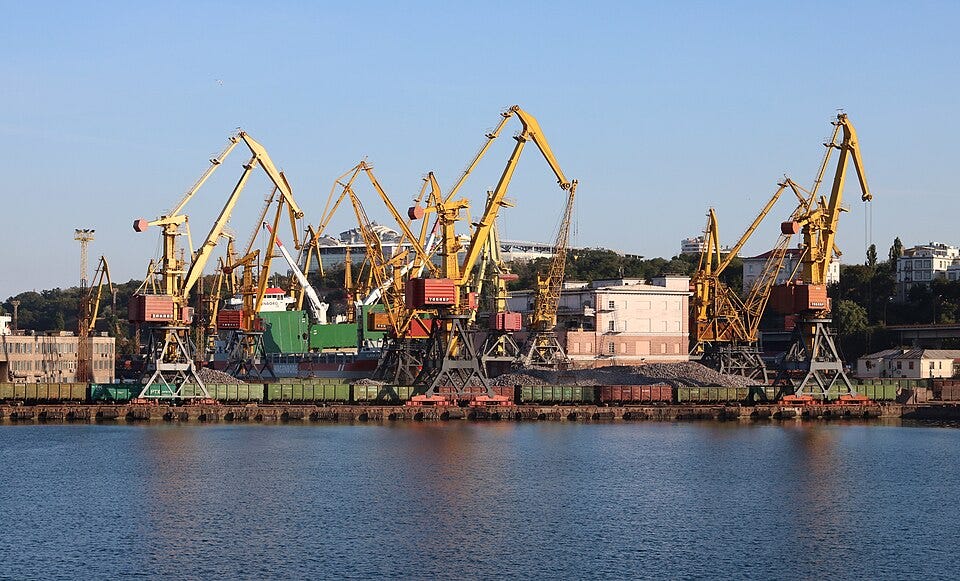
“Odessa Marine Trade Port” by George Chernilevsky is marked with Public Domain

Over the last several months, the conflict between Russia and Ukraine in the Black Sea has escalated rapidly, endangering shipping routes and heightening tensions between Russia and NATO. Most recently, drone strikes have occurred in Romanian territorial waters and near Bulgaria’s. The worsening crisis in the Black Sea is undermining both Ukraine and Russia’s ability to export from Black Sea ports, which has particularly important implications for global agricultural markets. Strikes targeting the waters of NATO members are also intensifying Russia’s overall campaign against Ukraine’s European supporters and could potentially create new sources of tension between the US and Europe.
The Black Sea’s security crisis creates both downside and upside risks for international businesses. The strangling of Black Sea shipping could risk undermining global food security and worsening shortages on global energy markets, undercutting economic prospects and potentially feeding political instability in countries reliant on imports. However, growing NATO focus on the Black Sea could increase demand for defense technologies supporting air defenses, surveillance and domain awareness. Interest in diversification and supply security could create opportunities for alternative supply routes and alternative sources of commodities.
In today’s full analysis:
Escalation and a Worsening Maritime Security Environment
Between NATO and Moscow: The Security Politics of the Black Sea
Outlook, Risks, and Opportunities
Or listen to the full report here:

Listen to the news:
Europe
UK Chancellor of the Exchequer John Healy will present a budget tomorrow in a major test for Andy Burnham’s Labour government. The UK, like other European governments, faces a difficult fiscal picture amid increasing borrowing costs, defense obligations, and inflation of essentials like food and energy bills. Healy’s task is to balance dual objectives of keeping gilts attractive to bond markets—which are fleeing France—while also meeting the government’s goal of inclusive growth. The previous Labour government led by Keir Starmer faced an internal revolt over the previous budget, which was considered too austere by party members.
The budget is reported to focus on modest social relief and devolution. One major initiative includes a £1.5 billion borrowing facility that can allow municipalities to take on debt in coordination with Westminster, front-loaded by an initial £285 million. This facility, which will be created in consultation with local governments, is contextualized by Burnham’s emphasis on greater “devolution,” or decentralization, from London. Another idea is to finance cost-of-living relief packages through additional surcharges on gambling and bank profits, without broad tax increases. Major spending questions regarding defense are reportedly overlooked in the current budget draft.
Read More: The Guardian, Bloomberg [paywall], Financial Times [paywall]
Middle East
A flurry of high-level diplomacy took place in the Middle East amid rising signals of renewed conflict. On Monday, the Mecca Pact countries – Saudi Arabia, Turkiye and Pakistan – made a rare joint visit to Tehran to discuss regional security. The meeting followed a visit by Qatari mediators and a solo visit by a Pakistani representative the week before. Concurrently, Oman called for a regional non-aggression pact, and China pledged to send an envoy to the Middle East in the near future to “promote dialogue and ease tensions.”
The apparently unsuccessful diplomatic push comes as the US and Iran increasingly signal readiness for a return to full-scale war. Last week, media reported that the US and Israel had drawn up new plans to target Iran again; in the wake of these reports, Iranian officials are apparently convinced that the US is on the brink of unleashing a new round and are in advanced stages of planning a new attack (per US intelligence this week). The electoral calendar could impose some brakes – it would be risky for the US to launch a new offensive, which would push oil prices further up, in the days before midterm elections. But as Iranian leverage over the Strait of Hormuz has lessened and diplomatic tracks have mostly failed, the US does appear increasingly convinced that only decisive military victory could shake up the stalemated conflict.
Read More: New York Times [paywall], Gulf News, Reuters [paywall], New York Times [paywall], NPR
Asia-Pacific
German Chancellor Friedrich Merz on Tuesday called for stronger Europe-Asia cooperation on trade and security, urging the reduction of “unhealthy, one-sided dependencies” on China without fully decoupling. Speaking in Singapore, the first stop of his week-long Asian tour accompanied by around 30 business leaders, Merz advocated coordinated responses to trade violations and proposed a free trade agreement between the EU and the Comprehensive and Progressive Agreement for Trans-Pacific Partnership (CPTPP). He also announced plans with Singaporean Prime Minister Lawrence Wong to expand bilateral cooperation, including on protecting critical underwater infrastructure. Meanwhile, Singaporean investors reaffirmed confidence in Germany’s long-term economic potential.
Merz will also visit Japan and South Korea to strengthen economic and security ties amid regional tensions and shifting trade relationships. In Japan, he is expected to meet Prime Minister Sanae Takaichi and attend the German-Japanese Business Summit, where discussions will cover regional security and advanced technology, including a planned partnership between Japanese and German companies to develop nuclear fusion technology and build a commercial plant in Germany over the next decade. In South Korea, Merz will meet President Lee Jae Myung, who on Monday expressed reluctance to join the CPTPP during his term. Merz may also raise reports that South Korea shipped 176,000 tons of fuel to Russia via sanctioned tankers in July and August, which Seoul has denied.
Read More: Bloomberg [paywall], DW, Reuters [paywall], Nikkei Asia [paywall], Guardian
Americas
Maria Corina Machado returned to Venezuela on Sunday after nearly 10 months abroad. The opposition leader and 2025 Nobel Peace Prize laureate was greeted by large crowds of supporters, and on Tuesday the Nobel Peace Prize committee released a statement welcoming her return. The massive show of support by her supporters in the streets of Caracas underscored her continued influence within Venezuela’s pro-democracy movement despite being excluded from formal transition talks. Machado has called for presidential elections by the summer of 2027. She has previously said that she would run for president again if elections are held.
Machado’s return comes amid ongoing negotiations on Venezuela’s political transition. The US-backed talks between the interim government of Delcy Rodriguez and a faction of the opposition are focused on overhauling the country’s electoral institutions before any vote is held. US Secretary of State Marco Rubio said progress is being made toward appointing a new supreme judicial tribunal and electoral council, arguing that the existing institutions must be replaced before elections can take place. While Machado’s Vente Venezuela movement is not participating directly in the talks, Rubio said Washington supports her right to return and has pressed Venezuelan authorities to allow her to operate freely in the country.
Read More: Reuters [paywall], Reuters [paywall], State Department
Energy
Saudi Arabia is planning to stockpile crude oil in Singapore to boost Asia’s energy security. Riyadh will store reserves in Singapore’s Jurong Rock Caverns starting in the second half of 2027, according to both countries’ energy ministers. According to Tan See Leng, Singapore’s minister for energy, trade and industry, negotiations on the agreement are underway and should conclude within the next several months. Saudi Arabia already stores oil in South Korea and Japan, where Seoul and Tokyo receive priority to buy the crude supplies in the case of unexpected supply issues.
Asia was particularly affected by the Strait of Hormuz’s closure and the subsequent energy crisis. More than half of the oil directed for Asia transited the Strait of Hormuz before the Iran war began. While supplies from the region have stabilized and other producers have stepped in to meet Asia’s needs, the initial shock was nonetheless severe. The Iran war has pushed energy security to the top of regional and global agendas and highlighted the dangers in reliance on single sources of critical resources and on overall dependency on outside energy providers.
Read More: Reuters [paywall], Yahoo Finance, New York Times [paywall]
Defense
Germany is planning to buy jet-powered drones from a Ukrainian startup. Berlin is in discussions with Kyiv to buy the Bars drone, which has a range of 1,000 kilometers and a top speed of 700 kilometers per hour. Ukraine has used thousands of Bars drones per month in its deep strike campaign into Russia.
Germany already cooperates with Kyiv on Bars manufacturing. Germany committed to finance the manufacturing of drones for Ukraine’s armed forces as part of a deal signed in July as part of the Build with Ukraine initiative.
Germany is leveraging its connections with Ukraine in its defense buildup. As Berlin rearms, it is tapping Ukraine’s technical and battlefield experience. As of September, there were 36 joint ventures in defense technology between Ukrainian and German firms.
Read More: Kyiv Independent, Ukrainska Pravda, Stepwise Risk Outlook


Contact Us
Karl Hopkins
Partner
+1 202 429 6499
khopkins@steptoe.com
Melissa B. Mahle
Senior Advisor
+1 202 261 0577
mmahle@steptoe.com
Anni Coonan
Senior Intelligence Analyst
+1 212 506 3979
acoonan@steptoe.com
Samuel Bloebaum
Senior Due Diligence Analyst
+1 602 410 6240
sbloebaum@steptoe.com
Zayna Dembinski
Analyst
+1 202 778 3567
zdembinski@steptoe.com
Thomas Goldstein
Analyst
+1 202 862 6735
tgoldstein@steptoe.com
Ian Cameron
Analyst
+1 202 327 6908
icameron@steptoe.com
Elton Smole
Analyst
+1 202 261 0556
esmole@steptoe.com
Carter Spahn
Intelligence Fellow
+1 202 261 7555
cspahn@steptoe.com
Chris Dantes
Intelligence Fellow
+1 202 327 6904
cdantes@steptoe.com
Legal disclaimer: This Substack is for educational and informational purposes only and does not constitute the rendering of legal counseling or other professional services. Reading, subscribing to, or communicating through this Substack does not create an attorney-client relationship. Do not send confidential information through this platform. Consult qualified legal counsel regarding your specific circumstances.