


Welcome to the Stepwise Risk Outlook, which highlights and contextualizes over-the-horizon developments in key regions of the world and industries of the global market. Today’s featured deep dive by Elton Smole examines the implications of the Brazilian general election.

Lula’s Surprise Comeback Shifts Economic Outlook for Brazil
By Elton Smole
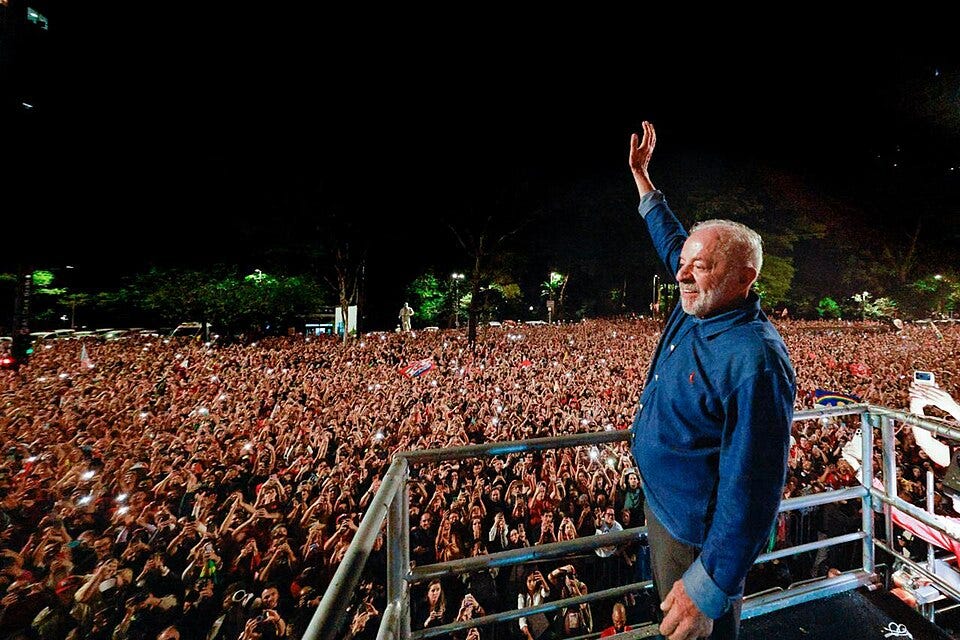
“25.10.2026 - Lula é reeleito Presidente do Brasil - 55612286757.jpg” by Lula Oficial is licensed under CC BY-SA 4.0.
Brazil reelected President Luiz Inácio Lula da Silva on Sunday to a fourth term in a historic political comeback that halted Latin America’s streak of right-wing election wins. His opponent, Flávio Bolsonaro, had outperformed expectations in the first round of voting on October 4, prompting Lula to launch an aggressive push of campaigning that won him around ten million more votes in Sunday’s runoff than he received in the first round. Despite Bolsonaro's initial calls to annul the election results over alleged irregular court rulings, Bolsonaro's Liberal Party subsequently acknowledged Lula's victory and there will likely be no repeat of the unrest that followed the 2022 election. Lula’s challenge will now be to govern with a conservative majority in Congress while seeking to address the country’s precarious fiscal position. Downside risks include political chaos in the short term, including potential US sanctions on government officials after Flávio Bolsonaro fled Brazil and was granted a visa to enter the US. Upside risks include a potential market correction in the medium-to-long term.
In today’s full analysis:
Brazilian Markets Tumble amid Fiscal Concerns
Questions Remain around Lula’s Economic Agenda
Global Implications of Lula 4.0
Or listen to the full report here:

Listen to the news:
Global
Public backlash against power-hungry data centers is spreading beyond the US to Europe and Asia. In the US, data centers have become an election issue in some states, pitting pro-growth business interests against community concerns over electricity, water and land use. In Europe, grassroots groups are backing petitions, legal protests and civil society campaigns to demand increased transparency for projects and moratoriums on future development plans. In countries like Australia, India and South Korea, citizen groups are fighting fast-tracked government approvals that ignore local resource constraints.
Governments and companies are increasingly focused on local communities to address concerns while making the case that advancing projects are central to future economic growth. According to McKinsey’s forecast, the AI revolution is profoundly transforming data centers, driving a projected $7 trillion global investment by 2030, with hyperscalers committing over $1.3 trillion by 2027. To meet growing demand, national-level governments are adopting regulatory regimes to shape the buildout for sustainable growth, tying physical expansion directly to energy efficiency, power availability, grid congestion, and environmental mandates rather than just land and capital.
Read More: CNBC, Nikkei Asia, The Regulatory Review
Europe
Finnish President Alexander Stubb and Norwegian Prime Minister Jonas Gahr Støre held a phone call with Russian President Vladimir Putin yesterday. The meeting follows up on a Finnish-Norwegian mediation between the US and Ukraine on October 20. Stubb and Støre emphasized that their countries border Russia, implying that this gives them the authority to represent European voices in US-led negotiations. They emphasized that their diplomatic track is linked to US efforts to participate in a trilateral format with Russia and Ukraine in late November. Not all European leaders were pleased with the call; Danish Prime Minister Mette Frederiksen and caretaker Swedish Prime Minister Ulf Kristersson warned that Europe must act cohesively and Russia is unwilling to give substantive concessions.
European attempts to steer US-led negotiations come amid concern about potential US-Russia commercial deals intended to thaw a political track. Three Russian tankers carrying diesel are en route to the US, albeit without a buyer, as part of a commercial-focused strategy. The Financial Times also reported that the Trump administration is exploring a US consortium acquiring most Lukoil international assets worth $22 billion (with the US International Development Finance Corporation taking a 15% stake) and an LNG joint venture on Sakhalin, an island in Russia’s far east. This could open the door to some sanctions delistings, potentially including Russia’s National Direct Investment Fund.
Read More: Norway Office of the Prime Minister, Reuters [paywall], The New York Times [paywall], Financial Times [paywall]
Middle East
Israeli exit polls show no clear winner of yesterday’s Knesset election. Likud, Netanyahu’s party, made a surprisingly strong showing – winning 26 seats to Yashar’s 21, despite pre-election polls regularly giving Gadi Eisenkot’s party the advantage. Israel’s Arab parties, the Joint List and Ra’am, also made a historic showing, garnering 17-19 seats together (compared to just five in the previous Knesset). The election, seen in Israel as an existential referendum on post-October 7 leadership and on issues central to the fabric of Israeli society (like the power of the Supreme Court and ultra-Orthodox military service), saw high turnout – 77.7%, up from 70.6% in 2022.
The lack of a clear majority forecasts a messy government formation period. According to one exit poll, the pro-Netanyahu bloc had 53 seats in preliminary exit polls, short of the 61 needed to form a government; the anti-Netanyahu bloc (led by Yashar) had 48. With the support of the Arab parties, who have pledged to help oust Netanyahu, the Yashar bloc could clear 61 – but all Jewish parties have pledged not to sit in government with the Arabs.
Answers are weeks away. The final results are not set to be released until next week, after which President Isaac Herzog will ask one party to attempt to form a coalition. It will be a tough task given the inability of either bloc to form a coalition, given exit poll results, and could result in significant political divisiveness.
Read More: New York Times [paywall], Reuters [paywall], The Jerusalem Post, The Times of Israel, New York Times [paywall]
Asia-Pacific
US Defense Secretary Pete Hegseth on Wednesday proposed an “ambitious” new defense cooperation framework with Southeast Asia, emphasizing maritime awareness and closer coordination among regional navies. Speaking at the US-ASEAN Defense Ministers’ Informal Meeting in Cebu, Philippines, Hegseth said the framework would guide cooperation over the next several years, building on existing efforts to strengthen interoperability and expand joint training. The speech gave few details but said Washington was ready to begin developing the framework as Singapore assumes the ASEAN Defense Ministers’ Meeting-Plus chairmanship next year.
The proposal comes as Washington’s Indo-Pacific partners weigh its ability to sustain regional security commitments amid competing military demands. The war in Iran has raised questions about whether Washington can maintain its regional presence while responding to other security priorities. China’s growing military and coast guard presence in the disputed South China Sea adds urgency to maritime cooperation, particularly for the Philippines, a US treaty ally. The proposal offers Washington an opportunity to reinforce its regional partnerships, although its practical significance will depend on how it translates into concrete terms.
Read More: Reuters [paywall], Reuters [paywall], Wall Street Journal [paywall], Channel News Asia, ABS CBN, Antara News
Americas
Brazilian presidential candidate Flavio Bolsonaro fled Brazil on Tuesday, just two days after losing the election. Brazil’s Supreme Court had ordered that he surrender his passport due to an ongoing investigation into alleged financial misconduct. Bolsonaro denies wrongdoing and alleges that the investigation is politically motivated. Following his electoral loss, he told supporters that he had no plans of leaving Brazil. Soon after, it was reported that he had crossed the border into Argentina and boarded a jet bound for Ecuador, and then Florida. His dramatic exit is reminiscent of his father Jair Bolsonaro’s flight from Brazil to Florida after losing the 2022 election to Lula.
The Trump administration has granted Flavio Bolsonaro a visa to enter the US. President Donald Trump said he approved of Flavio Bolsonaro’s arrival, describing Sunday’s elections in Brazil as “strange.” Eduardo Bolsonaro, another son of Jair Bolsonaro, has close ties to the Trump administration and lives in Texas. He was granted a green card by the US government in July. Brazilian officials had warned the US not to allow entry to Flavio Bolsonaro, who would be subject to an extradition treaty between the US and Brazil if he is convicted in the ongoing investigation.
Read More: New York Times [paywall], Washington Post [paywall], The Hill
Geoeconomics
Canada and the UAE have signed a trade agreement intended to expand commerce and investment as Ottawa diversifies beyond the US. Signed October 27, the Comprehensive Economic Partnership Agreement is expected to enter into force in 2027, subject to domestic approval. Once fully implemented, it will reduce or eliminate tariffs on more than 99% of current Canadian exports to the UAE, benefiting producers of pulses and canola, industrial machinery, power-generation equipment and aerospace products. It also addresses non-tariff barriers and improves access for services, including engineering and environmental services. The UAE is already Canada’s largest export market in the Middle East, with two-way merchandise trade reaching C$3.5 billion in 2025. Ottawa expects the agreement to help roughly double bilateral trade to C$7 billion over the next decade.
The partnership could also help Canada finance and build the transport links needed to reach new markets. It builds on the UAE’s November 2025 commitment to invest up to US$50 billion, approximately C$70 billion, in Canada. During the visit, Dubai-based logistics company DP World announced an agreement with Arctic Gateway Group and CentrePort Canada to explore a transportation corridor connecting the Port of Churchill, the Hudson Bay Railway and Winnipeg’s inland shipping hub with its global network. That could create additional export routes for Canadian grain, potash and critical minerals.
The deal comes as Canada accelerates efforts to diversify trade beyond the US amid American tariffs and stalled negotiations with Washington. Carney has pledged to double exports to other markets over the next decade, pursuing new trade and investment partnerships across Asia, Europe and the Middle East.
Read More: Prime Minister of Canada, Global Affairs Canada, Reuters [paywall], Arctic Gateway Group, Macdonald-Laurier Institute
Energy
Russia is boosting its production of diesel to take advantage of sanctions relief. Russian production had fallen to around 160,000 tons per day in the first two weeks of October, but that number is moving towards 180,000 on the back of the Kremlin’s decision to issue export licenses for diesel. Taken against Russia’s domestic consumption, that would leave around 1 million tons per month available for exports. Over the summer, Moscow had instituted a ban on diesel exports due to a domestic fuel crisis triggered by Ukrainian strikes on Russian refineries. Earlier this month, the US and Russia reached an agreement on diesel exports, under which Russia received sanctions relief for its diesel and agreed to sell diesel to the US.
The uptick in diesel production is being accompanied by a downtick in crude oil exports. Exports out of Russia’s western ports could be as much as 200,000 barrels per day (bpd) next month as refineries ramp up their demand for crude. Even though the agreement with Washington is pushing diesel up, overall Russian crude production has been falling for months, and crude exports from Russia had already been trending downwards. How Ukraine continues its campaign against strategic Russian energy targets will also have significant impact on Moscow’s ability to take advantage of the sanctions relief.
Read More: Reuters [paywall], Oilprice.com, Stepwise Risk Outlook
Transnational Crime and Corruption
Private sector cybersecurity companies helped US, German, UK, and Dutch authorities seize an online cybercrime platform. Virtualine was a so-called “bulletproof” hosting service that advertised itself to cybercriminals looking to upload illegal content online. These services advertise that they ignore takedown requests and law enforcement orders. Virtualine was known to host malware, cyberattack software, and sexually explicit images of minors. The service accepted payments through unhosted cryptocurrency wallets, with funds reportedly traceable to known criminal groups and money laundering networks.
Read More: US Department of Justice, Chainalysis, Hacker News
Defense
Poland will be the site of a new European facility for Patriot interceptor maintenance. The new facility is being established in partnership with the NATO members Germany, the Netherlands and Sweden, all of which will contribute to the facility through “critical supply chain” integration. The facility will be able to provide repair, maintenance, and overhaul for PAC-3 interceptor missiles. The facility will not produce interceptors, it will only provide maintenance and repairs. The US has looked into establish a licensing agreement for Patriot interceptor production to Ukraine, with a tentative agreement announced at the NATO summit in Ankara. However, shortly thereafter the announcement was walked back by the administration.
The US is rapidly directing new investment into production capacity for critical capabilities like Patriot interceptors. Over the summer the Pentagon unveiled $3 billion dollars of framework agreement to triple the production of Patriot interceptors and Terminal High Altitude Area Defense (THAAD) interceptors, another category of air defense missiles. Demand has skyrocketed over the last several years against the background of growing global instability and risks, which have strained stockpiles and production capacity’s ability to fill demand.
Read More: Breaking Defense, Military Times, Defense News


Contact Us
Karl Hopkins
Partner
+1 202 429 6499
khopkins@steptoe.com
Melissa B. Mahle
Senior Advisor
+1 202 261 0577
mmahle@steptoe.com
Anni Coonan
Senior Intelligence Analyst
+1 212 506 3979
acoonan@steptoe.com
Samuel Bloebaum
Senior Due Diligence Analyst
+1 602 410 6240
sbloebaum@steptoe.com
Zayna Dembinski
Analyst
+1 202 778 3567
zdembinski@steptoe.com
Thomas Goldstein
Analyst
+1 202 862 6735
tgoldstein@steptoe.com
Ian Cameron
Analyst
+1 202 327 6908
icameron@steptoe.com
Elton Smole
Analyst
+1 202 261 0556
esmole@steptoe.com
Carter Spahn
Intelligence Fellow
+1 202 261 7555
cspahn@steptoe.com
Chris Dantes
Intelligence Fellow
+1 202 327 6904
cdantes@steptoe.com
Legal disclaimer: This Substack is for educational and informational purposes only and does not constitute the rendering of legal counseling or other professional services. Reading, subscribing to, or communicating through this Substack does not create an attorney-client relationship. Do not send confidential information through this platform. Consult qualified legal counsel regarding your specific circumstances.