


Welcome to the Stepwise Risk Outlook, which highlights and contextualizes over-the-horizon developments in key regions of the world and industries of the global market. Today’s featured deep dive by Ian Cameron examines potential US sanctions relief for Russia.

The Trump Administration Considers Sanctions Relief for Russia: Background, Outlook, and Implications
By Ian Cameron
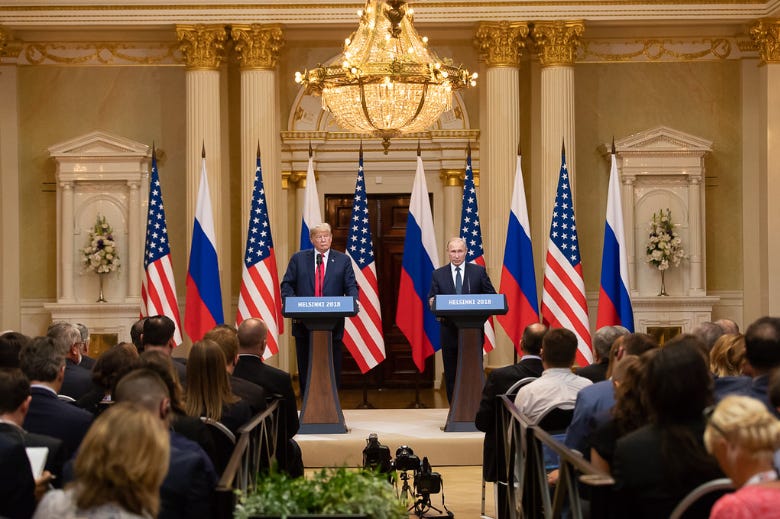
"President Trump & the First Lady's Trip to Europe" by The White House is marked with Public Domain Mark 1.0.
Washington appears to be trending back toward future economic engagement and sanctions relief for Russia despite its ongoing war with Ukraine, which could create misalignments between the US and Europe on sanctions policies and overall economic statecraft toward Russia. Over the last several months, the Trump administration has repeatedly signaled openness to reintegrating Russia into the global economy. At the same time, the EU’s stance on sanctions toward Russia and economic engagement is not softening but rather potentially hardening as Russia escalates its air war against Ukraine and its sabotage efforts against Europe.
Any moves by the US to offer sanctions relief to Russia will likely increase friction between the US and Europe on overarching policy goals regarding Russia and Ukraine. If the US provides Russia with concrete sanctions relief or economic engagement, companies could be confronted with compliance issues from divergent American and European sanctions regimes. American relief for Russia could markedly worsen US-European relations and undermine European trust in American policymaking given the overwhelming belief in most European capitals that Russia represents the most acute threat to the continent’s security.
In today’s full analysis:
Potential For Sanctions Relief: Recent Developments
US and European Divergences on Russia Are Reemerging
Winter is Coming: Potential Risks and Implications
Or listen to the full report here:

Listen to the news:
Global
Logistics costs are keeping oil prices high despite increased flow of oil from the Persian Gulf. Shipowners are paying high risk premiums to keep the oil moving. Sailors and ship captains are receiving double or triple pay and hefty bonuses to crew ships transiting the Red Sea, Gulf of Oman and the Persian Gulf. Maritime war risk insurance for transiting the Strait of Hormuz, cargo insurance and the cost of bunker fuel remain elevated. The Persian Gulf is not the only chokepoint. Panama Canal restrictions are tightening, with the Canal Authority reducing transit capacity and charging surcharges for access. Panama Canal restrictions are related to below-expected rainfall. Geopolitical risks will keep logistics costs high, as a structural feature of the market rather than a temporary spike.
Read More: Financial Times [paywall], Renkert, Yahoo!Finance
Europe
French President Emmanuel Macron and German Chancellor Friedrich Merz jointly called for new trade tools to counter cheap foreign imports in a letter to the European Commission. Specifically, they call for a new “diversification tool” to reduce European dependencies on important supply chains, and second, they call for a “cut-off” tool to counter trading partners that deploy measures leading to “severe and systematic distortions” in specific markets. The second tool is somewhat similar to the existing but untested Anti-Coercion Instrument, but that tool requires a lengthy process for activation; a new “cut-off” tool, meanwhile, is envisioned as being activated by qualified majority, giving the Commission greater speed and discretion of action. Both of these tools would be “country-agnostic” but react to a rapidly growing trade deficit with China, in addition to Beijing’s restrictions on rare earths exports.
Germany’s support for delegating additional trade measures to Brussels bridges typical friction with France. As an export-driven economy, Germany typically prioritizes open trade rules and frets away from potentially provocative actions, especially in regards to China, a major export destination. However, its growing openness to protectionist measures may become a structural shift amid the increasing competitiveness of German manufacturers. German and French unity on additional measures sends a sharp signal to Beijing as EU Trade Commissioner Maroš Šefčovič flies there for trade negotiations.
Read More: Politico, Euronews, Financial Times [paywall]
Asia-Pacific
Ten Indian opposition lawmakers, including Congress leader Rahul Gandhi, were briefly detained Tuesday during a protest demanding the resignation of Chief Election Commissioner Gyanesh Kumar. Around 300 opposition lawmakers marched toward the Election Commission yesterday as part of near-daily protests led by opposition parties, student groups and the “Cockroach” youth movement. Police detained ten lawmakers for attempting to breach security barricades, as well as 260 people.
Protests began Friday over the Election Commission’s voter-roll revisions, which have removed about 130 million names nationwide. Opposition parties allege this has disenfranchised eligible voters and disproportionately affected minority communities, particularly Muslims. Meanwhile, the Election Commission says it is removing duplicate, deceased, “infiltrators” and otherwise ineligible voters. Critics also object to documentation requirements that could exclude eligible voters who cannot establish their eligibility.
Opposition parties accuse Kumar of using the commission to strengthen Prime Minister Narendra Modi’s Bharatiya Janata Party (BJP), an allegation the government and commission reject. For instance, right after a voter roll revision in May that removed nine million names, the BJP won power in West Bengal after decades of not being able to win a majority for the state legislature. The protests come months after the student-led protests that forced the ouster of the federal education minister.
Read More: New York Times [paywall], The Hindu [paywall], Reuters [paywall], DW
Americas
Interpol has announced that its Operation Madre Tierra VIII crackdown on environmental crime led to 233 arrests across Latin America and the Caribbean. The operation, from June 1 to July 31, targeted illegal gold, timber and wildlife trafficking and involved nine countries in the region: Colombia, Costa Rica, the Dominican Republic, El Salvador, Guatemala, Honduras, Mexico, Nicaragua and Panama. In addition to the 233 arrests, the operation reported 313 seizures, including 4.6 tons of cyanide, as well as mercury (used for illegal gold mining), ammunition, and the recovery of more than 1,000 live animals. The operation identified 312 individual suspects and 148,000 acres of illegally cleared forest. The investigation also uncovered financial mechanisms including alleged shell companies used to move profits.
Read More: INTERPOL, AP, The Washington Post [paywall]
Africa
Malian and Russian forces retook the town of Kidal, the most significant victory in recent months, but their ability to hold it remains uncertain. Kidal was captured by JNIM and its allied secular separatist group, the Azawad Liberation Front (FLA), in April and was a major blow to Russia’s credibility as a security guarantor. The Malian military and Russia’s Africa Corps reportedly employed significant airpower, prompting insurgents to withdraw rather than decisively defeating them. Given that much of northern Mali remains a stronghold of JNIM and FLA influence, the recapture is primarily symbolic and unlikely to substantially alter the broader security environment. However, if the Africa Corps is able to retain control, it will be better positioned to retake other towns in the Kidal region, although the Malian army would likely sustain high casualties.
Read More: Radio France Internationale, Al Jazeera, Financial Times [paywall]
Geoeconomics
The US trade deficit widened to its largest level in 17 months in August as record imports outpaced export growth. The goods-and-services gap increased 13.7% to $105.6 billion from a revised $92.8 billion in July. Imports rose 4.3% to $420.8 billion, while exports increased 1.4% to $315.2 billion. Capital-goods imports reached a record $146.4 billion, driven partly by semiconductor and machinery purchases supporting the AI buildout. Crude-oil imports increased by $3.3 billion and nonmonetary gold imports by $3.1 billion, adding to the imbalance. Despite the monthly deterioration, the cumulative deficit through August remained 19.9% below the same period in 2025.
The widening trade gap could weigh on measured GDP. The Atlanta Fed’s October 6 GDPNow model estimates that net exports will subtract roughly 2.7 percentage points from third-quarter growth, but still projects a 3.7% annualized expansion as consumption and investment remain strong. GDP accounting excludes foreign production from domestic output, meaning substantial spending on imported equipment can coexist with slower headline growth.
18 months out from “Liberation Day”, tariffs alone have been unable to narrow the trade imbalance. American demand for imported goods, despite the higher prices, remains strong. More fundamentally, research from the Peterson Institute finds that fiscal and exchange-rate policies play a much larger role than tariffs in determining trade balances. The paper estimates that each $1 reduction in a country’s budget deficit improves its current-account balance by about 30 cents, while each $1 of foreign-exchange reserve purchases improves it by roughly 50 cents or more.
Read More: BEA, Reuters [paywall], Atlanta Fed, Peterson Institute for International Economics
Defense
The US is pushing forward with its directed energy technology for counter-drone missions. The Pentagon has selected four vendors for a directed energy pilot program to counter drones. The program aims to build out the “operational use” of high-energy laser (HEL) and high-powered microwave (HPM) capabilities inside US territory, and it is being managed by the Army-led Joint Interagency Task Force (JIATF) 401. In December, JIATF 401 will conduct a “shoot-off” as part of the pilot program, and systems that perform well could be immediately purchased.
The Army is integrating directed energy systems into larger, layered counter-drone networks. As part of its Operation JAILBREAK FALCON FURY, the Army successfully deployed Epirus’ Leonidas high-power microwave weapon within a larger network connecting sensors, command decisions, and effects. As part of the Army’s Operation Jailbreak, the goal is to examine how to use sensors, command systems, and weapons provided by different suppliers.
Read More: Breaking Defense, Army Recognition


Contact Us
Karl Hopkins
Partner
+1 202 429 6499
khopkins@steptoe.com
Melissa B. Mahle
Senior Advisor
+1 202 261 0577
mmahle@steptoe.com
Anni Coonan
Senior Intelligence Analyst
+1 212 506 3979
acoonan@steptoe.com
Samuel Bloebaum
Senior Due Diligence Analyst
+1 602 410 6240
sbloebaum@steptoe.com
Zayna Dembinski
Analyst
+1 202 778 3567
zdembinski@steptoe.com
Thomas Goldstein
Analyst
+1 202 862 6735
tgoldstein@steptoe.com
Ian Cameron
Analyst
+1 202 327 6908
icameron@steptoe.com
Elton Smole
Analyst
+1 202 261 0556
esmole@steptoe.com
Carter Spahn
Intelligence Fellow
+1 202 261 7555
cspahn@steptoe.com
Chris Dantes
Intelligence Fellow
+1 202 327 6904
cdantes@steptoe.com
Legal disclaimer: This Substack is for educational and informational purposes only and does not constitute the rendering of legal counseling or other professional services. Reading, subscribing to, or communicating through this Substack does not create an attorney-client relationship. Do not send confidential information through this platform. Consult qualified legal counsel regarding your specific circumstances.