


Welcome to the Stepwise Risk Outlook, which highlights and contextualizes over-the-horizon developments in key regions of the world and industries of the global market. Today’s featured deep dive by Elton Smole examines business expectations surrounding the results of the Brazilian elections.

Brazilian Markets Reflect Optimistic Business Outlook Ahead of Key Runoff
By Elton Smole
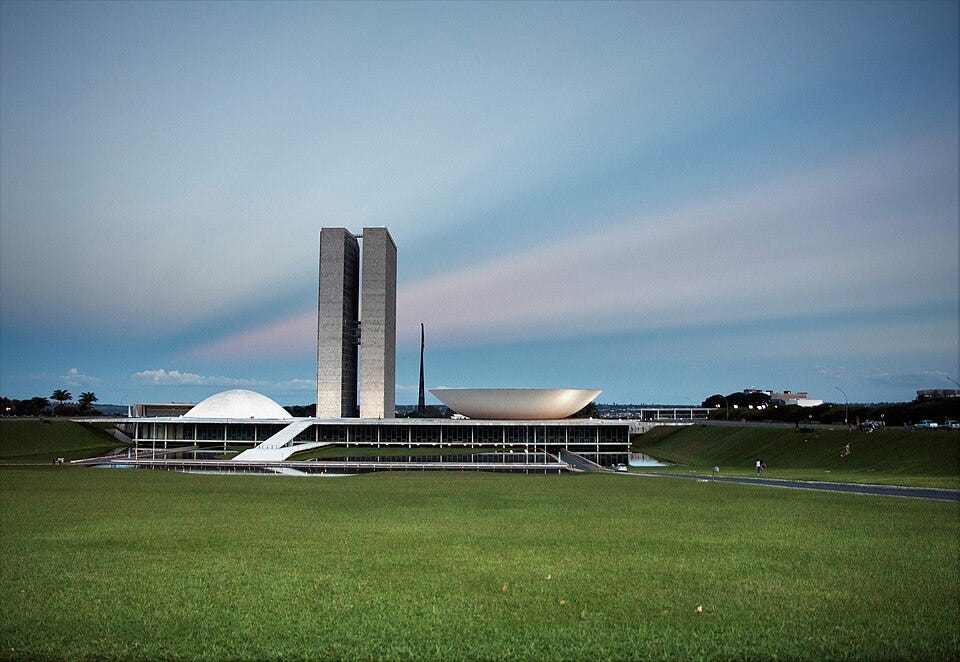
"Pôr do sol sobre Congresso Nacional do Brasil" by Dasfour2022 is licensed under CC BY-SA 4.0.
Markets in Brazil rallied this week after Flavio Bolsonaro’s unexpectedly strong showing in the first round of the presidential elections. The Bovespa index jumped 7.7% on Monday to a new closing record, the real (BRL) appreciated more than 4% against the US dollar, and internationally traded shares of Brazilian companies soared. The bullish reaction to Sunday’s election results were largely driven by expectations that Flavio Bolsonaro, the son of imprisoned former president Jair Bolsonaro, will have the leg up in the October 25 runoff by winning voters from the other conservative candidates that are now eliminated.
Incumbent Luiz Inacio Lula da Silva (Lula) admitted that the results were unexpected, launching a more aggressive campaign strategy to attempt to win votes from the 21% of Brazilians who abstained in the first round. However, the right’s victories in gubernatorial and congressional elections on Sunday point to a broader conservative shift, which would also strengthen Flavio Bolsonaro’s mandate to govern if he is elected. As a result, markets have begun to price in the likelihood of a Bolsonaro presidency in 2027. In this scenario, planned fiscal reforms and a business-friendly policy approach would benefit Brazilian equities and the BRL. Bolsonaro would also align Brazil with the Trump administration on regional security policy and seek to open Brazil’s critical minerals sector to US investment, while balancing strategic economic ties with China, Brazil’s largest trade partner.
In today’s full analysis:
Conservative Gains in Congress
Political Implications of a Bolsonaro Victory
Financial Outlook and Business Risks
Or listen to the full report here:

Listen to the news:
Global
The US expressed support for the Greek-backed undersea power cable in the eastern Mediterranean, in a long-running dispute with Turkey. The Great Sea Interconnector is a €1.9 billion project to build a transmission cable linking Greece to Cyprus and later Israel. The project has been stalled for years over cost and a dispute between Greece and Turkey on overlapping claims to Exclusive Economic Zones and continental shelves in the Aegean Sea and the Eastern Mediterranean. In a statement to the Greek press, US Secretary of State Rubio emphasized diplomacy to advance the project and manage the dispute.
Shifting regional politics could unlock development in the Mediterranean. Egypt, Israel, Lebanon, Syria, Turkey and Greece have strong interests in developing energy sources in the Mediterranean and increased energy cooperation, linking the eastern Mediterranean countries to Europe. The end of the Syrian civil war, renewed Gulf investment in the Levant and Egypt, the retreat of Iranian and Hizballah influence in the Levant, and the blossoming Turkish-Saudi relationship all shake up the status quo that has forestalled delineation of maritime boundaries and regional economic cooperation. Greece, Cyprus and Egypt are moving forward to develop their planned energy corridor, optimizing existing infrastructure to accelerate project implementation, which will demonstrate the opportunity costs to the neighboring countries of not resolving territorial disputes.
Read More: Reuters [paywall], Great Sea Interconnector, SAIS Review of International Affairs, Cyprus Business News
Europe
A diplomatic dispute between Seoul and Kyiv is escalating. Seoul is withdrawing its envoy from Ukraine following accusations from Kyiv that shipments of diesel from South Korean ports helped Russia to withstand a domestic fuel crisis this summer brought on by Ukrainian attacks on Russian refineries. Korea has denied the claims by Ukraine’s top sanctions official. South Korea’s presidential office referred to the accusation as “inappropriate’ and stated that Seoul “consistently enforced sanctions and export controls against Russia.”
The diplomatic row originated after a transfer of North Korean prisoners of war (POWs) to South Korea became public. Ukrainian President Volodymyr Zelenskyy announced the transfer of two POWs to South Korea during the United Nations General Assembly. Seoul sharply criticized Ukraine’s decision to make the transfer public, claiming that Seoul and Kyiv had agreed to secrecy. Seoul subsequently demanded an apology from the Ukrainian government.
South Korea has become a major arms supplier to NATO’s Eastern Flank since 2022. Seoul’s defense exports to countries like Poland have surged as European states look to rapidly build their defense capabilities, and South Korea is also working on deepening security cooperation with the EU in areas like space infrastructure. Kyiv has also tried to acquire South Korean arms in the past, although Seoul has largely refused on the grounds that its laws prohibit sales to an active conflict zone.
Read More: Reuters [paywall], Kyiv Independent, Notes From Poland, Defence Industry Europe, BBC
Middle East
Iran pledged that “illegal” transit routes in the Strait of Hormuz will soon be closed as attacks on tankers reached early wartime levels. The pledge, by a member of the Iranian Revolutionary Guards command, comes as Iran has stepped up attacks on vessels transiting the waterway; the UK Maritime Trade Operations center reported 10 attacks from September 29th to October 5th, a high not reached since the early days of the US-Iran war (since then, multiple attacks – including on a tanker near Qatar, far from transit routes – have been recorded).
The pledge, and recent attacks, could reverse the US’ significant progress in opening the Strait in recent weeks and renew Iran’s leverage. Kpler reported that crude crossing the strait fell 27% from the Iran war high, levels similar to July, in light of the escalating threats. The US had, since then, been markedly successful in opening the waterway, mostly by escorting tankers in and out of a southern lane of the strait at night. The success – returning oil flows to almost a prewar level by late September - had reduced Iranian leverage in floundering peace negotiations. But Iran’s reassertion of its ability to reduce oil flows in the Strait is a calculated move to regain some of the influence, potentially scheduled to renew oil price hikes ahead of the midterm.
Read More: Reuters [paywall], TradeWinds, CNBC, The Wall Street Journal [paywall]
Asia-Pacific
Malaysian Prime Minister Anwar Ibrahim on Thursday pledged to support Myanmar’s reintegration into ASEAN during junta leader-turned-President Min Aung Hlaing’s two-day visit to Malaysia. Senior Myanmar officials have been barred from high-level ASEAN meetings for failing to implement the bloc’s peace plan, but Min Aung Hlaing’s election as president in April has prompted greater regional engagement despite widespread criticism of the vote’s credibility. Malaysia became the fifth ASEAN member Min Aung Hlaing has visited since taking office, after Laos, Thailand, Vietnam and Cambodia. His diplomatic outreach across the region and to China, India, Russia and Belarus underscores the military-backed government’s efforts to secure international normalization despite failing to resolve its civil war.
Malaysia’s engagement with Min Aung Hlaing reflects growing pressure to address the country’s long-standing refugee challenge, not recognition of Myanmar’s military-backed government, according to Prime Minister Anwar. Anwar hosted Min Aung Hlaing just one week after Malaysia began repatriating 1,500 Myanmar nationals, despite international objections over persecution risks. Malaysia hosts roughly 193,000 registered refugees from Myanmar, about two-thirds of whom are Rohingya. Although Malaysia initially welcomed Rohingya refugees, public sentiment has soured, with rising anti-Rohingya rhetoric contributing to at least nine refugee school closures. The two leaders also discussed restoring diplomatic ties and expanding economic cooperation, which exceeded $1 billion in the first eight months of 2026, up 140% YoY.
Read More: Nikkei Asia [paywall], Reuters [paywall], Stepwise
Americas
Venezuelan President Nicolas Maduro is expected to face new charges this week for alleged torture. Maduro is awaiting trial in New York, with a trial date set for June 1, 2027. He was indicted for alleged drug trafficking before his capture by US forces in January. The new charges expected to be brought against Maduro and his wife Cilia Flores by federal prosecutors this week are for the alleged torture of Americans detained in Venezuela during his rule. Flores is also due in court on Thursday for a bond hearing, and her trial is expected to be set for 2027.
Maduro and Flores have asked U.S. District Judge Alvin K. Hellerstein to dismiss the earlier indictment. They argue that they have immunity as foreign heads of state, although the judge has not yet heard arguments on those motions. In total, Maduro currently faces four charges: narco-terrorism conspiracy; cocaine importation conspiracy; possession of machine guns and destructive devices; and conspiracy to possess machine guns and destructive devices. The expected torture charges would add to this list, and additional individuals may also be charged.
Read More: CBS, CNN, BBC [paywall]
Geoeconomics
The African Union has launched the Africa Credit Rating Agency (AfCRA) to challenge assessments that African governments say inflate their borrowing costs. Launched on October 7 in Port Louis, Mauritius, the agency will assess governments, companies and financial institutions, with an expected emphasis on local-currency debt. Supporters argue that Moody’s, S&P Global and Fitch rely on incomplete data and insufficient local knowledge, creating an unjustified “Africa premium.” The AU says 23 African economies lack ratings from the three major agencies, giving AfCRA an opportunity to expand coverage. Although established under an AU mandate, the agency is intended to operate independently without government ownership to limit political conflicts.
AfCRA’s ability to lower borrowing costs will depend on whether investors trust its assessments. Many institutional investors follow mandates or regulatory requirements tied to established rating agencies, so a more favorable AfCRA rating would not automatically unlock financing. The agency will need transparent methodologies, reliable data and a demonstrated willingness to downgrade borrowers despite political pressure. Research remains divided over whether African countries face a systematic ratings penalty, while debt burdens and weak institutions present risks that a new agency cannot fix. Its most practical early contribution may therefore be improving information about previously unrated borrowers and supporting local-currency bond markets. That could help channel domestic savings into longer-term corporate and infrastructure financing while reducing borrowers’ dependence on foreign-currency debt.
Read More: Financial Times [paywall], Reuters [paywall], UN Economic Commission for Africa, German Institute for International and Security Affairs
Energy
Kazakhstan is looking into opening another main transport route for its oil exports. Kazakhstan’s leading oil producers are considering the establishment of a much larger Trans-Caspian transport route for oil exports, with the intent to move oil across the Caspian Sea and then into the Baku–Tbilisi–Ceyhan (BTC) pipeline. In 2022, Kazakh president Kassym-Jomart Tokayev announced the Trans-Caspian route as a priority for the government, and now a working group will put together a feasibility study on developing the route. The two most likely proposals under study are a subsea pipeline or a much larger fleet of tankers for the Caspian.
Kazakh oil exports are currently dependent on the Caspian Pipeline Consortium (CPC), which runs through Russia. Over 80% of Kazakhstan’s oil exports flow through the CPC to Russia’s Black Sea port of Novorossiysk. Astana’s alternatives, such as current shipments through the Caspian Sea, currently offer very limited capacity.
The CPC has faced disruptions from the fallout of Russia’s war against Ukraine on Black Sea shipping. Oil loading at Novorossiysk terminals stopped multiple times over the summer after drone attacks. This forced Kazakhstan to throttle its production and exports due to a lack of replacement routes to compensate for closures at the Novorossiysk port. Astana reportedly lowered production by more than half. The CPC in total handles approximately 2% of all global crude supplies.
Read More: The Times of Central Asia, Moscow Times, Reuters [paywall]
Defense
The EU has officially agreed on the possibility of a collective response to threats against any member’s orbital and space-related infrastructure. The EU’s Council Decision 2026/2195 provides for a collective response up to and including military means against threats to EU space infrastructure. The Council decision expands and broadens the U’s Space Threat Response Architecture created in 2021, which was originally designed for jointly owned/operated infrastructure.
The decision is part of the EU’s increasing focus on security and defense policy related to space. Across Europe, defense spending is boosting the space economy, with European government space spending rising 12% in 2025. Berlin in particular plans to invest €35 billion in space defense by 2030, and Paris is also planning an additional almost €5 billion between 2026 and 2040. The EU recently identified five priority areas for common defense spending, one of which was space. That makes those five areas eligible for funding through the European Defence Industry Program. The EU is also working on joint projects such as the IRIS2 satellite constellation for connectivity.
Read More: Breaking Defense, Space News [paywall], Defense News


Contact Us
Karl Hopkins
Partner
+1 202 429 6499
khopkins@steptoe.com
Melissa B. Mahle
Senior Advisor
+1 202 261 0577
mmahle@steptoe.com
Anni Coonan
Senior Intelligence Analyst
+1 212 506 3979
acoonan@steptoe.com
Samuel Bloebaum
Senior Due Diligence Analyst
+1 602 410 6240
sbloebaum@steptoe.com
Zayna Dembinski
Analyst
+1 202 778 3567
zdembinski@steptoe.com
Thomas Goldstein
Analyst
+1 202 862 6735
tgoldstein@steptoe.com
Ian Cameron
Analyst
+1 202 327 6908
icameron@steptoe.com
Elton Smole
Analyst
+1 202 261 0556
esmole@steptoe.com
Carter Spahn
Intelligence Fellow
+1 202 261 7555
cspahn@steptoe.com
Chris Dantes
Intelligence Fellow
+1 202 327 6904
cdantes@steptoe.com
Legal disclaimer: This Substack is for educational and informational purposes only and does not constitute the rendering of legal counseling or other professional services. Reading, subscribing to, or communicating through this Substack does not create an attorney-client relationship. Do not send confidential information through this platform. Consult qualified legal counsel regarding your specific circumstances.