


Welcome to the Stepwise Risk Outlook, which highlights and contextualizes over-the-horizon developments in key regions of the world and industries of the global market. Today’s first-ever The Analysts' Brief examines the upcoming BRICS Summit.

The Analysts’ Brief: BRICS Meets in New Delhi
By Zayna Dembinski, Ian Cameron, Elton Smole, Chris Dantes and Carter Spahn
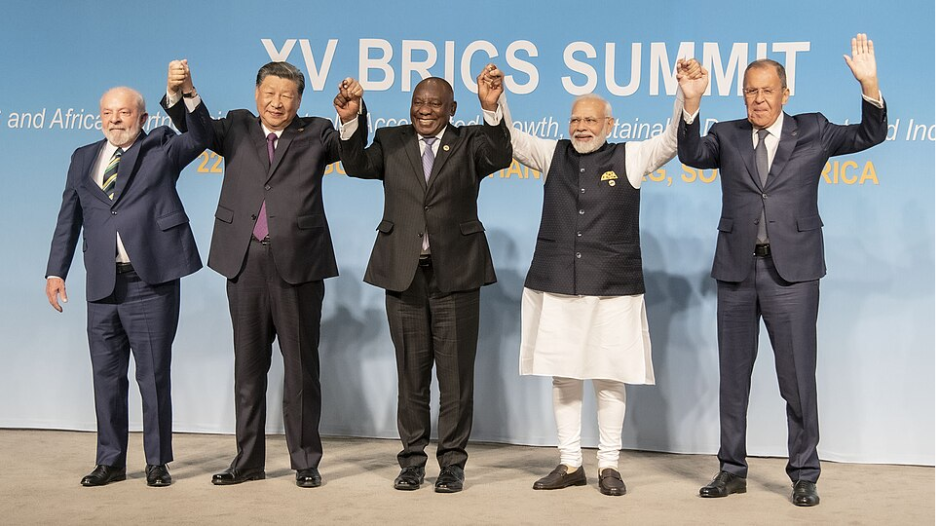
“XV BRICS Summit family photo” by 15th BRICS SUMMIT is marked with Public Domain 1.0
This weekend, India will host international leaders for the 18th annual BRICS Summit in New Delhi. India, which assumed the chairmanship in January, faces the difficult responsibility of keeping the summit neutral and unified as members seek diverse objectives: Russia will look to assert its status as a global power player despite Western isolation, India and China will attempt to further their diplomatic and economic thaw, and New Delhi will continue seeking to connect members' digital currencies (as opposed to introducing a common BRICS currency) and boost global rupee usage. Meanwhile, bloc unity is increasingly tested by upcoming Brazilian elections, the Iran war, global economic pressures, and diverging relationships with partners like the US and Israel. Read our analysts’ takes below.
In today’s full analysis:
Zayna Dembinski: President Xi Jinping is confirmed to attend the BRICS Summit, reinforcing signals that China and India are seeking to rebuild ties
Ian Cameron: The summit is an opportunity for Moscow to show that Russia remains a global player
Carter Spahn: India seeks wider rupee usage, but risks US retaliation and will struggle to address the underlying trade imbalance
Elton Smole: With Brazil’s October presidential elections neck and neck, the future path of a founding BRICS member hangs in the balance
Chris Dantes: South Africa seeks deeper economic ties with BRICS members amid domestic challenges and estrangement from the US
Or listen to the full brief here:

Listen to the news:
Global
In April, a joint American, British, and Norwegian operation tracked and confronted Russian submersible vessels suspected of potentially testing the deployment of new technology to disrupt subsea cables. Russia’s Main Directorate for Deep-Sea Research (GUGI) was conducting an exercise near Svalbard, an Arctic island under Norway’s sovereignty whose extractive resources and territorial waters are shared by several countries. Svalbard is home to the SvalSat satellite ground station, which is one of the world’s largest and transmits data back to mainland Europe through two 1,400 km undersea cables. GUGI reportedly aborted the exercise after a confrontation during the joint operation.
Subsea cables are a vulnerable target for Russian hybrid warfare operations. About 95% of the world’s data and $10 trillion in daily financial transactions travel through subsea cables daily. Russian shadow fleet vessels like the Eagle S have been accused by Western authorities of deliberately dragging anchors along the seabed in an attempt to damage cables, but Russia denies this. Nonetheless, NATO member intelligence services have increasingly warned about the potential of Russia to escalate hybrid operations, as exemplified by the failed Leipzig airport drone attack in early August 2026.
Read More: Defense News, Reuters [paywall], Carnegie Endowment for International Peace
Europe
On Wednesday, the US and Poland concluded a $4 billion Foreign Military Financing (FMF) agreement. This money could act as a loan guarantee for Polish procurement of American defense systems, including Patriot or HIMARS interceptors, in addition to the build-out of an additional military base to host American troops, which could cost as much as $3 billion. The US currently rotates brigades to small bases, such as one near Poznan, but does not have permanently stationed troops in Poland. US Under Secretary of War for Policy, Elbridge Colby, is expected to visit Poland soon to tour potential sites for a military base.
The FMF agreement is a signal that Poland might be a winner from the ongoing US force posture review. There is some ambiguity surrounding the outcome of the posture review, which is slated for completion by the end of 2026, but one potential outcome is a redistribution of American conventional forces in Europe to allies perceived as pulling their weight in the alliance. Poland, sitting on NATO’s eastern flank, seeks to build one of the largest conventional forces in Europe and anticipates spending 4.8% of their GDP on defense in 2026.
Read More: US Department of State, Breaking Defense, Stars and Stripes
Middle East
Iran is producing missiles again, per media reports. On Thursday, the Wall Street Journal reported that Iran has resumed its production of ballistic missiles using stockpiled components, despite heavy attacks on missile sites and increasingly stringent trade restrictions that have limited the supply of components. The renewed production underscores the difficulty of fully dismantling Iranian capabilities, given the resilience of Iran’s illicit supply lines, although it is unclear how long its supplies will hold.
The news comes as Iran seems poised to escalate further, despite US desires to contain the war on the economic front. Over the last week, Iranian forces have taken direct aim at the US Navy in a way it has mostly avoided since the start of the war and targeted US bases in Jordan. The escalation comes as the Hormuz blockade and new sanctions further squeeze Iran’s oil exports and struggling wartime economy. Tehran is betting that upping the military ante will compel some US capitulation (potentially in the form of a return to the June Memorandum of Understanding), especially as US midterms approach. President Trump has publicly disavowed negotiations until midterms, even as separate escalation on the Yemeni front is increasing maritime pressure.
Read More: Wall Street Journal [paywall], New York Times [paywall], DW, BBC
Asia-Pacific
China purchased one million metric tons of US soybeans this week, bringing its total purchases to more than half of the annual volume Beijing committed to buy through 2028. The purchases come ahead of the highly anticipated Trump-Xi summit on September 24, where the two leaders are expected to discuss the durability of their fragile trade truce. Soybeans remain a particularly sensitive commodity for US producers and have previously been targeted by Chinese retaliatory tariffs, making purchases a visible signal of Beijing’s compliance with its trade commitments.
However, China’s willingness to purchase US soybeans comes as its trade surplus with the US widens, reaching more than $29 billion in August, up nearly 44% from a year earlier and the largest monthly gap since Trump returned to office. Moreover, China continues to deepen its reliance on Brazil as an alternative soybean supplier, underscoring the limits of the US purchase commitments. Over the first five months of 2026, more than 60% of China’s soybean imports came from Brazil, with US imports making up just 23%.
Read More: Reuters [paywall], The New York Times [paywall], AgWeb, CNBC, The Brookings Institution
Americas
Peruvian President Keiko Fujimori announced that Peru will join the Shield of the Americas. Also known as the Americas Counter Cartel Coalition (ACCC or A3C), the Shield of the Americas is a US-led regional security coalition aimed at expanding counternarcotics cooperation among member states. The announcement of Peru’s decision to join came as US Secretary of State Marco Rubio continued his tour of South America, following visits to Colombia and Ecuador earlier this week. Colombia joined the coalition in August under the new administration of Abelardo de la Espriella. Fujimori and De la Espriella were both elected in recent months amid Latin America’s shift to the right.
Fujimori began her term in July with a mandate to crack down on crime. Peru is currently the world’s second-largest producer of cocaine, after Colombia. At a joint news conference with Rubio, Fujimori said that Peru’s membership in the Shield of the Americas will allow for increased intelligence sharing and joint operations against transnational criminal groups. Peru also recently declared a state of emergency in five high-security prisons as part of an effort to ramp up security efforts.
Read More: Reuters [paywall], Al Jazeera, Politico
Africa
US Assistant Secretary of State for African Affairs Frank Garcia visited Ethiopia, Zambia, and Kenya this week to discuss future investment and financing deals. Among the areas of cooperation discussed was Ethiopia’s Bishoftu International Airport, which is anticipated to be the continent’s largest regional air hub and has become a key area of strategic competition between the US and China. Garcia advocated for US investors and pledged financing from the US International Development Finance Corporation in talks with the Ethiopian Airlines CEO.
US-Zambia relations also appear to be warming following a diplomatic row over Washington’s America First Health Strategy. Zambian officials criticized the Trump administration earlier this year, accusing Washington of pursuing a transactional approach by tying health cooperation to critical minerals access. Negotiations are ongoing to finalize a health deal and secure US access to the country’s cobalt and copper projects, but it remains unclear whether the two will be linked in the same agreement.
Garcia’s visit coincided with the US-East Africa Investment Forum in Nairobi, where further progress was made in negotiating the US-Kenya minerals deal. The US has committed to aiding Kenya in developing its capacity to process minerals locally, which Kenyan President William Ruto recently stated was a primary objective of the country’s development of its mining sector.
Read More: The Africa Report, Reuters [paywall], Semafor, Stepwise Risk Outlook
Geoeconomics
An investigation found Iran used oil revenue to finance imports from China while bypassing direct international bank transfers. Sources estimated that $2 billion to $2.5 billion passed through a special-purpose vehicle over the past year. Chinese oil buyers deposited funds with an obscure entity called ChuXin, which paid infrastructure contractors and channeled money to Chinese suppliers. Purchases included medicines, vehicles and communications equipment.
Iranian oil income can remain useful even if it never reaches an Iranian bank. Oil proceeds retained in China financed goods and infrastructure for Iran, reducing reliance on cross-border payments vulnerable to US scrutiny. These networks also extend beyond bilateral trade: Emirati companies provide shadow-banking and transshipment services for Chinese entities involved in Iran-related activity. Operation Economic Outcast may therefore struggle to close these channels while Washington remains reluctant to sanction major Chinese financial institutions, given the risk of financial disruption and retaliation from Beijing.
Read More: Reuters [paywall], The Wall Street Journal [paywall], Washington Institute
Disruptive Technology
Anthropic released a report Thursday detailing potential misuses of its AI models, including to develop suspected biological weapons. The company stated that it banned accounts that tried to evade AI models’ safeguards or appeared to be used for gain-of-function research, which is when scientists engineer new viruses to develop vaccines. Anthropic clarified that the intent of that research was unclear, so it took a preventative approach to mitigate potential catastrophic risk. Beyond potential biological weapons, Anthropic closed accounts suspected of using Claude to develop conventional weapons, like bombs and drones. These accounts were in Russia, China, and Yemen.
Read More: Forbes, New York Times [paywall], Anthropic
Energy
France and South Korea are deepening their cooperation in nuclear energy. Korea Hydro & Nuclear Power and French nuclear fuel cycle company Orano have signed an agreement for long-term cooperation in uranium enrichment. The agreement was signed in Paris during a visit by South Korean President Lee Jae Myung, and it expands on an earlier memorandum of understanding from April. Seoul and Paris also agreed to open a high-level dialogue on cooperation for the private sector in nuclear energy, and the governments also intend to sign further documents to deepen nuclear cooperation going forward.
Earlier this year, South Korea signed an agreement with Japan and the US to cooperate on small modular reactors (SMRs). The agreement focuses on speeding up the deployment of SMRs in third countries, specifically in the Indo-Pacific as an initial focus point. According to the US Department of State, the agreement should de-risk project development, enable economies of scale, and lead to increased private investment.
There is strong global interest in nuclear energy, especially in the context of the US war with Iran. Energy security has become one of the most important issues of the year, and disruptions in the Middle East have highlighted supply security vulnerabilities. Many countries are therefore looking for ways to build out domestic energy supplies, and Russia has been a key player in global nuclear energy partnerships through its state-owned nuclear company Rosatom.
Read More: World Nuclear News, US Department of State, The Diplomat [paywall], Stepwise Risk Outlook
Defense
Ukrainian defense technology companies are previewing new systems to counter Russia’s advances. At the MSPO defense industry show in Kielce, Poland, several Ukrainian producers of anti-drone capabilities are showing their solutions to Russia’s use of jet-powered drones. The companies are working to develop systems that can have top speeds of between 400 km/h and 700 km/h. Simultaneously, companies need to keep costs per system lower than the costs of the targets they are designed to intercept.
Russia has begun using jet-powered drones to overwhelm Ukraine’s air defense capacity. Ukraine had reportedly achieved around a 90% interception rate against Russia’s Geran drones, which Moscow acquired from Iran early in the war. Russia’s new drones are far harder to intercept than what Russia has used to attack Ukraine in the past, but Russia has only recently begun to apply them en masse.
Ukrainian companies are potentially preparing to begin selling their products abroad in the near future. Earlier this year in May, Kyiv announced that it was working on lifting the country’s ban on exporting defense products. A number of countries have shown interest in Ukrainian defense technology and Ukraine’s expertise in unmanned systems, and Ukraine has signed numerous deals for defense industrial cooperation with countries across Europe.
Read More: Defense News, Defense News, Ukrinform, New York Times [paywall]


Contact Us
Karl Hopkins
Partner
+1 202 429 6499
khopkins@steptoe.com
Melissa B. Mahle
Senior Advisor
+1 202 261 0577
mmahle@steptoe.com
Anni Coonan
Senior Intelligence Analyst
+1 212 506 3979
acoonan@steptoe.com
Samuel Bloebaum
Senior Due Diligence Analyst
+1 602 410 6240
sbloebaum@steptoe.com
Zayna Dembinski
Analyst
+1 202 778 3567
zdembinski@steptoe.com
Thomas Goldstein
Analyst
+1 202 862 6735
tgoldstein@steptoe.com
Ian Cameron
Analyst
+1 202 327 6908
icameron@steptoe.com
Elton Smole
Analyst
+1 202 261 0556
esmole@steptoe.com
Carter Spahn
Intelligence Fellow
+1 202 261 7555
cspahn@steptoe.com
Chris Dantes
Intelligence Fellow
+1 202 327 6904
cdantes@steptoe.com
Legal disclaimer: This Substack is for educational and informational purposes only and does not constitute the rendering of legal counseling or other professional services. Reading, subscribing to, or communicating through this Substack does not create an attorney-client relationship. Do not send confidential information through this platform. Consult qualified legal counsel regarding your specific circumstances.