


Welcome to the Stepwise Risk Outlook, which highlights and contextualizes over-the-horizon developments in key regions of the world and industries of the global market. Today’s featured deep dive by Anni Coonan examines Iran's wartime economy.

How Iran’s Wartime Economy Works, and How Long it Can Last
By Anni Coonan
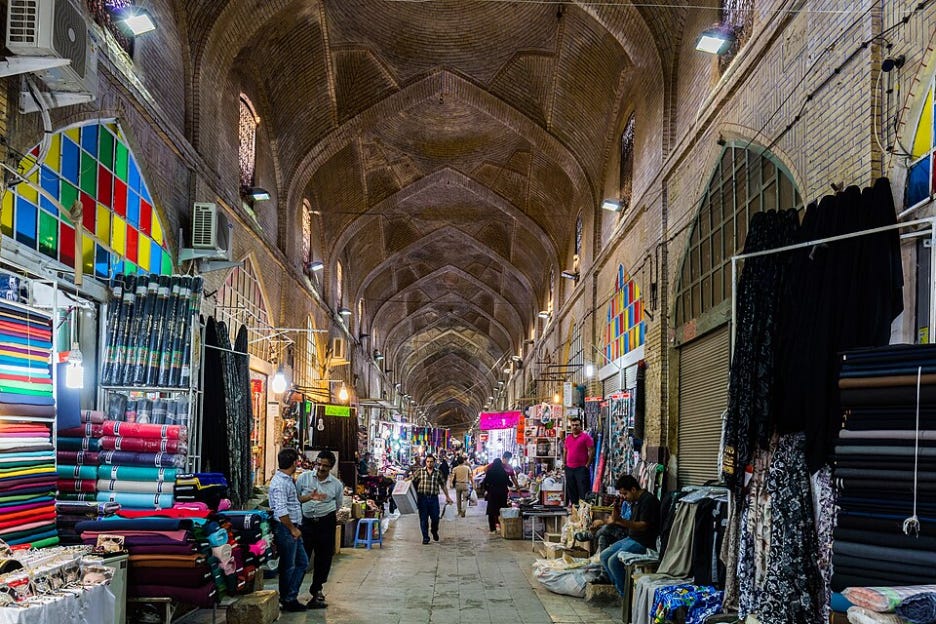
“Vakil Bazaar, Shiraz, Iran” by Diego Delso is licensed under Creative Common License.
In recent weeks, the US has escalated economic pressure on Iran in a bid to exacerbate Tehran’s financial woes and precipitate a return to the negotiating table without escalating militarily. While the pressure is having an effect, Iran’s war-torn economy, hardened by years of economic isolation, remains resilient. What is the state of Iran’s economy? And how exactly is it weathering escalating economic pressure without fear of imminent collapse? Iran retains effective sanctions evasion strategies honed over years (and still largely successful under heightened pressure), maintains cross-border trade in key goods, and its regime is insulated from the complaints of everyday Iranians. While the cessation of oil exports through the Strait of Hormuz hurts, Iran still assesses that it can endure Operation Economic Outcast longer than the US can tolerate broad Middle East disruption.
In today’s full analysis:
The Scale of Disruption
Resilience Strategies
How Long Can This Last?
Or listen to the full report here:

Listen to the news:
Global
The World Trade Organization warns in a new report that the global trade system is at a critical juncture, with erosion of support for WTO free trade rules risking long-term trade growth. The multilateral trading system has been one of the most successful frameworks of international economic cooperation in modern history. The splintering of the world trade system into geopolitical blocs would cut economic activity, reducing global exports by 18.6% and economic output by 5.1% by 2050. An alternative path would see flows of exports and imports centered on free trade agreements, which have proliferated in recent years, lowering exports by 26.9% and GDP by 6.9%, with the poorest countries suffering the largest losses.
The lack of reform at the WTO is undermining member state support. The organization has been paralyzed by disagreements. In reaction, member states are adopting trade policies, such as tariffs and industrial policy subsidizing critical industries, under the WTO national security exception. This exception allows member countries to break normal trade rules to protect their essential security interests. Because the WTO Appellate Body is not functioning, member states can unilaterally define the scope of national security, making the exception the rule.
Read More: Wall Street Journal [paywall], World Trade Organization, Council on Foreign Relations
Europe
European Commission President Ursula von der Leyen urged new security measures in her annual State of the European Union address. She called for the creation of a “European Security Council” that brings together EU and like-minded countries—like the UK, Canada, and Ukraine—to discuss regional security issues, akin to NATO Article IV. On economic security, von der Leyen stated that the bloc’s €1 billion daily trade deficit with China has “reached a tipping point,” but she did not elaborate on the Commission’s upcoming proposals to rebalance trade flows. Von der Leyen did not delve deeply into the EU budget, which may dominate upcoming Council meetings, but she urged the EU to take “new own resources” (i.e., revenue-raising measures like taxes) for a larger EU budget capable of investing in the bloc’s competitiveness.
Von der Leyen invited Canada to become an “associate member” of the EU. Von der Leyen laid out a new “alliance of the future” with Canada, a close like-minded partner, that includes greater tech, defense industrial, critical mineral, and energy integration. Von der Leyen also hinted at a “flagship” joint project in the Arctic. Associate membership in the EU has not been defined or tried before, but it will likely not include a customs union so that Canada can maintain its obligations to the USMCA free trade area. Canadian Prime Minister Mark Carney may elaborate on what “associate membership” entails in a speech to the European Parliament tomorrow.
Read More: European Commission, Politico, Wall Street Journal [paywall]
Middle East
US officials met with the Iran-backed Houthis in Oman over the weekend to confirm the lack of US involvement. The meeting, reported today by Western media, was facilitated by Muscat and resulted in a promise from the Houthis not to attack any vessels belonging to the US, Israel, or any country besides Saudi Arabia. It is unclear if the US made reciprocal promises.
The meeting underlines Saudi Arabia’s lack of options as its conflict with the Houthis escalates. Saudi Arabia is in an extremely difficult position with oil exports cut off from both its Red Sea and Arab Gulf ports. It is unclear how Riyadh can deal with the Houthi problem: it has no desire to get mired in a renewed conflict that was a serious drain and reputational risk the first time around, nor can it cajole any partners to join efforts to push the Houthis back. Pakistan and Türkiye, members of the Mecca Pact that ostensibly includes a mutual defense agreement, have signaled that they will not join the fray. Saudi officials are headed to Egypt this week, where they will likely be similarly rebuffed. And the US, Saudi’s onetime partner in Yemen and main security guarantor, has reportedly told Riyadh that it will not get involved.
Read More: Reuters [paywall], Al Jazeera, Associated Press, Axios, Responsible Statecraft
Asia-Pacific
China’s new exit-entry rules took effect yesterday, allowing Beijing to bar Chinese citizens deemed potential national technology or industrial security risks from leaving the country. Unveiled in July, the rules target citizens who are believed to have engaged in illegal or criminal activities abroad that threaten China’s national security and interests, as well as those who violate technology import or export controls in ways that could endanger China’s “national industrial or technological security.” Exit bans can last six months to three years. Foreign nationals can also be denied entry for one to five years for providing false information on visa applications or falling under one of China’s countermeasure lists.
The rules formalize Beijing’s growing efforts to prevent the overseas transfer of sensitive technology and talent, particularly in strategic sectors such as AI. While travel restrictions have long applied to officials and state employees with access to sensitive information, Beijing has increasingly scrutinized overseas travel and foreign ties among civil servants and employees of state-backed enterprises. Authorities have already taken action against key AI personnel, including the co-founders of Chinese-founded AI startup Manus in March, preventing them from leaving China while reviewing its acquisition by a US firm. Beijing ultimately blocked the acquisition, underscoring its willingness to intervene when Chinese-developed AI capabilities risk moving overseas.
Read More: The State Council The People’s Republic of China, Wall Street Journal [paywall], Reuters [paywall]
Americas
The UK on Tuesday announced it will appoint an ambassador to Venezuela, upgrading its diplomatic representation in Caracas and strengthening its ability to support Venezuela’s democratic transition. London said the move will facilitate engagement with interim President Delcy Rodríguez and her government, support British nationals and businesses, and promote regional stability and security. The UK downgraded its diplomatic mission to Caracas to a chargé d’affaires in 2019. London emphasized the appointment does not constitute an endorsement of Venezuela’s 2024 election process or any particular political party.
The move reflects a growing wave of international reengagement with Venezuela following Maduro’s ousting, as governments look toward reestablishing channels with Caracas. The EU’s ambassador arrived in Caracas on Monday, coinciding with Venezuela’s appointment of a new ambassador to Brussels, following similar moves by the US and Italy. Such efforts of reengagement mark a shift from 2018 to 2019, when numerous governments recalled or downgraded diplomatic representation and several, including the US, severed diplomatic ties, over Venezuela’s shift to authoritarian rule.
Read More: House of Commons, Demócrata, Demócrata
Africa
The US will impose new visa restrictions on South African officials amid a continued deterioration in bilateral relations. The Department of State announced that the restrictions will target South African officials deemed complicit in discrimination against Afrikaners or other minorities. The policy follows months of fraught US-South Africa ties, after the Trump administration accused Pretoria of failing to address genocide and discrimination against Afrikaners. Pretoria continues to reject these accusations.
The US-South Africa relationship is likely to remain tense, but cooperation in Pretoria’s mining sector continues for the time being. The US recently backed South Africa’s Phalaborwa rare earths project with a $50 million investment through the US International Development Finance Corporation. South Africa is the US’ leading source of chromium, palladium, platinum and zirconium, while also supplying significant quantities of manganese and vanadium. The diplomatic row has so far not disrupted US involvement in developing the Phalaborwa site. However, greater restrictions on South African officials and other sources of pressure could result in Pretoria suspending or reducing economic cooperation with the US, including in its mining sector.
Read More: CBS, US Department of State, PBS, Center for Strategic and International Studies
Energy
Russia and Ukraine continue striking with attacks on energy infrastructure despite US announcement of temporary ceasefire. US President Donald Trump had previously announced that Ukraine and Russia had agreed to refrain from attacking energy infrastructure. Trump also claimed that Ukraine and Russia’s respective energy campaigns were the main driver of global fuel shortages. While both sides expressed interest in such an arrangement, both sides launched strikes on September 15 against energy targets. Ukraine attacked the Syzran oil refinery in Russia’s Samara region, and Russia struck energy and port facilities.
Trump’s push to protect energy infrastructure in Europe is happening in parallel to disruptions in the Middle East and rising prices. Brent futures reached $108 a barrel yesterday and have been steadily rising since late August. Last week, a drone attack damaged a major pipeline in Saudi Arabia equivalent to 4% of global supplies, which could likewise impact energy markets going forward.
Read More: NBC News, Reuters [paywall], Kyiv Independent
Transnational Crime & Corruption
Hackers used a compromised Italian governmental email system to solicit personal information from the fintech firm Revolut. Revolut, thinking it was communicating with Italian law enforcement, handed over personal information for almost 700 customers, including their addresses, phone numbers, passport details and transaction histories. Hackers claimed to have targeted accounts associated with individuals holding large amounts of cryptocurrency and are reportedly demanding ransom payments from Revolut for the stolen data to be destroyed.
The breach could expose affected customers to in-person “wrench” attacks to steal crypto. According to cryptocurrency compliance organization Chainalysis, $58 million in cryptocurrency was stolen through violent attacks in 2025, with an additional $30 million stolen through similar attacks in the first half of 2026. The attacks are especially prevalent in France, where a hack of French tax records revealed personal information on major cryptocurrency holders. The Revolut hack also reportedly disproportionately affected France- and Switzerland-based customers.
Read More: Financial Times [paywall], Financial Times [paywall], Wall Street Journal [paywall], Chainalysis


Contact Us
Karl Hopkins
Partner
+1 202 429 6499
khopkins@steptoe.com
Melissa B. Mahle
Senior Advisor
+1 202 261 0577
mmahle@steptoe.com
Anni Coonan
Senior Intelligence Analyst
+1 212 506 3979
acoonan@steptoe.com
Samuel Bloebaum
Senior Due Diligence Analyst
+1 602 410 6240
sbloebaum@steptoe.com
Zayna Dembinski
Analyst
+1 202 778 3567
zdembinski@steptoe.com
Thomas Goldstein
Analyst
+1 202 862 6735
tgoldstein@steptoe.com
Ian Cameron
Analyst
+1 202 327 6908
icameron@steptoe.com
Elton Smole
Analyst
+1 202 261 0556
esmole@steptoe.com
Carter Spahn
Intelligence Fellow
+1 202 261 7555
cspahn@steptoe.com
Chris Dantes
Intelligence Fellow
+1 202 327 6904
cdantes@steptoe.com
Legal disclaimer: This Substack is for educational and informational purposes only and does not constitute the rendering of legal counseling or other professional services. Reading, subscribing to, or communicating through this Substack does not create an attorney-client relationship. Do not send confidential information through this platform. Consult qualified legal counsel regarding your specific circumstances.