

Welcome to the Stepwise Risk Outlook, which highlights and contextualizes over-the-horizon developments in key regions of the world and industries of the global market. Today’s featured deep dive by Chris Dantes examines Algeria's intervention in the Niger coup attempt.

Niger Coup Attempt: Algeria’s Assertive Sahel Policy and Potential Challenges to US and Moroccan Strategic Interests
By Chris Dantes
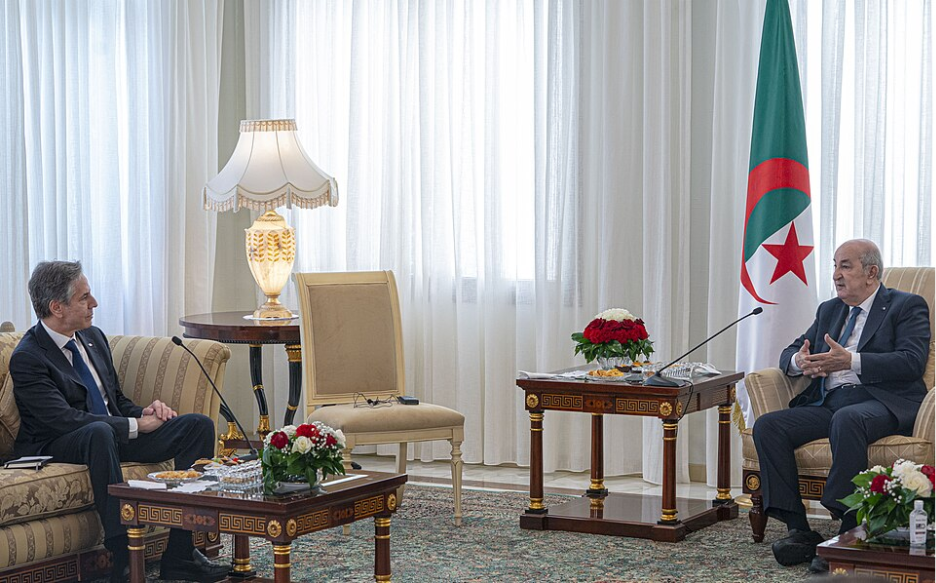
“Secretary Blinken Meets With Algerian President Tebboune” by U.S. Department of State, United States Government Work
One day after the attempted coup in Niger in late August, Algeria deployed two air patrol squadrons to support the Nigerien junta – a move that marks Algiers’s first foreign deployment since 1973 and a notable shift from its historical non-interventionist policy. The deployment reflects Algeria’s broader effort to secure its southern border, rebuild relations with the Alliance of Sahel States (AES) (comprised of Niger, Mali and Burkina Faso), and regain influence amid growing regional and external competition. Niger is particularly important to Algeria as it occupies a central position in Algeria’s economic and energy ambitions and is its closest diplomatic partner in the AES. At the same time, Morocco, a regional rival, is expanding its economic and diplomatic presence across West Africa and promoting alternative energy corridors. As Algeria adopts a more assertive Sahel policy, its competition with Morocco could complicate US relations with both states, fragment regional counterterrorism cooperation, and increase political and commercial risks surrounding major infrastructure and energy projects.
In today’s full analysis:
Algeria’s Interests and AES Reengagement, Explained
Morocco’s Power Play in the Sahel
Implications for US Strategy and Risks to Businesses
Or listen to the full report here:

Listen to the news:
Europe
The US House of Representatives passed the Graham Russia sanctions bill yesterday evening. The legislation is the first major bill in support of Ukraine since a 2024 aid supplemental. The bill empowers the White House to issue 100% stacked tariffs on the top five global importers of Russian crude and oil products, the top five countries enabling transshipment of those exports, and any country that increases purchases of Russian fuels 30 days after the bill is enacted. The President has complete discretion on whether to apply the tariffs and the blocking sanctions prescribed by the bill. The President can waive blocking sanctions if notification and a report are given to Congress that explain the national security grounds of a delisting.
China and India are the most likely targets of the 100% stacked tariffs, but the President may prioritize this tool as negotiating leverage instead. When President Trump interpreted IEEPA as having a flexible tariff authority, he had briefly issued a 25% stacked tariff on India for purchases of Russian crude, which were removed upon the conclusion of a bilateral trade deal. Trump did not apply the tariffs to China in a bid to preserve a fragile truce in the April 2025 trade war. The White House will likely continue to prioritize market stability when engaging with China and India, but the new tariff authority could act as negotiating leverage for interlinked issues in bilateral relationships.
Read More: Politico, Stepwise Risk Outlook
Middle East
The US is investigating whether Iran is behind cyberattacks on two energy tankers bound for American ports, which risk broadening the war. The two tankers were transiting the Strait of Gibraltar when they were hit by attacks, raising concerns that Iran could be seeking to disrupt another maritime chokepoint or damage a US port. Ships run on integrated systems that, if compromised, could result in an explosion, a collision, or an oil spill.
Cyber attacks have been an active, but secretive, front in the US-Iran war. US officials have declined to put a number on the attacks, but analysts say cyber warfare is an increasingly important tool for Iran as the war escalates. Over the last several months, Iran has hacked SS7 (a major telecommunications protocol that allowed it to locate US troops), attacked US water facilities in six states, conducted cyber espionage against US and Israeli leaders, and targeted critical American infrastructure. Analysts say Iran has previously been relatively constrained (perhaps due to damaged capabilities following March strikes on the IRGC’s cyber and information warfare headquarters), but the cadence could now be increasing.
Read More: Wall Street Journal [paywall], NBC, CSIS
Asia-Pacific
South Korean President Lee Jae Myung on Wednesday called to build a “new Silk Road” with Central Asia, seeking to translate ties with the region into deeper cooperation on trade, critical minerals and infrastructure. Speaking at the inaugural Korea-Central Asia Business Summit, which brought together all five Central Asian leaders in Seoul for the first Korea-Central Asia summit, Lee called for cooperation to expand beyond bilateral relationships to a regional framework. The leaders adopted the Seoul Declaration, which establishes a 30-year vision for cooperation across critical sectors and institutionalizes a biennial leaders’ summit, with Kazakhstan set to host the next gathering in 2028.
Seoul’s outreach reflects an effort to diversify its supplies of energy and strategic minerals while positioning South Korean companies across Central Asia’s emerging industrial value chains. The summit emphasized critical minerals, energy and supply-chain cooperation, with Lee advocating for partnerships that extend beyond importing raw materials to include exploration, processing and manufacturing. The push follows three days of bilateral meetings that produced more than 70 agreements and memorandums of understanding covering energy, mining, infrastructure, technology and investment. Deeper engagement broadens resource-poor South Korea’s access to strategic resources and also creates new markets for Korean technology and industrial expertise, crucial for Central Asian countries interested in speeding up their infrastructure modernization.
Read More: The Korea Herald, Yonhap News Agency, The Korea Times, Organisation for Economic Co-operation and Development
Americas
Brazil’s Supreme Court decided on Tuesday to postpone the decision on whether to open an investigation of Justice Alexandre de Moraes. Moraes, who led the prosecution of Jair Bolsonaro for an attempted coup in 2023, is accused of advising disgraced banker Daniel Vorcaro, whose arrest in November 2025 kicked off the Banco Master scandal. Justice Andre Mendoca recently unsealed a police dossier with WhatsApp messages between Moraes and Vorcaro, making Moraes the most recent of numerous powerful figures in Brazil’s political establishment to be tied to Vorcaro. The Bolsonaros, as well as other members of the supreme court, have also been ensnared in the scandal. Any decision on whether to investigate Moraes will likely come after the upcoming October elections.
The accusations against Moraes have upended the race between Flavio Bolsonaro and incumbent Lula. Lula had been consistently leading in the polls throughout the summer, as Bolsonaro was in the spotlight for allegedly receiving millions from Vorcaro to produce a film about his father, Jair Bolsonaro, who was sentenced to over 27 years and is currently under house arrest. Due to the public association between Moraes and Lula, and because of Moraes’ role in prosecuting Bolsonaro, Lula has taken a hit in the polls, and the two candidates are now neck and neck.
Read More: Reuters [paywall], The Guardian, AP
Africa
Somaliland President Abdirahman Mohamed Abdullahi “Irro” is in Washington to secure US recognition. President Irro plans to meet with officials at the White House and Capitol Hill to advocate for US recognition of Somaliland as a state, offering a future military base agreement, investment opportunities and access to the port of Berbera, and access to minerals (the details of which are very unclear). The US already cooperates with Somaliland security forces but has avoided recognition to preserve its partnership with Mogadishu, which views the breakaway territory as part of Somalia. US recognition of Somaliland remains unlikely, but the partnership may deepen as Somalia faces greater insecurity and political fragmentation, potentially complicating coordination of counterterrorism and counterpiracy operations between the federal government and state authorities.
Read More: Semafor, Stepwise Risk Outlook
Geoeconomics
The Federal Reserve raised interest rates for the first time since 2023 and signaled further tightening as inflation remains persistently above target. The FOMC voted unanimously on September 16 to raise its benchmark rate by 25 basis points to 3.75%–4%. Sixteen of 18 policymakers projected at least one additional increase this year, with the median forecast implying a 4%–4.25% target range at both the end of 2026 and the end of 2027. Officials raised their 2026 forecast for PCE inflation to 3.7%, from 3.6% in June, and projected a return to the 2% target in 2029. They also increased their growth forecast to 2.3% and lowered projected unemployment to 4.1%, indicating greater confidence in the economy’s resilience.
The decision reflects the Fed’s judgment that strong employment and investment give it room to prioritize inflation. Chair Kevin Warsh said summer inflation readings had not demonstrated meaningful improvement in underlying price pressures, while robust business lending and spending suggested that financial conditions were still supporting economic activity. The Fed therefore viewed the increase as withdrawing some monetary support, with further action possible if inflation fails to slow sufficiently. Warsh also emphasized preventing higher prices in individual sectors from spreading across the economy and keeping inflation expectations anchored. The unanimous decision puts him at odds with President Donald Trump, who renewed his call for rates of 1% or less.
Read More: Warsh’s Remarks, Reuters [paywall], Financial Times [paywall], Reuters [paywall], FOMC Economic Projections
Disruptive Technology
The European Commission presented its proposal for child social media restrictions until the age of 15. Dubbed the “EU KIDS Act,” the legislation would codify a ban on social media, AI assistants, and some online gaming until the age of 13. During ages 13 and 14, children can have “mini accounts” on social media accessed through a guardian’s account. Commission President Ursula von der Leyen, a doctor herself, wants to prioritize putting parents in the “driver’s seat” with regard to screen time for kids. In her State of the European Union speech on Wednesday, von der Leyen noted that “young Europeans now spend four to six hours per day on screens,” a capture of attention “depriving children of childhood.”
Social media restrictions are overwhelmingly popular but still face challenges to adoption. Member states may hold considerable debate on the legislation’s enforcement mechanisms, such as an envisaged age verification app and defining “addictive design features” for platforms to restrict for children. These could include endless content scrolling, automatic video playback, geolocation, live video streaming, and virtual rewards for playing. The focus on design restrictions rather than an outright ban follows legal challenges to a French ban on social media for under-15s, which was struck down by its Constitutional Court in mid-August.
Read More: Yahoo!news, Le Monde [paywall], Special Panel on Child Safety [pdf]
Energy
Germany is planning new incentives to boost gas storage levels. Germany’s Economy Minister Katherina Reiche wants to introduce new market incentives to make more gas available this winter. The incentives include increasing a planned autumn tender for Long Term Options and allowing Trading Hub Europe to take gas deliveries from traders to make use of in the future. Reiche’s ministry intends to decide on the incentives by September 21, according to reporting.
Europe is going into the winter with exceedingly low storage levels for gas. Germany’s storage levels are only at 53%, the lowest level for the past 15 years. The storage association INES has warned that a bad winter could lead to supply issues as early as January.
Read More: Reuters [paywall], Oilprice.com, The Guardian
Transnational Crime & Corruption
President Donald Trump designated 23 countries as major illicit drug producers and removed Venezuela from a sub-list of countries that “failed demonstrably” to implement counternarcotics policies. The 23 listed countries were identical to those designated on last year’s “Major’s List,” including India, China, the Dominican Republic, Colombia and Pakistan. Venezuela had been on the “failed demonstrably” sub-list since 2005. With Venezuela’s removal, the remaining countries deemed to have failed to implement counternarcotics reforms are Afghanistan, Bolivia, Myanmar and Colombia. Citing national security reasons, Trump’s determination stated that the US would continue providing assistance to Bolivia, Myanmar and Colombia.
The determination praised Venezuela for counternarcotics cooperation with the US. It noted the capture of former President Nicolás Maduro and the assassination of Tren de Aragua leader Niño Guerrero. It also praised new US-friendly leaders elected in Bolivia and Colombia and urged them to implement counternarcotics reforms to be removed from the “failed demonstrably” sub-list. Colombia was added to the sub-list last year, and Bolivia has been present since 2008. The determination also criticized Brazil, which is not currently one of the 23 designated countries, for failing to confront drug cartels in its territory.
Read More: White House, Department of State, Reuters [paywall]
Defense
The US war with Iran has cost at least $38 billion. According to a new report by the Congressional Budget Office, by the end of July the war had cost the US almost $40 billion and resulted in depletions in weapons stocks that could take five years or more to rebuild. According to the report, which only covered direct costs from the war, munitions costs were the source of most of the spending on the conflict.
Washington has been rapidly creating new programs to accelerate production of key systems. The Pentagon recently announced two new 7-year deals to bolster production of air defense interceptors, and earlier in August the Pentagon also announced another deal to boost production of Tomahawk missiles.
Depleted stockpiles have also had consequences for countries interested in or reliant on US weapons. The war with Iran has overloaded demand for Patriot missile interceptors, and shortages of systems like Tomahawk missiles have led to complications for countries like Germany that are interested in procuring them. However, that could also create momentum for more US allies to take over a role in supply chains for US systems.
Read More: ABC News, The Hill, Defense News, Politico EU


Contact Us
Karl Hopkins
Partner
+1 202 429 6499
khopkins@steptoe.com
Melissa B. Mahle
Senior Advisor
+1 202 261 0577
mmahle@steptoe.com
Anni Coonan
Senior Intelligence Analyst
+1 212 506 3979
acoonan@steptoe.com
Samuel Bloebaum
Senior Due Diligence Analyst
+1 602 410 6240
sbloebaum@steptoe.com
Zayna Dembinski
Analyst
+1 202 778 3567
zdembinski@steptoe.com
Thomas Goldstein
Analyst
+1 202 862 6735
tgoldstein@steptoe.com
Ian Cameron
Analyst
+1 202 327 6908
icameron@steptoe.com
Elton Smole
Analyst
+1 202 261 0556
esmole@steptoe.com
Carter Spahn
Intelligence Fellow
+1 202 261 7555
cspahn@steptoe.com
Chris Dantes
Intelligence Fellow
+1 202 327 6904
cdantes@steptoe.com
Legal disclaimer: This Substack is for educational and informational purposes only and does not constitute the rendering of legal counseling or other professional services. Reading, subscribing to, or communicating through this Substack does not create an attorney-client relationship. Do not send confidential information through this platform. Consult qualified legal counsel regarding your specific circumstances.