

Welcome to the Stepwise Risk Outlook, which highlights and contextualizes over-the-horizon developments in key regions of the world and industries of the global market. Today’s The Analysts' Brief examines the upcoming Trump-Xi meeting.

The Analysts’ Brief: The Upcoming Trump-Xi Meeting
By Zayna Dembinski, Thomas Goldstein, Anni Coonan, and Carter Spahn
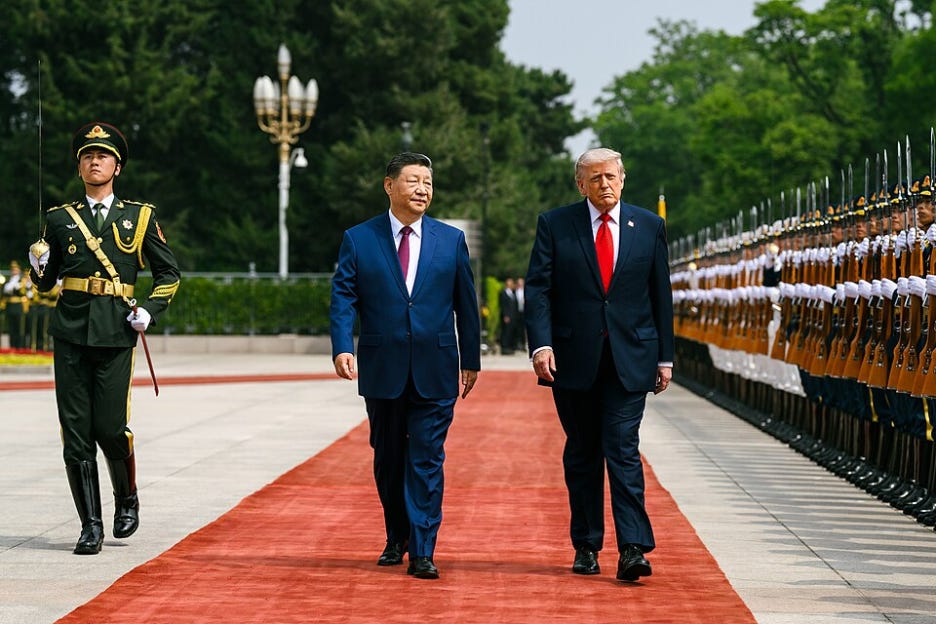
“Welcome ceremony of Trump by Xi Jinping (3)” by The White House is marked with PDM 1.0.
-20260514.jpg)
With less than a week before President Xi Jinping is scheduled to arrive in Washington for talks with President Donald Trump, expectations for a major breakthrough remain low. The September 24 summit comes as the November 10 expiration approaches for the one-year trade truce that eased tariffs and paused several trade and export-control measures. Meanwhile, tensions over AI and the ongoing war in Iran add new points of friction to an already fragile relationship. The meeting will test whether Washington and Beijing can extend the relative stability of the past year, or whether mounting economic and geopolitical tensions will begin to unravel it.
In today’s full analysis:
Zayna Dembinski, Asia Pacific analyst: Beijing is unlikely to leave next week’s summit with firm assurances of more predictable US policy
Carter Spahn, geoeconomics analyst: The summit could expand trade while preserving the strategic barriers reshaping US–China commerce
Thomas Goldstein, tech analyst: Thorny disagreements over tech issues continue to steer bilateral competition
Anni Coonan, Middle East analyst: The Iran war looms over the summit as China remains one of the last remaining economic levers on the Iranian regime
Or listen to the full brief here:

Listen to the news:
Global
The 81st session of the UN General Assembly General Debate starts on Monday, convening world leaders to discuss global cooperation at a time of deep strain in the international order. Khalilur Rahman of Bangladesh will preside over the session, under the theme of “Restoring trust, managing transformation: A United Nations that delivers for all.” In addition to statements by world leaders outlining their positions and priorities, key events will include climate change, development, pandemic prevention, global racial justice and the total elimination of nuclear weapons. The UN, founded as part of the post-World War international security architecture, is widely viewed as an organization in crisis and in need of reform, unable to meaningfully manage today’s security challenges.
The Trump Administration has little interest in the official UN agenda and will focus on advancing American national and economic security priorities, both during UN sessions and on the margins. The US delegation will likely focus on implementing the Board of Peace initiative on bringing stability and reconstruction to Gaza, galvanizing support for economic isolation of Iran to compel Tehran to stop blocking freedom of navigation through the Strait of Hormuz, and lobbying for Washington’s preferred candidate to replace UN Secretary-General Guterres, who appears to be Rafael Grossi, the current head of the IAEA. President Trump’s bilateral meeting with Chinese President Xi is the highest-stakes meeting on Trump’s agenda.
Read More: United Nations, Foundation for Defense of Democracies, International Crisis Group
Europe
Romanian President Nicușor Dan nominated Siegfried Mureșan as Prime Minister in a third attempt to form a government in five months. Mureșan comes from the center-right National Liberals and is currently a Member of the European Parliament and the vice-president of the umbrella center-right European People’s Party. He has ten days to form a cabinet but faces a steep and narrow prospect of winning support from the Social Democrats (PSD), which withdrew from a coalition with the National Liberals, centrist Save Romania Union, and the Hungarian ethnic rights party after disputing the coalition’s tough austerity agenda. The latter three parties have consensus with Mureșan’s leadership, but without PSD’s support, they must attempt to form a minority government with support of other parties. The only other party with enough seats to back the government, the ultranationalist Alliance for the Unity of Romanians, would prefer to exploit the political instability to pressure snap elections, which have never occurred in Romania’s post-Communist history.
Read More: Associated Press, Euractiv, Politico
Middle East
JP Morgan analysts said they would stop attempting to model an Iran endgame after President Trump blew past their analytical redlines. JP Morgan’s global commodities had been operating under the assumption that the occurrence of one or several economic redlines – including oil above $100, gas near $5 a gallon, and 10-year Treasury yields above 5% - would force the US into an agreement to open the Strait. With all economic red lines now crossed, the off-ramp for the war is less clear, not more, and the conflict is escalating further.
Meanwhile, President Trump said he is once again considering a restart to major military escalation. A month-long push to shift to economic escalation with the announcement of Operation Economic Outcast has largely failed, with Iranian strikes and the reignition of the conflict in Yemen forcing a more active kinetic conflict. The US may see a new hot war as the only way to force concessions from Iran. But it is not clear how much more active conflict the US can sustain, with US stocks of missile interceptors dwindling and the cost of the Iran war reportedly at $3 billion a month.
Read More: CNBC, Axios, Wall Street Journal [paywall], Reuters [paywall]
Asia-Pacific
Longstanding US intelligence concerns over Chinese access to Saudi military and telecommunications infrastructure are resurfacing as Washington moves the F-35 sale to Riyadh into its final review stage. The concerns center on whether China could gain access to sensitive F-35 technology through its military and security ties with Saudi Arabia. The State Department on Thursday approved the potential $24.3 billion sale of up to 48 F-35s and 49 engines, triggering a 30-day congressional review. A detailed Pentagon intelligence assessment issued months ago and reviewed by the New York Times examines Chinese military access to Saudi bases and Riyadh’s use of Chinese telecommunications equipment. Similar concerns were raised in a DIA assessment last year.
The sale highlights Washington’s challenge of limited, but deepening, Chinese security ties with Middle Eastern countries. While the US remains the region’s primary security partner, with Riyadh still the largest buyer of American defense equipment, Beijing continues to expand its foothold in a region it considers economically vital. China has used arms sales to deepen security ties with the region, including selling Saudi Arabia ballistic missiles since the late 1980s and helping Riyadh develop domestic missile production capabilities and improve missile operations. The precedent of the UAE, where concerns over Abu Dhabi’s ties to China contributed to the suspension of F-35 talks in 2021, underscores the potential complications for Washington as it expands advanced defense cooperation with Gulf partners.
Read More: US State Department, New York Times [paywall], New York Times [paywall], The Washington Institute for Near East Policy, Breaking Defense
Americas
Venezuelan authorities arrested former Mayor Javier Oropeza, a prominent opposition leader, on Thursday. Oropeza’s arrest came just two days after he had returned from exile, drawing international condemnation, including from within the US. Rep. Carlos Gimenez (R-FL) publicly criticized the Delcy Rodriguez government’s decision to detain Oropeza, which he described as “unjust.” Oropeza was released just hours later, on Thursday night, after Dinorah Figuera also demanded his release. Figuera is leading the opposition in ongoing talks with Venezuela’s interim president Delcy Rodriguez.
Despite his subsequent release, the arrest of Oropeza raises the political risks for Nobel laureate opposition leader Maria Corina Machado, who is reportedly considering a return to Venezuela. Machado is currently in Panama. According to multiple sources in the Venezuelan opposition, Machado will return to Venezuela; however, the date of her return remains uncertain. The Trump administration had previously asked her to delay her plans to return to the country after two devastating earthquakes. She has the highest approval rating of any Venezuelan political figure, although her support dropped from 72% in July to 53% in August.
Read More: Yahoo! News, NTN24 [Spanish], Voz, Reuters [paywall]
Africa
The US agreed to extend funding for the UN Support Office in Somalia (UNSOS) for one year amid growing political instability and insecurity. UNSOS, which operates on a budget of approximately $500 million, provides critical logistical support to the African Union Support and Stabilization Mission, including fuel, medical services, and transportation. Reuters reported in July that the Trump administration planned to block funding for the office due to frustration with Mogadishu’s limited progress in taking the lead on counterterrorism. Meanwhile, al Shabaab has regained territory and influence since launching an offensive in February 2025. Analysts have warned that a reduction in international support could exacerbate jihadist violence, a concern that likely contributed to Washington’s decision to temporarily maintain funding.
The one-year extension provides a narrow window for Mogadishu and the African Union to achieve measurable gains against al Shabaab. Key indicators of progress will likely include improvements in territorial control, operational effectiveness, and the Somali government’s ability to independently manage security responsibilities. Renewed US funding for UNSOS beyond this extension remains unlikely, particularly if Mogadishu fails to demonstrate tangible progress toward assuming greater responsibility for the country’s security.
Read More: Reuters [paywall], Reuters [paywall], International Crisis Group
Geoeconomics
South Korea is pushing back against US demands over how its $350 billion investment pledge will be deployed. President Lee Jae Myung said on September 18 that an agreement on implementation was close, but some proposed terms remained unacceptable to Seoul. The package, negotiated last year in exchange for US tariff relief, includes $150 billion for shipbuilding and $200 billion for other strategic investments. Projects under discussion include a $22.3 billion gas-fired power plant in Texas to supply AI data centers and semiconductor facilities, alongside up to eight nuclear reactors estimated to cost roughly $15 billion each. These proposals remain under negotiation, with financing and commercial terms still being worked out.
The disagreement concerns how much risk South Korea should bear for projects selected by Washington. Under the framework for the $200 billion strategic investment portion, President Trump selects projects after consulting Seoul, which supplies the funding and could face higher tariffs if it refuses. Cash distributions are divided equally up to specified repayment and return amounts, with additional distributions split 90% to the US and 10% to Korea. Seoul insists that investments must be “commercially reasonable,” and Lee says negotiators are still debating how Korea would recover its investment, share profits and handle projects that lose money. That creates a risk that Seoul could finance projects serving US industrial priorities without earning enough to justify its financial exposure.
Read More: Reuters [paywall], Reuters [paywall], White House, Korea Economic Institute of America


Contact Us
Karl Hopkins
Partner
+1 202 429 6499
khopkins@steptoe.com
Melissa B. Mahle
Senior Advisor
+1 202 261 0577
mmahle@steptoe.com
Anni Coonan
Senior Intelligence Analyst
+1 212 506 3979
acoonan@steptoe.com
Samuel Bloebaum
Senior Due Diligence Analyst
+1 602 410 6240
sbloebaum@steptoe.com
Zayna Dembinski
Analyst
+1 202 778 3567
zdembinski@steptoe.com
Thomas Goldstein
Analyst
+1 202 862 6735
tgoldstein@steptoe.com
Ian Cameron
Analyst
+1 202 327 6908
icameron@steptoe.com
Elton Smole
Analyst
+1 202 261 0556
esmole@steptoe.com
Carter Spahn
Intelligence Fellow
+1 202 261 7555
cspahn@steptoe.com
Chris Dantes
Intelligence Fellow
+1 202 327 6904
cdantes@steptoe.com
Legal disclaimer: This Substack is for educational and informational purposes only and does not constitute the rendering of legal counseling or other professional services. Reading, subscribing to, or communicating through this Substack does not create an attorney-client relationship. Do not send confidential information through this platform. Consult qualified legal counsel regarding your specific circumstances.