


Welcome to the Stepwise Risk Outlook, which highlights and contextualizes over-the-horizon developments in key regions of the world and industries of the global market. Today’s featured deep dive by Anni Coonan examines the potential impacts of the US F-35 sale to Saudi Arabia.

The US Sale of F-35s to Saudi Arabia: How, Why and What Next
By Anni Coonan
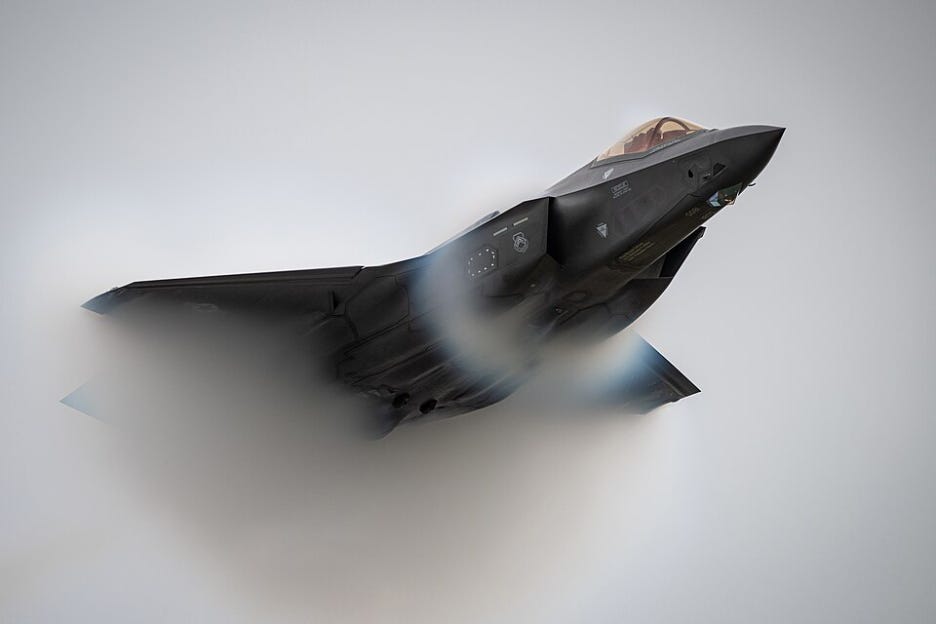
“F35 Lightning during the Oregon International Airshow” by Air Force Senior Airman Alexander Cook is in the public domain.

On September 17th, the US announced the pending sale of F-35 fighter jets to Saudi Arabia. The Kingdom has long sought the purchase, but it has proven controversial for critics in Washington concerned with Saudi Arabia’s ties to China and consequences for Israel’s qualitative military edge. Washington’s agreement to sell Riyadh the world’s most advanced multirole stealth fighter would make it the first Middle Eastern country other than Israel to operate the aircraft. And occurring against the backdrop of an escalating US-Iran war, the sale could have significant implications for the regional balance of power, Gulf defense independence, Iranian security perceptions, US-Gulf partnerships, and the operating environment for regional businesses and international commodities.
In today’s full analysis:
Why Riyadh Wants F-35s, and why the US Wants to Sell Them
Lingering Concerns: Chinese Tech and Israel’s QME
What the Sale Means for the Region
Or listen to the full report here:

Listen to the news:
Global
Russia gives its backing to the expansion of the UN Security Council while maintaining the existing veto system. The UN Security Council is composed of five permanent members with veto powers, including Britain, China, France, Russia and the US. There are ten non-permanent members, elected for staggered two-year terms, split up by world regions for a global balance: Africa and Asia with five seats, Western Europe and other states with two seats, Latin America and the Caribbean with two seats and Eastern Europe with one seat. The Russian statement came in the context of Turkish calls to reform the global body.
UN Security Council reform has been under discussion for decades without progress. Formed in 1945, the last reform of the organization was in 1963, increasing non-permanent seats from six to ten. Permanent members support expansion in principle but disagree over various proposals to make the body more representative, inclusive and democratic. There is some agreement in principle to adding G4 nations (Brazil, Germany, India and Japan). However, permanent members oppose altering or restricting the existing veto power of current members, citing concerns about diluting the council’s effectiveness. Given the current geopolitical rivalry, it is unlikely that discussion of reform will advance, and the effectiveness of the body will continue to be limited by disputes among the veto-wielding permanent members.
Read More: Reuters [paywall], Stimson Center
Europe
The EU is still struggling to agree on its latest sanctions package. Latvia was the sole vote opposing a compromise that would have extended most sanctions for three years in exchange for delisting two Russian oligarchs. France, Luxembourg, and Slovakia have drawn pushback from other EU countries with their attempts to delist the two oligarchs to further national policy goals. The ambassadors of the EU member states will continue negotiations today, and they have until the end of the day to reach unanimity.
The EU is increasingly running up against sanctions deadlines. While the EU will almost certainly find a compromise — all sanctions will lapse if one isn’t found — the last several rounds of sanctions negotiations have demonstrated that it’s becoming more difficult for member states to compromise and negotiate on sanctions issues.
Read More: Politico EU, Reuters [paywall], Kyiv Post
Middle East
Iraq’s Prime Minister pledged to disarm his country’s Iran-backed militias by June 27, 2027. Iraq is under mounting pressure from the US (and, increasingly, attacks by its Gulf neighbors) over its close ties to Iran and Iran-backed elements active in the country or under the umbrella of Iraq’s unwieldy patchwork of militias. Iraqi Prime Minister al-Zaidi, a political newcomer, made the claim for the first time in a weekend profile with the New York Times. This deadline is separate from al-Zaidi’s pledge to bring the Iran-backed groups under full control of the state by September 30 (recently recast as the start of the regulatory process).
The announcement comes on the eve of the US’ wind-down of Operation Inherent Resolve; it will withdraw final troops from Iraq following a 20+ year presence. President Trump made the promise to al-Zaidi, whom he backed in government formation, over the summer. The withdrawal of US troops and end of the US-backed d-ISIS coalition’s military mission is a concession to al-Zaidi, given the historic unpopularity of US troops in Iraq. But the withdrawal could pose risks for an ISIS resurgence (especially as Syria, whose military is stretched thin, has taken over the operation within its borders).
Read More: New York Times [paywall], Euronews, Atlantic Council, Al-Monitor [paywall]
Asia-Pacific
North Korea launched two short-range ballistic missiles off its eastern coast on Sunday. These tests brought the total number of ballistic missiles launched by North Korea this year to 15. This is three times the amount launched last year. The office of the Prime Minister of Japan issued a warning as the missiles fell into the Sea of Japan.
South Korean President Lee Jae Myung called on US President Donald Trump to ease sanctions on Pyongyang in exchange for an agreement that freezes its nuclear weapons program. This is a break with decades of South Korean policy towards North Korea. Despite describing such an agreement as unpalatable, he also said there is no realistic alternative. Russia and China have both increasingly embraced North Korea as a strategic partner. North Korea recently opened its first road bridge to Russia and is repairing a previously abandoned bridge to China. North Korea has also sent troops to support Russia’s war in Ukraine.
Read More: ABC, New York Times [paywall], AP
Americas
Eighteen suspects were extradited to the US from Haiti on Sunday over the 2021 assassination of Haitian President Jovenel Moïse. They were among 30 individuals indicted for the attack, who are allegedly Colombian mercenaries who posed as Drug Enforcement Administration (DEA) agents. According to the indictment, they killed Moïse for personal gain. They will face justice in Florida. The former Haiti Ministry of Justice employee Joseph Badio is accused of being the mastermind behind the plot. A Florida jury convicted four men in the killing in May, and five others have pleaded guilty.
Haiti’s first elections in a decade are scheduled for December 13. Haitian officials are pushing ahead with preparations, despite continued outbreaks of violence. Armed groups control large areas of the capital, Port-au-Prince, and observers fear that the violence could undermine the electoral process. Haitian officials have called for increased security forces and electoral observers to support the process, as elections originally planned for August 30 were pushed back due to the security challenges.
Read More: NPR, ABC, Al Jazeera
Africa
Seven Ethiopian rebel groups announced an alliance against the Ethiopian government, marking a major escalation in tensions between Addis Ababa and Tigrayan militants. The alliance includes the Tigray People’s Liberation Front (TPLF), which fought the Ethiopian government in a civil war from 2020 to 2022, as well as Oromo and Fano rebel groups. The announcement follows armed clashes between the TPLF and the Ethiopian National Defense Force in August amid disagreements between Tigrayan authorities and Addis Ababa over the implementation of the Pretoria Agreement, which was signed to end the Tigray war.
A war in Ethiopia could draw in other Horn of Africa states and their Gulf backers, further destabilizing the Red Sea region and creating a proxy conflict that would be difficult for the US to contain. Eritrea, a longstanding rival of Ethiopia, has deepened ties with the TPLF to counterbalance Addis Ababa’s regional ambitions, while the Sudanese Armed Forces have also strengthened relations with Asmara and could potentially support Eritrean efforts to undermine Ethiopia. Ethiopia has also accused Eritrea of supplying arms to the group. Meanwhile, Saudi Arabia and the UAE back Eritrea and Ethiopia, respectively, and a broader conflict involving multiple African states could prompt the Gulf countries to increase support for their preferred actors in pursuit of their regional interests.
At the same time, it is unclear how effectively the alliance can function given the conflicting objectives of its member groups. The Amhara Fano National Movement previously fought alongside the Ethiopian government against the TPLF during the Tigray war. These political differences could weaken or ultimately fracture the alliance, though the risk of conflict between the government and the TPLF or other rebel groups would remain.
Read More: Reuters [paywall], Al Jazeera, The Soufan Center, Stepwise Risk Outlook
Geoeconomics
The IMF and World Bank have approved reforms to their Debt Sustainability Framework for Low-Income Countries, the first update since 2017. Expected to take effect in the second half of 2027, the changes expand how the institutions assess governments’ ability to manage their debt. A new domestic-debt assessment will examine vulnerabilities including banks’ exposure to their own governments. A separate long-term development assessment will consider the fiscal costs and growth benefits of investments in infrastructure, human capital and climate adaptation. The reforms also strengthen stress tests, improve checks on economic forecasts and encourage more comprehensive debt reporting, aiming to capture risks arising from increasingly diverse borrowing sources while better accounting for countries’ development needs.
The reforms aim to clarify when countries need debt relief. These assessments influence access to concessional loans and grants and help determine how much debt relief creditors must provide. More detailed risk assessments are intended to clarify which countries can address their difficulties through policy changes and financing support, and which require more fundamental action. Giving greater consideration to the long-term benefits of development spending could improve decisions about productive borrowing, but does not create additional borrowing capacity. Results will still depend on credible forecasts and complete disclosure of liabilities, with the review identifying overly optimistic long-term export and revenue projections, alongside gaps in reporting state-owned enterprise debt.
Read More: IMF, Reuters [paywall], World Bank, Carnegie Endowment
Energy
The EU will maintain its opposition to new drilling in the Arctic. The EU had been reassessing its policy towards Arctic energy exploration but ultimately decided to continue its support for a future ban on Arctic oil and gas drilling, in line with the EU’s decision not to purchase any energy supplies from future Arctic projects. Oslo had been pressuring the bloc to drop its opposition to Arctic drilling projects because, while not a member of the EU, Norway is tightly economically integrated with the EU and sells most of its energy resources to the bloc.
The EU is currently in the process of revising its Arctic policy. Earlier this month, EU leaders met in Finland to plan out the EU’s future approach towards the Arctic as the region becomes a focal point of great power competition and economic potential as a shipping route and source of resources like minerals. The EU is also preparing to unveil a new Arctic strategy, which was last updated in 2021.
The Arctic has taken on increasing importance for a range of global actors. The war in Iran has highlighted the Arctic’s potential as a shipping route, and both China and South Korea are testing routes through Russia’s Northern Sea Route. Russia operates significant energy projects in the region, and it has also been the focus of increasing military attention from Russia, NATO, and China.
Read More: Reuters [paywall], Deutsche Welle, The Guardian, High North News, Stepwise Risk Outlook
Defense
The US Army has awarded a contract to a Ukrainian defense firm for long-range reconnaissance drones. The Army is giving Skyeton a $10.64 million contract to purchase the company’s Raybird drones and the services relevant to operating the drones. The Raybird is a Ukrainian-origin reconnaissance platform with up to 24 hours of endurance and a maximum distance of 2,500 km. The exact number of systems the Army is procuring, and the purposes they will be used for, were not revealed by the Army.
Raybird systems have seen extensive combat time in Ukraine. By June of this year, the Raybird has more than 350,000 combat flight hours, with Skyeton specifically advertising it as supporting long-range fires capabilities like the HIMARS multiple rocket launcher due to its endurance.
The US has partnered with Ukrainian companies in the past on drone technologies. Ukrainian drone manufacturer F-Drones gave 2,000 drones to the US for evaluation as part of the Pentagon’s Drone Dominance program earlier this summer. Skyeton also has plans to build its primary manufacturing facility in North Carolina and to invest $3.1 million. In the facility.
Read More: Army Recognition, Stars and Stripes [paywall], Kyiv Independent


Contact Us
Karl Hopkins
Partner
+1 202 429 6499
khopkins@steptoe.com
Melissa B. Mahle
Senior Advisor
+1 202 261 0577
mmahle@steptoe.com
Anni Coonan
Senior Intelligence Analyst
+1 212 506 3979
acoonan@steptoe.com
Samuel Bloebaum
Senior Due Diligence Analyst
+1 602 410 6240
sbloebaum@steptoe.com
Zayna Dembinski
Analyst
+1 202 778 3567
zdembinski@steptoe.com
Thomas Goldstein
Analyst
+1 202 862 6735
tgoldstein@steptoe.com
Ian Cameron
Analyst
+1 202 327 6908
icameron@steptoe.com
Elton Smole
Analyst
+1 202 261 0556
esmole@steptoe.com
Carter Spahn
Intelligence Fellow
+1 202 261 7555
cspahn@steptoe.com
Chris Dantes
Intelligence Fellow
+1 202 327 6904
cdantes@steptoe.com
Legal disclaimer: This Substack is for educational and informational purposes only and does not constitute the rendering of legal counseling or other professional services. Reading, subscribing to, or communicating through this Substack does not create an attorney-client relationship. Do not send confidential information through this platform. Consult qualified legal counsel regarding your specific circumstances.