

Welcome to the Stepwise Risk Outlook, which highlights and contextualizes over-the-horizon developments in key regions of the world and industries of the global market. Today’s featured deep dive by Carter Spahn examines the economy of the new space race.

The Race to Build the Space Economy
By Carter Spahn
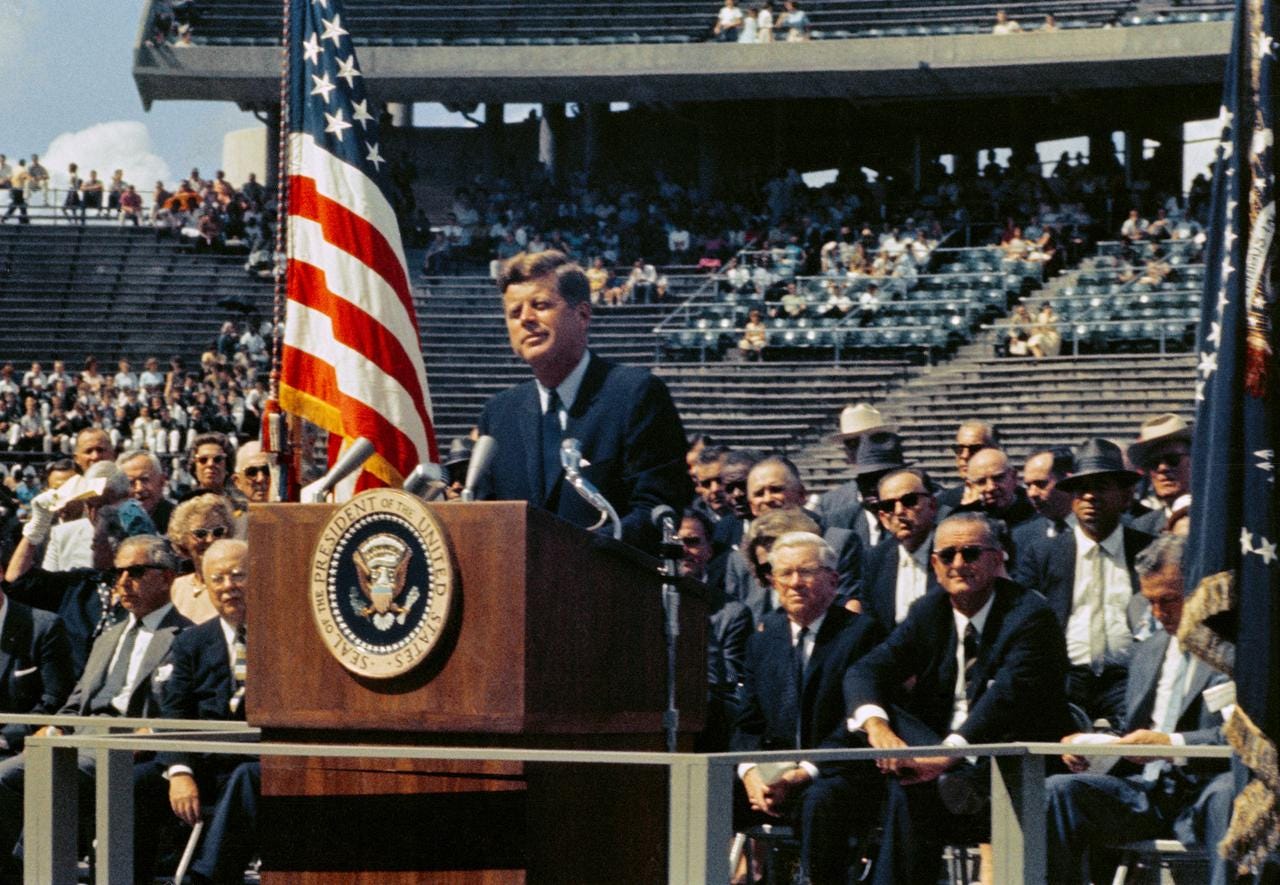
“KENNEDY, JOHN F. - PRESIDENT - Houston, Texas Visit“ by NASA is marked with Public Domain Mark 1.0.
We choose to go to the Moon in this decade and do the other things, not because they are easy, but because they are hard. – John F. Kennedy, 1962
Countries no longer choose to go to space; they have to.
US-Soviet competition at the peak of the Cold War thrust the world into the space age, defined not only by intergovernmental competition and national pride, but also by economic necessity. Since 1965, corporations have sent assets into orbit to claim market share in telecommunications, television broadcasting, remote sensing, and weather monitoring. Space-based infrastructure has lowered costs and improved productivity on Earth by enabling services that support most of the world’s economy.
Today, a new space race has taken off. Driven by falling launch costs, rapid private-sector innovation, and intensifying strategic competition between the US and China, space represents both a commercial market and a domain of national power. While the depths of space are infinite, viable opportunities are finite. Being first in space is no longer merely a symbolic act of planting a flag on the moon. Rather, it secures the most valuable places to operate, where you can build the infrastructure that could make it cheaper for later arrivals to become customers instead of competitors. That infrastructure could make space a place to manufacture specialized materials and medicines, generate energy, and extract resources, creating new products for Earth and the means to sustain economic activity beyond it. As the US and China compete for primacy in space, the stakes of showcasing the supremacy of their differing innovation ecosystems are on full display. This time, the contest will be measured not only by extraordinary national achievements; the outcome will shape which companies and countries build and profit from the next economy, and the terms on which everyone else can access it.
In today’s full analysis:
Building an Economy Beyond Earth
A New Era of Competition
The Implications of the Next Economy
Or listen to the full report here:

Listen to the news:
Global
US President Trump reversed positions and now backs a ban on diesel exports as a way to curb record fuel prices. Diesel prices have hit record levels due to supply constraints caused by the Iran and Ukraine wars, surging more than 70% since late February. High fuel prices create a vulnerability for Republicans in the approaching November elections, creating political pressure to provide some relief to US consumers, with whom the affordability of food and other necessities is of great concern.
A diesel export ban would likely create more problems than it would solve. US Energy Secretary Wright is warning that a ban would create regional market disruptions, with gluts in the Gulf Coast forcing producers to reduce production, not just of diesel but other distillates, such as jet fuel. A ban would not lower prices beyond several weeks. S&P Global Energy estimates that U.S. refiners would need to reduce crude runs by nearly 2 million barrels a day—more than 10%—to eliminate the resulting diesel surplus.
An export ban would remove the single largest source of global diesel from the market, risking a surge in the global price of diesel. Of the 8 million barrels of diesel traded globally by sea each day, the US supplies about 1.5 million barrels, about 20% of market share. An export ban would hit developing countries hard and send shockwaves across Europe, which is heavily reliant on imports of American petroleum products. With Mexico and other Latin American economies relying on US diesel (Latin America buys nearly two-thirds of US diesel exports), a ban risks driving up prices for US supply chains for food and agricultural products. Additionally, other countries could retaliate by reducing or cutting off fuel exports to US regional markets, such as California and the East Coast.
Read More: Reuters [paywall], Wall Street Journal [paywall], American Petroleum Institute, Atlantic Council
Europe
On the sidelines of the UN General Assembly, the US, Denmark, and Greenland signed a defense agreement allowing two additional US bases in Greenland. As part of the deal, the US will be allowed to open bases at Narsarsuaq in the south and Mestersvig in the east, as well as expand the current Pituffik Space Base, which collects information for missile warning systems and space surveillance. The agreement reaffirmed the US military’s right to access Greenland for the defense of the NATO area covered under Article 5, including via President Trump’s envisaged Golden Dome missile defense system, which is still in conceptual stages. No non-NATO country will be allowed to open military installations in Greenland or invest in or operate mining projects without consent from the US, Greenland, and Denmark. If Greenland becomes independent, it maintains Denmark’s responsibilities and obligations.
The agreement ends the transatlantic Greenland dispute, for now. The US appears to have achieved its military objectives of expanding its Arctic military presence and preventing a Russian or Chinese foothold on the island. Moreover, ratifying and implementing the agreement could take a few years, extending beyond the Trump administration’s tenure. Nonetheless, the US could revisit the agreement if it becomes perceived as outdated, such as if Russia’s Arctic build-up accelerates. The Trump administration will likely prioritize the Golden Dome in the short term.
Read More: Politico, Associated Press, CBS News
Middle East
Iran and the US held their first negotiations in months, raising hopes for a settlement. Washington and Tehran held talks via shuttle, mediated by Qatar, on the sidelines of the UN General Assembly in New York. Iranian conditions for an end to the war reportedly included an end to hostilities on all fronts, a halt to US “acts of aggression,” an end to the naval blockade, and the release of frozen Iranian funds. US conditions were not reported, although any deal would likely be limited in scope (similar to the summer MOU).
Oil prices fell on hopes for diplomacy, even as rhetoric escalated and strikes in the region were reported. At his UNGA speech, President Trump said he had a decision between negotiation and “annihilating” Iran. Over the last several days, the IRGC reportedly struck new targets in the Strait of Hormuz, following days of reporting that the regime was considering new escalation in anticipation of potential US strikes.
Read More: Reuters [paywall], Iran International, CNN, AP, TradeWinds News, Al Jazeera
Asia-Pacific
Chinese President Xi Jinping is expected to land at Joint Base Andrews today in the first formal visit to Washington by China’s head of state in over a decade. US President Donald Trump is expected to greet Xi personally on the tarmac, kicking off the three-day state visit that will include talks with Trump at the White House on Thursday. Trade is expected to top the agenda, which also includes artificial intelligence and Taiwan. A key focus will be whether the two sides can extend their October 2025 trade truce, which suspended higher US tariffs while China eased restrictions on critical rare-earth exports. It is set to expire in November.
Expectations for major breakthroughs or business deals remain low, and the summit is likely to focus more on preserving the current détente than resolving deeper disputes. Xi has an incentive to extend the truce as China contends with an economic slowdown, while Trump faces pressure to avoid higher consumer prices ahead of the November midterm elections. Beijing also retains leverage through its dominance of critical-mineral supply chains, while Xi is expected to press Trump on Taiwan, including a pending multibillion-dollar US arms sale that Trump has so far withheld approval for.
Read more: BBC, New York Times [paywall], Wall Street Journal [paywall], Reuters [paywall]
Americas
A UN report released on Monday concluded that US boat strikes against alleged drug smugglers plausibly constitute crimes against humanity. The report by UN special rapporteur Ben Saul found reasonable grounds to believe that 68 strikes carried out between September 2025 and August 2026, which killed at least 223 people, amounted to crimes against humanity of murder under customary international law. Saul rejected the Trump administration’s argument that the strikes were justified as self-defense against designated terrorist organizations, arguing that drug trafficking does not constitute an armed attack. He also said the strikes were neither necessary nor proportionate.
The US has continued the campaign under Operation Southern Spear despite ongoing legal scrutiny. The Pentagon announced two additional strikes in September, bringing the total to 70 vessels and 234 people killed since the campaign began a year ago. The most recent strike, on Saturday, killed four people in the Caribbean. The UN finding raises the prospect of individual criminal liability for officials who ordered or carried out unlawful strikes. The Trump administration has continued to defend the campaign as part of its broader effort against narco-terrorism. The UN report could nonetheless intensify pressure for greater scrutiny.
Read More: New York Times [paywall], The Guardian, BBC
Africa
War has erupted in Ethiopia’s Tigray region, ending a fragile peace between Addis Ababa and the Tigray People’s Liberation Front (TPLF). The TPLF seized the airport in Mekelle, Tigray’s capital, and declared war on the Ethiopian government. The Tigray regional government stated it was responding to “intensive bombardments” by federal forces on Tuesday, including airstrikes, drone attacks, and artillery fire. The declaration followed an announcement that the TPLF had formed an alliance with other ethnic rebel groups seeking to overthrow Prime Minister Abiy Ahmed Ali’s government. Fighting has also been reported in the neighboring regions of Afar and Amhara. Other members of the alliance do not appear to be engaging federal forces but could soon declare war on the government.
Read More: Radio France Internationale, DW
Disruptive Technology
ICYMI: The US and China have agreed to advance an AI safety dialogue. US Treasury Secretary Scott Bessent stated that he and Chinese Vice Premier He Lifeng agreed to establish a formalized dialogue on AI safety with a direct line of communication regarding AI incidents, thereby following up on a similar commitment from May 2026. An operationalized dialogue could become a forum to discuss technical protocols and how to respond to determined AI risks. A dialogue also leaves substantial flexibility for how to manage AI safety as both the US and China fine-tune their policy approaches. A separate 22-country declaration at the UN, led by Finland, calls for managing AI risks through an international institution similar to the IAEA, but neither the US nor China signed onto the document.
Read More: Yahoo!finance, Reuters [paywall], Politico
Energy
The US is considering an investment fund for rebuilding energy infrastructure in the Middle East. The proposal, which the US is calling the Partnership for Allied Trust and Construction (PACT), would see the US commit $5 billion dollars and ask partners in the region to match with their own $5 billion contribution. PACT also aims to reduce the reliance on the Strait of Hormuz for regional energy shipping. The Development Finance Corporation (DFC) would manage the fund. It is unclear when or if other regional countries would sign onto the initiative and commit their own money.
The US war with Iran has resulted in extensive damage to regional energy infrastructure. By April 15, the conflict had led to as much as $58 billion dollars of damage to energy infrastructure. While active hostilities have significantly lessened since earlier phases of the war, damage is still accumulating. A major Saudi Arabian east-west pipeline that Riyadh uses to reroute oil from the Strait of Hormuz suffered significant damage this month, although it has now partially returned to operation. However, a full restart likely won’t occur for at least a month.
Read More: Wall Street Journal [paywall], Reuters [paywall], CNBC
Transnational Crime and Corruption
Russian government-backed payment processor A7 allegedly developed an international money laundering network to help Russian firms evade sanctions. A Financial Times investigation found that at least $6.9 billion was laundered through A7 front companies that accessed the international financial system, in violation of international sanctions. The funds were reportedly used to acquire “war-related goods.” A7’s front companies reportedly used a sophisticated system of forged invoices to disguise the nature of their transactions.
A7 began the alleged money laundering operations in 2024 and shifted its strategy over time. Initially, most of A7’s front companies set up bank accounts in Kyrgyzstan, with much of the money routed through the state-controlled Trading Company of the Kyrgyz Republic. After several Kyrgyz banks were placed under scrutiny for facilitating suspicious A7-linked transactions, the shell company network diversified towards the UAE and Hong Kong. 17 separate front entities opened bank accounts with First Abu Dhabi Bank, which is over 55% owned by the Abu Dhabi government and ruling family. The bank facilitated over $1.7 billion in payments for A7 entities and helped them convert Emirati dirhams into dollars, euros and renminbi.
Read More: Financial Times [paywall], Wall Street Journal [paywall], Open Source Centre
Defense
Seoul is looking to partner with the EU on space-based communications infrastructure. South Korea signed an agreement with the EU last week on cooperation in the realm of secure satellite communications and to explore South Korea’s integration into the EU’s IRIS2 satellite communications constellation. The agreement establishes a working group that will exchange information about current and future programs for satellite communications, joint applications and technical areas of future cooperation. The cooperation could potentially involve the future linkage of Seoul’s planned military communications satellites with the EU’s IRIS2.
IRIS2 has not yet launched but is set to begin its first phase by the end of 2029. The constellation will ultimately include 348 satellites primarily in Low Earth Orbit (LEO) but also 18 in Medium Earth Orbit (MEO).
Read More: Defense Industry Europe, Hartpunkt [in German]


Contact Us
Karl Hopkins
Partner
+1 202 429 6499
khopkins@steptoe.com
Melissa B. Mahle
Senior Advisor
+1 202 261 0577
mmahle@steptoe.com
Anni Coonan
Senior Intelligence Analyst
+1 212 506 3979
acoonan@steptoe.com
Samuel Bloebaum
Senior Due Diligence Analyst
+1 602 410 6240
sbloebaum@steptoe.com
Zayna Dembinski
Analyst
+1 202 778 3567
zdembinski@steptoe.com
Thomas Goldstein
Analyst
+1 202 862 6735
tgoldstein@steptoe.com
Ian Cameron
Analyst
+1 202 327 6908
icameron@steptoe.com
Elton Smole
Analyst
+1 202 261 0556
esmole@steptoe.com
Carter Spahn
Intelligence Fellow
+1 202 261 7555
cspahn@steptoe.com
Chris Dantes
Intelligence Fellow
+1 202 327 6904
cdantes@steptoe.com
Legal disclaimer: This Substack is for educational and informational purposes only and does not constitute the rendering of legal counseling or other professional services. Reading, subscribing to, or communicating through this Substack does not create an attorney-client relationship. Do not send confidential information through this platform. Consult qualified legal counsel regarding your specific circumstances.