

The Sanctions Update, compiled by attorneys from Steptoe’s award-winning International Regulatory Compliance team and the Stepwise: Risk Outlook editorial team, publishes every Monday (subscribe here). Guided by the knowledge of Steptoe’s industry-leading International Trade and Regulatory Compliance team, the Sanctions Update compiles and contextualizes weekly developments in international regulatory enforcement and compliance, as well as offers insights on geopolitical context, business impacts, and forthcoming risks, and non-sanctions news updates.
For more detailed analysis on related issues, see Steptoe’s International Compliance Blog. For information on industry-specific monitoring or bespoke services, please contact the team here.
By Evan T. Abrams, Meredith Rathbone, Karl Hopkins, Guy Soussan, Alexandra Melia, Wendy Wysong, Ali Burney, Quentin Johnson, Elliot Letts, Algirdas Semeta, Melissa B. Mahle, Anni Coonan, Thomas Goldstein, Zayna Dembinski, Samuel Bloebaum, Elton Smole, Ian Cameron, Wilson Zhao, Zoey Hong, Hoi Chung Liu, Jonathan Eaton, Carter Spahn, Chris Dantes

The Lede
US Considers Removing Sanctions on Türkiye as F-35 Sale Remains Uncertain
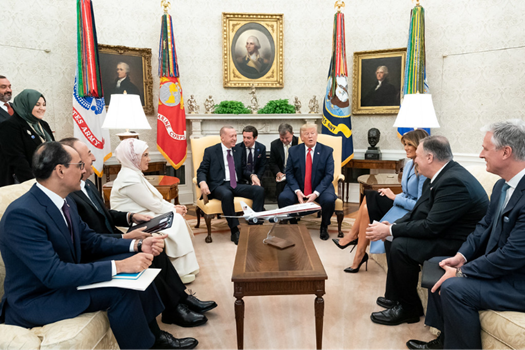
“President Trump and the First Lady Visit with the President of Turkey and Mrs. Emine Erdogan“ by The White House is marked with Public Domain Mark 1.0.
At the NATO Summit in Ankara, President Trump indicated he is considering removing sanctions on Türkiye’s Defense Industry Agency (SSB) and allowing for the sale of F-35 aircraft. Ankara was removed from the F-35 program and sanctioned in 2019 due to its purchase of the Russian S-400 air defense system. More recently, US-Türkiye relations have warmed amid political tensions with other NATO members over the issue of alliance burden-sharing. These tensions have elevated Türkiye’s standing within the Trump administration, which views Ankara as a self-reliant ally and key interlocutor in the Middle East. Lifting sanctions on the SSB would be a strategic win for Ankara, as it loosens export restrictions and permits US financial assistance to the agency. The removal of sanctions is likely, but any transfer of the F-35 to Türkiye is still contingent upon the removal of the S-400 system and credible assurances that it will not be repurchased. Furthermore, longstanding security concerns from Congress could also pose an obstacle. If the sale of F-35s ultimately does not proceed, US-Türkiye relations could face some friction, but significant disruptions to the partnership are unlikely.
US and Türkiye relations have degraded since 2016, a period in which Türkiye embraced an independent foreign policy to secure its position across the Middle East and sometimes diverged with NATO allies in places like Syria and Libya. Türkiye’s independent strategy was open to greater collaboration with Russia, culminating in the purchase of the Russian S-400 surface-to-air defense system in 2019. US officials argued that operating the S-400, designed to collect information on aircraft, could allow Russia to collect intelligence on the stealth capabilities of the F-35 fighter jet, which Ankara was at the time under contract to purchase.
Following unsuccessful attempts to convince Ankara to replace the S-400 with the Patriot air defense system, the US sanctioned Türkiye’s Defense Industry Agency (SSB), Türkiye’s defense procurement organization, pursuant to the Countering America’s Adversaries Through Sanctions Act (CAATSA). Signed into law in 2017, the law imposes sanctions on Iran, Russia, and North Korea, and authorizes the president to impose sanctions on persons determined to have knowingly engaged in a “significant transaction” with Russia’s defense or intelligence sectors. The package includes a prohibition on specific US export licenses and loans, a ban on US Export-Import Bank assistance, and visa restrictions on four SSB officials. Turkish President Recep Tayyip Erdoğan decried the sanctions as a violation of the country’s sovereignty and threatened to close Turkish bases to US military personnel and assets.
Supplemental legislation prevents any sale of F-35s without the complete removal of the S-400 system from Türkiye. Section 1245 of the National Defense Authorization Act for Fiscal Year 2020 prohibits the transfer of the F-35, its parts, and any related technical data and intellectual property. However, the Secretary of War and Secretary of State are permitted to waive this limitation by submitting a written certification to Congress that Türkiye no longer possesses the S-400 and does not plan to acquire it in the future. Although Congress does not approve or reject the certification, lawmakers could still create political obstacles through political pressure or new legislative action.
Shared strategic interests have renewed efforts to lift sanctions, and the Trump administration aims to strengthen ties by resolving a longstanding source of friction. The US views Türkiye as an increasingly important partner in advancing NATO burden-sharing and addressing regional security challenges. In particular, Ankara has become one of the most influential external actors in post-Assad Syria, making its cooperation important to US objectives related to regional stability and counterterrorism. Moreover, the US sees Turkish investment and influence in Africa as a preferable alternative to a more entrenched Russian or Chinese presence. For Türkiye, acquiring the F-35 would advance military modernization goals and strengthen interoperability with NATO allies. Participation in the F-35 program would also bolster Türkiye’s defense industrial base and reinforce its position as a leading regional military power.
Congress appears to be cautious about removing sanctions. Lawmakers from both parties have argued that Türkiye’s continued possession of the S-400 presents an unacceptable counterintelligence risk to the F-35 program. Turkish media have reported that the S-400, which has not been used, will be exported to a third Gulf country, potentially reducing this opposition. Separately, members of Congress have expressed concerns over Ankara’s strategic orientation, including its continued defense and economic ties with Russia and increasingly tense relationship with Israel. As a result, efforts to transfer F-35 aircraft are not guaranteed. Although the failure to complete the sale could hinder a renaissance in US-Türkiye relations, it is unlikely to significantly undermine the broader strategic partnership, given the countries’ shared interests within NATO and in regional security.
US Developments
US Imposes New Sanctions, Revokes GL on Iran Amid Renewed Hostilities
On July 10, 2026, the Department of the Treasury’s Office of Foreign Assets Control (“OFAC”) imposed sanctions against Ali Ansari (“Ansari”), who allegedly oversees a “sprawling global network” of assets that benefit Iran’s leader, Mojtaba Khamenei (“Khamenei”), and other regime elites. Concurrently, OFAC imposed sanctions against Ansari’s Saint Kitts and Nevis-based holding company, Smart Global Limited (“Smart Global”), which it said Ansari has used to engage in large-scale embezzlement of publicly funded wealth. OFAC also sanctioned multiple Iranian exchange houses and their owners for allegedly facilitating transactions for sanctioned Iranian banks.
These sanctions follow the suspension of new sanctions designations against Iran anticipated by the Memorandum of Understanding (the “Iran MOU”) signed in mid-June. As we reported previously, renewed hostilities in the region have threatened to derail the ongoing negotiations between the US and Iran. Following further hostilities, President Trump stated on Truth Social that the ceasefire was no longer in effect, even as negotiations continue.
OFAC, in the days leading up to the new designations, issued an amended Iran-related General License (“GL”) X1, which revoked the previously issued GL X, authorizing the wind-down of transactions made pursuant to GL X through July 17, 2026. GL X implemented Point 10 of the Iran MOU by temporarily authorizing certain transactions ordinarily incident and necessary to the production, sale, delivery, or offloading of Iranian-origin crude oil, petrochemical products, or petroleum products.
Senators Find a Path Forward on Russian Sanctions Bill
On July 10, 2026, Senator Jeanne Shaheen (D-NH), the Ranking Member of the Senate Foreign Relations Committee, alongside Senators Roger Wicker (R-MS), the Chair of the Senate Armed Services Committee, Lindsey Graham (R-SC), and Richard Blumenthal (D-CT), released a statement claiming that they had “reached an agreement with the Trump Administration to move [their] updated Russia sanctions legislation [the Sanctioning Russia Act of 2025] forward.”
The Act is a sweeping sanctions and tariff-related bill first introduced in April 2025 that received strong bipartisan support in the Senate. Lawmakers reportedly sought Secretary of the Treasury Scott Bessent’s support for the bill during the NATO summit in Türkiye last week. Previously, we reported that the Act saw a renewed push in Congress in late November 2025 following President Trump’s indication that he would support the legislation, provided he retained ultimate decision-making flexibility with respect to the sanctions and tariffs contained therein. We also reported that Senator Graham had said President Trump “greenlit” the Act in January 2026, though it was never put to a vote.
It will be important to monitor the changes made to the Act during the months of negotiations between Congress and the White House. According to the Senators’ statement, the Act has indeed been updated, and if the White House has approved of the latest version, there is a strong possibility it now contains wording that would provide President Trump with greater flexibility on the imposition and retraction of sanctions, tariffs, and related economic measures.
OFAC Extends Term of License for Certain Payments with Russian Central Bank
On July 8, 2026, OFAC issued Russia-related GL 13R, “Authorizing Certain Administrative Transactions Prohibited by Directive 4 under Executive Order 14024.”
GL 13R effectively extends the term of the authorization under Russia-related GL 13 by three months, from its previous expiration date of July 9, 2026, to October 9, 2026. Russia-related GL 13 authorizes certain payments of taxes, fees, or import duties to, and purchase or receipt of permits, licenses, registrations, certifications, or tax refunds from the Russian Central Bank, National Wealth Fund, or Ministry of Finance, that would otherwise be prohibited by Directive 4 of Executive Order (EO) 14024.
Alongside GL 13R, OFAC also issued two amended FAQs:
FAQ 999 (describing authorizations available for entities subject to Directive 4)
FAQ 1118 (explaining the license does not authorize payment of the Russian “exit tax”)
OFAC Issues Democratic Republic of the Congo Sanctions GL
On July 10, 2026, OFAC issued a Democratic Republic of the Congo (“DRC”)-related GL 2, “Authorizing Transactions Related to Agricultural Commodities, Medicine, Medical Devices, Replacement Parts and Components, Software Updates, or Clinical Trials.”
GL 2 generally authorizes transactions that would otherwise be prohibited by the Democratic Republic of the Congo Sanctions Regulations (“DRCSR”), provided they are ordinarily incident and necessary to:
The exportation or reexportation of agricultural commodities, medicine, medical devices, replacement parts and components for medical devices, or software updates for medical devices to the DRC or Rwanda, or to persons in third countries purchasing specifically for provision to the DRC or Rwanda;
The prevention, diagnosis, or treatment of any disease or medical condition in the DRC or Rwanda; or
The conduct of clinical trials and other medical research activities in the DRC or Rwanda.
GL 2 does not currently have an expiration date.
UK Developments
UK Makes New Designations Under Chemical Weapons Sanctions Regime
The UK has designated seven individuals who are directors and technical specialists at leading scientific research institutes involved in Russia’s development and synthesis of toxic chemicals, and two leading scientific research institutes (SC Signal and the State Research Institute of Military Medicine (GNIII VM)) under its chemical weapons sanctions regime. The newly designated persons are Russian actors involved in the development of the deadly toxins Novichok and Epibatidine, linked to the deaths of Alexei Navalny and Dawn Sturgess. According to a press release issued by the Foreign, Commonwealth and Development Office, the designations were made ahead of the NATO Summit in Ankara and represent the latest effort by the United Kingdom to expose and deter Russia’s illegal chemical weapons activity. The action also comes after the United Kingdom and its international partners united at the Munich Security Conference in February 2026 to confirm the circumstances surrounding the death of Alexei Navalny in Russian custody.
OFSI Amends and Extends Maritime Mutual Re-Insurance Wind Down General Licence
OFSI has published an amended and extended Maritime Mutual Re-Insurance Wind Down General Licence INT/2026/8893924 (MMR GL). The expiry date of the MMR GL has been extended from 6 July 2026 to 7 October 2026. Additionally, the MMR GL has been amended to introduce a monthly reporting requirement, whereby the designated persons relying on the MMR GL must provide OFSI HM Treasury with a report setting out details of all activities and/or payments carried out under the MMR GL during that month within 14 days of the end of each calendar month.
UK Secures First Conviction for Breach of UK Russia Luxury Goods Sanctions
According to media reports, Jonathan Hornby, a businessman from Cheshire, has been convicted of breaching the UK’s luxury goods trade sanctions under the Russia sanctions regime. According to HMRC, Mr. Hornby tried to send four pieces of artwork to Russia in February 2024. After UK Border Force officers seized the shipments at Heathrow airport, Mr. Hornby (who admitted the offences at Westminster Magistrates Court) was fined £30,085. According to HMRC, the consignment was linked to Mr. Hornby’s businesses, Global Customs Systems UK Limited and In Time Worldwide Express Ltd.
UK Court Dismisses Case Against Art Gallery for Breach of UK-Russia Trade Sanctions
A judge sitting at Southwark Crown Court has dismissed the charges against Hauser & Wirth Gallery Limited and Artay Rauchwerger Solomons Limited in relation to an alleged breach of Russia’s luxury goods trade sanctions involving the artwork “Escape from Humanity” by George Condo, which was made available to Alexander Popov. The court concluded that the prosecution was unable to establish that Mr. Popov was, at the relevant time, a person connected with Russia to whom the making available of the artwork would have been prohibited. Consequently, the case was dismissed in its entirety.
EU Developments
EU Proposes New Sanctions Regime Against Migrant Smugglers and Human Traffickers
On July 9, the European Commission and the High Representative of the EU proposed a new horizontal sanctions regime targeting migrant smuggling, human trafficking, and other serious forms of organized crime. The proposed framework would enable the EU to sanction individuals and entities involved in conduct originating outside the EU that poses a serious threat to the EU’s values, the security of the EU and its Member States, or international security.
The proposal aims to disrupt the business model of organized criminal networks by restricting their movements and cutting off their profits. Under the proposed regime, listed individuals and entities would be subject to asset freezes and a prohibition on making funds or economic resources available. Listed individuals would also be subject to travel bans preventing entry into, or transit through, EU Member States.
The initiative was first announced by Commission President Ursula von der Leyen during her September 2025 State of the Union address as part of the EU’s broader defense and security agenda. In the Q&A document accompanying the proposal, the Commission stated that the new sanctions regime would complement, rather than replace, existing criminal law tools and investigations. The Commission also noted that the proposed measures would not target migrants, asylum seekers, or persons in need of international protection, and would be without prejudice to legitimate humanitarian activities.
The proposal will now be considered by the Council and requires unanimous approval by all 27 EU Member States before it can enter into force.
EU Member States Continue Discussions on the 21st Sanctions Package Against Russia
EU Member States of the Council have yet to reach an agreement on the proposed 21st package of sanctions against Russia, with negotiations continuing over several politically sensitive measures.
Speaking ahead of the Foreign Affairs Council on July 13, High Representative of the EU Kaja Kallas confirmed that a number of issues remained unresolved, preventing agreement on the package. Reports indicate that several of the package’s key measures have been scaled back during negotiations, including the proposed ban on Russian combatants’ entry into the EU. In addition, it remains unclear whether EU Member States will agree to a six-month suspension of the adjustment mechanism of the Russian seaborne crude price cap (until January 2027). The Commission pushed for the suspension to prevent the cap from adjusting above $60 per barrel, which is above the Urals crude benchmark. According to reports, several shipping-dependent Member States, including Greece, support a shorter, three-month suspension period.
Reportedly, Russian Orthodox Patriarch Kirill and Lukoil founder Vagit Alekperov have been excluded from the draft text following objections raised by Bulgaria. A statement issued following the July 9 meeting of Bulgarian Prime Minister Roumen Radev’s Cabinet argued that sanctions on Patriarch Kirill would have no meaningful economic impact on Russia, while potentially generating adverse propaganda effects against Europe. The statement also maintained that measures against Alekperov could negatively affect Lukoil Group companies operating in Bulgaria.
The proposed restrictions on imports of certain Russian fish products have also been revised during negotiations. According to reports, Germany is likely to be permitted to continue importing haddock, while Poland and Portugal are expected to receive exemptions from proposed restrictions on pollock and cod, respectively.
Asia-Pacific Developments
China Calls for End to US Embargo on Cuba at UN Debate
At a UN General Assembly debate requested by Cuba, China strongly urged the United States to end its decades-long economic, commercial and financial embargo on Cuba, arguing that the sanctions have caused severe economic losses, humanitarian hardship, and shortages of fuel, food, medicine, and essential goods. Chinese Ambassador Fu Cong said the overwhelming vote to hold the debate (136 in favor, 9 against, and 30 abstentions) reflected broad international support for lifting the embargo, which China views as a violation of the UN Charter, international law, and Cuba’s rights to sovereignty, development, and self-determination. China called for an immediate end to all unilateral and secondary sanctions, greater humanitarian assistance for Cuba, and stronger international support for the country.
China Defends Sanctions on Philippine Defense Chief Amid South China Sea Tensions
China defended its sanctions against Philippine Defense Secretary Gilberto Teodoro Jr. after Philippine President Ferdinand Marcos Jr. criticized the move as “unhelpful” and escalatory. Beijing said the sanctions—including travel bans and restrictions on transactions involving Teodoro and certain family members—were imposed in response to Teodoro’s comments on the South China Sea and condemning China’s countermeasures.
Indonesia Receives First Russian Crude Shipment Despite Western Sanctions
Indonesia has received its first shipment of 770,000 barrels of Russian crude oil under a 150-million-barrel agreement, using a government-to-government structure to navigate sanctions-related financial and compliance constraints. To avoid exposing state-owned energy company Pertamina to potential bond covenant breaches linked to transactions involving sanctioned entities, Jakarta designated the state-run agency Lemigas as the official importer of record. The arrangement relies on alternative legal, financial, and logistical channels that allow continued access to Russian energy exports despite Western sanctions and price-cap measures. The deal underscores Indonesia’s focus on securing affordable energy supplies and contributes to the ongoing redirection of Russian oil exports toward markets in the Global South.
Japan Tightens Enforcement of Russia Sanctions by Targeting Indirect Jet Fuel Exports
Japan has clarified that its ban on jet fuel exports to Russia applies not only to direct shipments but also to indirect transfers through third countries and ship-to-ship transfers at sea, as part of its sanctions against Russia coordinated with the G7 and other international partners. The announcement came after reports that Russia was preparing to import a cargo of Japanese-origin jet fuel through intermediaries amid fuel shortages linked to attacks on its energy infrastructure. Japanese Trade Minister Ryosei Akazawa said authorities are taking steps to prevent sanctions evasion through industry outreach, warnings, information sharing, and cooperation with foreign governments, emphasizing that Japan will continue to enforce strict export controls in line with international sanctions measures.

Global
Extreme weather exacts a steep human toll in Europe. European countries reported more than 10,000 excess deaths during the record-breaking heatwave hitting the continent in late June. The human costs were highest among vulnerable populations, aged 65 and above. Extreme heat disrupted power supplies, leaving people exposed to heat stroke and aggravating other medical conditions. Western Europe registered the hottest June on record. The heat is continuing into July in parts of Western Europe, fueling devastating wildfires in France and the Iberian Peninsula.
Globally, June was the second warmest on record, slightly below June 2024. The 10 warmest Junes on record have all occurred since 2015. Additionally, this month marked the 50th consecutive June with global temperatures above the 20th-century average; the last below-average June occurred half a century ago in 1976. In addition to Europe, June temperatures shattered records across the eastern and central tropical Pacific Ocean, portions of Canada, northern South America, Africa and Asia.
Read More: Euronews, World Meteorological Organization, National Oceanic and Atmospheric Administration
Europe
The Trump administration has reportedly greenlit a revised version of the Graham-Blumenthal Russia sanctions bill. The Sanctioning Russia Act of 2025, which would allow the President to impose 500% secondary tariffs on countries that buy Russian fuels, stalled amid diplomatic efforts to mediate an end to the Russia-Ukraine war. In the meantime, Ukraine’s reputation has improved with the White House. Russia is increasingly perceived as the intransigent actor; Ukraine’s defense industrial base has managed to cultivate an indigenous deep-strike capability; and Russia continues to lose momentum on the battlefield with as many as 30,000 casualties per month. It is not clear what changes were made to the Graham-Blumenthal bill, but momentum for increased sanctions authority likely stems from the US-Ukraine relationship and additional presidential flexibility.
Advancing the sanctions bill would follow up on deepening US-Ukraine defense cooperation. On the sidelines of the Ankara NATO summit, the US agreed to license the production of Patriot Pac-3 interceptors—helping close Ukraine’s air defense vulnerability—in addition to offensive ATACMs and Stinger missiles. The US and Ukraine also anticipate closer drone cooperation, with a prominent Ukrainian contractor opening a manufacturing plant in Ohio.
Passing the bill depends on the White House. The Trump administration has reportedly approved the bill on two separate occasions, only for attention to be redirected. Moreover, Senator Lindsey Graham, the bill’s chief architect and champion, died suddenly Saturday evening. Despite new momentum, the bill may again face an uphill climb.
Read More: Reuters [paywall], The Hill
Middle East
Renewed strikes between the US and Iran escalated over the weekend, severely straining the countries’ ceasefire. Tit-for-tat airstrikes have been ongoing since last Tuesday over the management and status of the Strait of Hormuz. On Saturday, the US struck 140 targets throughout Iran after the Iranian Revolutionary Guard Corps (IRGC) attacked a commercial ship transiting the strait. The IRGC asserted that the Strait of Hormuz would be closed again, alleging violations by the US of the bilateral memorandum of understanding (MOU) governing the ceasefire.
Iran is seeking to block the creation of a Hormuz transit route that avoids Iranian waters. The US Navy had been directing commercial ships to transit the strait along the coast of Oman since early May and continued to do so after the MOU was signed in June. Iran alleged that the coordination violated the MOU, which Iran interpreted as giving it control over strait traffic. The US countered that the MOU allowed free passage through the strait.
Read More: New York Times [paywall], Financial Times [paywall], Foreign Affairs [paywall]
Asia-Pacific
India and New Zealand on Saturday elevated bilateral relations to a strategic partnership during Prime Minister Modi’s visit to Auckland. The trip marks the first visit by an Indian prime minister to New Zealand in 40 years, underscoring Modi’s effort to strengthen India’s diplomatic outreach and regional standing. The two sides agreed to deepen cooperation in defense, trade, and diplomacy, among other areas. The visit follows China’s ballistic missile test launch last week and also comes as Auckland eyes joining the recently signed Australia-Fiji mutual defense treaty, signaling its determination to expand regional defense partnerships amid growing uncertainties.
The visit also comes amid growing political tensions in New Zealand over the India-New Zealand free trade agreement signed earlier this year. The agreement would reduce tariffs on 95% of New Zealand’s exports to India. The deal has faced domestic pushback within Prime Minister Luxon’s governing coalition and still requires parliamentary approval before it can enter into force. Lawmakers from the New Zealand First Party have raised concerns about perceived immigration concessions and a reported $34 billion investment commitment to India. India maintains that the agreement’s visa provisions are intended to facilitate business mobility rather than migration, while New Zealand Trade Minister McClay has said the investment provision reflects a commitment to promote investment rather than an obligation to invest that amount.
Read More: Reuters [paywall], South China Morning Post [paywall], New Zealand Foreign Affairs & Trade, Radio New Zealand, Awaaz
Americas
On Friday, Colombian President-elect Abelardo de la Espriella stated that his incoming administration would take an active role in Venezuela’s earthquake recovery. His statement declared that “the reconstruction of Venezuela after the earthquake has to be carried out by Colombia, with all that it implies.” De la Espriella also indicated that the issue would be raised with the United States and later clarified that he was proposing international cooperation rather than attempting to replace Venezuelan authorities. The comments reflected his broader vision of a more assertive Colombian regional role and signaled a willingness by the incoming government to engage directly in Venezuela’s post-disaster recovery. De la Espriella will take office on August 7.
On Saturday, Venezuela’s Foreign Ministry responded to De la Espriella’s remarks, reaffirming that the recovery and reconstruction of earthquake-affected areas is the sole responsibility of the Venezuelan state. The statement emphasized that no coordination with Colombia’s incoming government is currently planned. While Caracas left open the possibility of cooperation with foreign public and private entities, it stressed that any such arrangements would be made on Venezuela’s own terms and under its sovereign authority. The exchange reflects Venezuela’s longstanding sensitivity to perceived external involvement in domestic affairs and suggests that reconstruction efforts could become an early source of friction in relations with Colombia’s next administration.
Read More: CNN en Español [Spanish], Última Hora [Spanish], Demócrata
Africa
Namibia and China signed a series of cooperation agreements covering energy, mining, infrastructure, agriculture, education, and technology. Namibia is a strategically important source of natural resources. It is the world’s third-largest uranium producer and possesses significant lithium deposits. The country could also become Africa’s fourth-largest oil producer by 2030, following major offshore discoveries estimated at approximately 2.6 billion barrels of crude by US and European energy companies.
Economic competition between the US and China in Namibia is intensifying. Washington has sought to strengthen bilateral ties, while US energy companies continue offshore exploration. US Ambassador to Namibia John Giordano is driving cooperation on AI in support of Windhoek’s Vision 2030 strategy, which aims to advance the country’s digital economy. Despite these efforts, Namibian President Netumbo Nandi-Ndaitwah chose China for her first state visit outside Africa, underscoring both Beijing’s enduring influence and the hedging strategy pursued by many African states.
Read More: Reuters [paywall], AllAfrica, Newsweek, US Embassy in Namibia
Geoeconomics
The US-India trade deal remains unfinished. In February, India had agreed to reduce tariffs on all US industrial goods and selected agricultural products, address regulatory barriers and purchase $500 billion in US goods over five years. Washington offered to lower its reciprocal tariff on Indian products from 25% to 18%, with further relief for pharmaceuticals, gems, aircraft parts and other products. However, the Supreme Court’s subsequent rejection of the administration’s global tariffs largely erased that preferential offer, leaving India unwilling to implement the deal in its current state.
India is prepared to delay an agreement further until they receive more favorable terms. June negotiations failed to resolve New Delhi’s demands for better treatment than competing exporters and protection against additional US levies, including a proposed 12.5% tariff tied to forced-labor concerns. India also continues to resist greater agricultural access, a politically sensitive issue for farmers and small businesses. Strong exports and new agreements with the UK and EU have strengthened its negotiating position, while the impasse prolongs uncertainty for companies that expected the February framework to stabilize market access.
Read More: Reuters [paywall], DW, The Diplomat [paywall]
Disruptive Technology
The US loosened export controls on the UAE to enable greater AI and defense tech cooperation. The Bureau of Industry and Security (BIS) reclassified the UAE to the A5 group under the Export Administration Regulations, which will broadly allow greater commercial cooperation across a range of dual-use technologies, including civil nuclear deployment, oil and gas extraction, satellites, and drones. This move ends previous dual-use oversight, including in industries that contribute to missile technology, which were restricted due to the presence of UAE-based entities in Iran’s ballistic missile procurement network.
The Iran war has brought the US and the UAE closer together. As hostilities dissipate to a lower but latent level, the US will seek to rebuild the UAE’s air defense and energy capabilities. The UAE could also increase investment and tie-ups with the American defense industrial base. This deepening is a sign that the US views the UAE as aligned with regional interests rather than a balancing actor.
The growing US-UAE tech relationship likely contributed to the decision. In May 2025, the US reversed its anticipated AI diffusion rule, which cleared the way for the UAE to procure up to 500,000 of Nvidia’s most advanced semiconductors. The BIS statement from Friday emphasized that the UAE has made progress on limiting the diffusion of such chips to China, which would benefit its AI stack. Diffusion is likely a diminishing concern as China cultivates a homegrown AI stack.
Read More: Bureau of Industry and Security, Reuters [paywall]
Energy
Russia’s loss of refining capacity is presenting another challenge to the global supply of refined oil products. Russia’s decision to suspend exports of diesel, a result of Ukraine’s strike campaign against Russian refining capacity, is further disturbing global markets and worsening shortages of industrial fuel. Across the US and Europe, which no longer import Russian diesel, prices have spiked due to shortages. Diesel makes up the largest share of global oil consumption, and price increases there can spread across the economy and affect a variety of other sectors and products. Russia is the world’s largest exporter of diesel after the US, and its exit from the export market has the capacity to significantly affect global supplies. Exports had already been slowing before Moscow instituted the ban.
Russia’s energy troubles are unlikely to end soon, signaling more uncertainty for its role in global energy markets. The International Energy Agency (IEA) recently cut its assessment for Russian oil output for this year and next year. The IEA assessed that output in Russia will fall approximately 3% due to Ukrainian attacks on energy infrastructure. However, in recent months, Russian crude exports have risen due to an inability to refine oil domestically. The pressure on Russian energy output, combined with the recent resumption of hostilities in the Strait of Hormuz, creates significant uncertainty and supply risks for global energy markets. This could be further exacerbated by a recent US push to place exceedingly high secondary sanctions on countries procuring Russian energy products.
Read More: Reuters [paywall], Reuters [paywall], Oilprice.com, Politico
Transnational Crime & Corruption
Iraq is engaged in a widespread anti-corruption crackdown. The campaign began in late May with the arrest of Iraq’s deputy minister of oil and refining affairs for embezzlement. In late June, authorities announced that they had seized $107 million in embezzled funds and arrested dozens of senior provincial officials and lawmakers. State media described it as one of the largest anti-corruption efforts in recent Iraqi history.
The anti-corruption push is driven by Iraq’s new Prime Minister Ali al-Zaidi. Al-Zaidi assumed office in mid-May after being selected as a compromise candidate with a limited political record. Regional analysts suspect al-Zaidi will attempt to moderate the arrests to maintain popular public support, balance US and Iranian interests in Iraq and preserve his parliamentary coalition. Al-Zaidi may also be escalating anticorruption efforts ahead of his visit to Washington this week, where he will seek US support for foreign investment in Iraq’s petrochemical industry and broader economy.
Read More: Organized Crime and Corruption Reporting Project, OCCRP, Reuters [paywall], Foreign Policy [paywall]


Contact Us
Karl Hopkins
Partner
+1 202 429 6499
khopkins@steptoe.com
Melissa B. Mahle
Senior Advisor
+1 202 261 0577
mmahle@steptoe.com
Anni Coonan
Senior Intelligence Analyst
+1 212 506 3979
acoonan@steptoe.com
Samuel Bloebaum
Senior Due Diligence Analyst
+1 602 410 6240
sbloebaum@steptoe.com
Zayna Dembinski
Analyst
+1 202 778 3567
zdembinski@steptoe.com
Thomas Goldstein
Analyst
+1 202 862 6735
tgoldstein@steptoe.com
Ian Cameron
Analyst
+1 202 327 6908
icameron@steptoe.com
Elton Smole
Analyst
+1 202 261 0556
esmole@steptoe.com
Carter Spahn
Intelligence Fellow
+1 202 261 7555
cspahn@steptoe.com
Chris Dantes
Intelligence Fellow
+1 202 327 6904
cdantes@steptoe.com
Legal disclaimer: This Substack is for educational and informational purposes only and does not constitute the rendering of legal counseling or other professional services. Reading, subscribing to, or communicating through this Substack does not create an attorney-client relationship. Do not send confidential information through this platform. Consult qualified legal counsel regarding your specific circumstances.