


The Sanctions Update, compiled by attorneys from Steptoe’s award-winning International Regulatory Compliance team and the Stepwise: Risk Outlook editorial team, publishes every Monday (subscribe here). Guided by the knowledge of Steptoe’s industry-leading International Trade and Regulatory Compliance team, the Sanctions Update compiles and contextualizes weekly developments in international regulatory enforcement and compliance, as well as offers insights on geopolitical context, business impacts, and forthcoming risks, and non-sanctions news updates.
For more detailed analysis on related issues, see Steptoe’s International Compliance Blog. For information on industry-specific monitoring or bespoke services, please contact the team here.
By Evan T. Abrams, Meredith Rathbone, Karl Hopkins, Guy Soussan, Alexandra Melia, Wendy Wysong, Ali Burney, Quentin Johnson, Elliot Letts, Algirdas Semeta, Melissa B. Mahle, Anni Coonan, Thomas Goldstein, Zayna Dembinski, Samuel Bloebaum, Elton Smole, Ian Cameron, Wilson Zhao, Zoey Hong, Kiki Dong, Isabella Rao, Jonathan Eaton, Carter Spahn, Chris Dantes

The Lede
US Sanctions M23 and FDLR Commanders as DRC-Rwanda Peace Talks Stall
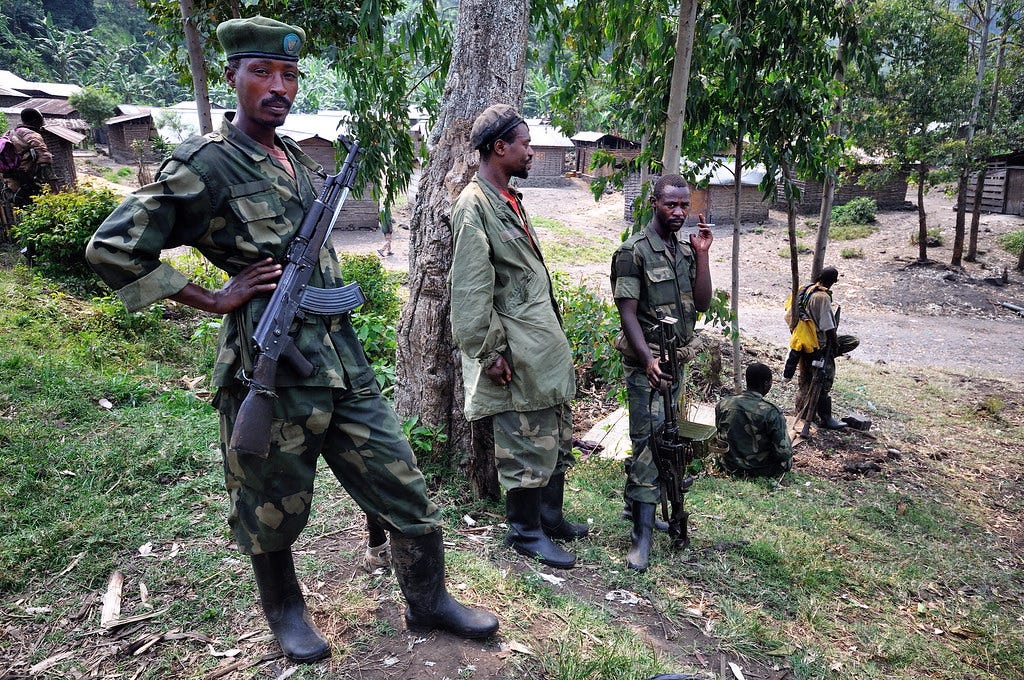
"M23 troops Bunagana 4" by Al Jazeera English is licensed under CC BY-SA 2.0.
On Tuesday, the US imposed sanctions on commanders of M23 and the Democratic Forces for the Liberation of Rwanda (FDLR), opposing paramilitary groups embroiled in conflict in the eastern Congo. The Treasury Department added two senior commanders to the Specially Designated Nationals List: Gustave Kubwayo and John Imani Nzenze. Kubwayo is the leader of the Commando de Recherche et d’Action en Profondeur, an FDLR intelligence and special operations unit. Nzenze is M23’s chief of intelligence and a close associate of Sultani Makenga, the US-sanctioned military commander of the group.
The sanctions follow repeated attempts by the Trump administration to broker peace between Rwanda, which covertly backs M23, and the Democratic Republic of the Congo (DRC), which has cooperated with the FDLR to hold territory. Previous sanctions packages targeted Rwandan military officers and others who provided financial and material support to M23. Sanctions on the FDLR, which has historical ties to the Congolese military, signal new efforts by the US to increase pressure on the DRC to dismantle the group, which was a commitment in the December 2025 Washington Accords. Washington’s interest in ending the fighting is partially underpinned by critical minerals cooperation with the DRC, which has been constrained by ongoing insecurity in the east. As fighting persists, it remains uncertain whether additional sanctions will be sufficient in extracting meaningful concessions from the rebel groups.
The “March 23” Movement (M23) insurgency first emerged in the DRC in 2012. Tenuous peace between M23 and the DRC ended in 2021 after the Congolese government failed to integrate M23 into the military. Rwanda has long provided military and financial support to the group, viewing it as key to containing the FDLR and perceived anti-Rwandan forces in Kinshasa. The FDLR was formed in 2000 from remnants of the Rwandan Armed Forces responsible for the 1994 genocide against ethnic Tutsis. Kigali views the FDLR as an existential threat and has repeatedly called on the DRC to dismantle it. Although the DRC’s official policy prohibits cooperation with the FDLR, Congolese Army units have supported the group in operations in North Kivu province.
The Trump administration has sought to resolve the conflict to stabilize the region and advance its critical minerals partnership with the DRC, the largest global supplier of cobalt. In December 2025, the presidents of the DRC and Rwanda signed the Washington Accords for Peace and Prosperity. Soon after, however, M23 seized the strategic port city of Uvira in South Kivu province with assistance from the Rwandan Defense Force. M23 eventually withdrew following immense US pressure, but fighting continues in North and South Kivu. Most recently, M23 has moved to consolidate political control over captured territory. Emboldened by perceived favoritism from Washington, the DRC has also delayed implementation of its recent commitments. Kinshasa has expanded drone strikes to contain the M23 insurgency, and its commitment to disarm the FDLR has yet to show tangible progress.
Despite pressure from the US and offers of economic development, both Rwanda and the DRC have significant incentives to prolong the conflict. Kigali not only views the FDLR as a threat to its security, but also sees control over the eastern Congo as a means to deter regional rivals and secure critical mineral sites in the region. Meanwhile, Kinshasa aims to totally eradicate M23, believing it will remain in Washington’s favor because of its strategic value to the global minerals industry. If measurable progress toward a ceasefire and disarmament of the rebel groups is not made in the next one to two months, the Trump administration could expand the sanctions package to include other M23 and FDLR commanders as well as Rwandan and Congolese military units supporting them. Nonetheless, new sanctions decisions will be geared to preserving a semblance of the Washington Accords so that the US can gain greater access to the DRC’s mineral extraction industry.
US Developments
Economic Fury Continues as Rubio Testifies Before Congress
The Office of Foreign Assets Control (OFAC) has continued to increase sanctions pressure on Iran as negotiations to end the conflict stall.
On May 29, 2026, OFAC sanctioned individuals and entities allegedly associated with an Iran-based procurement network that “impersonated and defrauded” US companies in order to procure goods for Iran’s Ministry of Defense and Armed Forces Logistics (MODAFL) and other sanctioned Iranian end users.
On June 2, 2026, OFAC designated multiple Iranian digital asset exchanges for allegedly providing “significant support” to the Iranian regime, including by acting as a “vehicle for sanctions evasion.”
On the same day, OFAC issued a new Iran-related FAQ (FAQ 1257), which stated that non-US persons (including foreign financial institutions) faced sanctions risk for dealing with the above-mentioned Iranian asset exchanges.
On June 5, 2026, OFAC sanctioned a network of individuals, entities, and vessels across multiple jurisdictions for allegedly shipping Iranian-origin liquid petroleum gas (LPG) “intentionally disguised as Omani LPG” to end users in South and East Asia. OFAC also sanctioned an Iranian exchange house, Mehrdad Geramian Nik and Partners, which it said moved “hundreds of millions of dollars of foreign currency” on behalf of sanctioned Iranian banks.
The May 29, June 2, and June 5, 2026, sanctions follow multiple similar actions taken by OFAC and the Department of State over the previous two months, pursuant to the Trump administration’s “Economic Fury” campaign.
On June 2, 2026, Secretary of State Marco Rubio testified before Congress that the US is not discussing, nor has it offered, sanctions relief for Tehran in exchange for opening the Strait of Hormuz. It was previously reported that Iran counted among its conditions to end the conflict relief from US, UN, and potentially other sanctions. While Rubio’s testimony does not entirely foreclose the possibility of imminent sanctions relief, it indicates that the US will likely only entertain the request for relief after certain benchmarks are met.
State Department Sanctions Cuban Leaders and Entities
On June 4, 2026, the Department of State designated five individuals and five entities alleged to have met specified criteria under Executive Order (EO) 14404, which President Trump signed on May 1, 2026, and which we covered in greater depth in the May 4, 2026 edition of the Sanctions Update. Among those sanctioned were the Ministry of the Revolutionary Armed Forces of Cuba (“MINFAR”), which is the ministry in charge of the Cuban military; Minera la Victoria SA (“Minera”), a Cuban gold mining joint venture, and the Cuban state-owned enterprise (SOE) Geominera SA, as well as Miguel Diaz-Canel Bermudez (“Diaz-Canel”), the President of Cuba.
The Department of State’s designations represent yet another escalatory action taken by the Trump administration against the incumbent Cuban regime. They follow similar designations on May 7 and May 18, 2026, as well as rhetoric from President Trump that the US may consider a “friendly takeover” of the country after the US negotiates an end to the conflict in Iran.
UK Developments
FCA Publishes Findings on Sanctions Systems and Controls
The UK Financial Conduct Authority (FCA) has published the findings of its review of sanctions systems and controls across the financial services sector, drawing on supervisory work involving more than 150 firms since February 2022. Covering both financial and trade sanctions compliance, the report identifies strengths and weaknesses across six key areas: governance and oversight, risk assessments, due diligence, screening, alert management and asset freezing. The FCA noted that assets frozen in the UK increased from £24.4 billion in 2023–24 to £37 billion in 2024–25, reflecting the growing scale of sanctions implementation and enforcement.
The report highlights screening failures and weaknesses in alert management as the most common causes of suspected sanctions breaches. Among the findings, only 75 percent of screening alerts correctly identified sanctioned parties where names appeared in alternative forms, more than a quarter of firms took between three and five days to resolve name screening alerts, and financial sanctions controls were generally more mature than trade sanctions controls. The FCA also identified examples of poor practice, including firms lacking contingency arrangements for system outages, employees bypassing escalation procedures due to performance pressures, and payments being processed after customers had been identified as subject to asset freezes. The regulator has urged firms to review sanctions controls across the customer and transaction lifecycle and is engaging directly with firms where deficiencies were identified.
OTSI and FCA Formalise Sanctions Enforcement Cooperation Under New Memorandum of Understanding
The Office of Trade Sanctions Implementation (OTSI) and the Financial Conduct Authority (FCA) have signed a new Memorandum of Understanding (MoU), formalising cooperation and information sharing between the two authorities on trade sanctions enforcement. The agreement reflects the increasing interaction between OTSI’s role in enforcing UK trade sanctions and the FCA’s supervision of firms’ financial crime and sanctions controls. Under the MoU, both authorities will be able to share intelligence, compliance information and details of suspected sanctions breaches where relevant to their respective functions.
The MoU establishes a framework for both proactive and request-based information sharing, including information relating to suspected sanctions violations, weaknesses in firms’ sanctions controls, and broader intelligence relevant to either authority’s remit. The agreement also contemplates cooperation on investigations and enforcement activity where trade sanctions issues intersect with FCA-regulated firms. The development is a further indication of the UK Government’s increasingly coordinated approach to sanctions enforcement, with greater collaboration between regulators, licensing authorities and enforcement bodies intended to strengthen compliance oversight and improve detection of sanctions breaches.
EU Developments
EU To Discuss Possible Sanctions Against “Extremist” Israeli Ministers
The EU is reportedly exploring possible restrictive measures against “extremist” Israeli ministers, according to draft EU Council conclusions seen by the press. The proposal is to be discussed by Member States at the upcoming Foreign Affairs Council meeting on June 15, with discussions likely to continue at the European Council summit on June 18 to 19. EU foreign ministers are expected to consider, for the first time, whether to target senior members of Israel’s government in connection with the mistreatment of activists detained following the interception of the Global Sumud Flotilla in international waters in May.
According to reports, the sanctions proposal was driven by reactions from several Member States after Israeli National Security Minister Itamar Ben-Gvir circulated footage showing detainees being mistreated. Several governments, including Italy, then pushed to place the matter on the EU sanctions agenda.
Discussions remain at an early stage, with EU foreign ministers working towards building a common position among all 27 Member States. Reportedly, the Czech Republic and Bulgaria have already signaled their opposition to sanctions against Israeli ministers.
Advocate General Opinion on “Violent Demonstrations” Criterion in EU Sanctions Against Moldova
Advocate General Dean Spielmann of the European Court of Justice Union has issued a non-binding opinion in Case C 179/25 P concerning the EU sanctions regime against persons destabilizing the Republic of Moldova. The Opinion follows an appeal brought by Moldovan politician Marina Tauber against a 2024 judgment of the General Court, which upheld her inclusion on the EU sanctions list for allegedly organizing violent anti-government protests.
Advocate General Spielmann takes the view that the General Court did not correctly apply the listing criterion in Article 1(1)(a)(ii) of Council Decision 2023/891, which provides for asset freezes and prohibits access to funds or economic resources for persons “planning, directing, engaging in, supporting or facilitating violent demonstrations or other acts of violence.” In particular, the General Court treated evidence of “violent intentions” as sufficient to satisfy that criterion. According to AG Spielmann, the listing criterion requires a “material element”, consisting in the person’s involvement, through planning, directing, engaging in, supporting or facilitating, in demonstrations that are violent or constitute acts of violence. Consequently, Advocate General Spielmann proposes that the Court of Justice set aside the judgment and refer the case back to the General Court.
Asia-Pacific Developments
Australia Targets West Bank Settler Farms in New Sanctions
On June 2, 2026, Australia announced a new round of “Magnitsky‑style human rights sanctions” targeting three Israeli individuals and four entities linked to “escalating settler violence against Palestinians in the West Bank.” The measures impose financial restrictions and travel bans, marking the first inclusion of “farming outposts that serve as hubs for settler violence.” The sanctions were coordinated with partners including New Zealand and build on joint actions previously taken with Canada, New Zealand, Norway and the United Kingdom, which targeted Israeli ministers Itamar Ben‑Gvir and Bezalel Smotrich.
China Opposes US Sanctions on Cuban Leaders
On June 5, 2026, China voiced firm opposition to the United States’ decision to impose new sanctions on Cuban President Miguel Díaz‑Canel, several senior officials, and state-linked entities, following the US Treasury Department’s latest expansion of its Specially Designated Nationals List. Beijing’s Foreign Ministry criticized the move as another example of Washington’s “hegemonic and domineering behavior and bullying practices,” urging the US to end what it described as a decades‑long blockade that violates Cuba’s right to development and stability.
North Korea Continues UN Sanction Violation, Coal Exports Reach 1.5 Million Tons in 2025
On June 7, 2026, North Korea reportedly exported about 1.5 million tons of coal in 2025, defying United Nations sanctions that prohibit such trade to curb funding for Pyongyang’s nuclear and missile programs. Citing assessments from South Korea’s National Intelligence Service, Rep. Yu Yong‑weon said the North imported “refined oil from China and Russia in 2025 also exceeded seven times the 500,000-barrel cap set by the UN.” North Korean and foreign‑flagged vessels were used to smuggle coal and other minerals, often disguised as Russian cargo to evade tracking. Despite mounting evidence of sanctions violations, Seoul has imposed no new unilateral measures since mid‑2025, raising concerns about enforcement gaps and the growing resilience of North Korea’s illicit trade networks.

Global
European leaders push fresh ceasefire proposal for Ukraine War as the conflict grinds on and peace prospects seem remote. The EU, an informal minilateral group comprised of the UK, France and Germany. The European leaders set conditions for a ceasefire, starting with direct talks between the Kremlin and Kiev, with an agreement including legally binding security guarantees such as the deployment of a multinational force. European leaders are working in close coordination with Ukrainian President Zelensky, but their intervention is also designed to give them a seat at the negotiating table, should diplomacy gain traction.
Last week, President Zelensky sent two letters to President Putin proposing direct negotiations, with the messages aimed at audiences beyond the Kremlin. In a letter delivered via intermediary Roman Abramovich, and then an open message, Zelensky said Ukraine would be prepared to observe a full ceasefire for the duration of negotiations. He called on President Putin to set a clear date for the meeting. Zelensky wanted it known that Putin continues to be the obstacle to negotiations. Zelensky is seeking to stir discontent in Russia over the growing cost of war. Regarding the US, Zelensky wants to remind policy makers of the European war and Ukraine’s military needs, as attention has shifted to the Middle East. Ukraine, not just Russia, is facing economic pressures.
Ukraine is trying to shake up the status quo and perceptions on peace. Ukrainian deep penetration attacks inside Russia are starting to expose internal doubt in the Kremlin’s messaging that Russia is prevailing. The costs of war are becoming more difficult for Moscow to dismiss. Attacks against Russian energy infrastructure have caused domestic shortages. Ukraine embarrassed President Putin by attacks on Saint Petersburg coinciding with a major economic forum. Russian Finance Ministry and Central Bank officials have warned President Putin that soaring defense spending is driving the federal budget deficit to unsustainable levels. If Ukraine is not able to shift the battlefield advantage, it may be able to shift perceptions on the merits of diplomacy.
Read More: Reuters [paywall], Euronews, Euronews, Council on Foreign Relations
Europe
Armenia is set to reelect the pro-EU party of current Prime Minister Nikol Pashinyan despite Russia’s best efforts. Pashinyan’s Civic Coalition party gathered over just short of 50% of the final vote according to Armenia’s Central Election Commission (CEC), convincingly defeating opposition parties including the pro-Kremlin party of the Russian-Armenian oligarch Samvel Karapetyan. Before the election, Moscow had thrown significant resources into swaying the outcome of the Armenian elections, including disinformation and economic pressure campaigns as well as reportedly trying to bus Armenians residing in Russia to the country to cast votes.
The election is a victory for the West over Russia. In the runup to the election, US President Donald Trump endorsed Pashinyan, and the EU mobilized an economic support package worth almost $60 million for Armenia to help it resist Russian economic pressure. President Trump had also hosted a meeting of the leaders of Armenia and Azerbaijan in 2025, during which the two countries signed a peace declaration and a US-backed infrastructure corridor in the Zangezur Corridor to connect Azerbaijan with its exclave territory.
The elections come at a pivotal moment for Armenia’s geopolitical alignment between the West and Russia. Since Russia failed to come to Armenia’s aid during its conflict with Azerbaijan, despite Russia deploying peacekeepers and Armenia being a member of Russia’s Collective Security Treaty Organization (CSTO), Armenia has reoriented its foreign policy away from Russia. This has included suspending its membership in the CSTO in 2024 and taking steps towards a bid for EU membership. Shortly before the elections, Pashinyan signaled that he might withdraw Armenia from the CSTO completely, and the speaker of the Armenian parliament said that Armenia would leave both the CSTO and the Eurasian Economic Union if Russia increased the price of Armenia’s gas imports.
Read More: Politico EU, Politico EU, Reuters, Reuters, Meduza, The Bell, Stepwise Risk Outlook
Middle East
Ceasefires across the Middle East showed cracks over the weekend. Over Saturday and Sunday, Israel struck targets in southern Lebanon and Beirut, defying a US request not to continue strikes in the capital and its suburbs. The strikes would have been prohibited under the partial Israel-Hizballah ceasefire announced early last week, which the Iran-backed group ultimately rejected. The US and Iran also traded attacks, with the US intercepting drones and missiles over the Strait of Hormuz.
The strikes represent a prolonging of the no-peace, no-war limbo in the region. A semi-enforced ceasefire – used as a way to dampen escalation without making substantive concessions – has become the status quo throughout the region over the last several months. The result is costly in a political, economic and humanitarian sense, but not as devastating as all-out conflict. Iran, Israel, and the US appear to all prefer the current environment to the alternative – but political will and military resources are not inexhaustible.
Meanwhile, President Trump rejected Iranian calls to unfreeze sanctioned cash, which has emerged as a sticking point, as a preliminary step in a peace deal. Iran is demanding access to $12 billion in Iranian state assets frozen in overseas bank accounts as a first step to any ceasefire or peace agreement, and up to $24 billion over the course of a longer ceasefire and negotiation period. For Tehran, which is deeply distrustful of American promises, access to cash is a more valuable immediate outcome than sanctions relief, which could be canceled. The request is politically sticky for the president, who sharply criticized the fact that President Obama’s deal included $1.7 billion in payments from frozen Iranian accounts to the regime.
Read More: Reuters [paywall], Washington Post [paywall], Wall Street Journal [paywall]
Asia-Pacific
Chinese President Xi Jinping is in North Korea for a two-day visit with Kim Jong Un. The visit is the first from Beijing in seven years and is seen as part of Beijing’s effort to draw Pyongyang closer into its orbit. Pyongyang has recently strengthened its alliance with Russia while maintaining its nuclear capabilities. Beijing has been openly critical of Pyongyang’s nuclear program in the past, decrying nuclear tests and calling for its neighbor’s disarmament. Kim sought to display North Korea’s strength upon Xi’s arrival, announcing plans for a new 10,000-ton naval destroyer.
Closer ties between Pyongyang and Moscow have paid off militarily and economically for North Korea. The country’s economy is performing better than it has in years, as Pyongyang supplied troops to support Russia’s war in Ukraine. In return, Moscow has provided economic support and military technology. This has emboldened Kim to assert more autonomy in his discussions with Xi.
Kim seeks to draw further economic gains from the talks with Xi. China remains North Korea’s primary benefactor, and topics of discussion include cross-border trade and further developing border economic zones. North Korea is starting a five-year development plan that includes expanding the tourism industry. Before the pandemic, Chinese tourists accounted for 90% of foreign tourists in North Korea, although North Korea shut its borders to tourists in 2020. North Korea’s development plan also puts emphasis on the development of more housing for North Koreans.
Read More: Reuters [paywall], Wall Street Journal [paywall], BBC
Americas
Peru’s runoff election is too close to call, with a quick count showing a statistical tie between Keiko Fujimori and Roberto Sánchez. The counting process, which may include a recount, could take days or weeks. Sánchez, who received 50.3% in the quick count results, pivoted his platform to the center in recent weeks. Fujimori received 49.7% in the preliminary results from Ipsos, which samples vote counts from a representative sample of polling stations. While the gap between the two candidates is within the margin of error, Ipsos has a strong record of predicting Peruvian runoff winners, making correct predictions in every runoff since 2001.
As of Monday morning, 91% of votes have been counted. Fujimori, an establishment center-right candidate and the daughter of a former president, dominated in the capital Lima and the coast of Peru. Sánchez, an ally of former President Pedro Castillo, has proposed broad economic reform and leads in the rural Andes regions. The first round of voting in a crowded field of candidates was marred by logistical errors that resulted in an extension of voting and allegations of fraud. Isolated reports of irregular ballots on Sunday raised concerns about the integrity of the vote, but Peruvian electoral officials rejected the possibility of systemic fraud, stating that any irregularities were quickly resolved. At a press conference, officials say that the final audited vote count would take approximately one month.
Read More: New York Times [paywall], BBC, AP, DW
Africa
The DRC government announced confirmed Ebola cases rose to 515 as the CDC warns the outbreak could approach the scale of the 2014-2016 West Africa epidemic. The CDC projected Friday that poor control over the disease’s spread (isolation of only 20% of symptomatic patients) could produce over 20,000 cases in the next three months. The report furthers that a large scale-response is necessary to prevent the outbreak from becoming “one of the largest Ebola epidemics in history.” Late detection and continued conflict in the eastern Congo have exacerbated the spread in the DRC.
The US announced additional funding for Ebola response efforts. The Department of State pledged an additional $38 million as part of the US’ $1.8 billion contribution to the UN Office for the Coordination of Humanitarian Affairs. The funding will contribute to several response measures, including the procurement of equipment, border screening, and contact tracing. Concerns remain that the overall reduction in global health funds could inhibit the international response.
Read More: NPR, Reuters [paywall], US Centers for Disease Control and Prevention, US Department of State, The Conversation
Geoeconomics
The May jobs report was meaningfully stronger than expected and revised away some of the weakness in prior months. Employers added 172,000 jobs in May, while the unemployment rate held at 4.3%, where it has stayed within a narrow 4.3% to 4.5% range since July 2025. The prior two months were also revised up by a combined 93,000 jobs, with March raised to 214,000 and April to 179,000, making the labor market look steadier than the earlier data suggested.
The composition was mixed, but less health-care dependent than recent reports. Leisure and hospitality added 70,000 jobs, including 48,000 in restaurants and bars; local government added 55,000; and health care added 35,000, roughly in line with its recent trend. The weak spot was financial activities, which lost 22,000 jobs in May and is now down 107,000 from its May 2025 peak, while construction, manufacturing, retail, information, professional services, and most other major sectors showed little change. Wages remained contained, with average hourly earnings up 0.3% on the month and 3.4% over the year, lower than the 4% pace this time last year.
The labor market may be shifting back into a higher gear, but for different reasons than expected. Employers added more than 500,000 jobs between March and May, the best three-month stretch in more than two years, and job gains have averaged 188,000 a month over that period, calling into question the idea that the economy’s “break-even” pace of job creation had permanently fallen. But the fact that unemployment stayed at 4.3% despite stronger payroll growth suggests labor supply may also be rising, potentially because foreign-born workers who left the workforce during last year’s immigration crackdown are returning. As a result of the strong report, markets hardened their expectations that rate-cuts will be delayed, with Goldman Sachs pushing its expected Fed cuts into 2027 after the payroll data.
Read More: New York Times [paywall], Wall Street Journal [paywall], Bureau of Labor Statistics
Disruptive Technology
Anthropic calls for a development pause to prevent “recursive self-improvement,” where agentic AI can create and improve new models with full autonomy from humans. Anthropic notes that the speed of AI in completing tasks has doubled roughly every four months since at least 2024. Through this trendline, Anthropic warns that uncontrolled development could create a runaway scenario where humans lose control of the AI, possibly even before achieving so-called “artificial general intelligence” (a scenario in which AI achieves or eclipses the capability of humans).
Anthropic suggests that a global agreement is necessary to coordinate a development slowdown. Coordinating AI development would also require a verification mechanism to ensure developers hold their end of the bargain. Nonetheless, there are market and policy headwinds to this. Large public companies are betting on AI development for their growth, and developers like Anthropic are looking toward initial public offerings in 2026. Therefore, private governance may run into a collective action problem, with companies fearing that a slowdown could lock in winners and losers. Geopolitically, there may not be enough global alignment for a deal on an AI slowdown. Like the politics of climate change, countries will fear that accepting limits on certain economic activity could impact economic competitiveness and national security.
A discussion on “recursive self-improvement” adds momentum to broader conversations around AI safety. Some critics allege that developers thrive on overhyping the power of their models. Nonetheless, the White House’s recent executive order on voluntary public-private coordination for the release of new models reflects a new zeitgeist in AI policy.
Read More: Yahoo!news, Scientific American, Wall Street Journal [paywall]
Energy
Russia recently began construction on a nuclear power plant in Uzbekistan shortly after finalizing a deal to build a nuclear plant in Kazakhstan. The powerplants, which will be built by Russia’s state-owned Rosatom corporation, are being funded by Russian loans to the Central Asian countries. The construction of the plant in Uzbekistan, which will combine two large units and two small modular reactors, began during the St Petersburg International Economic Forum, Russia’s flagship international economic gathering. For Kazakhstan’s plant, a Rosatom-led consortium won the project over China National Nuclear Corporation, France’s EDF, and South Korea’s Hydro & Nuclear Power.
Nuclear energy cooperation provides a strong diplomatic and economic option in Russia’s toolkit. Nuclear cooperation involves long-term commitments in the areas of maintenance, technical expertise, and fuel supplies. Russia has used its nuclear industry repeatedly to develop its relationships with other countries. In early 2025, a Rosatom subsidiary signed an agreement with Vietnam Electricity and the director of Rosatom announced that construction on a nuclear plant in Vietnam would resume after having stopped in 2016. Rosatom is building plants in Bangladesh, Turkey, Egypt, and India, among other locations. Putin also recently met with the President of Tanzania, who, according to Russian media, expressed interest in cooperating with Russia on the construction of a nuclear power plant.
Read More: Reuters, Moscow Times, Izvestiya, Jamestown Foundation
Transnational Crime & Corruption
Civil society organizations dispute the efficacy of Cambodia’s crackdown on scam centers. Cambodia launched an initiative against scam centers in July 2025 and, by April 2026, claimed to have closed more than 250 operations, criminally prosecuted 1,089 people, and deported 13,039 foreign scammers. Amnesty International investigation released today found that Cambodian authorities had only targeted 24 of 86 identified scam compounds. Even these raids were allegedly for show, as scam operators allegedly obtained advance notice of police actions from corrupt officials. Amnesty also accused Cambodian authorities of routinely treating victims of human trafficking as criminal scammers.
The report updated Amnesty’s assessment of the extent of Cambodian scam operations. Investigators identified scam center workers who were trafficked from South Asia, South America, Africa, and the Middle East, highlighting the broad criminal networks involved. They also found financial connections between scam center owners, purportedly legitimate corporations, and Cambodian government officials. The Amnesty report concluded that international pressure and high-profile incidents were the only effective inducements for Cambodian responses to the centers.
Read More: South China Morning Post [paywall], Amnesty International


Contact Us
Karl Hopkins
Partner
+1 202 429 6499
khopkins@steptoe.com
Melissa B. Mahle
Senior Advisor
+1 202 261 0577
mmahle@steptoe.com
Anni Coonan
Senior Intelligence Analyst
+1 212 506 3979
acoonan@steptoe.com
Samuel Bloebaum
Senior Due Diligence Analyst
+1 602 410 6240
sbloebaum@steptoe.com
Zayna Dembinski
Analyst
+1 202 778 3567
zdembinski@steptoe.com
Thomas Goldstein
Analyst
+1 202 862 6735
tgoldstein@steptoe.com
Ian Cameron
Analyst
+1 202 327 6908
icameron@steptoe.com
Elton Smole
Analyst
+1 202 261 0556
esmole@steptoe.com
Carter Spahn
Intelligence Fellow
+1 202 261 7555
cspahn@steptoe.com
Chris Dantes
Intelligence Fellow
+1 202 327 6904
cdantes@steptoe.com
Legal disclaimer: This Substack is for educational and informational purposes only and does not constitute the rendering of legal counseling or other professional services. Reading, subscribing to, or communicating through this Substack does not create an attorney-client relationship. Do not send confidential information through this platform. Consult qualified legal counsel regarding your specific circumstances.