


The Sanctions Update, compiled by attorneys from Steptoe’s award-winning International Regulatory Compliance team and the Stepwise: Risk Outlook editorial team, publishes every Monday (subscribe here). Guided by the knowledge of Steptoe’s industry-leading International Trade and Regulatory Compliance team, the Sanctions Update compiles and contextualizes weekly developments in international regulatory enforcement and compliance, as well as offers insights on geopolitical context, business impacts, and forthcoming risks, and non-sanctions news updates.
For more detailed analysis on related issues, see Steptoe’s International Compliance Blog. For information on industry-specific monitoring or bespoke services, please contact the team here.
By Evan T. Abrams, Meredith Rathbone, Karl Hopkins, Guy Soussan, Alexandra Melia, Wendy Wysong, Ali Burney, Quentin Johnson, Elliot Letts, Algirdas Semeta, Melissa B. Mahle, Anni Coonan, Thomas Goldstein, Zayna Dembinski, Samuel Bloebaum, Elton Smole, Ian Cameron, Wilson Zhao, Zoey Hong, Kiki Dong, Kuangqi Zhong, Andy Xu Sofia, Jake Fitzpatrick, Carter Spahn, Chris Dantes

Listen to the Lede:
The Lede
US Delists Prominent Venezuelan Politician Amid Push for Diplomacy and Energy Investment Expansion
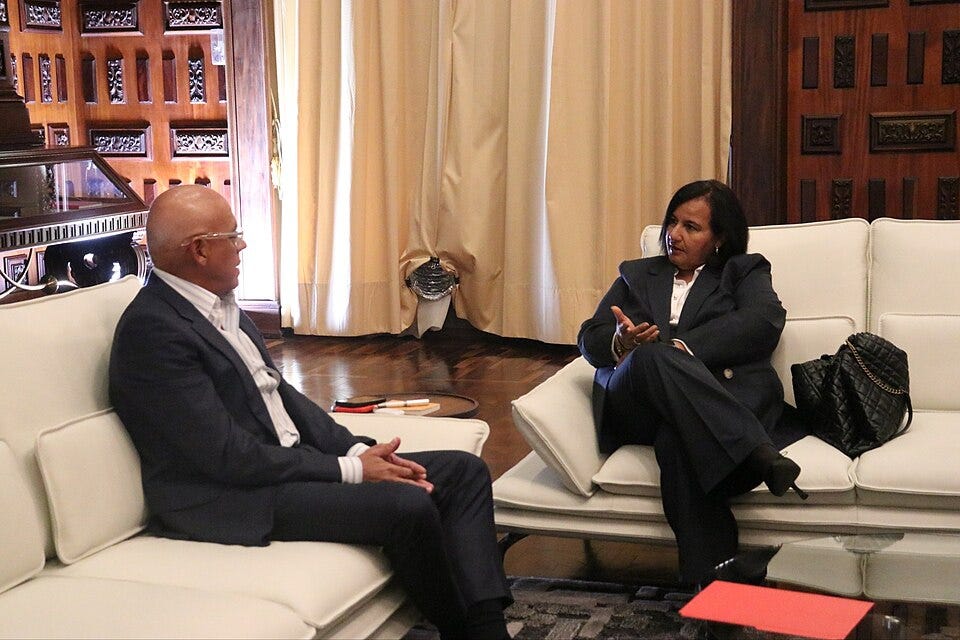
“Jorge Rodríguez y Dinorah Figuera en 2026” by Prensa de la Asamblea Nacional de Venezuela is in public domain.

Last week, the US lifted sanctions on Jorge Rodriguez, a Venezuelan political power player and brother of interim President Delcy Rodriguez, amid Washington’s latest push for diplomacy and expansion of energy investment. On October 14th, the US Treasury Department’s Office of Foreign Assets Control (OFAC) removed Rodriguez from its Specially Designated Nationals and Blocked Persons (SDN) list, ending the associated asset freeze and obstacles for US persons attempting to deal with him. Rodriguez, the President of Venezuela’s National Assembly since 2021 and former vice president under Hugo Chavez, was initially designated in 2018. Alongside members of Nicolas Maduro’s inner circle, including Delcy Rodriguez and Maduro’s wife Cilia Flores, Jorge was designated pursuant to E.O. 13692 for his contribution to Venezuela’s democratic backsliding, human rights abuses and government corruption.
The designation removal coincided with the start of the third round of US-backed negotiations between the interim government and the Venezuelan opposition. The government delegation has been led by Jorge Rodriguez, while the opposition delegation has been represented by Dinorah Figuera, President of Venezuela’s 2015 National Assembly. Focuses of the first two rounds have included earthquake recovery, the return of frozen overseas funds, and the reform of the country’s Supreme Court, historically a bulwark of support for Maduro. The rounds have been followed by steps to ease political repression, including the release of some political prisoners and reforms to repressive laws.
Little information has thus far emerged about the current round, but the US said that delegations would focus on finalizing Supreme Court selection processes and developing participation guarantees for individuals and political parties in future elections. The ultimate stated goal of these negotiating rounds is indeed the establishment of credible elections, although the timeline for polls remains cloudy. At the UN General Assembly last month, President Rodriguez pledged that Venezuela would hold elections, but did not provide a timeline and over the summer, President Trump told reporters that Venezuela was “not really ready” for elections. Both President Trump and Rodriguez’s government have appeared to prioritize a gradual approach that preserves continuity. By contrast, prominent Venezuelan opposition figure Maria Corina Machado, who has the highest public approval of any Venezuelan political figure, but who the Trump administration has characterized as destabilizing, has called for elections to take place by July 2027. Machado is currently in Panama, and risks arrest if she returns; despite Venezuela’s recent reforms, exiled opposition leader Javier Oropeza was recently arrested upon return to the country, underscoring enduring political risks.
Even as movement on the political front has been stop-and-start, progress in the economic portfolio has been relatively rapid. Rodriguez has shepherded major reforms through the legislature as part of this effort, including the January 2026 reforms that permitted private and foreign investment in the state-dominated oil sector, and a similar law for the mining sector. In late August, the White House announced a joint venture with North American Blue Energy Partners (NABEP), which outlines up to $100 billion in potential investments to develop 17 oil fields containing approximately 65 billion barrels of proven reserves. Western oil majors have increasingly entered the market as well; Halliburton, for example, in late September signed a series of memoranda of understanding with Venezuelan entities for natural gas development and infrastructure, reentering the market for the first time since exiting in 2020 due to US sanctions risk. Washington has also made moves to support international development of Venezuela’s gold mining industry, which has long been dominated by criminal organization, including by pledging security assistance to new US and foreign entrants.
At the same time, sanctions easing on Venezuela is far from comprehensive: 2017 sanctions broadly remain in place, as do 2019 blocking sanctions that prevent dealings with the Venezuelan government. Most sanctions relief thus far has come in the form of General Licenses, which OFAC retains authority to revoke or modify at any time. Significant regulatory uncertainty remains.
Nonetheless, Rodriguez’s delisting signals ongoing US efforts to pursue stability in Venezuela amid further opening of Venezuela’s energy sector and progress towards an eventual, but not immediate, political transition. The removal of sanctions on Rodriguez underscores the continuity of Washington’s once unlikely partnership with Delcy Rodriguez and other members of Maduro’s inner circle. Rodriguez’s government has become the Trump administration’s partner of choice as Washington seeks to preserve stability, shepherd the opening of Venezuela’s economy to Western investment, and bring Caracas in political alignment with Washington as it pursues greater influence in Latin America. The delisting could be a vote of confidence in President Rodriguez’s government as political transition talks continue, as well as an effort to preserve the collaborative bilateral relationship as energy investment ramps up. Accelerating international investment in Venezuela’s economy presents immense opportunities for early movers, but carries significant regulatory and operational risks given the shifting political environment. Some analysts worry that an eventual democratically elected Venezuelan government may renege on oil deals with the US, which conflict with the 1999 constitution, and that the Trump administration may be incentivized to preserve a Rodriguez government.
US Developments
President Waives Sanctions and Tariffs Under the Sanctioning Russia Act
On October 16, President Donald Trump issued an Executive Order (“E.O.”) implementing the Lindsey O. Graham Sanctioning Russia and Iran Act of 2026, while waiving the application of nearly all sanctions, restrictions, and tariffs provided for under the Act. President Trump certified to Congress that the waivers are in the national interest of the United States, as required by section 115 of the Act.
The E.O. nominally imposes a 500 percent tariff on goods from Russia and 100 percent tariffs on goods from certain major purchasers of Russian oil and natural gas and countries that facilitate Russian oil sanctions evasion. However, the E.O. simultaneously waives those tariffs, as well as the Act’s sanctions concerning Russian officials and supporters, financial institutions, state-owned entities, and restrictions on fund transfers, securities trading, investment in and exports by Russia’s energy sector, the purchase of sovereign debt, financial messaging services, and importation of uranium. The E.O. states that the waivers will remain in effect until the President or designated agency officials determine that further action is appropriate. The E.O. does not affect Russia-related sanctions imposed under preexisting Executive Orders.
The decision drew criticism from members of both parties. Republican Senators Darline Graham (R-SC), Thom Tillis (R-NC), and John Cornyn (R-TX) expressed opposition to the waivers, while Democratic Representative Don Beyer (D-VA) argued that the decision was inconsistent with the law’s purpose and called on Congress to limit the President’s waiver authority. The White House opposed earlier versions of the Act that lacked the broad waiver authority that was ultimately enacted. The President’s E.O. follows the Trump administration’s decision on October 9 to authorize the sale and import of Russian diesel fuel, which we covered in last week’s update.
Treasury Targets Iran-Linked Banks and Warns of Charity Abuse
On October 15, the Department of the Treasury’s Office of Foreign Assets Control (“OFAC”) sanctioned 16 individuals and 10 entities for allegedly enabling sanctions evasion and sustaining Iran’s military and proxy forces.
The designated parties included Iran-based banks Jazireh International Bank Company and Chabahar International Bank Overseas Company, which OFAC said operated offshore in free trade zones, as well as Iran-based exchange houses and individuals allegedly involved in foreign exchange operations.
Also among the designated parties was Iraq-based International Development Bank for Investment and Finance (“IDB”), which allegedly provided financial facilitation services and access to U.S. dollars for Iran. OFAC issued General License (“GL”) FF, authorizing transactions that are ordinarily incident and necessary to the wind-down of dealings with IDB and its affiliates through 12:01 a.m. Eastern Daylight Time, October 30, 2026.
Treasury’s action was taken pursuant to E.O. 13902, which targets certain sectors of the Iranian economy, including Iran’s financial and petroleum sectors.
In a separate action, the Department of the Treasury’s Financial Crimes Enforcement Network (“FinCEN”) issued an alert to financial institutions about potential Iranian regime abuse of religious charity networks, including diversion of religious tithes or “khums.” According to FinCEN, the Iranian regime abuses religiously affiliated institutions and charitable organizations to finance elites, fund repression within Iran, and support violence abroad.
State Department Sanctions Cuban State-Owned Banco Internacional de Comercio, S.A.
On October 15, the Department of State sanctioned Banco Internacional de Comercio, S.A. (“BICSA”), a Cuban state-owned bank. According to the State Department, BICSA has provided services to Karafarin Bank, an Iranian financial institution sanctioned by the United States since 2020. The State Department designated BICSA for operating in the financial services sector of the Cuban economy.
The action was pursuant to E.O. 14404, “Imposing Sanctions on Those Responsible for Repression in Cuba and for Threats to United States National Security and Foreign Policy.” The action was announced alongside a broader U.S. effort targeting Iranian financial actors and reflects the Trump Administration’s focus on alleged financial links between Cuba and Iran.
OFAC Extends Lukoil General Licenses
On October 15, OFAC issued Russia-related GL 128D and GL 130B concerning certain activities involving Lukoil International GmbH (“LIG”) and certain related entities. GL 128D, which replaces and supersedes GL 128C, extends the authorization for certain transactions involving specified Lukoil-owned retail automobile service stations outside Russia, while GL 130B, which replaces and supersedes GL 130A, extends the authorization for transactions involving certain Bulgaria-based Lukoil entities and certain related entities. Both licenses extend the relevant authorizations from October 29, 2026, to April 24, 2027.
Treasury Targets Cartel del Noreste’s Commercial Network and Horse Racing Operations
On October 13, OFAC designated four individuals and 11 entities allegedly linked to Cartel del Noreste (“CDN”), a Mexico-based cartel designated as both a Foreign Terrorist Organization and a Specially Designated Global Terrorist (“SDGT”). According to the Treasury Department, the action is OFAC’s largest sanctions action to date targeting CDN.
The designations were imposed pursuant to E.O. 14059, which targets the international proliferation of illicit drugs and their means of production, and E.O. 13224, as amended, which targets terrorists and their supporters. Treasury stated that the action was undertaken in coordination with multiple U.S. law enforcement agencies and Mexico’s Financial Intelligence Unit.
OFAC Extends Venezuela Earthquake Relief Authorization
On October 16, OFAC issued Venezuela-related GL 60A, “Authorizing Transactions Related to Earthquake Relief Efforts in Venezuela.” GL 60A replaces and supersedes GL 60, extending the authorization period from its original end date of October 23, 2026, to April 21, 2027. Venezuela-related FAQ 1263 was amended to reflect the extended authorization end date.
UK Developments
UK Imposes Sanctions on Two Iranian Nationals over Alleged Hostile Activities
The UK Government has announced the designation of two Iranian nationals under the Iran sanctions regime. According to a UK Government press release, the individuals have been designated for their alleged involvement in facilitating or conducting hostile activities on behalf of the Iranian regime, including threats and planned attacks overseas. The individuals are Ruhollah Bazghandi, Head of Counterespionage Operations within the Islamic Revolutionary Guard Corps (IRGC), and Shahram Ali Reza Tamarzadeh Jakki, an alleged facilitator of the Zindashti criminal network implicated in plots targeting Iranian dissidents. Both individuals are now subject to asset freezes, travel bans and director disqualification sanctions. The Foreign Secretary also announced that the Iranian Ambassador would be summoned to reiterate the UK’s opposition to Iranian state-backed threats and interference. The designations form part of the UK’s broader efforts to counter hostile Iranian activity, including its recent use of state threats powers against the IRGC and further sanctions targeting individuals and networks allegedly involved in activities threatening UK and international security.
UK Calls for Tighter International Sanctions on Russia’s Shadow Fleet
UK Finance Minister, John Healey called for stronger international sanctions targeting Russia-linked shipping services during the International Monetary Fund’s annual meetings in Bangkok. Healey urged other countries to maintain economic pressure on Russia, particularly by tightening restrictions on maritime services that enable Russia’s shadow fleet to operate and circumvent existing sanctions. His comments follow several recent UK sanctions packages targeting Russian oil tankers, shipping networks and related service providers, reflecting the UK Government’s continued focus on restricting the energy revenues used to finance Russia’s war in Ukraine. The call comes amid potential divergence in international sanctions policy, with reports that the US administration is considering easing restrictions on certain shadow fleet vessels transporting oil and petroleum products from Russia, Iran and Venezuela to address elevated global freight rates. The developments highlight the UK’s continued commitment to strengthening maritime sanctions enforcement, while underscoring the potential compliance challenges for shipping companies, insurers and financial institutions arising from differences in sanctions policy between jurisdictions.
OFSI Issues General Licence Permitting Ground Rent and Service Charge Payments by Designated Persons
OFSI has issued the Ground Rent and Service Charge Payments General Licence (INT/2026/10050568), authorising UK designated persons, or those acting on their behalf, to make certain property-related payments that would otherwise be restricted under UK financial sanctions. The licence permits payments for ground rent, service charges and certain late payment fees relating to eligible leases of relevant properties in England and Wales, provided payments are made to a UK bank account held by a landlord, managing agent or person acting on a landlord’s behalf. It also authorises landlords and managing agents to receive such payments, transfer funds to superior landlords where applicable, and retain overpayments as credit against future liabilities. Importantly, the licence does not authorise payments to UK designated persons. The General Licence took effect on October 12, 2026, and expires at 23:59 on October 11, 2027. The measure provides a mechanism for UK designated persons to meet ongoing property-related obligations while maintaining applicable financial sanctions restrictions. UK designated persons, landlords, managing agents and financial institutions seeking to rely on the licence should ensure that payments fall within its scope and that all applicable conditions, reporting obligations and record-keeping requirements are satisfied.
Expansion to the Scope of the Global Human Rights Sanctions Regime
The UK Government has revoked and re-enacted its Global Human Rights Sanctions regime, expanding the purpose and designation criteria under the new regime. The reformulated sanctions regime is intended to give the UK Government greater power to target those involved in serious violations and abuses of human rights, violations of international humanitarian law, as well as obstruction of the delivery or distribution of humanitarian assistance. Consequently, under the new Global Human Rights and International Humanitarian Law Sanctions Regulations 2026, the range of conduct for which a person can be designated has been broadened, most significantly to include serious violations of international humanitarian law. A new power to designate by description has also been introduced. The new regime came into effect on October 15, 2026.
In part, this action relates to the package of sanctions measures announced by the UK Government in September 2026 in relation to settlement activity in the West Bank. At that time, the Foreign, Commonwealth and Development Office announced the UK Government’s intention to defend the two-state solution by, among other things, strengthening the UK’s global human rights focussed sanctions regime to target those who commit serious violations of international humanitarian law around the world, including in Palestine.
EU Developments
EU Council Designates 77 Individuals Under Russia Sanctions Regime for Involvement in State Duma Elections
On October 12, the EU Council adopted restrictive measures against 77 individuals involved in the illegal Russian State Duma elections held in September 2026 in occupied territories of Ukraine.
The new listings include 74 candidates who stood for election in the so-called “Donetsk People’s Republic”, the so-called “Luhansk People’s Republic”, the Zaporizhzhia and Kherson regions, and the so-called “Republic of Crimea and the City of Sevastopol”. Those listed include former acting Prime Minister of Ukraine Serhiy Arbuzov, journalist and Channel One war correspondent Irina Kuksenkova, and the so-called “Mayor of Yalta” Yanina Pavlenko. The EU Council also imposed restrictive measures on three members of the Central Election Commission of the Russian Federation for organizing the elections.
According to the Council, by participating in or facilitating the illegal elections for the Russian State Duma, the listed individuals actively contributed to efforts to legitimize Russia’s war of aggression against Ukraine and to sustain Russia’s illegal occupation of Ukrainian territory.
EU Council Targets under the Asset Freeze Sanctions Regime Individuals and Entities Involved in the Circumvention of EU Sanctions
On October 15, the EU Council updated the Russia asset freeze sanctions regime under Council Decision 2014/145/CFSP and Council Regulation (EU) 269/2014 by listing three individuals and nine entities involved in the circumvention of EU sanctions. The new designations target individuals facilitating the import of goods subject to EU restrictive measures into Russia, as well as entities involved in sanctions-evasion schemes related to oil trade and financial transactions.
Among those designated are the Russian cargo delivery company Movers Group LLC and its General Director, Dmitry Chudovsky, for facilitating the parallel import of restricted goods into Russia. The Russian customs broker and full-cycle logistics operator DT Inier LLC and its majority shareholder, Ivanna Savchuk, were also designated for operating customs, logistics, and procurement networks used to circumvent EU trade restrictions. Additionally, the Russian financial services company United Stream LLC and its founder and director, Svetlana Gumenyuk, were designated for facilitating the processing of transactions and the covert importation of goods from the EU into Russia.
The EU Council also designated several companies based in third countries. These include Turkish companies Begler Tekstil Insaat Elektronik ve Dis Ticaret Ltd. Sti. and Medse Group LLC, which were identified as being involved in the foreign trade and procurement of products subject to EU restrictive measures for export to Russia. The Council further listed HURUS TRADE FZE, a trading intermediary established in the United Arab Emirates (UAE) that supplies Russian-origin crude oil to India, and DIS Logistics DMCC, a company based in the UAE that manages vessels linked to the Russian shadow-fleet ecosystem.
Additional listings include Vigor Marine Services LLP, a shipping company based in India, and Shiva Shipping Ltd, a company established in Mahe Island, Seychelles, both of which were identified by the Council as managing or owning vessels involved in the transport of Russian-origin crude oil or petroleum products and practicing irregular and high-risk shipping practices.
EU Council Renews Chemical Weapons Sanctions Regime for Five Years
The EU Council recently renewed the restrictive measures against the proliferation and use of chemical weapons under Council Decision (CFSP) 2018/1544 until October 30, 2031. The renewal marks the first time that an EU sanctions regime is renewed for a period of five years. Currently, the individual restrictive measures apply to 31 individuals and six entities.
Designated individuals and entities are subject to an asset freeze and a prohibition on making funds or economic resources available. In addition, listed individuals are subject to an EU travel ban.
EU Council Adds Three Individuals and Four Entities to Sanctions List Targeting the Democratic People’s Republic of Korea
The EU Council amended its autonomous sanctions regime against the Democratic People’s Republic of Korea (DPRK) to designate three individuals and four entities for supporting, promoting or facilitating activities related to the DPRK’s nuclear, ballistic missile, and other weapons of mass destruction programs, as well as for violating UN Security Council sanctions. The new listings target activities linked to the growing military, economic, and industrial cooperation between the DPRK and Russia, including the deployment of DPRK workers to Russia, bilateral commercial and industrial cooperation projects, and the DPRK-Russia “arms-for-oil” trade.
Among those designated are Ri Song Jin, a researcher at the DPRK National Aerospace Technology Administration and an official of the DPRK Missile General Bureau, whom the EU Council stated was deployed to Russia as a technician supporting Russia’s use of DPRK missiles. Samolet Group, a Russian real estate development company, and its CEO, Anna Akinshina, were listed for employing DPRK workers in construction projects in Vladivostok in breach of UN sanctions. The EU Council also targeted Vladimir Sokolov, founder and president of Russian holding company Black Horse, together with Black Horse and its subsidiary Golden Autumn Agroholding, for facilitating commercial and industrial cooperation with the DPRK. In addition, Paekyangsan Shipping Co Ltd. was designated for operating the DPRK-flagged vessel Paek Yang San 1, which was involved in shipments of refined petroleum products from Russia to the DPRK in violation of UN Security Council sanctions.
As a result of the designations, the listed individuals and entities are now subject to asset freezes and a prohibition on the provision of funds or economic resources. Listed individuals are also subject to an EU travel ban.
EU Council Removes Mikail Gutseriev and Viktar Shautsou from Belarus Sanctions List
On October 13, the EU Council updated the sanctions regime targeting Belarus under Council Decision 2012/642/CFSP and Council Regulation (EC) 765/2006 to remove two businessmen from the sanctions list. Specifically, Mikhail Gutseriev, a prominent Russian businessman with interests in Belarus’ energy, potash, and hospitality sectors, was delisted. The EU Council had previously designated Gutseriev on the grounds that he benefited from and supported the Lukashenka regime. Gutseriev remains listed under the EU’s Russia asset freeze sanctions regime.
In addition, the EU Council removed Belarusian businessman Viktar Shautsou from the Belarus sanctions list. Shautsou had previously been designated on the grounds that he benefited from and supported the Lukashenka regime, including through his involvement in Reshenie Bank and business interests connected to the Dudutki museum complex.
Asia-Pacific Developments
China Proposes New Export Restrictions on AI, Biotechnology and Solar Power Technologies
On October 16, 2026, China unveiled a draft proposal to tighten export controls on 40 advanced technologies across AI, biotechnology, and photovoltaic solar power, including 14 technologies subject to outright export bans and 26 subject to additional restrictions. Beijing cited national security concerns, particularly the potential misuse of advanced AI technologies to threaten critical infrastructure, military facilities, and government systems, as justification for the measures.
China Sanctions Paraguayan and Belizean Ministers Over Ties with Taiwan
On October 12, 2026, China imposed sanctions on Paraguay’s Communications Minister Gustavo Villate and Belize’s Foreign Minister Francis Fonseca over their countries’ continued diplomatic relations with Taiwan, accusing them of interfering in China’s internal affairs, spreading misinformation about Chinese cyberattacks, and making anti-China statements. The sanctions, which include entry bans covering mainland China, Hong Kong, and Macau, as well as restrictions on transactions and cooperation with Chinese entities, are largely symbolic given the officials’ limited engagement with China.

Listen to the news:
Global
The Conference of the Parties to the Convention on Biological Diversity (CBD) opens today with global biodiversity goals significantly off track. COP17, hosted in Yerevan, Armenia, is focused on conservation of the natural world, its sustainable use, and how to share the benefits of its genetic resources. Countries are currently not on track to meet 22 of the 23 targets for 2030, which include protecting 30% of land and sea for nature, restoring 30% of the planet’s degraded ecosystems, and reforming financing for activities that damage nature. This year’s conference will center on conducting the first-ever midterm review of global nature targets and closing major implementation gaps.
The CBD is struggling to prevent and reverse nature loss because it relies on voluntary national targets, lacks enforcement power, and is underfunded. While 144 countries have created action plans, implementation is mixed, with many governments prioritizing economic growth. Governments support economic policies that can harm ecosystems by promoting land conversion, leading to deforestation and destruction of wetlands and grasslands, or by enabling overfishing, hunting, and pollution. Expectations for COP17 are low. Parties disagree over which direction the Convention should take and why, how it is going to be funded, and the level of commitment. Resource mobilization will probably be the most controversial item in Yerevan.
Read More: Reuters [paywall], United Nations, International Institute for Sustainable Development
Europe
France was rocked by violent protests over the weekend following weeks of student demonstrations. Riots and looting broke out as 550,000 people across France went to the streets voicing concerns over the rising cost of living. French Prime Minister Sebastien Lecornu said that 150 police officers were injured and 1,200 people were arrested. Paris Mayor Emmanuel Gregoire described entire streets of Paris as “devastated” after stores were ransacked and cars set alight. Government buildings were also vandalized, including a town hall that was burned down in Limoges. French President Emmanuel Macron vowed that vandals would be prosecuted.
The nationwide unrest came just months before the presidential elections scheduled for April 2027. The National Rally party in particular is using the atmosphere of shock across France to position itself as the law-and-order option on the ballot. The party’s President Jordan Bardella spoke from a police station in the center of Paris, saying the violence was a result of “decades of being soft on crime.” Far-right candidate Marie Le Pen blamed the leftist party of Jean-Luc Mélenchon, who has been a vocal supporter of the recent student demonstrations but called on protesters to avoid looting. Meanwhile, US Vice President JD Vance gave a statement in which he put the blame on immigration.
Read More: AFP, New York Times [paywall], The Guardian
Middle East
Egypt’s president asked its parliament to authorize military support to Saudi Arabia in Yemen. Egyptian President Abdel Fattah al-Sisi requested an urgent parliament session to authorize the military, one of the Arab world’s largest, to help defend its Gulf Arab ally if the kingdom requested its support. A parliamentary vote had been expected on Sunday, but discussions were due to continue on Monday. Saudi Arabia also secured promises of military support from Pakistan and Türkiye (although the latter is held up in the legislative process), and has requested and not received help from the US, Syria, and other partners. Some worry Egyptian involvement could widen the Yemeni conflict and, with it, the US-Iran war.
Saudi Arabia is ramping up its efforts to build a coalition as domestic economic costs build. In addition to the headline costs of reduced oil exports due to ongoing instability in the Bab al-Mandeb, attacks on airports have rocked Saudi Arabia’s ambitions to become a regional hub for business, tourism and sport. The Riyadh airport was closed for a week following major attacks, and is now reopened with slashed service; international events like a Formula 1 race, FIFA event, and EU-Gulf summit have been canceled or postponed. Saudi Arabia’s flagship business summit, the Future Investment Initiative (or “Davos in the desert”), has gone hybrid and the Kingdom fears international attendance will crater.
Read More: Reuters [paywall], The National, New York Times [paywall], Financial Times [paywall]
Asia-Pacific
North Korea has threatened to resume loudspeaker broadcasts and deploy more weapons along its border with South Korea. North Korea’s Kim Yo Jong, the sister of leader Kim Jong Un, on Monday said Seoul’s “reckless behavior” has prompted Pyongyang to consider deploying tactical strikes along the border “as a preemptive and suppressive measure to deal with contingency” and resuming loudspeaker broadcasts, which have been dormant since June 2025. Kim accused Seoul of firing 201 warning shots and issuing 2,870 rounds of warning broadcasts since August and that such provocations have “gone beyond the red line” since last month’s mine blast incident.
Seoul-Pyongyang relations have escalated since last month’s landmine blast, devolving into a series of dangerous military maneuvers and rhetorical threats. Seoul accused North Korea of having deployed 7,000 workers this year to install mines and fences along the border, which caused the border blast last month. Since the incident, both countries have test-fired advanced weaponry, including submarine-launched strategic cruise missiles and hypersonic missiles. The discovery of washed-ashore mines has stoked regional panic, and frontline South Korean units have been placed on high alert with authorization to open fire at short notice to suppress sudden provocations.
Read More: Reuters [paywall], AP News, Al Jazeera, Strait Times
Americas
Brazilian presidential candidates Flavio Bolsonaro and Luiz Inacio Lula da Silva (Lula) faced off in their first debate last night, one week before the run-off vote. Although the debate frequently devolved into heated personal accusations over substantive policy discussion, both candidates stood their ground and avoided any catastrophic faux pas. Lula sought to portray Bolsonaro as out of touch with working-class Brazilians, while Bolsonaro accused Lula of reckless social spending. Both accused the other of corruption, evoking multiple recent scandals involving the family members of both candidates.
The race remains close according to the most recent polls, with Bolsonaro appearing slightly ahead. Bolsonaro outperformed polls and expectations in the first round of voting, but Lula supporters have since rallied in large-scale protests. Lula supporters filled Copacabana beach yesterday in Rio de Janeiro, where the iconic Brazilian singer Caetano Veloso performed to crowds. Bolsonaro supporters filled Avenida Paulista in Sao Paolo over the weekend, with many calling for the release of Jair Bolsonaro, who is currently under house arrest. On Sunday, Brazil’s Federal Police also asked the Supreme Court to open an investigation into alleged money laundering by a lawyer close to Bolsonaro.
Read More: AP, Al Jazeera, Latin America Risk Report
Africa
Kenya confirmed its eighth Ebola case, raising concerns that the virus could further spread into East Africa. The Bundibugyo Ebola virus broke out in the Democratic Republic of the Congo (DRC) in May 2026 and has resulted in 9,277 confirmed cases in the country as of October 15, including 4,478 related deaths. Kenya’s report follows confirmation from the DRC that the outbreak has spread to an eighth province, North Ubangi. Kinshasa and its international partners continue to struggle to detect infections and contain the outbreak due to insecurity in the eastern Congo (the M-23-controlled North and South Kivu provinces have also been impacted) and distrust from locals in healthcare workers. The US has expanded its financial support for containing the outbreak, announcing an additional $267 million in health and humanitarian assistance in September, adding to Washington’s $887 million spent in assistance so far.
Five months into the outbreak in the eastern DRC, there is still no approved vaccine against the Bundibugyo strain. The World Health Organization stated that the first clinical trial of a potential vaccine would begin at the end of this month. If results are positive and phase 2 and 3 trials are successful, a rollout of the vaccine could take place in the first half of 2027.
Read More: Reuters [paywall], AllAfrica, European Centre for Disease Prevention and Control, US Department of State, The Conversation
Geoeconomics
China’s economic growth accelerated in the third quarter as strong exports and industrial production offset weak domestic demand. GDP expanded 4.5% from a year earlier, up from 4.3% in the second quarter and slightly above economists’ 4.4% forecast. Growth reached 4.6% over the first nine months, keeping Beijing within reach of its annual target of 4.5%–5%. Industrial output increased 5.5% year over year, but retail sales grew by just 1.1%, despite improving from August’s 0.4%. Global demand for electronics, AI-related equipment and vehicles continues to support Chinese manufacturers, but that strength has yet to generate a comparable recovery in household spending.
The stronger growth figures have not reversed China’s investment contraction or deepening property downturn. Fixed-asset investment fell 7.2% during the first nine months, while property investment declined 20.6%, worsening from the 19.9% contraction through August. Falling home values weaken household wealth, while existing mortgage obligations and limited social protections encourage consumers to save. Beijing’s support remains concentrated on industrial upgrading and purchase subsidies, with insufficient attention to household incomes and financial security. The IMF reinforced that concern on October 15, calling for larger fiscal stimulus, stronger social safety nets and measures to resolve the property crisis.
Read More: National Bureau of Statistics, Reuters [paywall], Financial Times [paywall], Reuters [paywall], MERICS
Energy
US Secretary of State Marco Rubio is visiting the world’s largest oil refineries during a visit to India. The Jamnagar refinery has a capacity to process 1.4 million barrels of oil per day and has the capability to process crude sourced from Venezuela and Russia. The State Department noted that Rubio would discuss enhanced energy cooperation during his India visit.
The Jamnagar refinery will be a major player in the White House’s efforts to lower diesel prices. The refinery’s capacity will likely supplement Russia’s own refining capacity to supply the world’s diesel needs, especially as Russian fuel exports have come under temporary US sanctions waivers. As the US and Venezuela work to restart the latter’s crude oil exports, Jamnagar will also be well placed to process Venezuela’s especially heavy crude variety.
Read More: Deutsche Welle, Times of India, US Department of State
Transnational Crime & Corruption
Gold industry supply chain monitors are under increased scrutiny over alleged compliance issues. A major investigation by the New York Times found that cursory on-site checks at gold mines confirmed the presence of criminals, cartels, and child laborers. This was despite the mines being certified by the London Bullion Market Association (LBMA) as operating without human rights, environmental, or other criminal issues. Reporters found similar issues at mines in Colombia, Venezuela, Brazil, and Madagascar, all of which were designated by Geneva- and London-based private authorities as ethically mined.
The LBMA is facing a major lawsuit in the UK High Court from Tanzanian gold miners and their families over certification practices. The plaintiffs include family members of miners killed by Tanzanian security forces at the North Mara gold mine in 2019. The security forces allegedly used tear gas and live ammunition to disperse artisanal miners searching the mine’s tailings for gold. The plaintiffs alleged that LBMA had certified the mine as ethical despite the killings and never conducted due diligence on the mine’s operations before certifying it. LBMA has argued that it cannot be held liable for the actions of local police, miners, and refiners. A ruling against the LBMA would have a major impact on the ability of gold refiners to assert that the gold they handled was ethically sourced.
Read More: New York Times [paywall], Wall Street Journal [paywall], Financial Times [paywall]
Defense
China will expand export controls on drones and related components starting November 18, citing their “military-civil dual-use nature.” The measures, announced Monday by the Ministry of Commerce and other agencies, cover items including UAV-specific autopilots, certain engines, communications equipment, motors, carbon-fiber propeller blades, and technologies used to develop or operate unmanned aircraft. The expanded controls also cover flight-control, autonomous-navigation and swarm-control technologies. Exporters who intend to export these goods to sensitive countries and regions with which China has disputes are required to apply for a license with the Ministry of Commerce.
The measures build on China’s existing restrictions on drone exports, which Beijing has tightened several times since 2023. China is a major source of the drone-related components used by military drones worldwide. A recent report highlighted Ukraine’s continued dependence on Chinese-made components despite efforts to diversify its supply chains, noting that replacing them with Western alternatives could substantially increase costs and reduce production capacity. The expanded controls underscore China’s leverage over global drone supply chains, with licensing requirements creating risks of higher costs and supply disruptions for foreign defense manufacturers.
Read More: China’s Ministry of Commerce, Bloomberg, China Daily, AP News


Contact Us
Karl Hopkins
Partner
+1 202 429 6499
khopkins@steptoe.com
Melissa B. Mahle
Senior Advisor
+1 202 261 0577
mmahle@steptoe.com
Anni Coonan
Senior Intelligence Analyst
+1 212 506 3979
acoonan@steptoe.com
Samuel Bloebaum
Senior Due Diligence Analyst
+1 602 410 6240
sbloebaum@steptoe.com
Zayna Dembinski
Analyst
+1 202 778 3567
zdembinski@steptoe.com
Thomas Goldstein
Analyst
+1 202 862 6735
tgoldstein@steptoe.com
Ian Cameron
Analyst
+1 202 327 6908
icameron@steptoe.com
Elton Smole
Analyst
+1 202 261 0556
esmole@steptoe.com
Carter Spahn
Intelligence Fellow
+1 202 261 7555
cspahn@steptoe.com
Chris Dantes
Intelligence Fellow
+1 202 327 6904
cdantes@steptoe.com
Legal disclaimer: This Substack is for educational and informational purposes only and does not constitute the rendering of legal counseling or other professional services. Reading, subscribing to, or communicating through this Substack does not create an attorney-client relationship. Do not send confidential information through this platform. Consult qualified legal counsel regarding your specific circumstances.