
The Sanctions Update, compiled by attorneys from Steptoe’s award-winning International Regulatory Compliance team and the Stepwise: Risk Outlook editorial team, publishes every Monday (subscribe here). Guided by the knowledge of Steptoe’s industry-leading International Trade and Regulatory Compliance team, the Sanctions Update compiles and contextualizes weekly developments in international regulatory enforcement and compliance, as well as offers insights on geopolitical context, business impacts, and forthcoming risks, and non-sanctions news updates.
For more detailed analysis on related issues, see Steptoe’s International Compliance Blog. For information on industry-specific monitoring or bespoke services, please contact the team here.
By Evan T. Abrams, Meredith Rathbone, Karl Hopkins, Guy Soussan, Alexandra Melia, Wendy Wysong, Ali Burney, Warren Geary, Elliot Letts, Algirdas Semeta, Melissa B. Mahle, Anni Coonan, Thomas Goldstein, Zayna Dembinski, Samuel Bloebaum, Elton Smole, Ian Cameron, Wilson Zhao, Zoey Hong, Hoi Chung Liu, Andy Xu Sofia, Jake Fitzpatrick, Carter Spahn, Chris Dantes

Listen to the sanctions update:
The Lede
US Department of Homeland Security Issues Exclusion and Removal Order on DeepSeek Products Across the Federal Government
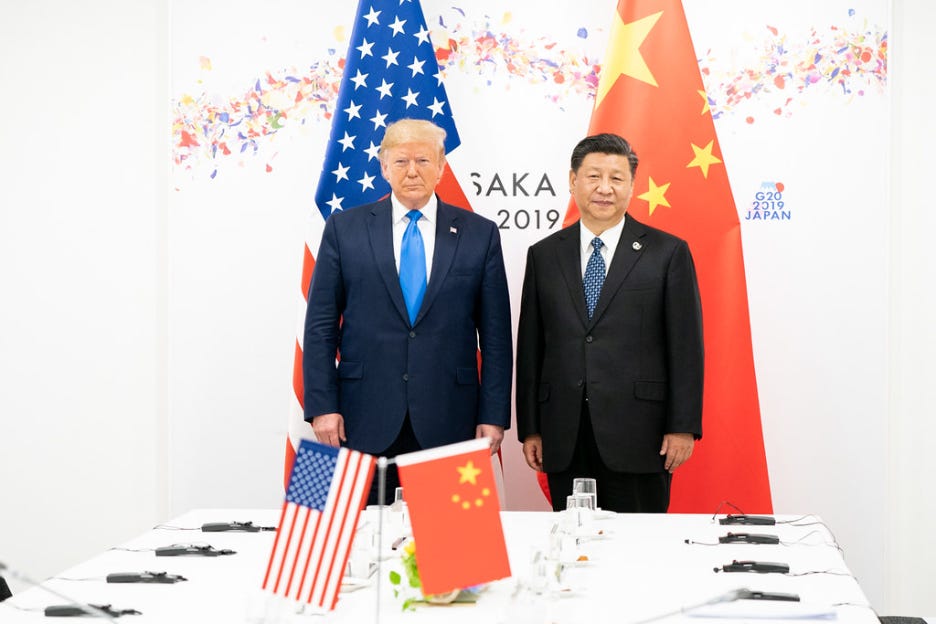
"President Trump at the G20" by The White House is marked with Public Domain Mark 1.0.
On October 20, the US Department of Homeland Security (DHS) published an Exclusion and Removal Order on products produced by or affiliated with Hangzhou DeepSeek Artificial Intelligence Basic Technology Research Co. Ltd., aka DeepSeek, one of China’s leading AI developers. The order acknowledges DeepSeek products as a supply chain risk and mandates that their products be excluded and removed from all federal civilian IT systems and procurements, extending a similar order issued for the intelligence community in December 2025. Vendors to the federal government must also prevent the presence of DeepSeek in their operations and IT systems. The order extends to AI tools developed on DeepSeek’s open-source code. This would presumably discourage tech companies interested in working with the US federal government from using DeepSeek’s cheaper open-source models for any purpose. This precedent, contextualized by calls in the summer to sanction Chinese-developed open-weight models, could discourage use of open-weight models developed by other China-based AI developers.
The DHS order suggested that DeepSeek, as a prompt-and-response AI model, potentially transfers sensitive data, including personally identifiable information and digital fingerprints of government employees, to its servers based in China. The order further suggests that the Chinese government is legally permitted to access those private servers in its jurisdiction, and therefore yield or compile “actionable intelligence” on US persons and government programs. The risks rationalized in the DHS order could theoretically extend to other China-based AI developers in the future, but the October 20 order only applies to DeepSeek.
The DHS order may materially impact the competitiveness of DeepSeek in the US. Western companies may be discouraged from using DeepSeek for their operations or creating new AI models on DeepSeek’s open-source code. The DHS order is less comprehensive than actions from the Federal Communications Commission—such as market bans on electronics tested in China-based labs, Chinese-produced solar inverters, and Chinese-produced humanoid robots—but nonetheless reinforces a context of growing derisking measures or leverage against China in trade negotiations.
China interprets DeepSeek’s exclusion and removal order from federal civilian agencies as an implicit export control “under the guise of national security.” Chinese Foreign Ministry spokesperson Mao Ning reiterated Beijing’s broader opposition to “overstretching the concept of national security and politicizing tech and trade issues,” reflecting China’s longstanding objection to restrictions it views as discriminatory or aimed at specific countries. China’s Ministry of Commerce suggested that the DHS order “disregards” constructive efforts made by US President Donald Trump and Chinese President Xi Jinping to improve trade relations, including the extension of the Busan trade truce to January 2027. If interpreted as an export control, China may meet the DHS measure tit-for-tat before further meetings between Trump and Xi at the Asia-Pacific Economic Cooperation forum in November and the G20 summit in December.
The US could escalate its controls on DeepSeek and China-based companies. US security agencies have warned of distillation from China-based AI developers. Distillation refers to the practice in which AI models are trained to emulate the process and outputs of stronger frontier models, which is fairly common. The US, however, alleges that Chinese developers are distilling at an “industrial” scale comprising millions of tokens, which Beijing disputes. In July 2026, US Secretary of the Treasury Scott Bessent explicitly warned that blocking sanctions against China’s open-weight AI developers remain on the table to deter distillation as a form of intellectual property theft, a priority for the Trump administration. On October 20, the US sanctioned five Chinese entities tied to Ding Linwei, a former engineer at Google accused of intellectual property theft of Google’s AI-enabling infrastructure, like tensor processing unit designs.
The Trump administration may aim to get tougher on distillation to preserve a qualitative edge in AI deployment. Distillation and China’s open-weight AI ecosystem allow for rapid catch-up to frontier models developed by American firms, mitigating (but not overcoming) China’s compute disadvantage. This is how the US alleges Chinese AI developers, including Moonshot and Z.ai, have developed AI models with similar cybersecurity capabilities to Anthropic’s Mythos, just “weeks away” from American frontier capabilities. As a downside risk, the prospect of China’s AI parity could fuel security dilemmas in Washington and momentum for further AI derisking measures. As an upside risk, growing mutual AI restrictions could fuel diplomatic opportunities regarding AI safety, including under an anticipated AI Dialogue channel announced after the September meeting between Trump and Xi. Growing coordination regarding AI controls could improve regulatory expectations and market certainty.
US Developments
Treasury Targets Iran’s Shadow Fleet Network as Part of Operation Economic Outcast
On October 21, the U.S. Department of the Treasury announced a new round of sanctions under Operation Economic Outcast targeting a network of legal, maritime, and shipping service providers that allegedly facilitated Iran’s sanctions evasion and petroleum trade. The action sanctioned five individuals, four entities, and nine vessels, and was taken pursuant to Executive Order (“E.O.”) 13902, which targets key sectors of the Iranian economy.
The Treasury designated the Panama- and Greece-based law firm Karnakis and Karnakis, alleging that it helped establish and manage corporate structures used by shadow fleet operators and previously sanctioned Iranian-linked shipping networks. The Treasury also sanctioned Roxette Maritime Shipping and Trading S.A., along with seven cargo vessels it allegedly managed and operated, for transporting Iranian-origin commodities.
In the same action, Treasury sanctioned Singapore-based Amigoz Singapore PTE. Ltd. and UAE-based Whales Shipping Line LLC for allegedly providing shipping and logistics services that supported Iranian petroleum shipments and sanctions-evasion activities, while two vessels owned by Whales were identified as blocked property.
In connection with the designations, the U.S. Department of the Treasury Office of Foreign Assets Control (“OFAC”) issued Iran-related General License (“GL”) GG and GL HH, both authorizing certain wind-down activities through November 20, 2026.
· GL GG permits transactions ordinarily incident and necessary to the wind-down of dealings involving Karnakis and Karnakis and any entity which it owns, directly or indirectly, a 50% or greater interest, including transactions involving the firm’s blocked employees and representatives acting in their official capacities.
· GL HH authorizes the wind down of transactions involving Roxette Maritime Shipping and Trading S.A. and its blocked vessels, as well as limited safety, environmental, and port-related activities outside Iranian and Russian ports, including vessel management, crewing, insurance, emergency repairs, and the delivery and offloading of non-Iranian cargo loaded on or before October 21, 2026.
US Imposes Sanctions to Counter IP Theft
On October 19, the Department of State sanctioned five entities connected to Chinese national Linwei Ding, founder of Shanghai Zhisuan Technology Co. Ltd. (“Zhisuan”). According to the State Department, Zhisuan “has knowingly engaged in, or benefited from, significant theft of trade secrets of United States persons.” This action was taken pursuant to the Protecting American Intellectual Property Act of 2022 (“PAIPA”). A Chinese Ministry of Commerce spokesperson opposed the move and warned that it may retaliate if the US does not correct its actions.
The sanctions follow Ding’s earlier conviction of IP theft. On January 29, 2026, a federal jury in San Francisco found Ding guilty on seven counts of economic espionage and seven counts of theft of trade secrets. Ding was convicted of stealing thousands of pages of confidential information containing Google’s trade secrets related to artificial intelligence technology to benefit China-based tech companies. A federal judge subsequently dismissed the economic espionage convictions and sentenced Ding to just under a year in prison. The Justice Department is reportedly appealing the post-trial dismissals.
OFAC issued two new PAIPA-related GLs along with the designations:
· GL 1 generally authorizes transactions prohibited under PAIPA to the extent such transactions are authorized or exempt under the Cyber-related Sanctions Regulations.
· GL 2 generally authorizes transactions ordinarily incident and necessary to the wind-down of any transaction involving certain entities that were designated on October 19 through 12:01 a.m. Eastern Standard Time, January 19, 2027. One of the designated entities, Zhisuan, is not within the scope of the authorization.
These designations mark the second round of sanctions for alleged trade secret theft under PAIPA. The initial sanctions were issued in February, which we covered in a blog post. As we highlighted then, the Trump administration’s interest in pursuing trade secret sanctions may provide an opportunity for US victims of trade secret theft to advocate for sanctions against entities and individuals that are often difficult to sue.
OFAC Delists Belarus and North Korea-Related Targets
On October 21, OFAC removed two individuals and two entities and their naming variations from the SDN List. Specifically, OFAC delisted Belarusian national Andrei Alekseevich Rybakov under the Belarus sanctions program, as well as Chinese national Lu Hezheng and two China-based animation studios under the North Korea sanctions program. Rybakov was sanctioned by OFAC in 2021 for serving as Director-General of the Belarusian State Concern for Oil and Chemistry, also known as Belneftekhim. OFAC did not provide a reason for the delistings.
OFAC Issues Russia-related General License and Updated FAQs
On October 21, OFAC issued Russia-related GL 131K, replacing and superseding GL 131J. The license continues to authorize transactions ordinarily incident and necessary to the negotiation of and entry into contingent contracts for the sale of Lukoil International GmbH (“LIG”) and any entity which it owns, directly or indirectly, a 50% or greater interest, as well as the maintenance or wind-down of LIG operations and agreements. Performance of any such contract must be expressly contingent on a separate authorization from OFAC. GL 131J was originally set to expire on October 22. The license extends the authorization period through November 21.
EU Developments
EU Reaffirms Commitment to Russian Energy Sanctions
On October 21, European Commission President Ursula von der Leyen confirmed that the EU sanctions on Russian energy will remain in place until Russia ends its war of aggression against Ukraine. Speaking before the European Parliament in Strasbourg, the Commission President stated that Russia is not a trusted supplier of energy, noting that Russia had previously cut gas supplies to Europe and weaponized energy dependence to exert political pressure. According to von der Leyen, this experience is a lesson that Europe “will certainly not forget.”
The Commission President’s speech comes amid emerging transatlantic differences over the future role of Russian energy in global markets following U.S. President Donald Trump’s decision to authorize the sale and import of Russian diesel fuel until April 7, 2027. As questions emerged over whether the EU would follow suit, President von der Leyen reiterated the EU’s commitment to maintaining energy sanctions against Russia. The Commission President had previously confirmed that the EU is preparing a new round of sanctions against Russia, which would constitute the 22nd package of restrictive measures targeting the country since its full-scale invasion of Ukraine in 2022.
European Commission Publishes Updated FAQs on Export of Energy Products to Russia
The European Commission published updated FAQs on sanctions against Russia, with a focus on Articles 3k and 3c of Council Regulation (EU) 833/2014. The updated guidance confirms that EU operators are prohibited from exporting refined petroleum products, such as diesel to Russia in accordance with Article 3k and 3c. Specifically, Article 3k prohibits the sale, supply, transfer or export of refined petroleum products to any individual or entity in Russia or for use in Russia, as goods falling under CN code 2710 are listed in Annex XXIII to the Regulation. In addition, Article 3c prohibits EU operators from the sale, supply, transfer or export of jet fuel and fuel additives listed in Annex XX to any individual or entity in Russia or for use in Russia.
The Commission also reiterates that these prohibitions extend to the direct or indirect provision of technical assistance, brokering services, financing or financial assistance related to the refined petroleum products where such services are provided to any individual or entity or body in Russia or for use in Russia.
EU Removes Swiss Company LOGARCHEO S.A. from Iraq Sanctions List
On October 21, the European Commission, acting under powers delegated by Article 11(b) of Council Regulation (EC) 1210/2003, removed LOGARCHEO S.A. from the EU Iraq sanctions list. The Swiss company had been subject to EU sanctions since 2006 due to its association with the regime of former Iraqi President Saddam Hussein. The update follows the October 5 decision of the UN Security Council Committee to delist the company from the corresponding UN sanctions list.
As a result, LOGARCHEO S.A. is no longer subject to the restrictive measures applicable under the EU Iraq sanctions regime, including an asset freeze and a prohibition on making funds or economic resources available.
EU Council Amends Sanctions Listings Targeting ISIL (Da’esh) and Al-Qaeda
The EU Council recently amended two entries concerning an individual and an entity designated under the restrictive measures regime targeting ISIL (Da’esh) and Al-Qaeda, following an update at the UN level. Changes to Council Regulation (EC) No 881/2002 reflect the October 15 decision of the UN Security Council Sanctions Committee to update the identifying information of Mounir El Motassadeq and Tehrik-e Taliban Pakistan (TTP).
Asia-Pacific Developments
China Condemns US Sanctions on Five Chinese Firms, Threatens Countermeasures
China has strongly opposed recent US sanctions on five Chinese companies under the Protecting American Intellectual Property Act (PAIPA), which the US justified based on allegations of trade secret theft. China argued that the sanctions unfairly target Chinese enterprises, infringe their legitimate rights and interests, and are based on unfounded claims. A spokesperson for the Ministry of Commerce of China stated that the growth of China’s artificial intelligence sector is driven by sustained investment in research, innovation, and open cooperation, not intellectual property theft. China urged the US to recognize the achievements of Chinese companies objectively, stop what it described as unjustified suppression, and maintain a fair competitive environment, while warning that it would take necessary countermeasures if the sanctions are not lifted.
China Offers Concessions in Bid to Remove EU Sanctions on Textiles Manufacturer
China has offered commitments aimed at securing the removal of EU sanctions on a Chinese textile manufacturer. Under the reported proposal, the Chinese company would refrain from supplying prohibited goods to buyers linked to Russia’s military structures, while China would remove a German materials supplier to ASML from its export control list. In exchange, the EU is reportedly considering lifting sanctions on the Chinese firm, which had been accused of transferring sensitive European technology to Russian purchasers.
Australia Targets North Korean Sanctions Evasion Network
Australia has imposed sanctions on two North Korean companies and two individuals whom US authorities have identified as key financial brokers for the North Korean regime. According to the Australian Foreign Minister, the sanctioned parties facilitated the use of fraudulent North Korean IT workers who obtained remote employment while posing as foreign nationals, generating revenue that allegedly supported North Korea’s nuclear weapons and ballistic missile programs in violation of UN Security Council resolutions. The measures were taken based on findings by the Multilateral Sanctions Monitoring Team and in coordination with international partners, including the European Union. The action follows reports that tens of thousands of North Korean workers remain active abroad, particularly in China and Russia, despite UN sanctions requiring their repatriation.
Cuba Looks to South Korea as US Sanctions Pressure Mounts
Amid worsening economic and energy shortages that Cuban officials attribute to intensified US sanctions, Cuba is seeking closer economic cooperation with South Korea in sectors including renewable energy, biotechnology, agriculture, and critical minerals. Claudio Raul Monzon Baeza, Cuba’s ambassador to Seoul, described the sanctions as contributing to severe constraints on trade, fuel supplies, and healthcare, and his remarks came ahead of a UN General Assembly vote on a resolution calling for an end to the US embargo.
Iran Conditions Talks on Sanctions Relief
Iran has stated that any future negotiations with the US must be preceded by the lifting of sanctions and an end to what Tehran describes as US threats and economic pressure. Speaking during a meeting with Pakistan Army Chief Field Marshal, Iranian President Masoud Pezeshkian said Washington could not simultaneously impose economic restrictions on Iran and expect productive negotiations, arguing that sanctions and pressure undermine trust and prospects for a diplomatic resolution. Pezeshkian linked regional tensions and disruptions in the Strait of Hormuz to US policies and warned that military action would fail to achieve US objectives while causing broader regional harm.

Listen to the news:
Global
France’s nuclear deterrence strategy gains support as European allies seek to boost deterrence against Russia. With a growing crisis of confidence in the US, European leaders are backing the “forward deterrence” strategy advanced by France. This nuclear defense strategy announced by President Macron last March involves deploying nuclear-enabled French Rafale fighter jets to allied territory and inviting European partners to participate in French nuclear drills. Additionally, France is working with around 10 European partners, including Germany, Poland, Sweden, the UK, the Netherlands, Belgium, Finland, Norway, and Denmark, to build intelligence, early-warning, and communications links.
The forward deterrence strategy is not meant to replace but supplement the US nuclear umbrella. This concept is a direct response to Russia’s protracted war in Ukraine, NATO’s preparation for high-intensity conflict, and transatlantic restructuring via “burden-shifting.” France maintains absolute, exclusive control over its nuclear arsenal and launch decisions. It does not offer formal treaty security guarantees or enter into joint decision-making or nuclear-sharing arrangements. This structure requires NATO partners to align on the nuclear doctrine and agree on the strategic purpose. For now, France has created 10 separate steering groups with “forward deterrence” partners and is holding talks in a hub-and-spokes bilateral fashion rather than gathering them all together in a nuclear club.
Read More: Wall Street Journal [paywall], French Ministère des Armées et des Anciens Combattants, GLOBSEC
Europe
The first shipment of 300,000 barrels of Russian diesel is en route to New York. The shipment left from the port of Primorsk on Friday and is the first under the US-Russian diesel deal. The shipment is slated to arrive on November 7, shortly after the US midterm elections. President Trump’s gamble was to calm market anxieties with the influx of additional supplies. However, energy prices continue to climb due to fears of renewed hostilities in Iran. Markets may also be pricing in increased maritime shipping costs as barrels find alternative routes and cargo vessels endure attacks in the Strait of Hormuz and the Black Sea.
US diesel imports may sustain transatlantic divisions over Russia strategy. The announcement of the deal in early October sparked tense exchanges between US President Donald Trump and Ukrainian President Volodymyr Zelenskyy. Since then, US-Ukraine relations have experienced a downward spiral, culminating in a slowdown in Starshield services on the Ukrainian frontlines. The Trump administration waived all the statutory sanctions in the Lindsey Graham Sanctioning Russia and Iran Act of 2026, clarifying that it is reviewing enforcement over a 60-day period.
Read More: AP, Euronews, Stepwise Risk Outlook
Middle East
Israelis vote tomorrow in an election that has become a referendum on Prime Minister Netanyahu’s leadership. The Knesset elections will be the first since Hamas’ October 7 attack in 2023, which had a significant impact on Israel’s regional strategy, Gaza and West Bank policies, and perceptions of security. The polls are seen as a referendum on Netanyahu’s (the longest-serving Israeli leader in history) response to October 7, but other issues – like ultra-Orthodox military service and the Supreme Court – are also on the ballot.
It will be several weeks until there is any concrete information on Israel’s next government. After official election results are published next week, President Herzog will assign a Knesset member – typically the leader of the party that has won the most seats – the task of forming a government, a process that could be repeated twice more. If all three efforts fail, snap elections are called. Historically, no government has been sworn in less than 50 days after an election.
But foreign policy is unlikely to change under any of the frontrunners. Gadi Eisenkot, the moderate Netanyahu alternative, has primarily differentiated himself on alignment with the Orthodox right and handling of October 7, and will not significantly shift Israel’s strategies in Gaza, the West Bank (although settler activity may moderate after the intensity of elections), Lebanon, Syria, or Iran. Nor will further-right challengers or potential coalition members. The election is momentous for Israel’s national dialogue, but less so for its neighbors or international partners.
Read More: AP, Jerusalem Post, New York Times [paywall], Israeli Democratic Institute
Asia-Pacific
China’s Communist Party will convene the fifth plenum of its 20th Central Committee in Beijing today for a four-day, closed-door meeting focused on strengthening party governance and discipline. The agenda departs from the fifth plenums of 2015 and 2020, which adopted economic and social development-focused proposals for the subsequent five-year plans. The shift underscores Beijing’s continued emphasis on internal party control, especially as it prepares for the 21st Party Congress, when a new Central Committee will be selected, though President Xi Jinping is expected to secure an unprecedented fourth term as general secretary.
The focus on party discipline aligns with President Xi Jinping’s characterization of corruption as the Party’s “greatest threat” and his efforts to strengthen political loyalty and policy implementation. China’s anti-corruption campaign has ensnared millions of officials, including senior political and military leaders. In 2025, disciplinary officials opened more than 1 million cases, up from just 155,000 in 2012, while officials disciplined for bureaucratic practices like buck-passing and box-checking increased from around 46,000 in 2023 to 118,000 in 2025. These figures underscore Beijing’s concern not only with corruption but also with officials’ failure to implement central directives effectively.
Read More: Reuters [paywall], Asia Society, Carnegie Endowment
Americas
Luiz Inácio Lula da Silva won Brazil’s presidential election on Sunday, securing a fourth term in office. Lula defeated Flávio Bolsonaro by 51.8% to 48.2% in the runoff, completing a dramatic comeback after trailing in the first round and becoming the first candidate in modern Brazilian history to lose the first round but win the runoff. The result marked a setback for the broader rightward political trend seen across Latin America in recent years and extended Lula’s political comeback at age 80. He turns 81 tomorrow.
Flávio Bolsonaro declined to concede defeat and said he would seek a review of the result, arguing that a court-ordered extension of voting hours affected the election process. His challenge is expected to increase scrutiny of the outcome in the coming days. Financial markets reacted negatively to Lula’s victory, which had not been widely anticipated by investors after the first-round results. The iShares MSCI Brazil ETF fell about 25% in premarket trading, while shares of several major Brazilian companies also declined. Analysts attributed the market reaction to concerns about Brazil’s fiscal outlook and uncertainty over the economic direction of a new Lula administration.
Read More: New York Times [paywall], The Economist, CNBC
Africa
The Parliament of Algeria approved a proposal to deploy troops to Niger, marking a significant expansion of Algerian involvement in Sahel security. The move follows growing engagement between the Nigerien junta and Algeria on security cooperation and builds on Algiers’ deployment of air patrol squadrons to Niamey during a coup attempt in September. Algeria has sought to repair ties with the three Alliance of Sahel States members (Niger, Mali, and Burkina Faso) after relations deteriorated following the Algerian shootdown of a Malian drone. The deployment also marks the country’s first military deployment since 1973.
Algeria’s traditionally noninterventionist foreign policy is shifting amid growing competition among regional actors to address the worsening security environment in the central Sahel. Algeria has long viewed the Sahel, particularly Niger and Mali, as falling within its sphere of influence and is sensitive to increasing competition from Morocco, Libya, and other regional powers. It also has substantial energy interests in Niger, which serves as a critical node within the Trans-Saharan Gas Pipeline, a $13 billion project designed to transport Nigerian natural gas to Europe through existing infrastructure in Algeria and Niger. The pipeline also serves as a strategic counterweight to Morocco’s African Atlantic Gas Pipeline and, by extension, Rabat’s expanding influence in West Africa, as Morocco has long been a geopolitical rival of Algeria.
Read More: Al Jazeera, Stepwise Risk Outlook
Geoeconomics
The US is granting targeted exceptions from its 50% tariffs on Canadian goods while extending duties to other products. Changes announced October 23 will take effect October 30, removing the additional tariffs from selected plywood, packaging materials, machinery and refrigeration equipment while adding products including valves, carpets and waste. The exemptions follow lobbying by Senator Susan Collins on behalf of Maine producers dependent on Canadian supplies, including blueberry, potato and apple growers. The remaining Section 338 tariffs apply to covered products even when they qualify for preferential treatment under the USMCA. President Trump said October 25 that the trade dispute would be settled “pretty soon,” but offered no details of an agreement.
The exemptions highlight how tariffs on Canadian inputs also raise costs for American businesses. Collins said some Canadian equipment and packaging cannot be replaced affordably with American alternatives: Maine blueberry growers, for example, use specialized Canadian harvesting boxes compatible with their existing processing machinery. Selective exemptions could reduce immediate costs, but repeated changes to tariff coverage leave businesses uncertain about the future economics of cross-border production.
Read More: White House, Senator Susan Collins, Reuters [paywall], CSIS
Disruptive Technology
Anthropic files for an initial public offering (IPO) as soon as the week of November 9. This follows a confidential filing on June 1 and Anthropic’s release of its Q3 results on October 14. Anthropic generated $16.3 billion in the first half of 2026, significantly higher than $1.2 billion a year earlier. These results complement a leaked IPO prospectus in late September, which detailed a net loss of $42 billion in 2025 as the company invests in the compute necessary to train the most advanced frontier models. About a quarter of the company’s revenue was from two customers. The prospectus also noted risks of misalignment between AI models and their users.
An Anthropic IPO may be the largest in history, targeting a $2 trillion valuation. Anthropic’s inclusion in the NASDAQ and index funds would increase the company’s influence in financial markets beyond private credit and venture capital. This could increase systemic financial risk in the event that Anthropic’s bets do not pay off.
Read More: Axios, yahoo!news, Reuters [paywall]
Energy
A proposed LNG project in Alaska has been linked to backing from Russia. A potential LNG project in Alaska, which would involve an American company buying Russian technology to access significant natural gas reserves, has reportedly also received secret financial support from the Russian energy giant Novatek. While Novatek’s reported backing for the project is disputed, Novatek has also announced intentions to buy a “minority shareholder” position in the project. The project is far from potential realization and faces a number of significant hurdles: most significantly, sanctions compliance issues and competition with another project that has already received political support from the administration.
Any US-Russia cooperation in energy would present a major evolution in Washington’s approach towards Moscow. The Novatek-linked plan has reportedly been broadly under discussion since 2025 and has reemerged in recent months as the White House has moved to thaw its relations with Moscow. Washington has recently offered Russia sanctions relief on diesel exports, worked to increase Russia’s presence in the G20, and has reinvigorated its efforts to negotiate an end to the Russia-Ukraine war.
Read More: New York Times [paywall], Reuters [paywall], Stepwise Risk Outlook
Defense
Ukraine is looking at new partnerships for space-based infrastructure following its issues with Starlink. Kyiv is building out cooperation with the Finnish tech companies ICEYE and Nokia to develop Kyiv’s own satellite communications capabilities. The two companies signed a letter of intent with the Ukrainian Ministry of Defense on October 22, which follows an announcement by ICEYE and Nokia several weeks ago to work together on “broadband low Earth orbit (LEO) satellite communications systems for governments.” The two firms’ plan for the project envisions giving nations ownership over the satellites, ground segment, and terminals, thereby reducing reliance on other countries or private sector actors.
Ukraine has struggled with limitations placed on its use of Starlink satellite communications. Kyiv suddenly and unexpectedly found its use of satellite communications capabilities provided by SpaceX to have been limited, which restricted Kyiv’s ability to fight and to defend against Russian missile and drone threats. The exact reason for the limitations has been unclear, but it has highlighted the influence private sector companies can have on critical infrastructure and security and military policy.
Read More: Kyiv Independent, Breaking Defense, The Hill, Stepwise Risk Outlook


Contact Us
Karl Hopkins
Partner
+1 202 429 6499
khopkins@steptoe.com
Melissa B. Mahle
Senior Advisor
+1 202 261 0577
mmahle@steptoe.com
Anni Coonan
Senior Intelligence Analyst
+1 212 506 3979
acoonan@steptoe.com
Samuel Bloebaum
Senior Due Diligence Analyst
+1 602 410 6240
sbloebaum@steptoe.com
Zayna Dembinski
Analyst
+1 202 778 3567
zdembinski@steptoe.com
Thomas Goldstein
Analyst
+1 202 862 6735
tgoldstein@steptoe.com
Ian Cameron
Analyst
+1 202 327 6908
icameron@steptoe.com
Elton Smole
Analyst
+1 202 261 0556
esmole@steptoe.com
Carter Spahn
Intelligence Fellow
+1 202 261 7555
cspahn@steptoe.com
Chris Dantes
Intelligence Fellow
+1 202 327 6904
cdantes@steptoe.com
Legal disclaimer: This Substack is for educational and informational purposes only and does not constitute the rendering of legal counseling or other professional services. Reading, subscribing to, or communicating through this Substack does not create an attorney-client relationship. Do not send confidential information through this platform. Consult qualified legal counsel regarding your specific circumstances.