


Welcome to the Stepwise Risk Outlook, which highlights and contextualizes over-the-horizon developments in key regions of the world and industries of the global market. Today’s featured deep dive by Anni Coonan examines the impact of the US-Iran war on the future of Qatar and LNG.

How the US-Iran War is Shaping Qatar’s Future and the Global LNG Market
By Anni Coonan
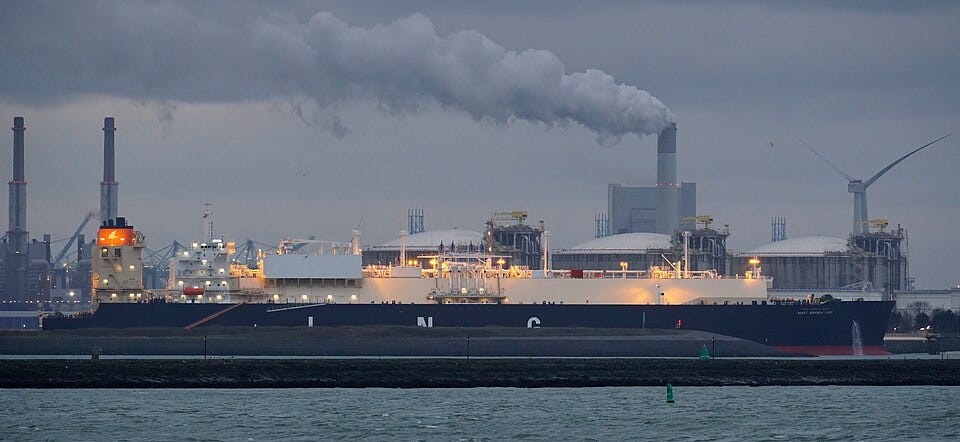
VIVIT ARABIA LNG by kees torn is licensed under CC BY-SA 2.0.

Qatar, and the global LNG trade, have been among the biggest losers of the ongoing US-Iran war and battle for the Strait of Hormuz. State-owned QatarEnergy previously supplied about a fifth of the world’s LNG as the world’s second-largest producer (after the US), but exports dropped to virtually zero in the immediate aftermath of the war. Although transits have rebounded somewhat, the International Energy Agency recently projected that global LNG supply will decrease by 3% in 2026, the largest-ever drop on record. With transits through the Strait still contested and, even more importantly, large-scale damage to Qatari infrastructure still unrepaired, Doha remains the most exposed of any Gulf country to long-term disruption to its main exports. With a political solution in the Strait of Hormuz nowhere on the horizon, Qatar and LNG customers are exposed to long-term supply disruptions and the ultimate reorganization of the LNG market towards other suppliers or alternative fuel sources, like coal or renewables.
In today’s full analysis:
Damage to Qatar’s LNG Exports: Impacts for Doha and Global Energy Markets
Long-Term Disruption and Energy Market Reorganization
Or listen to the full report here:

Europe
Tomorrow, Berlin will host a European defense summit with more than 20 leaders to discuss a European position on US-led peace negotiations. The summit coincides with a planned meeting between US President Donald Trump, Chinese President Xi Jinping, and Russian President Vladimir Putin in Shenzhen. The Europeans have agreed that Germany, the UK, France, Italy, and Poland—dubbed the E5—will collectively represent the continent in future US-led negotiations. It appears that the Berlin summit intends to coalesce common European interests in a Russia-Ukraine political settlement. The UK and France seek to lead a “Coalition of the Willing” to establish a civilian or security cooperation mission in Ukraine to act as a “tripwire” to a future Russian attack, or at least embolden Ukrainian deterrence and integration with Western armed forces. It remains unclear in what capacity such a mission would or could be deployed, the role of non-participating members, whether Russia would agree to it, or if the Europeans will be invited to the negotiating table.
The Europeans’ immediate agenda is to provide financial support to Ukraine and transfer additional air defense interceptors. The European Commission will present a new €45 billion support loan to Kyiv to prevent a fiscal cliff, but additional financial aid from Europe will be needed. Germany and Norway are working to integrate their air defense systems (the IRIS-T and NASAMS) to supplement a shortage of Patriot interceptors, as well as buy more American Patriots through the PURL initiative. Ukraine’s lack of Patriot interceptors leaves it vulnerable to Russian ballistic missile attacks.
Read More: The Kyiv Independent, Reuters [paywall], Stepwise Risk Outlook
Middle East
Saudi Arabia is prepared for the war against Yemen’s Houthis to extend well into 2027. According to Western officials briefed by Saudis, the Kingdom is planning for the possibility that the conflict – including the active battle for territory in Yemen and consistent strikes on military, infrastructure and civilian targets within Saudi Arabia – will stretch well into next year. Saudi officials now foresee the campaign stretching on for up to six months, aiming to see gains on the ground by the kingdom’s Yemeni allies before any negotiations with the Houthis. The forecast comes days after the Houthis retook significant territory from Yemen’s Saudi-backed government; taking and holding territory from the Houthis has been a historic weak spot for Saudi’s anti-Houthi campaigns, which heavily rely on airstrikes.
The deadline contrasts with President Trump’s repeated assertions that peace with Iran is near. While that messaging has faded in recent months, the White House has never acknowledged a longer horizon for the ongoing conflict with Iran – despite assumptions from analysts in spring that it could continue through the midterms. Some analysts now forecast that the war could continue, in some form, until the end of President Trump’s term.
Read More: Reuters, Middle East Eye, The Hill
Asia-Pacific
Chinese President Xi and Russian President Putin met on the sidelines of the APEC summit today, ahead of a historic trilateral meeting with US President Trump scheduled for Thursday. The two leaders met alongside senior officials after delivering speeches at the APEC CEO Summit. Xi called for lower tariffs, fewer trade barriers, and greater cooperation on AI, positioning China as a defender of open trade amid rising protectionism. Putin, meanwhile, criticized Western sanctions as ineffective and urged closer economic ties with Asia-Pacific economies, which account for more than half of Russia’s trade. Both leaders’ remarks showcase their intent to frame their countries as advocates of what they describe as a more multipolar economic order, contrasting their approach with Washington’s.
Trump arrived in Shenzhen Wednesday and was personally greeted by Xi at the airport, ahead of Thursday’s first-ever trilateral meeting between the three leaders. The meeting will likely address trade, AI, Iran, and nuclear weapons, with Trump also raising the possibility of discussing Ukraine. The talks will offer an early indication of whether Washington, Beijing and Moscow can find common ground on issues beyond bilateral trade, and whether the Kremlin’s assessment that the meeting could have a “major impact on global affairs” and Beijing’s expectation that it will “promote world peace” prove accurate.
Read More: South China Morning Post [paywall], Nikkei Asia [paywall], CNBC, Al Jazeera
Americas
Amid corruption allegations, Puerto Rico’s Secretary of the Department of Family, Suzanne Roig Fuertes, announced her resignation on Monday, effective December 31. Roig is the latest in a string of government officials to resign or be fired under the administration of Governor Jennifer González Colón. Calls for Roig to resign began earlier this year and escalated after Blanca Medina Díaz, who was fired from her role as head of the Administration for the Socioeconomic Development of the Family, accused Roig of pressuring her to approve allegedly illegal contracts. This includes a planned $40 million contract with a Louisiana education company that would have used federal TANF funds. The contract was reportedly not signed.
The scandal may amplify calls for increased scrutiny of the island’s governance and management of public funds. Roig is being investigated by Puerto Rico’s Senate, the island’s Justice Department and its Office of the Inspector General, and her delayed resignation date drew additional criticism, despite her explanation that it was in the interest of preserving stability. In addition to pressuring Medina to sign the controversial contract, Roig is also accused of harassing and firing her when she refused. The pattern of resignations among top officials on the island is likely to damage investor confidence.
Read More: AP, Rio Times, The San Juan Daily Star
Africa
The US and Nigeria have reportedly deepened intelligence cooperation to combat jihadist and criminal groups ahead of the country’s 2027 elections. Nigerian Chief of Defence Staff Christopher Musa stated that recent operations targeting terrorist and bandit leaders have been supported by improved intelligence, including real-time satellite imagery from the US. Musa said that Abuja is also expecting helicopters from the US and Italy, adding to recently commissioned air assets. This follows an expansion of US-Nigeria security cooperation amid intensifying Islamist insurgencies in the northeast and armed banditry in the northwest.
Abuja is attempting to secure the country’s north in preparation for elections, but this may prove difficult. Despite successful US-Nigeria counterterrorism operations in recent months, jihadist insurgents continue to control substantial portions of territory in the country’s north. Mass kidnappings and attacks against security forces by both terrorist and criminal organizations remain common and difficult to prevent, raising questions about how effective Abuja’s measures will be in securing the country.
Read More: Reuters [paywall], European Union Agency for Asylum
Geoeconomics
Trade barriers covered a record $5.4 trillion in global goods imports by the end of June, according to the World Trade Organization’s November 17 annual review. Tariffs and other measures introduced since 2009 and still in force affected 21.3% of world imports, up from 20.4% at the end of 2025 and 12.1% at the end of 2024. WTO members and observers adopted 333 new measures that restricted or otherwise impeded trade in the first half of 2026, more than the 300 recorded in all of 2025. The new measures covered $2 trillion in imports and $794 billion in exports. In October, the WTO raised its forecast for 2026 goods trade growth from 1.9% to 3.9% by volume, largely because AI investment increased demand for computing equipment.
Governments eased access to supplies they needed even as they protected industries competing for market share. They adopted 466 measures to ease trade in the first half of 2026, many of them temporary responses to disruptions in energy and fertilizer shipments through the Strait of Hormuz. The EU, for example, suspended duties for one year on limited quantities of nitrogen fertilizers and inputs such as urea and ammonia, while excluding supplies from Russia and Belarus. Electric vehicles and solar cells showed the opposite pattern: they were the only sectors the WTO examined where new barriers covered more imports by value than measures that eased trade.
Read More: WTO Annual Overview, WTO Global Trade Outlook, Council of the European Union, MIT Center for Energy and Environmental Policy Research
Energy
Japan is proposing new coordination mechanisms to help safeguard Asian energy security. During the Association of Southeast Asian Nations (ASEAN) summit in Manila, Japanese Prime Minister Sanae Takaichi put forward a task force to coordinate stockpiling and releasing of oil supplies in emergencies. According to Takaichi, the potential task force would be done in coordination with another joint stockpiling initiative led by the Philippines. Similarly, Japan proposed a new “Power Gulf Initiative” to strengthen the region’s cooperation with Middle Eastern oil producers.
Asia was hit particularly hard by the energy crisis this year. Around 90% of all crude passing the Strait is shipped to Asia, a marker of how reliant the region is on Middle Eastern energy production. This has pushed countries to both look for alternative sources of oil and gas, develop new coordination mechanisms to manage the crisis and to investigate new sources of energy that are less vulnerable to disruption. Globally and in Asia, there has been a surge in interest in electrification, solar panels and nuclear energy technology imports to help build resilience to geopolitical shocks.
Read More: Reuters [paywall], Financial Times [paywall], Stepwise Risk Outlook
Transnational Crime and Corruption
Mongolian President Ukhnaa Khurelsukh announced his resignation on Tuesday in the wake of corruption allegations, highlighting the continued ability for high-profile scandals to bring down governments. Khurelsukh entered office in 2021 alongside Prime Minister Luvsannamsrain Oyun-Erdene, promising economic reform and anti-corruption campaigns, especially in relation to Mongolia’s natural resources. However, Oyun-Erdene resigned in June 2025 following public protests over his son’s unexplainable lavish lifestyle. Khurelsukh’s resignation was caused by widespread allegations that the president’s inner circle accepted bribes tied to a railway project for coal exports. A former justice minister accused Khurelsukh of accepting $25 million in bribes in 2019, when he was prime minister.
Read More: Financial Times [paywall], Reuters [paywall], Organized Crime and Corruption Reporting Project


Contact Us
Karl Hopkins
Partner
+1 202 429 6499
khopkins@steptoe.com
Melissa B. Mahle
Senior Advisor
+1 202 261 0577
mmahle@steptoe.com
Anni Coonan
Senior Intelligence Analyst
+1 212 506 3979
acoonan@steptoe.com
Samuel Bloebaum
Senior Due Diligence Analyst
+1 602 410 6240
sbloebaum@steptoe.com
Zayna Dembinski
Analyst
+1 202 778 3567
zdembinski@steptoe.com
Thomas Goldstein
Analyst
+1 202 862 6735
tgoldstein@steptoe.com
Ian Cameron
Analyst
+1 202 327 6908
icameron@steptoe.com
Elton Smole
Analyst
+1 202 261 0556
esmole@steptoe.com
Carter Spahn
Intelligence Fellow
+1 202 261 7555
cspahn@steptoe.com
Chris Dantes
Intelligence Fellow
+1 202 327 6904
cdantes@steptoe.com
Legal disclaimer: This Substack is for educational and informational purposes only and does not constitute the rendering of legal counseling or other professional services. Reading, subscribing to, or communicating through this Substack does not create an attorney-client relationship. Do not send confidential information through this platform. Consult qualified legal counsel regarding your specific circumstances.