


Welcome to the Stepwise Risk Outlook, which highlights and contextualizes over-the-horizon developments in key regions of the world and industries of the global market. Today’s Analysts' Brief examines the prospects for US-Iran negotiations.

Analysts' Brief: Prospects for US-Iran Negotiations
By Anni Coonan, Ian Cameron, and Zayna Dembinski
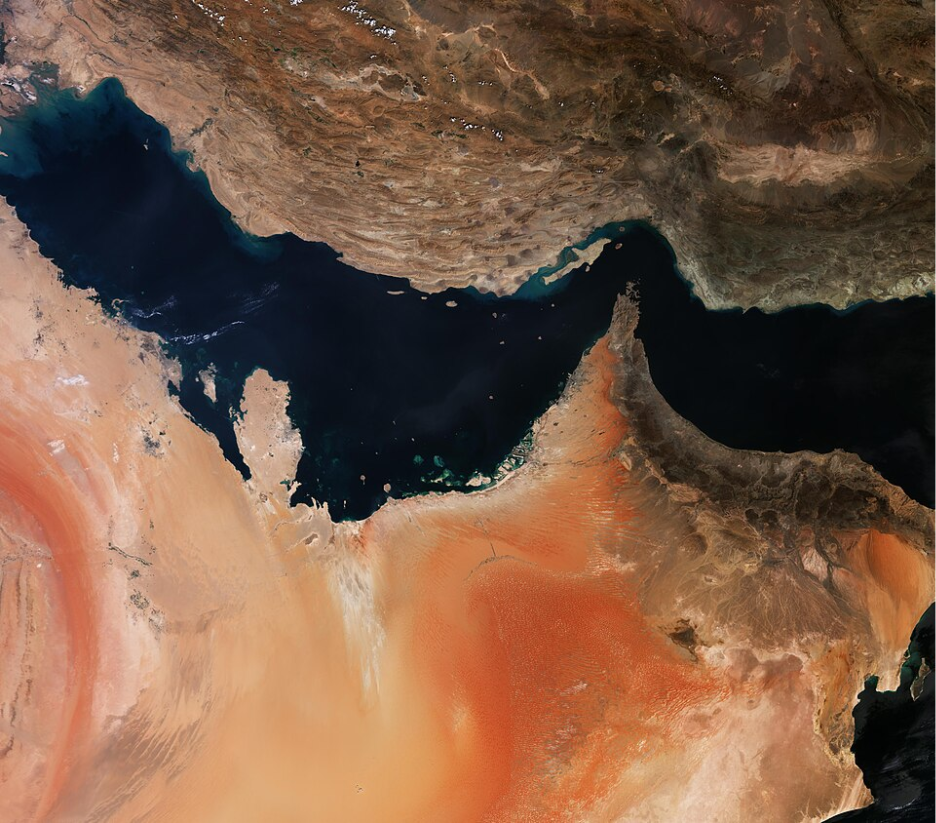
“The Gulf” by the European Space Agency is licensed under the Creative Commons Attribution-ShareAlike 3.0 IGO license.

On Saturday, President Trump publicly rejected Iran’s most recent peace proposal, delivered via shuttle diplomacy by Qatar during the UN General Assembly in New York. The apparent failure of this most recent negotiating round raises old and new questions about the prospects for a durable resolution to the conflict, the trajectory of the energy market and regional dynamics – including the perspective of Pakistan, the mediator of the June MOU.
In today’s full analysis:
Anni Coonan, Middle East analyst: With prospects for negotiations dim, long-term stalemate seems most likely
Ian Cameron, energy analyst: Diplomatic uncertainty and global instability are keeping energy prices high even as oil flows move towards prewar levels
Zayna Dembinski, Asia analyst: A protracted Iran war will make it increasingly difficult for Pakistan to juggle its competing roles in the conflict.
Or listen to the full brief here:

Listen to the news:
Global
United Nations’ Food and Agriculture Organization reported that world food prices in September rose to their highest in nearly four years. The FAO Food Price Index, which tracks monthly changes in international prices for a basket of food commodities, averaged 136.0 points, up from a revised 134.0 for August and the highest reading since November 2022. Increases in food prices are one of the basic drivers of inflation.
Food prices are increasing due to transportation disruptions and weather concerns. Sugar prices climbed 6.1% last month, on expectations of tighter global supplies in the 2026-2027 season. Below-normal rainfall is lowering production forecasts in Brazil, Thailand and India. Wheat prices climbed to their highest since August 2023, due to shipping disruptions in the Black Sea region and dry weather in parts of North America. Sorghum, barley and rice prices also increased, due to weather concerns and seasonally tighter supplies. Meat and dairy registered small declines in prices. These conditions are likely to persist well into 2027, if not beyond.
Read More: Reuters [paywall], Wall Street Journal [paywall], UN Food and Agriculture Organization
Europe
The EU and UK eye a November summit to advance a relations “reset,” but the summit will not discuss British participation in “Made in Europe” plans. Alongside the announcement of the summit, UK Prime Minister Andy Burnham reiterated that Brexit has “done more harm than good” and that the UK should evaluate its options, including rejoining the EU’s economic initiatives like the customs union and Single Market. French President Emmanuel Macron called Burnham’s statement “good news” but emphasized that the UK must meet EU obligations to reintegrate economically.
The long-delayed reset summit would likely focus on a youth mobility scheme and sectoral tariffs. Brussels wants the UK to grant up to 150,000 visas for EU citizens to study at British universities and work, but London wants only 50,000. Meanwhile, the UK wants to loosen tariffs and border checks on foodstuffs and agricultural goods. The EU and UK are compartmentalizing the thorny exclusion of “Made in Europe” industrial initiatives, partially because EU member states are still negotiating what that will look like.
Read More: The Guardian, Reuters [paywall], Financial Times [paywall]
Middle East
Both Iran and the US appeared poised for escalation amid another failed negotiating round. The Pentagon is sending the USS Theodore Roosevelt carrier group to join USS George H.W. Bush and USS George Washington in the Gulf, as well as the USS Makin Island Amphibious Ready Group, providing more options and firepower if the US chooses to attack. Meanwhile, sources told US media that Iran was preparing a broader and more forceful response in retaliation to any US attacks, including attacks on countries that support US military options and possible locations outside the Middle East.
The build-up comes as both sides are increasingly considering military escalation as ceasefire talks have failed to take hold. Yesterday, Iran reported that it had received an official response from the US (likely a reiteration of the public rejection over the weekend); both sides are telling sources that they do not believe a deal is within reach.
Read More: Reuters [paywall], Wall Street Journal [paywall], Wall Street Journal [paywall], AP
Asia-Pacific
The US Commerce Department has reportedly slowed export licensing for aircraft parts destined for China to increase Washington’s leverage in trade talks with Beijing. Commerce has reportedly slowed licensing approvals for aircraft parts and limited the volume of parts shipped to a Chinese state-owned aircraft manufacturer to prevent stockpiling. The department is also considering regulations that would make it easier to restrict exports of landing gear, aviation hydraulic fluid and other aircraft components, according to Reuters.
The restrictions could further complicate Beijing’s reported purchase agreement for 200 Boeing jets. Beijing has reportedly requested several years’ worth of spare parts for the aircraft and servicing, while Washington has been reluctant to guarantee future supplies, viewing them as potential leverage in trade negotiations. The reported request reflects concerns over China’s reliance on US suppliers amid recurring trade tensions. The agreement, announced during President Donald Trump’s May visit to China, remains vulnerable to broader US-China trade disputes, with the availability of aircraft components emerging as a point of contention and bargaining chip for concessions Washington is interested in.
Read More: Reuters [paywall], Politico, Simple Flying
Americas
Chilean President Jose Antonio Kast is facing a domestic backlash after Chile officially joined the Shield of the Americas coalition. The division over the issue in Chile has been the sharpest of any Latin American country to join the initiative, which is also known as the Americas Counter Cartel Coalition (A3C). Chile officially became a full member of the coalition last week, prompting former Presidents Michelle Bachelet and Gabriel Boric to release a joint declaration expressing concerns over Chile’s membership and calling on the government to reconsider the decision.
The backlash is largely driven by questions around the scope of membership obligations and implications for national sovereignty. Chile’s government has emphasized that membership in the coalition represents a political declaration, rather than a treaty with binding obligations. However, the statement of the former Chilean presidents expressed concerns over “subordinating foreign relations, security, or defense policy to priorities defined by a foreign power.” In addition to the Shield of the Americas declaration’s language around continental sovereignty, the debate in Chile also centered on the extent to which membership extends beyond counternarcotics to economic sectors, including critical mineral supply chains.
Read More: El Pais, AS/COA, Rio Times
Africa
Ethiopia and Eritrea severed diplomatic ties, further increasing the risk of a proxy conflict in northern Ethiopia. Ethiopia continues to accuse Eritrea, Sudan, and Egypt of supporting rebel groups and closed its embassy in Asmara while declaring 10 Eritrean diplomats persona non grata. Eritrea responded by closing its embassy in Addis Ababa, while Egypt declared an Ethiopian embassy counselor persona non grata. Should relations continue to deteriorate, Eritrea and Sudan could increase their support for the Tigray People’s Liberation Front (TPLF) through financial or military assistance, although Egyptian involvement is currently less likely.
Meanwhile, the Ethiopian National Defense Force (ENDF) launched a counteroffensive, halting key rebel advances in Tigray and Afar, though rebels could expand their use of drone warfare. Since recapturing Alamata on Monday, the ENDF appears to be advancing toward Tigray’s capital, Mekelle, which remains under the control of the Tigray People’s Liberation Front (TPLF). However, it is still too early to determine whether the ENDF can sustain these tactical gains. Moreover, the TPLF and other rebel groups could expand drone strikes targeting Addis Ababa and surrounding cities. Rebels reportedly attempted to launch drone attacks against ENDF headquarters in Addis Ababa. They also reportedly targeted Ethiopian Air Force headquarters in the Oromia region and an airport in the Afar region, likely seeking to force the ENDF to divert additional resources toward defending the capital rather than supporting the counteroffensive in the north.
Read More: Reuters [paywall], Critical Threats, Stepwise Risk Outlook
Disruptive Technology
European Commission officials reportedly dislike the current implementation of “sovereign backup” tech services to American systems. The Commission introduced a UK-produced video-chat software called Element Pro, which is also used by the UN and NATO. However, three anonymous officials told Politico Europe that the new software is inferior to American video-chat software services like Teams. Another official suggested that switching to a new service would be inherently disruptive but perhaps useful.
The Commission is rolling out alternatives to US-produced office suites to ensure continuity amid “disruptions,” namely if the US were to flip the “kill switch” on European access to American tech services. Those fears have increased with export controls on Anthropic’s Mythos 5 and Fable 5 models in June 2026 and the digital isolation of sanctioned officials in the Hague-based International Criminal Court starting in June 2025. The Austrian military has replaced American-made digital corporate services with German-produced LibreOffice in 2025, and the French government is using Linux instead of Windows.
Read More: Politico, AP, Foreign Policy [paywall], Stepwise Risk Outlook
Energy
China is reportedly reintroducing heavy restrictions on exports of refined oil products. Chinese refiners have reportedly stopped all exports of oil products to locations outside of Hong Kong and Macau, as Beijing looks to secure its own domestic energy supplies amid a continuing supply crunch in refined products. Chinese exports had plunged earlier this year from March to April but had soared in August. A number of countries import significant amounts of their refined products supply from China, such as Singapore, Vietnam, Australia, the Philippines, and Bangladesh.
Oil products are experiencing supply issues due to global issues with refining capacity. Russia halted diesel exports earlier this year over concerns about its own domestic supply following Ukrainian strikes on refiners, and Middle Eastern refining capacity also remains disrupted. The US is also considering a ban on diesel exports to support its own domestic market ahead of elections, and Washington has pushed Europe to release stocks from its reserves.
Read More: Reuters [paywall], Reuters [paywall], Deutsche Welle
Transnational Crime & Corruption
The US announced “unprecedented” sanctions against a Russian sanctions evasion network, declaring it a Transnational Criminal Organization. The Office of Foreign Assets Control release accused the A7 Network, operated primarily out of Russia and Kyrgyzstan by sanctioned Moldovan oligarch Ilan Shor, of helping Russian, Iranian and North Korean entities evade Western sanctions. A7 marketed itself as a parallel and alternative structure to the international SWIFT payment system. According to OFAC and independent researchers, A7 instead used shell “sub-agents” registered around the world to access the SWIFT system for sanctioned clients. Between January 2025 and June 2026, A7’s sub-agent network allegedly processed $17 billion, including to facilitate Iranian oil sales and weapons procurement.
The sanctions package proposes the creation of a list of known A7 sub-agents barred from the US financial system. Covered financial institutions would be required to make sure no clients are on the government-curated list and cease doing business with any designated A7 sub-agents. The Financial Crimes Enforcement Network’s notice of proposed rulemaking to set up the compliance program noted that cryptocurrency firms may be unable to block A7 sub-agents from using their platforms to transfer virtual currencies, due to technical limitations.
Read More: US Department of Treasury, Financial Crimes Enforcement Network, Financial Times [paywall], Stepwise Risk Outlook
Defense
Secretary of War Pete Hegseth announced a series of new initiatives at his “State of the Force” speech. The Department of War will establish a new combatant command, Autonomous Warfare Command (AutoWarCom), to procure new products in drone and robotics innovation. Hegseth also announced Fortress America, which will see every US base in the country have its own power supply disconnected from the national grid. The Pentagon will also conduct a study under the newly announced “Project Meridian” to lay out the future character of war, with a focus on American technological superiority.
The focus on autonomous warfare comes after the Pentagon ended an experimental drone unit earlier this year. The Army had created a dedicated drone battalion to study lessons from drone warfare and drone forces, such as the Ukrainian military’s use of drones. The unit returned to its airborne infantry mission after less than a year.
The administration has placed a significant emphasis on drone procurement since 2025. The White House issued an executive order in June 2025 directing the military to build up its arsenal of unmanned aerial systems. The Department of War also launched its Drone Dominance program in December 2025 to accelerate the build-out of the defense industrial base for drones.
Read More: The Hill, Breaking Defense, Defense Scoop


Contact Us
Karl Hopkins
Partner
+1 202 429 6499
khopkins@steptoe.com
Melissa B. Mahle
Senior Advisor
+1 202 261 0577
mmahle@steptoe.com
Anni Coonan
Senior Intelligence Analyst
+1 212 506 3979
acoonan@steptoe.com
Samuel Bloebaum
Senior Due Diligence Analyst
+1 602 410 6240
sbloebaum@steptoe.com
Zayna Dembinski
Analyst
+1 202 778 3567
zdembinski@steptoe.com
Thomas Goldstein
Analyst
+1 202 862 6735
tgoldstein@steptoe.com
Ian Cameron
Analyst
+1 202 327 6908
icameron@steptoe.com
Elton Smole
Analyst
+1 202 261 0556
esmole@steptoe.com
Carter Spahn
Intelligence Fellow
+1 202 261 7555
cspahn@steptoe.com
Chris Dantes
Intelligence Fellow
+1 202 327 6904
cdantes@steptoe.com
Legal disclaimer: This Substack is for educational and informational purposes only and does not constitute the rendering of legal counseling or other professional services. Reading, subscribing to, or communicating through this Substack does not create an attorney-client relationship. Do not send confidential information through this platform. Consult qualified legal counsel regarding your specific circumstances.