


Welcome to the Stepwise Risk Outlook, which highlights and contextualizes over-the-horizon developments in key regions of the world and industries of the global market. Today’s first-ever Dissent Channel by Thomas Goldstein and Ian Cameron debates whether German Chancellor Friedrich Merz will resign.

Dissent Channel: Will German Chancellor Friedrich Merz Resign?
By Thomas Goldstein and Ian Cameron
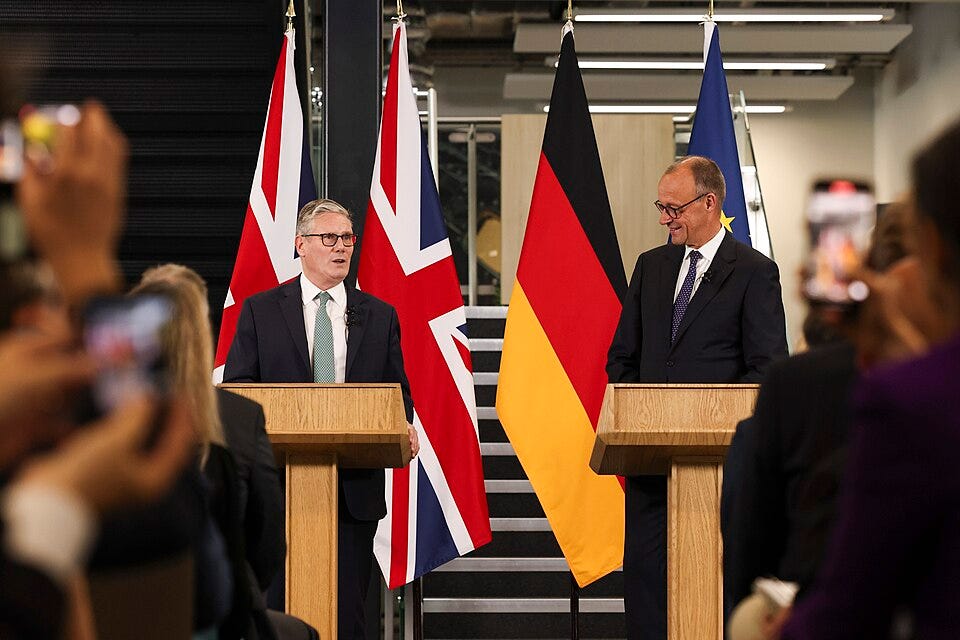
“Prime Minister Keir Starmer and Friedrich Merz visit Airbus (54661461238)“ by Number 10 is licensed under CC BY 4.0.
Welcome to Dissent Channel, a new Stepwise segment in which Global Strategic Engagement Team analysts will debate the impacts of geopolitical developments. Today, Germany: in September, three regional elections occurred in the German states of Saxony-Anhalt, Mecklenburg-Vorpommern, and Berlin. The Christian Democratic Union (CDU), the party of current chancellor Friedrich Merz, experienced disastrous results. The CDU’s vote share in Mecklenburg-Vorpommern was the worst in the party’s history, reaching just 4.9%, below the threshold to enter regional parliament.
The CDU’s decline has raised questions about Merz’s survival as chancellor or whether he will be forced to step down. Our team’s Europe analysts, Ian Cameron and Thomas Goldstein, debate Merz’s future.
In today’s analysis:
Ian Cameron – Merz will survive the fallout of the recent regional elections, but he is losing the ability to govern effectively
Thomas Goldstein – Merz may resist stepping down, but his Chancellorship appears terminal
Or listen to the full report here:

Listen to the news:
Global
At the UN, 80 countries signed a joint statement demanding the immediate reopening of the Strait of Hormuz. The statement, led by Bahrain, called for safe, secure, and unimpeded transit for all commercial vessels without the imposition of tolls, conditions, or illegal charges. The statement also condemned Houthi actions, including the resumption of conflict in Yemen, strikes on Saudi Arabia, and Red Sea shipping attacks, warning that an advance toward the Bab el-Mandeb Strait further imperils global trade. The statement followed an unsuccessful effort by Bahrain to secure UN Security Council support for a similar draft resolution, vetoed by Russia and China in April.
Reopening the strategic waterway has become a central demand by the US in the negotiations with Iran, which resumed on the margins of the UN this week. Iran is reportedly feeling the economic squeeze from the expanding blockade, now extended from maritime to Iran’s airlines. But the US is also under pressure from the elevated energy prices feeding inflation in the run-up to midterm elections. It is possible that another temporary deal could be reached, but the fiery speeches at UNGA demonstrate the difficulty of de-escalation when both sides continue to threaten escalation.
Read More: Reuters [paywall], Reuters [paywall]
Europe
The right-sovereigntist Alternative for Germany (AfD) and left-populist Alliance Sahra Wagenknecht (BSW) reportedly struck a loose agreement to elect an AfD speaker and BSW vice-speaker in Saxony-Anhalt. If confirmed, this will be the first demonstrated parliamentary cooperation between far-right and far-left factions in Germany’s postwar history. The AfD, which won nearly 44% of the vote in September 6 elections, previously dismissed a coalition with the BSW, which won only 5.3%. Nonetheless, the BSW could support a minority AfD government or elect regional leader Ulrich Siegmund in some sort of quid pro quo. This would bring the AfD to power in a federal state for the first time and pose a major test for the party.
Several obstacles remain for formal AfD-BSW cooperation. The BSW is internally divided on cooperation with the AfD, which converges on migration and a dovish approach to Russia but otherwise radically disagrees on economic policy. The AfD may calculate that cooperation is the wrong approach. It wants to rule without any coalition partner and has signaled willingness to bide more time and exploit the dysfunction of the political center’s multiparty coalitions. The AfD caucus will meet on Tuesday to discuss the merits of the reported deal.
Read More: Tagesspiegel [in German], Stepwise Risk Outlook
Americas
The US and Argentina launched an investment agreement on Wednesday with a focus on critical minerals. The agreement will finance up to $7 billion in infrastructure projects in Argentina with the aim of boosting Argentine natural gas and critical mineral exports. Argentine Foreign Minister Pablo Quirno and US Deputy Secretary of State Chris Landau met to discuss the agreement in New York at a forum on supply chains and energy infrastructure.
The agreement seeks to secure $6 billion in investment for a large-scale Argentine LNG project. Through the project, Argentina is seeking to convert its natural gas reserves into an export industry. However, Argentina still lacks sufficient infrastructure to process, liquefy and transfer the gas to international markets. The agreement with the US also covers investments in critical minerals. Argentina has large deposits of lithium and copper that make up key components in green energy technologies.
Read More: ABC, Yahoo! Finance, InsideTrade
Energy
Russia is lowering its projections for both natural gas production and exports. The revision to natural gas expectations comes as Europe is preparing to end all purchases of Russian LNG starting in January 2027. However, natural gas production for this year will still outstrip 2025’s production. Energy export projections are used to inform Russia’s budget due to their impact on Russian state revenues, and Russia’s budget up through 2029 will incorporate the new forecasts. Russia also recently revised its output projections for oil to a 17-year low. Across the energy sector, although primarily targeting oil, Ukraine has been waging a campaign against Russia’s energy infrastructure.
Europe had remained a significant buyer of Russian LNG despite its sanctions regime. In July, the EU purchased a record amount of LNG from Russia’s Yamal LNG facility. In the first half of 2026, almost all Yamal LNG cargoes were directed to the EU.
Read More: Reuters [paywall], Moscow Times [in Russian], Kyiv Independent
Defense
Italy has placed an order for two new naval destroyers with a state-backed defense company. Italy will purchase two DDX destroyers from Orizzonte Sistemi Navali (OSN), a joint venture between state shipyard Fincantieri and state defense company Leonardo. The deal was arranged by OCCAR (Organisation Conjointe de Coopération en matière d’Armement), the EU’s defense procurement office. The ships are meant to replace Italy’s two currently operational Horizon-class destroyers, but all four will operate simultaneously for a period before the current ships are retired.
Earlier this year, Rome asked for €8 billion ($9.3 billion) in cheap loans from the EU for defense spending. Italy had originally considered €14.9 billion but ultimately scaled back. Rome had hesitated somewhat regarding SAFE due to political pressure to prioritize public spending over defense. Italy has had difficulty raising its defense spending, which only reached 2.8% in 2026.
Read More: Defense News, Defense Post, Defense News


Contact Us
Karl Hopkins
Partner
+1 202 429 6499
khopkins@steptoe.com
Melissa B. Mahle
Senior Advisor
+1 202 261 0577
mmahle@steptoe.com
Anni Coonan
Senior Intelligence Analyst
+1 212 506 3979
acoonan@steptoe.com
Samuel Bloebaum
Senior Due Diligence Analyst
+1 602 410 6240
sbloebaum@steptoe.com
Zayna Dembinski
Analyst
+1 202 778 3567
zdembinski@steptoe.com
Thomas Goldstein
Analyst
+1 202 862 6735
tgoldstein@steptoe.com
Ian Cameron
Analyst
+1 202 327 6908
icameron@steptoe.com
Elton Smole
Analyst
+1 202 261 0556
esmole@steptoe.com
Carter Spahn
Intelligence Fellow
+1 202 261 7555
cspahn@steptoe.com
Chris Dantes
Intelligence Fellow
+1 202 327 6904
cdantes@steptoe.com
Legal disclaimer: This Substack is for educational and informational purposes only and does not constitute the rendering of legal counseling or other professional services. Reading, subscribing to, or communicating through this Substack does not create an attorney-client relationship. Do not send confidential information through this platform. Consult qualified legal counsel regarding your specific circumstances.